Alibaba Recreates Alibaba

Only two or three AI agents will remain

Author | Chai Xuchen
Editor | Zhou Zhiyu
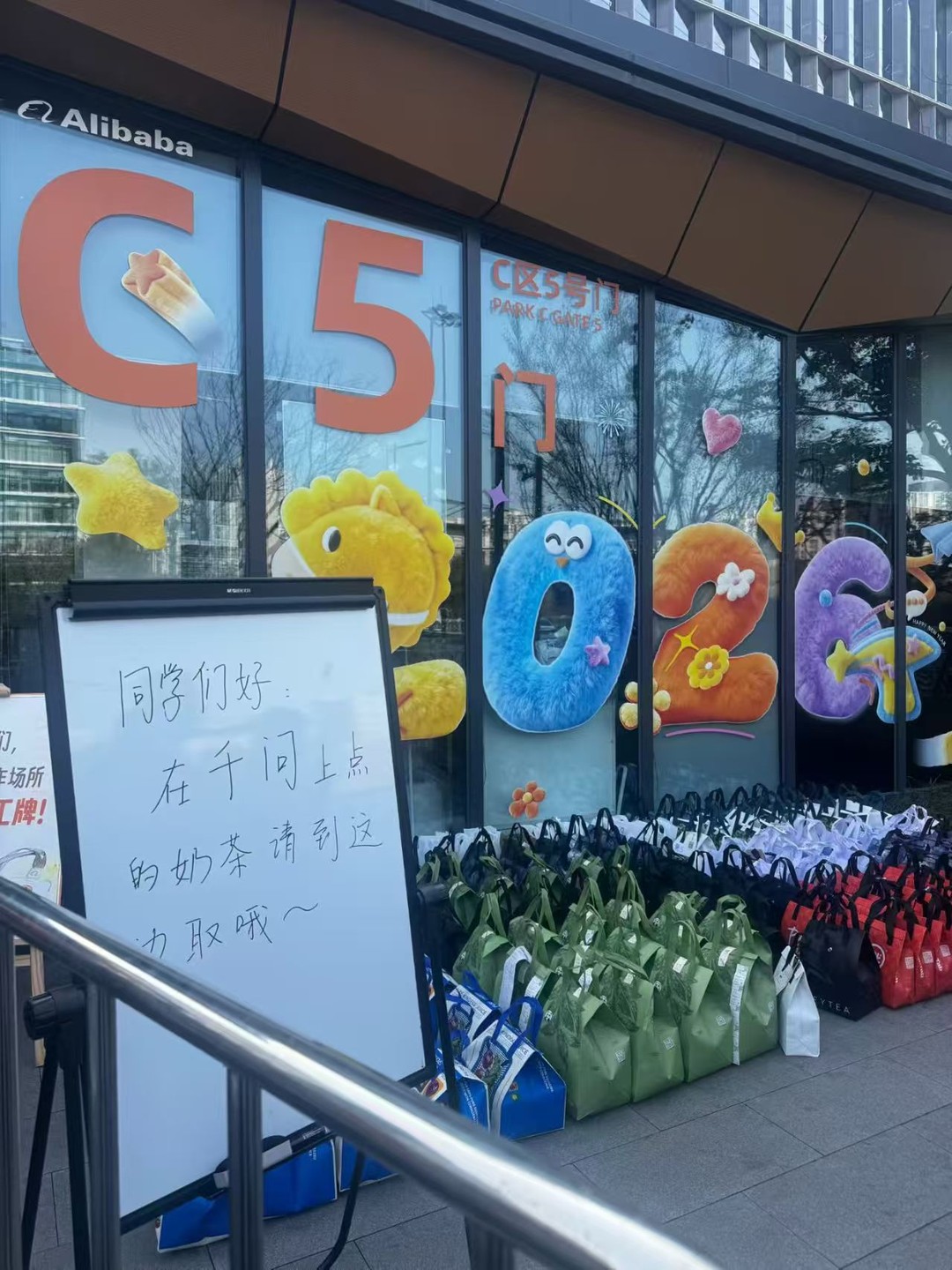
Alibaba Park is surrounded by AI-ordered milk tea.
On January 15th, Wu Jia, President of the Qianwen C-end Business Group, stood on stage and said to the Qianwen App, "Help me order 40 cups of Bawang Chaji's Boya Juexian." Qianwen directly placed the order and completed the payment. Soon after, a Taobao Flash Delivery rider delivered the milk tea to the scene. There was no need to switch between apps or backgrounds; everything was accomplished seamlessly within the Qianwen App.
This is a manifestation of top-down will. Alibaba is attempting to reshape its previously "dispersed Alibaba" into a highly efficient and collaborative "New Alibaba Kingdom" through AI.
At the event, Wu Jia announced that the Qianwen App has fully integrated with Alibaba's core ecosystem businesses, including Taobao, Alipay, Fliggy, Amap, and Taobao Flash Delivery. The AI that once could only chat and draw suddenly gained a series of capabilities such as ordering takeout and booking flights.
"Qianwen is the first AI that can truly help you get things done." Wu Jia told Wall Street Insight that the era of AI doing tasks has just begun, and he aims to make the Qianwen App the most powerful human AI assistant, covering every individual in the future.
This is not just an iteration of an app's functionality; it resembles Alibaba's "self-reconstruction" in the AI era.
Alibaba's ecosystem is vast, ranging from shopping and takeout to maps and travel, but forming a synergistic effect for users is a challenge. During the mobile internet era, it seemed to have dispersed entry points.
If Qianwen can truly become the "most powerful human AI assistant," Alibaba will achieve a leap from "shelf e-commerce" to "instruction e-commerce." This not only fills Alibaba's gap in high-frequency traffic entry points on the C-end but also builds a closed loop centered around itself, where users can ask for directions, book rides, dine, and shop within Qianwen, keeping all data and transactions within the Alibaba system without relying on external traffic.
However, this is not an easy task. The logic of "shelf e-commerce" is to let users browse, providing a vast array of choices with high tolerance; while the logic of "instruction e-commerce" is to help users choose, pursuing precision with a very low margin for error.
Letting AI "get things done" essentially means assigning decision-making responsibility to AI. This raises higher demands for Alibaba's large model's reasoning capabilities and real-time responsiveness to the service supply chain.
The Qianwen C-end Business Group faced fierce competition from the outset. In a post-event interview, Wu Jia candidly told Wall Street Insight that there may only be two or three players in the endgame.
However, in his view, the old internet logic of burning money and pouring traffic to win the market has become ineffective. Only companies that can elevate the intelligence level of their models and have the resources to invest in the ecosystem can enter the final game table. Such large companies are rare.
Thus, under Wu Jia's leadership, a "second entrepreneurship" belonging to Alibaba has begun to unfold vigorously. Whether Qianwen can become "Jarvis" in every Chinese person's phone remains to be seen But what is certain is that when AI starts to pick up the tab for you, a new commercial era has begun. In this era, whoever can first make AI "get things done beautifully" will be the new king.
The following is an excerpt from the dialogue with Wu Jia, President of the Qianwen C-end Business Group:
Q: What will be the core direction of general intelligence and Qianwen's iteration in the next six months?
Wu Jia: In the next six months, we will integrate into the Alibaba ecosystem, expand the boundaries of our operational capabilities, and strengthen the model's understanding of life scenarios. This is our very important main line.
Achieving satisfaction for everyone in life scenarios is quite challenging; consistency is better in office and learning scenarios. We still want to leverage the rich supply of the Alibaba ecosystem, combined with our model's capabilities and our understanding of user needs, to create a globally leading product in life scenarios.
Q: How does Qianwen balance the conflict between efficiency and depth of thought?
Wu Jia: We have a term internally called "appropriate." I believe AI should not equal extreme simplicity. For example, when I want to write a research report, I don't want AI to give me a draft; I want to co-create with it. Communication between AI and humans is essential, and the same goes for life scenarios. Sometimes you may not even know what your true needs are, so you need AI to communicate with you and even proactively offer suggestions.
I think the key to AI lies in intelligence, not efficiency. It's just that today, at this stage of intelligence, it may be more reflected in improving efficiency. However, higher-level intelligence does not necessarily equate to pure efficiency; AI should be able to think like a human.
Currently, we are more focused on using a model to enhance its intelligence and improve satisfaction across different needs.
Q: Qianwen is already the unified intelligent entry point of the Alibaba ecosystem. What is its collaboration structure with various departments of Alibaba Group, resource allocation, and coordination challenges?
Wu Jia: In the AI era, we will not do a lot of independent things just to connect to a specific service. It is actually a model that connects so many services, and each BU just needs to register its tool capabilities with AI. In this process, we need to debug. The current method is that we will have a common virtual team with all the second parties in the group.
This is a win-win situation; the larger Qianwen grows, the more it creates incremental life services. In the future, the new services we generate in AI will still be incremental, not just existing stock.
Q: Will Qianwen only connect to Alibaba's ecosystem?
Wu Jia: No, we will open official cooperation after the Spring Festival. But we will choose a timing because, as everyone can see, whether internationally or domestically, many companies use different methods. How do we achieve a good set of technologies? It also needs to be integrated with the domestic ecosystem, as the international ecosystem is different from the domestic internet ecosystem. So we need to consider what methods to use. Additionally, regarding the model's ease of use and convenience, we can summarize some better methods through connecting with the Alibaba ecosystem. However, we will definitely be open in terms of direction Question: How long does it take for Qianwen to transition from a novelty to a daily necessity on the capability side?
Eddie Wu: We are currently seeing a pretty good retention rate. I believe the AI features we released today are still essential for users. We haven't focused on entertainment or creative directions as much; we do that, but we haven't invested as much energy into it. Our focus is more on essential needs because office work is ongoing, learning is ongoing, and ordering takeout is also ongoing. We are concentrating on these areas. So, I see the retention is still acceptable, and if there are any losses, we should do better.
Question: What is the logic behind your choices of what to do and what not to do?
Eddie Wu: From the demand perspective, we are definitely focusing on high-frequency essential needs today. Secondly, we are still concentrating on the capabilities that AI can deliver today, especially in the consumer sector. I think the range of AI capabilities is also manageable; not everything can be done.
However, we are still in a leading position in the Chinese market, so relatively speaking, we haven't explicitly stated that we won't do anything. I think many questions today still focus on making AI products versus traditional products, and there is indeed a difference. In the past, for traditional products, we would break something down into dozens of projects, detailing how much for this and how much for that. But now it's different; we have models in place, and 90% of the products may already achieve 80% satisfaction, and we spend 70% of our energy on that. We are not specifically optimizing this, but I am enhancing coding capabilities, execution capabilities, planning capabilities, etc., all at once.
So, we have something very important, which is to abstract user needs from high-frequency, essential needs, model capabilities, and the Alibaba ecosystem. We translate that into the directions for model iteration and Agent iteration, and then we proceed. If there are particularly long-tail items that are indeed quite difficult and cannot be resolved by people, we will wait for the next phase.
Question: How can we further leverage our ecological advantages and refine our deep cultivation?
Eddie Wu: We currently have three lines. One main line, the long-term line, is still focused on models and Agents, which is about addressing shortcomings and is long-term. Today, looking at the market, not just AI products, we will have a ranking of user satisfaction for all products at this stage. The combination of these two lines will allow for layered iteration, with a major model iteration basically every quarter. This version will be developed together with Tongyi, which is a very important line.
Based on this, we need to do some follow-up work to enhance Agent capabilities, which is also one line. Then we will look at the three lines. So these three lines will be pushed out relatively rhythmically.
Generally speaking, I think today the core is still driven by technology data + ecosystem; it is not a bad case fix iteration model because we are still in a rapid phase of capability growth. So from this perspective, we hope that in our next version, for example, our next version of the life assistant, we can operate more on personalization But if we translate this sentence, it will have model issues. However, we might not say that the next version will excel at food delivery; we will definitely do it, but some of its capabilities we will abstract out to focus on separately. Food delivery has some developmental features, such as whether we can display the pickup code on the order, etc. This is more about the experience layer.
Q: How does Alibaba assess the impact of Qianwen on existing retail or e-commerce businesses?
Eddie Wu: We haven't seen that opening Qianwen means not opening Taobao. I believe we will create incremental growth because it is more convenient, the barriers are lower, and habits will create incremental growth.
However, I think we cannot rule out that some people will eventually get used to ordering food delivery on Qianwen instead of traditional platforms, and they will develop that habit.
People are not so entangled; rather, they look at whether this person's frequency of coming over has increased and whether the duration has improved.
Q: Is the iteration goal of Qianwen's model completely different from that of the base model?
Eddie Wu: Our iteration goal is part of the base model's iteration goal; it includes us because we need to build our own business on top of the base model. Of course, for some application sides, we will also do some post-training on this model, but we are also on top of its model.
Our major version, which I refer to as the three-month major version, will basically provide some demands observed over three months to the base model, and the base model will help us update a version. So we are a subset of their iteration goals because the base model serves the entire Alibaba ecosystem.
Q: If we are currently working on an AI general assistant application, which aspect—engineering or the base model—would yield higher efficiency?
Eddie Wu: Many people online are discussing this topic, whether more data for this model is better or whether the C-end does not need that much intelligence. I believe that at least within my scope, the business in China has already passed that stage; we are all using one model, not so many models.
It’s not that areas with lower intelligence have a small model, and areas with higher intelligence have a large model. They are all large models, not small-sized large models and large-sized large models. Rather, the model is smart enough to know that it should provide simple reasoning for simple questions and that intelligent questions should be answered by intelligent models. Therefore, as the number of models decreases, our interface for iteration with the base model will become clearer.
Secondly, is the capability of data important? Of course, it is important; additional data is very important, especially in life scenarios. Because the model's training is based on data from a certain time period, and China's supply is so rich, with data changing rapidly, it is necessary to address its timeliness issue, which is the core of capability construction.
Therefore, the long-term benefits will definitely come from the development of the base model. If we look at efficiency over one year or two years, then the base model is definitely the most important. However, if we talk about short-term efficiency, iteration efficiency, and functionality realization, then post-training may be more evident Question: What will be the differentiation between Qianwen and Quark in Alibaba's AI to C entry?
Eric Wu: I think they are still different. Quark is an AI browser, it's AI search; some people have a strong need for an AI browser, while Qianwen is an AI assistant, it’s more like a person, and some people have a strong need for an AI assistant.
The common point here is that all AI functions are features within Qianwen, and the AI functions in Quark are also features within Qianwen. I think this is a path issue. Regardless of how things develop over time, AI browsers and AI searches will not disappear in the future, but their proportion may not be as significant in the AI era compared to dialogue. However, it is also about user habits, invoking Qianwen from the AI browser and invoking Qianwen from search.
I think these are two different user-facing interfaces, but all AI is part of Qianwen. So today we see that on the PC side, users are split half and half; half prefer Qianwen, and the other half prefer to open Qianwen in the AI browser, which is also Qianwen. I think we shouldn't get too hung up on this. However, on the mobile side, more and more people will use Qianwen.
Question: There is a lot of competition regarding AI entry points; what is our strategic layout for this C-end entry?
Eric Wu: The current situation is indeed like this; you will see such issues on many platforms. However, I believe that in the end, there won't be so many players because there are very few companies that can truly elevate the intelligence level of the models and have the resources to invest in the ecosystem. I think ultimately, only a few companies will be able to provide this capability, perhaps one or two, or two or three. But whether the front-end interface will disappear and become one or two companies? I think it's hard to say.
Today, we are in the early stages of AI development, so everyone feels there is an opportunity. Because at this stage, it is still easy for everyone to create an AI assistant with a different style. People feel like I am this style of AI assistant, and you are that style of AI assistant; we still seem different.
However, I believe that starting from the first half of this year, it won't be like this anymore; I mean the first half of 2026. Because we are currently conducting a lot of tests online, actually with different agents and different styles. We may have used a main style, but in the future, we will change. This is just like in real life; I can become friends with you, but I may not become friends with him. You like my expression, but you may not like his expression, even though we are talking about similar things.
So, I think when we reach the stage of true personalization and personification, many companies will stop doing AI. I believe there will only be a few companies left in the market.
Question: Is the integration of these APIs across the group also because we foresee a significant improvement in model capabilities and agent capabilities in the next three months to six months?
Eric Wu: We have always believed that this direction is at the core of our AI product development; this is not something we suddenly realized we needed to do. This is the first point. The second point is that we noticed the trend of agents in daily life back in July of last year, which was after the model was developed, including the progress of VRL We have already seen this trend. Since then, we have been continuously increasing our investment.
Q: The competition among major companies' chat tools is quite intense now, with one company already exceeding 100 million DAU. From the perspective of DAU or MAU data, is Qianwen very concerned about this?
Wu Jia: Even in traditional internet, the difference between 80 million and 100 million is not that significant. I firmly believe in one viewpoint: in the era of intelligence, whether the product has crossed the intelligence threshold, whether it can truly serve and execute like a human, and whether it can achieve high accuracy and satisfaction in the digital world is key. Crossing the intelligence threshold is related to how much traffic you can drive to it, but it is not as strongly correlated as in traditional internet. It still depends on the training paradigm of the AI model's capabilities and a series of decisive factors. Therefore, for Alibaba, as a company that is very focused and invests a lot of energy in model development, we are looking at whether we have crossed the intelligence threshold, and we are also observing global progress in AGI.
Q: So, is the focus on user experience first?
Wu Jia: The world has never used this kind of thing before, just like when everyone first used the iPhone. When the first iPhone came out, the user experience was not that great, but by the time the iPhone 4 came out, it had completely changed. Today, AI may still be in the era of the first iPhone.
Making good decisions with AI is something we are also working on, and there will be a series of methods. It won't be like AI is just precise to a single product; I believe AI has a great opportunity to replace the traditional "scrolling" action, and this will take us a little more time.
Q: AI is currently disrupting the existing traditional traffic model, including mobile operating systems and the APP business ecosystem. As more and more AI emerges and is used in the future, how will the APP ecosystem evolve? Will the boundaries between Qianwen and Taobao become increasingly blurred?
Wu Jia: I think it will take some time to reach that point. First of all, I don't believe there will be that many large AI agents that can become entry points in the future. With the development of technology, the competitiveness of comprehensive agents is still very strong today. Agents are increasingly being proven to be a stage product, distinct from accessing comprehensive agents, similar to the relationship between mini-programs and WeChat, or merchants and Taobao. I believe that as an independent entry point, agents will not evolve much; they will be comprehensive. From the demand perspective, All-in-One is a trend.
Q: Or can we predict some changes that are most likely to happen by 2026?
Wu Jia: In terms of AI, I believe it will increasingly resemble humans; its way of thinking and working will make you feel like you are using something that meets human-like needs