


"Emerging Market Guru" Mobius: Absolutely do not buy gold now, unless it drops 20%! Optimistic about the Chinese market

The "Godfather of Emerging Markets," Mark Mobius, issued a warning as gold prices reached record highs, stating that he would absolutely not buy gold unless it retraces 20% from its peak. He believes that a potential rebound in the dollar could weaken the prices of precious metals. This view sharply contrasts with the majority of investors who remain optimistic about gold prices. Additionally, he continues to be bullish on Asian stock markets, particularly believing that breakthroughs in technology in China will support the upward trend in the stock market
As global gold prices continue to set historical records, veteran emerging market investor Mark Mobius has issued an unusual warning. He believes that gold is currently unattractive and points out that if the dollar strengthens, gold prices may face significant pressure.
On January 16, he clearly stated in an interview: "I would never buy gold at current levels." He added that he would only consider reallocating once gold prices have corrected by about 20% from their current highs. Mobius analyzed that as market expectations for the U.S. economic outlook strengthen, the dollar is likely to rebound, which could weaken gold's appeal as a safe haven.
Mobius has over forty years of experience in emerging market research and investment management and is recognized as one of the most successful investors in the field. His career has been decorated with numerous awards: in 1994, he was named CNBC's "Best Fund Manager of the Year," in 1999, he was listed by Carson Group as one of the "Top 10 Fund Managers of the 20th Century," and in 2011, he was included in Bloomberg Markets magazine's "50 Most Influential People in the World."
Notably, Mobius expressed this cautious viewpoint just as gold had recorded its strongest annual gain since 1979. Although the factors that drove last year's gold price increase, such as central bank purchases and declining interest rates, still exist, and most investors remain optimistic, his contrarian judgment highlights the divergence of opinions in the current market.
Drivers Behind Gold's Surge
Gold achieved its strongest annual gain since 1979 in 2025, primarily driven by three factors: continued central bank purchases, inflows into exchange-traded funds (ETFs), and interest rate cuts in major economies. Additionally, the "devaluation trade" strategy has also supported gold prices, as investors, concerned about rising debt, have reduced their holdings in government bonds and related currencies, opting instead to increase their holdings in physical assets like gold. Bloomberg data shows that these factors continued to play a role in 2025, driving gold prices to set new historical records.
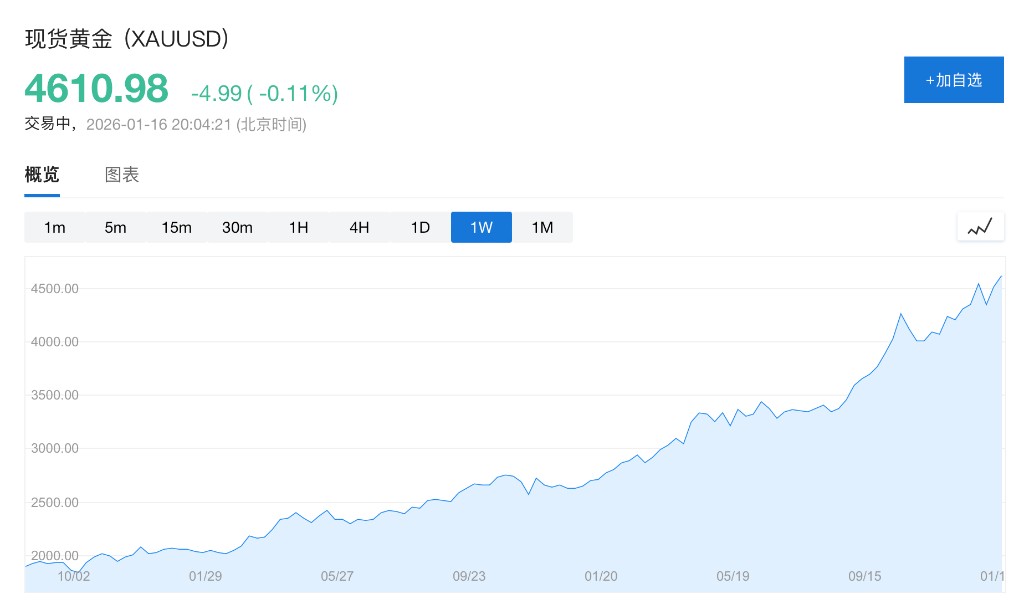
Despite veteran investor Mobius issuing a cautious warning, most investors remain optimistic about gold's prospects. The market generally believes that the main factors driving last year's gold price increase, including central bank purchases, expectations of monetary policy easing, and geopolitical uncertainties, will continue into 2026.
This divergence reflects differing judgments in the market regarding the dollar's trajectory and the U.S. economic outlook: Mobius's viewpoint is based on expectations of a potentially strengthening U.S. economy, while the bullish camp is more focused on long-term structural factors such as global monetary easing and debt risks.
Positive Outlook for Asian Stock Markets
In addition to his cautious stance on gold, Mobius also shared his views on Asian stock markets. He stated that China, India, and South Korea are the most globally attractive stock markets in the region.
Mobius believes that the upward trend in the Chinese stock market is sustainable, primarily due to its ongoing breakthroughs in the technology sector. He pointed out:
"China's goal is to surpass the United States in technology fields such as artificial intelligence, and funds are therefore flowing towards technology rather than traditional consumer sectors."
For the Indian market, he also maintains a bullish outlook, citing the government's continued increase in spending and investment, particularly in proactive layouts in technology-related fields
