


美国暂不征收 “关键矿产” 关税,摩根大通:白银暂时扛住了,但回调风险巨大,这对黄金是机会

JP Morgan's report indicates that the latest Section 232 executive order in the United States has not yet imposed tariffs on precious metals, alleviating short-term pressure on silver. However, it still faces multiple risks: industrial demand is suppressed by high prices, ETF funds continue to flow out, and although inventories have declined, they remain at high levels. In contrast, gold benefits from central banks' ongoing purchases, geopolitical risk hedging, and expectations of policy easing, leaving room for upward movement
JPMorgan Chase's latest research report points out that the 232 key mineral executive orders have adopted a relatively mild regulatory stance, and no tariffs have been imposed on precious metals such as silver for the time being. This policy environment is favorable for the market. The bank maintains a strong bullish confidence in gold while warning of significant correction risks in the silver market.
According to the Wind Trading Desk, the report analyzes that multiple warning signals have emerged in the silver market: prices have significantly deviated from fundamental predictions, ETFs continue to show net outflows, industrial demand is under pressure, and supply in non-U.S. regions is becoming more relaxed. Notably, silver prices have risen about 25% since Christmas, while during the same period, ETFs have seen a net outflow of about 18 million ounces, indicating a rare divergence in the market.
Tariff Delay
President Trump signed the key mineral import executive order under Section 232 of the Trade Expansion Act, determining that it poses a national security threat, but tariff measures have not been immediately implemented. The order sets a 180-day negotiation window, requiring adjustments to key mineral trade flows through bilateral consultations and authorizing alternative regulatory measures, including price floors.
JPMorgan Chase's analysis points out that this executive order signals a relatively relaxed regulatory stance, especially in stark contrast to the previous case of imposing a 50% tariff on refined copper products under Section 232. Although the order retains the possibility of implementing tariffs in the future, the current policy clearly focuses more on precise control of rare earth products and does not list precious metals as direct regulatory targets.
The institution believes that this move reflects a "negotiation takes precedence over taxation" policy approach, which retains tariffs as leverage for subsequent negotiations while providing the market with a buffer period to adapt. Compared to the broad tariff measures that the market previously feared, this outcome can be seen as a policy path with a smaller impact on precious metals and related fields.
Accelerated Inventory Flow
Although the market generally expects that silver is unlikely to be subjected to tariffs, this clear policy signal further alleviates related concerns, reducing the pressure of risk-driven inventory flows from New York to London.
Data shows that COMEX silver inventories have decreased by about 10 million ounces from a peak of approximately 530 million ounces in early October to about 430 million ounces. Notably, since January of this year, inventory outflows have accelerated significantly, with recent daily outflows approaching 2 million ounces. Nevertheless, current inventories are still about 125 million ounces higher than the levels before the 2024 U.S. elections. In scale, this inventory increase is roughly equivalent to 15% of the global annual silver mine supply.
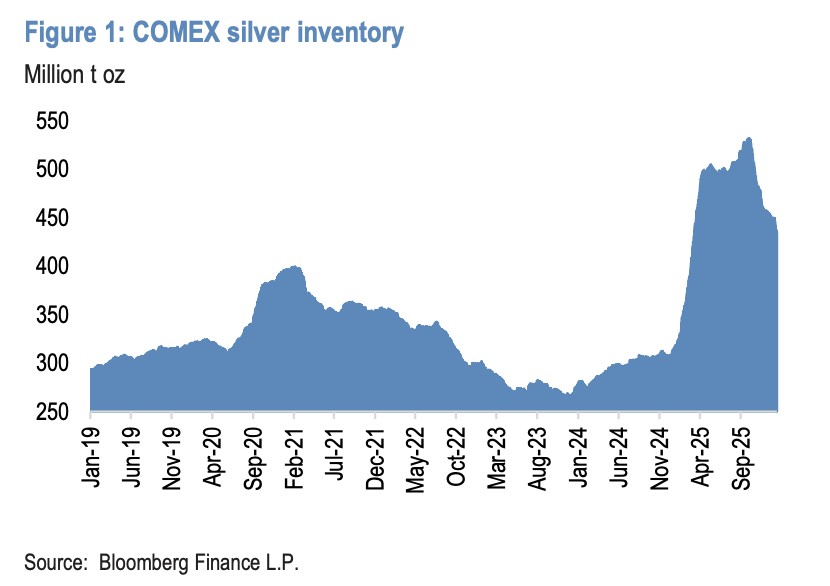
A similar trend is also observed in the platinum group metals market. COMEX platinum inventories are currently still about 525,000 ounces higher than pre-election levels (an increase of nearly five times), while palladium inventories are about 170,000 ounces higher than pre-election levels. Overall, although the trend of inventory return is beginning to show, the structural pressure on inventories in the key metals market has not yet been fully alleviated.
Industrial Demand Under Pressure
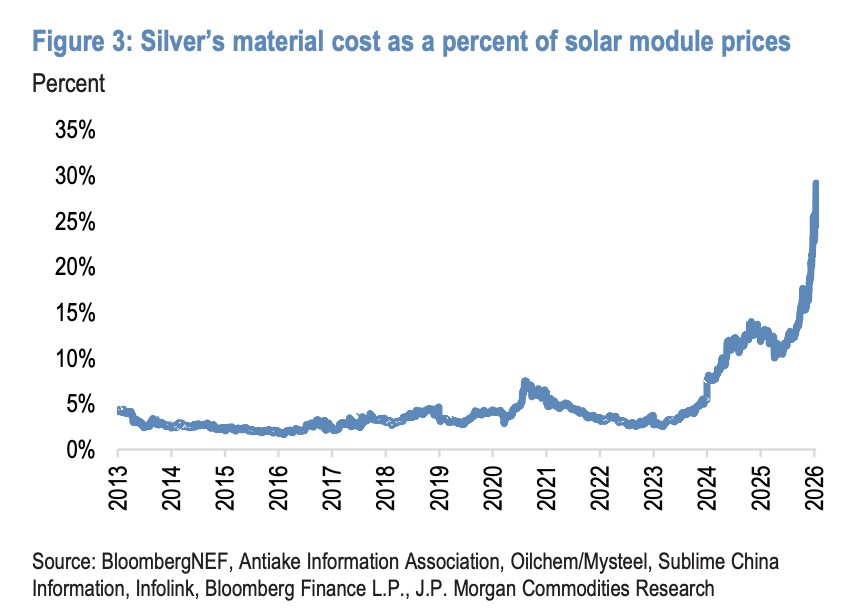
The report indicates that industrial demand is facing increasingly severe pressure. JP Morgan warned as early as last December that rising silver prices could threaten solar industry demand by up to 50-60 million ounces in the coming years. As silver prices continue to rise, cost pressures are further highlighted.
Currently, the raw material cost of silver accounts for about 30% of the total selling price of solar panels. Even if the prices of end products are adjusted upwards, it is still difficult to fully pass on the rapid increase in costs. Industry response measures have been gradually introduced, with several leading photovoltaic companies announcing that they will accelerate the promotion of "copper instead of silver" technology alternatives, with related capacity conversion expected to be gradually implemented starting from the second quarter.
At the same time, the demand structure on the investment side is also undergoing significant changes. Although global silver ETF holdings are expected to increase by 278 million ounces by 2025, a year-on-year increase of 27%, the market has shown a clear divergence between price and volume since the end of last year: silver prices rose nearly 25% after the holiday, while major silver ETFs experienced a net outflow of about 18 million ounces during the same period. This phenomenon contrasts sharply with the "simultaneous rise in volume and price" pattern observed in the second half of last year, and the net long positions of managed funds on COMEX have continued to shrink since mid-December, reflecting a cautious shift in institutional investor attitudes.
Supply Easing
As more silver inventories are transferred from New York to London, liquidity in the spot market has improved. Even before the announcement of Section 232 this week, this trend had begun to alleviate the tight structure in the forward market. Although the London OTC forward curve still shows a spot premium (backwardation) over longer terms, as inventories continue to shift to London, the price spread is expected to gradually narrow, potentially systematically easing the tightness in the core U.S. market, which has been one of the key factors supporting silver's relative strength.
According to LBMA data, since last September, the total silver holdings in London vaults have increased by approximately 10.4 million ounces, a scale comparable to the reduction in COMEX inventories during the same period. However, Metals Focus points out that the increase in freely circulating (non-ETP held) silver inventories is about 6 million ounces, rebounding from a low of 13.6 million ounces at the end of September to nearly 20 million ounces by the end of last year. 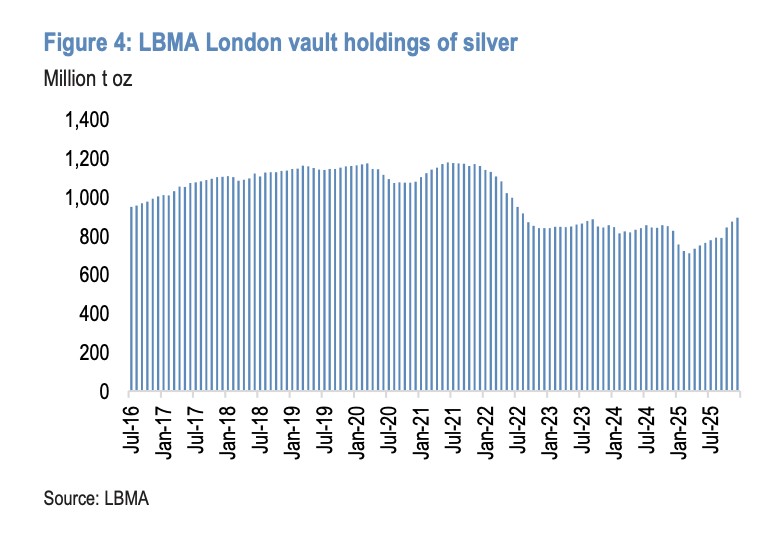
Bullish on Gold
JP Morgan clearly stated that it prefers gold over silver and holds a stronger bullish confidence in gold.
Since the beginning of this year, gold ETFs have continued to show stable capital inflows. Investors are turning to gold to hedge against multiple key risks: potential challenges to the independence of the Federal Reserve, escalating geopolitical turmoil, the impact of IEEPA tariff rulings on the U.S. fiscal deficit, and the risk of a potential U.S. government shutdown at the end of January. **
Central bank gold purchasing demand has shown significant resilience. The monthly net gold purchases in September, October, and November 2025 all exceeded 40 tons, constituting the strongest quarterly performance of last year. Among them, the Brazilian central bank restarted gold purchases in September for the first time since mid-2021, accumulating over 40 tons by the end of November; the Polish central bank purchased nearly 100 tons of gold in 2025, raising the proportion of gold in its foreign exchange reserves to about 30%, and its governor is seeking approval to further increase holdings by 150 tons.
Regarding gold price trends, current gold prices are running about a quarter ahead of JPMorgan's baseline forecast, which previously estimated that gold prices would only reach an average of $5,000 per ounce in the fourth quarter of 2026. If the aforementioned risk factors continue to escalate and hedging demand rises further, there is a possibility that gold prices could reach this target earlier than expected. According to JPMorgan's analysis in May 2025, merely reallocating 0.5% of foreign holdings of U.S. assets to gold, equivalent to an incremental demand of about $17 billion per quarter, could potentially drive gold prices up to $6,000.
