Bank of America: The storage industry is increasingly resembling "chip foundry" – cyclical weakening, high profit margins

Wallstreetcn
2026.01.17 04:39
portai
I'm PortAI, I can summarize articles.

Bank of America Securities' latest report points out that the global storage industry is showing a trend of transformation towards "chip foundry," characterized by weakening cycles, stabilizing prices, and continuously improving profit margins. Recent spot prices for DRAM/NAND have surged significantly, and TSMC's performance guidance further confirms the high prosperity of the industry chain, especially reinforcing SK Hynix's strategic position as a core HBM supplier. Although there are market discrepancies regarding valuation and subsequent supply and demand, the structural transformation of the industry has driven the sector into a "super cycle" phase characterized by technology leadership and high profits

Bank of America Securities' latest research report points out that the global memory chip industry's business model is increasingly approaching that of the chip foundry industry, exhibiting characteristics of "significantly weakened cycles, stable prices, and continuously improving profit margins." This transformation is supported by multiple factors: in early 2026, spot prices for DRAM and NAND continued to rise sharply, with DDR4 prices increasing by over 2000% in a single month; TSMC's strong performance guidance also confirms the high prosperity of the industry chain, particularly benefiting memory leaders like SK Hynix.

According to Hard AI, during a recent roadshow on the U.S. East and West Coasts, the Bank of America team observed that most investors recognize the current strength of the memory cycle far exceeds previous ones and have already gained considerable returns, but market sentiment is clearly polarized: there are both optimistic investors firmly believing in the long-term prosperity driven by AI and cautious investors worried about high valuations and the sustainability of future momentum.

Investors are primarily focused on the following risks: after 2-3 years of rising, the price-to-book ratio is at a historical high; capital expenditures are continuously rising, with leading companies like Samsung Electronics significantly expanding production; the upward momentum for average selling prices (ASP) may slow after the second half of 2026; the market still vividly remembers the demand pullback following the 2019 cloud computing hardware cycle; and there is a structural contradiction between the IT production pace and DRAM supply.

Despite these concerns, the core logic proposed in the report—that the memory industry is shifting towards an operational model of "high profits, stable prices, and weak cycles"—is still widely recognized. Even if the upward momentum for ASP may weaken after the second quarter of 2026, the industry is expected to maintain a high prosperity range, forming a "super cycle" centered on profit margins. Additionally, traditional DRAM capacity is accelerating its shift towards HBM or upgrading to high-end products like LPDDR5/GDDR7, and the sales of multi-chip integration solutions continue to show a growth trend.

It is noteworthy that some aggressive investors believe that if SK Hynix's profitability can match that of TSMC, its market value could potentially reach a trillion-dollar scale. However, the report also warns that the NAND market may face new supply-demand balance pressures by the end of 2026 due to capacity releases and the transition to 200-300 layer processes.

TSMC's Growth Guidance Benefits Hynix, Samsung Under Pressure

TSMC's recent performance guidance is seen as a key industry barometer: the company expects a compound annual growth rate of 30% in revenue by 2026 and to maintain an annual growth rate of over 20% through 2029, with annual capital expenditures remaining above $50 billion. This optimistic outlook is closely related to SK Hynix's leading position in the HBM market, which currently holds over 60% of the global HBM supply share. This situation is reshaping the competitive landscape of the industry. TSMC continues to consolidate its technological barriers with its sustained leadership in 2nm processes and CoWoS advanced packaging technology, limiting Samsung Electronics' space to catch up in the wafer foundry sector. Financial comparisons also highlight the gap: Samsung's wafer foundry business remains in loss, while TSMC's operating profit margin has long been above 50% Under this industrial linkage, SK Hynix's strategic position as a core HBM supplier for TSMC has been further strengthened, not only consolidating its competitive advantage in the memory chip field but also promoting the formation of a closed-loop ecosystem from advanced processes, high-end packaging to high-performance storage.

Spot Prices Soar as Supply Continues to Tighten

The report indicates that the DRAM spot market is experiencing extreme tension. In the first half of January this year, the spot prices of DDR4 and DDR5 continued to be strong, with weekly increases of about 10%, maintaining a cumulative increase trend of 100%-200% since the fourth quarter of 2025.

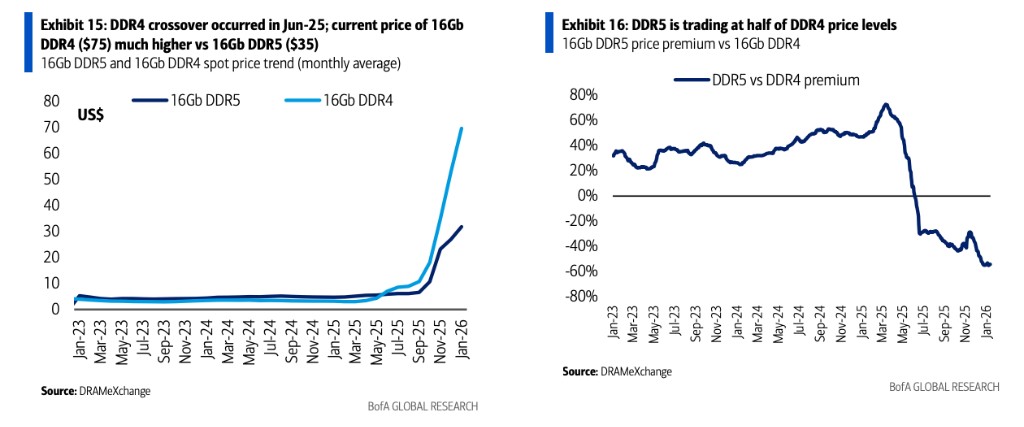
Specifically, the spot price of 16Gb DDR5 has risen to $35.0, with a weekly increase of 10%, a quarterly increase of 238%, and an annual increase of as much as 647%; the spot price of 16Gb DDR4 has reached $75.8, with a weekly increase of 7%, a quarterly increase of 323%, and an annual increase of 2315%; the spot price of 8Gb DDR4 has also climbed to $29.1, with an annual increase of 1886%.

Notably, the spot price of DDR4 has shown a structural "inversion": since June 2025, the price of 16Gb DDR4 ($75) has significantly exceeded that of the same specification DDR5 ($35), forming a rare price inversion phenomenon. This is mainly due to the three major memory chip manufacturers continuously shifting traditional DDR4 capacity to more advanced processes, leading to a continued tightening of the DDR4 supply side. Currently, manufacturers and OEMs still have concerns about the supply assurance of traditional DRAM modules. The report predicts that spot prices still have further upward momentum, although the current rise is partly driven by speculative trading rather than fully supported by actual demand. In addition, NAND spot prices also continue to rise, with this week's increase ranging between 5%-10%.

Trade Data Confirms Prosperity

Korean semiconductor export data continues to confirm the industry's high prosperity. In the first 10 days of January 2026, semiconductor export value reached $4.6 billion, a significant year-on-year increase of 46%, although it fell 12% month-on-month, it remains at a historically high level. Thus, Korean semiconductor exports have achieved year-on-year growth for 25 consecutive months, with growth rates consistent with the high levels of November 2025 (+18%) and December (+46%).

Looking ahead, investors are advised to focus on potential supply and demand opportunities in the NAND market in the second half of 2026, while closely monitoring the impact of capital expenditure expansion on the industry's long-term profit structure. Overall, the structural transformation of the memory chip industry towards a "foundry-like" model is driving the sector to break through traditional cyclical valuation logic, initiating a sustainable value reassessment process