A rising force! Successful meeting with Trump on Thursday, calls for BlackRock's Rieder to run for Federal Reserve Chair are growing

Wallstreetcn
2026.01.18 03:53
portai
I'm PortAI, I can summarize articles.

In terms of monetary policy, Riedel advocates that as the economy evolves, the Federal Reserve should lower interest rates to around a 3% "neutral level"; on fiscal issues, Riedel has repeatedly downplayed market concerns about the massive U.S. government deficit; regarding inflation, he suggested that if a slightly higher-than-target inflation rate helps stabilize debt dynamics and maintain employment, then such inflation is not unacceptable

The selection of the Federal Reserve Chair has added new variables at the last moment.

Media reports citing informed sources say that Rick Rieder, Chief Investment Officer of Global Fixed Income at BlackRock, had a "fairly smooth" interview with President-elect Trump on Thursday.

What has caught the market's attention most about Rieder, and what aligns best with the Trump administration's preferences, is his advocacy for interest rate cuts and his "atypical" tolerance for deficits and inflation.

In terms of monetary policy, he has consistently argued that as the economy evolves, the Federal Reserve should lower interest rates to around 3%, which he considers a "neutral level"; on fiscal issues, Rieder has repeatedly downplayed market concerns about the massive U.S. government deficit; regarding inflation, he suggested that if a slightly higher-than-target inflation rate helps stabilize debt dynamics and maintain employment, then such inflation is not unacceptable.

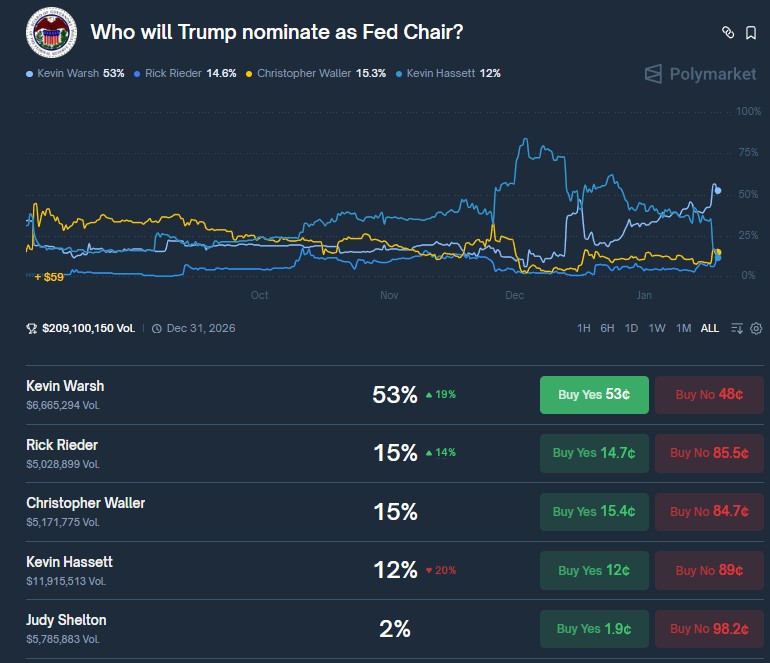
Against the backdrop of the top candidate Kevin Hassett essentially withdrawing due to White House retention demands, Rieder has emerged as one of the frontrunners for the Federal Reserve's leadership. Prediction market Polymarket shows that Rieder's nomination odds have significantly increased recently.

"Alternative" Proposals: Monetary Easing, Deficit Tolerance, Inflation Acceptance

(1) Interest Rate Cuts and "Innovation"

Although he has never held a position at the Federal Reserve or in government policy departments, Rieder is regarded as one of the most influential voices in the bond market over the past decade, and his views on monetary policy are highly respected by investors. At the same time, his core proposals align with Trump's long-standing criticism of the Federal Reserve for being "too tight."

In terms of monetary policy, Rieder believes that the current interest rate level is too high given the actual situation of economic evolution. He has consistently argued that as the economy evolves, the Federal Reserve should lower interest rates to around 3%, which he considers a "neutral level."

He warns that the Federal Reserve is overly reliant on lagging inflation indicators, ignoring the cooling of economic growth. In his view, maintaining restrictive interest rates for an extended period not only unnecessarily suppresses the credit market but could also lead to an "economic stall."

This market microstructure-based perspective makes him inclined to ease policies earlier and more decisively than traditional central bank officials, which is precisely the stance the White House currently hopes to see.

Additionally, while Rieder states that the independence of the Federal Reserve is "crucial," he also agrees with Treasury Secretary Mnuchin's view that the central bank should be "more innovative" in its use of its balance sheet.

(2) "Atypical" Tolerance for Deficits and Inflation

On fiscal issues, Rieder has repeatedly downplayed market concerns about the massive U.S. government deficit. He believes that strong global demand for U.S. assets, combined with structural forces such as an aging population and high global savings rates, is sufficient to support the expansion of U.S. debt. He argues that the deficit issue is far more manageable than critics anticipate.

More radically, he challenges the Federal Reserve's absolute dogma of "price stability." Rieder suggests that if a slightly higher-than-target inflation rate helps stabilize debt dynamics and maintain employment, then such inflation is not unacceptable. This view, while controversial in orthodox economics, perfectly aligns with the Trump administration's demands for "promoting growth and maintaining employment."

"Safe Option" in the Political Storm

The selection of the Federal Reserve Chair is at the center of a political storm in Washington.

Last week, the U.S. Department of Justice unusually issued a subpoena to current Chair Jerome Powell regarding comments related to the Fed's headquarters renovation project. Powell retaliated by claiming this was political retribution for not quickly lowering interest rates. This incident quickly escalated tensions, with Senate Banking Committee member Thom Tillis warning that any Federal Reserve nominee would face the most stringent scrutiny until the investigation is resolved.

This tense political environment has instead become a booster for Riedel. Unlike traditional candidates mired in Washington's policy quagmire, Riedel, as a senior bond trader on Wall Street, stays away from political controversies. Insiders indicate that Riedel is viewed as a "safe option" who is more likely to pass the Senate confirmation process compared to other candidates.

With Hassett likely to continue serving as the Director of the National Economic Council (NEC), the competition has effectively narrowed to a "three-way contest": Riedel versus former Federal Reserve Governor Kevin Warsh and current Governor Christopher Waller. Both have extensive central bank experience, representing a more traditional choice compared to Riedel's market-oriented background.

Will Next Week Bring the "Endgame Moment"?

Treasury Secretary Mnuchin hinted that Trump plans to officially announce the nomination around the Davos Forum to alleviate market uncertainty as soon as possible.

Macroeconomic data is also pushing for faster decision-making. Employment data released this month shows that the labor market is showing signs of fatigue by the end of 2025, with wage growth slowing, and voters' anxiety over living costs is translating into pressure for the midterm elections.

Although the Federal Reserve is expected to lower interest rates three times by the end of 2025, decision-makers have indicated they are not in a hurry to act again until they see more data, with the market widely predicting that the Fed will remain on hold at its January meeting.

As the pool of candidates narrows, Trump is actively meeting with candidates, and Riedel's appearance at the White House suggests that the Trump administration may be weighing traditional and non-traditional paths for the future direction of U.S. monetary policy