


Bank of America Hartnett: "New Global Order = New Global Bull Market = Bull Market for Gold and Silver," the biggest risk of the bull market is the appreciation of East Asian currencies

Bank of America Hartnett stated that the biggest risk currently comes from the rapid appreciation of the Japanese yen, South Korean won, and New Taiwan dollar, which will lead to a reversal of capital outflows from Asia, threatening the liquidity environment of global markets. Hartnett is optimistic about the long-term prospects of international stocks and gold, with China being its most favored market, while predicting that gold is likely to break through the historical high of $6,000
Bank of America Chief Investment Strategist Hartnett believes that Trump is driving global fiscal expansion, creating a "new world order = new world bull market" pattern. Within this framework, the bull market for gold and silver will continue, while the biggest risk currently lies in the rapid appreciation of the yen, won, and new Taiwan dollar, which could trigger a global liquidity tightening.
The yen is currently close to 160, nearing its historically weakest level, with the exchange rate against the renminbi hitting its lowest since 1992. Hartnett warns that if these extremely weak East Asian currencies experience rapid appreciation, it will lead to a reversal of capital outflows from Asia, threatening the liquidity environment of global markets.
In terms of asset allocation, Hartnett recommends going long on international stocks and "economic recovery" related assets, while being optimistic about the long-term prospects for gold. He believes that China is his most favored market, as the end of deflation in China will act as a catalyst for bull markets in Japan and Europe.
Gold is expected to break through the historical high of $6,000, while small-cap and mid-cap stocks will benefit from interest rate, tax, and tariff reduction policies. However, the sustainability of this optimistic outlook depends on whether the U.S. unemployment rate can remain low and whether Trump can boost his approval ratings by lowering the cost of living.
Appreciation of East Asian Currencies Poses the Biggest Risk
Hartnett points out that the current market consensus for the first quarter is extremely bullish, while the biggest risk comes from the rapid appreciation of the yen, won, and new Taiwan dollar. The yen is currently trading near the 160 level, with the exchange rate against the renminbi at its weakest position since 1992.
The rapid appreciation of these currencies could be triggered by factors such as interest rate hikes by the Bank of Japan, U.S. quantitative easing, geopolitical tensions between Japan and China, or hedging errors. If this occurs, it will lead to global liquidity tightening, as the capital flowing into the U.S., Europe, and emerging markets to recover the $1.2 trillion current account surplus from Asian countries will reverse.
Hartnett's warning signal is the risk-averse combination of "yen appreciation and rising MOVE index." Investors need to closely monitor this indicator to determine when to exit the market.
New World Order Fuels Global Bull Market
Assuming the yen will not collapse in the short term, Hartnett believes the market is entering a "new world order = new world bull market" phase. Trump is driving global fiscal expansion, replacing Biden's previous approach.
In this context, Hartnett recommends going long on international stocks, as the positions of American exceptionalism are rotating towards global rebalancing. Data shows that U.S. stock funds saw inflows of $1.6 trillion in the 2020s, while global funds only saw inflows of $0.4 trillion, indicating that this imbalance is likely to correct.
China is Hartnett's most favored market. He believes that the end of deflation in China will act as a catalyst for bull markets in Japan and Europe. From a geopolitical perspective, the Tehran Stock Exchange has risen 65% since last August, while the markets in Saudi Arabia and Dubai remain stable, indicating that there will be no revolution in the region. This is positive news for the market, as Iran accounts for 5% of global oil supply and 12% of oil reserves.
The Bull Market for Gold is Far from Over
Hartnett emphasizes that the new world order not only gives rise to a stock bull market but also to a gold bull market. Although gold, especially silver, has become overbought in the short term—silver prices are 104% above the 200-day moving average, the highest overbought level since 1980—the long-term logic for gold's rise remains valid.
Gold was the best-performing asset in 2020, driven by factors including war, populism, the end of globalization, excessive fiscal expansion, and debt devaluation. The Federal Reserve and the Trump administration are expected to increase quantitative easing liquidity by $600 billion through the purchase of government bonds and mortgage-backed securities by 2026.
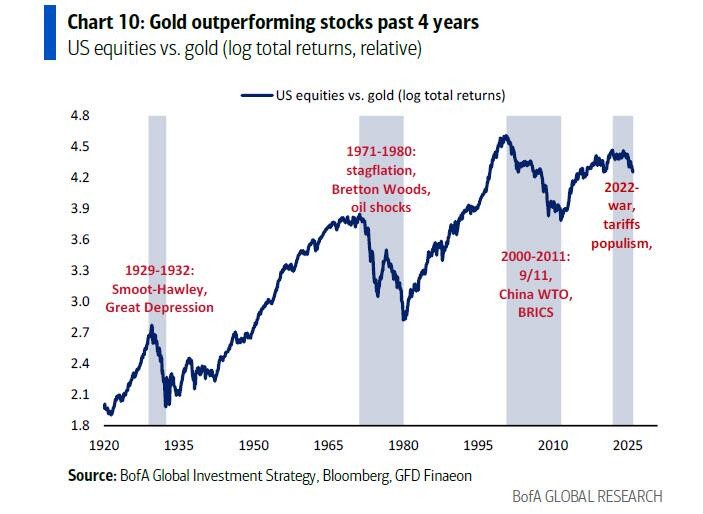
Over the past four years, gold has outperformed bonds and U.S. stocks, and there are no signs of this trend reversing. While strong pullbacks often occur in overbought bull markets, a higher allocation to gold can still be considered reasonable. Currently, the gold allocation ratio for high-net-worth clients at Bank of America is only 0.6%. Considering that the average increase during the four gold bull markets of the past century is about 300%, gold prices are expected to break through $6,000.
Small-cap stocks and economically recovering assets benefit
In addition to gold, other assets are also benefiting from the new world bull market. Hartnett believes that interest rate cuts, tax reductions, and tariff cuts, along with the "put option protection" provided by the Federal Reserve, the Trump administration, and Generation Z, are the reasons for the market's rotation to "devaluation" trades (such as gold and the Nikkei index) and "liquidity" trades (such as space and robotics) after the Federal Reserve's interest rate cut on October 29 and Trump's victory on November 4.
Hartnett recommends going long on "economically recovering" related assets, including mid-cap stocks, small-cap stocks, home builders, retail, and transportation sectors, while shorting large tech stocks until the following situations occur:
First, the U.S. unemployment rate rises to 5%. This may be driven by companies cutting costs, the application of artificial intelligence, and immigration restrictions failing to prevent the unemployment rate from rising. Notably, the youth unemployment rate has risen from 4.5% to 8%, while Canadian immigration has significantly decreased, yet the unemployment rate has risen from 4.8% to 6.8% over the past three years. If tax cuts are saved rather than spent, it will be detrimental to cyclical sectors.
Second, Trump’s policies fail to reduce the cost of living through large-scale intervention. Main Street interest rates remain high, and if energy, insurance, healthcare, and electricity prices driven up by artificial intelligence do not decrease, Trump's low approval ratings will be hard to improve. Currently, Trump's overall approval rating is 42%, with an economic policy approval rating of 41% and an inflation policy approval rating of only 36%.
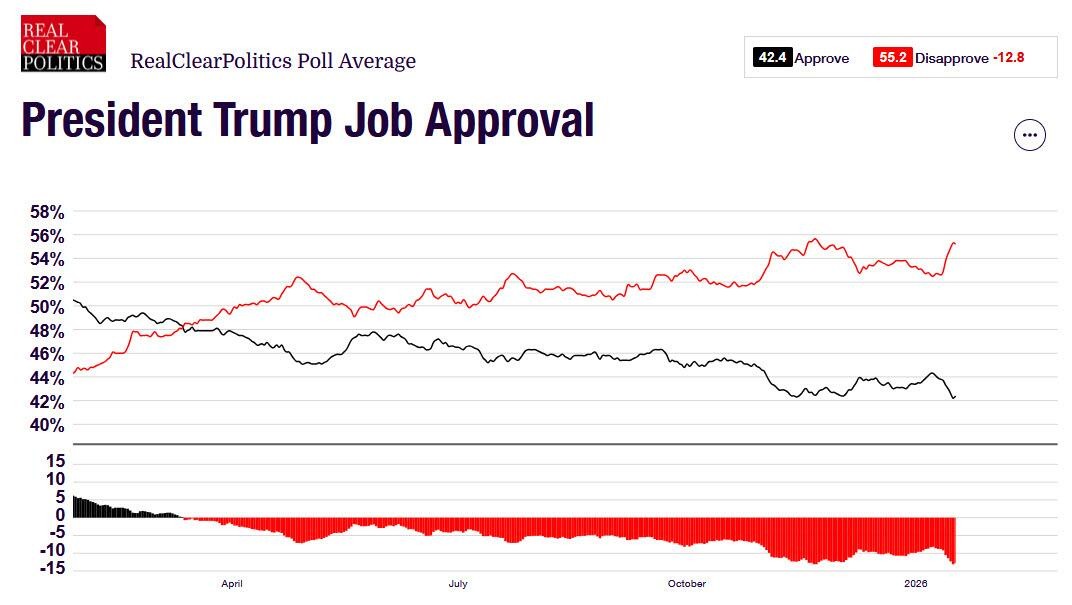
Historically, Nixon's freezing of prices and wages in August 1971 to improve living costs did indeed work—Nixon's approval rating rose from 49% in August 1971 to 62% at the time of his re-election in November 1972 However, if Trump's approval ratings do not improve by the end of the first quarter, the risks of the midterm elections will increase, making it more difficult for investors to continue to go long on "Trump prosperity" cyclical assets
