Severely Dependent on AI! The U.S. Economy is Experiencing a "Dangerous Prosperity"

Wallstreetcn
2026.01.19 03:11
portai
I'm PortAI, I can summarize articles.

UBS stated that the foundation for the expansion of the U.S. economy is rapidly narrowing: the marginal improvements in investment, consumption, and employment are almost entirely reliant on the single theme of artificial intelligence. This also means that it is an expansion with a very low tolerance for error; if the AI investment boom cools down, the U.S. economy will quickly lose its core support, with a recession probability of about 50% in the next 12 months

UBS has poured cold water on the U.S. economy.

According to the Wind Trading Desk, UBS pointed out in its latest research report that beneath the seemingly robust growth data, the foundation for U.S. economic expansion is rapidly narrowing: the marginal improvements in investment, consumption, and employment are almost entirely reliant on the single theme of artificial intelligence. Once AI investment slows or asset prices correct, the current expansion will lose its core support.

UBS's model shows that the probability of a recession in the U.S. over the next 12 months is about 50%. If the AI investment boom cools, the U.S. economy will quickly lose its core support. However, UBS remains cautiously optimistic about the long-term outlook, with potential GDP growth expected to rise to about 2.5%, thanks to a reduction in demographic drag and improvements in productivity.

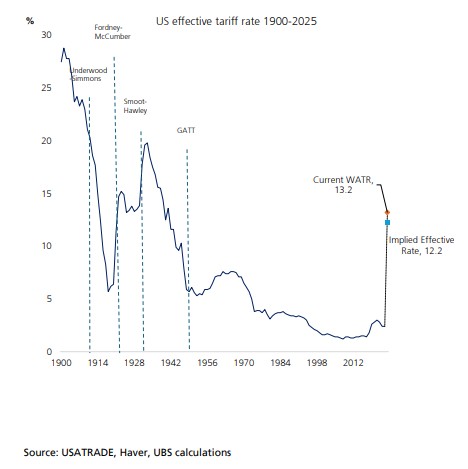
At the same time, tariff shocks are reshaping the inflation structure in a "slow variable" manner. The effective tariff rate in the U.S. has surged from 2.5% at the beginning of the year to over 13%, equivalent to a hidden tax increase of about 1.1% of GDP. UBS believes this is not a one-time shock but will continue to push core inflation higher in the coming years, keeping it above the Federal Reserve's 2% target in the long term.

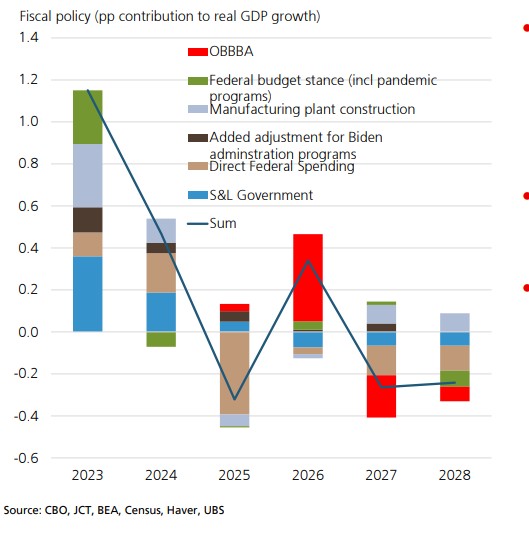
On the policy front, fiscal and monetary measures are caught in a typical "hedging-constraint" pattern. In 2026, the approximately $55 billion tax rebate from the "Inflation Reduction Act" (OBBBA) will provide a temporary boost to consumption in the second quarter, but this stimulus will quickly fade; while the Federal Reserve plans to continue cutting interest rates, it is constrained by cost-push inflation driven by tariffs, leaving limited room for easing.

In this context, UBS's judgment is not aggressive but exceptionally sharp: the U.S. has not entered a recession, but this is an expansion with a very low margin for error. The fate of economic growth depends on whether AI can transition from capital market narratives to real, widespread productivity improvements within the next 18 months.

Growth is still present, but the engine is highly concentrated

From the investment side, the U.S. economy's unipolar characteristics have become very evident.

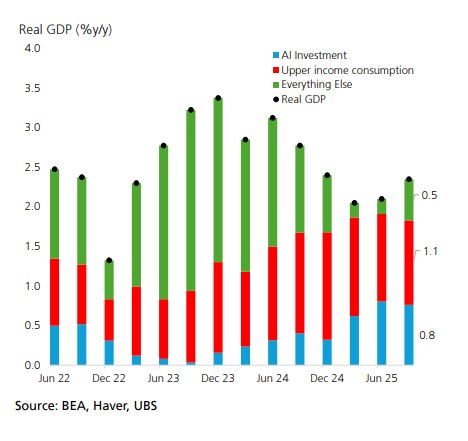
In the past four quarters, investment in AI-related equipment has grown by about 17%, covering computers, information processing equipment, and electronic components; meanwhile, investment in non-AI equipment has declined by about 1% during the same period. In non-residential construction investment, data center construction contributed about 0.7 percentage points to growth, while other sectors collectively dragged down about 7 percentage points.

UBS's calculations show that in terms of GDP growth contribution:

  • AI investment contributes about 0.5 percentage points
  • High-income group consumption contributes about 0.8 percentage points
  • All other economic activities combined contribute only 1.1 percentage points

Residential investment has contracted in four out of the past five quarters, and non-residential construction investment has shrunk for six consecutive quarters. Without AI, the U.S. economy is closer to "low-speed stagnation" rather than robust expansion.

The "resilience" of consumption comes from wealth concentration rather than income improvement

Data on the consumption side also presents a clear illusion.

With real disposable income growing by only 1.5%, real personal consumption expenditures have increased by 2.6%. UBS points out that this divergence is not due to improvements in wages or employment, but rather the highly concentrated release of stock wealth effects

In the second quarter of 2026, the proportion of stock assets in total household wealth rose to a historical high of 35%, driven mainly by the performance of the AI and technology sectors. The result is that high-income households' consumption has been significantly amplified, while middle- and low-income groups are still bearing the brunt of inflation and tariff erosion.

This means that the dependence of American consumption on asset prices has significantly increased, and once the stock market fluctuates, consumption will quickly lose its buffer.

Tariffs: A "Hidden Tax" That Is Brewing

On the issue of inflation, UBS has provided a judgment that is markedly different from the market's optimistic expectations.

The effective tariff rate in the United States has risen to 13.2%, approaching levels seen during the Smoot-Hawley Tariff Act of the 1930s. Based on the import structure, the actual effective tax rate is about 12.2%, equivalent to imposing a tax burden on the economy of approximately 1.1% of GDP.

Unlike traditional shocks, tariffs have not immediately compressed imports but have slowly permeated the price system through the cost side. UBS expects that over the next four years, tariffs will cumulatively drag down real GDP growth by about 0.8 percentage points, with the impact mainly concentrated in 2025-2026.

Inflation has begun to reflect this trend: core PCE has significantly rebounded since mid-year, and UBS expects it to peak in the second quarter of 2026, lingering around 3% in the long term. This is a typical cost-push inflation and the root cause of the Federal Reserve's policy constraints.

Employment Data "Stabilizes the Surface," but Underestimates Weakness

Although the unemployment rate remains relatively low, UBS believes it can no longer accurately reflect the state of the labor market.

Excluding healthcare and social assistance, non-farm employment has averaged a decrease of 41,000 jobs per month over the past four months. The unemployment rate has risen to 4.5%, while the U-6 broad unemployment rate has reached 8.43%, significantly higher than pre-pandemic levels.

Multiple survey indicators are weakening simultaneously: corporate hiring expectations are declining, the manufacturing ISM has fallen below 40, and commercial loans have decreased by 2% year-on-year. UBS points out that this is a chronic employment contraction driven by the demand side, which is more covert than one-time layoffs and harder to reverse quickly.

OBBBA: Short-term Support, Difficult to Change Mid-term Trends

OBBBA will provide phased support in 2026. UBS expects that approximately $55 billion in tax refunds will be concentrated in the second quarter, significantly boosting consumption for the quarter.

However, this stimulus has a clear "front-loaded" characteristic. UBS estimates that the positive contribution of fiscal policy to GDP will turn negative by 2027, with the deficit rate remaining above 6% of GDP. Fiscal policy is more like a stop-loss mechanism rather than a new round of expansion engine.

Monetary Policy on a Tightrope

UBS expects that the Federal Reserve will cut interest rates twice in 2026, lowering the policy rate to 3.00%–3.25%. However, under the backdrop of inflation driven by tariffs, the room for easing is limited, and policy divergence may intensify.

Meanwhile, the Federal Reserve has shifted to balance sheet expansion, stabilizing financial conditions through reinvestment and reserve management purchases.

It is worth mentioning that under the combination of "highly concentrated AI + cost-push inflation," the allocation logic of gold has changed. Real interest rates are compressed, policy visibility declines, and growth increasingly relies on a single narrative, causing gold to shift from a cyclical safe-haven tool to a structural asset in an era of high uncertainty.

Conclusion

This is not a recession that has already occurred, but a period of expansion that heavily relies on a single engine.

The real test for the U.S. economy in the next 18 months is: AI, can it complete the transition from narrative to structure before the next shock arrives?