Baijiu, reborn in the Kondratiev wave

Wallstreetcn
2026.01.19 07:13
portai
I'm PortAI, I can summarize articles.

The liquor industry is expected to be reborn during the current Kondratiev wave downturn, mainly benefiting from the Federal Reserve's potential implementation of quantitative easing (QE) in 2026. This policy will lead to increased dollar liquidity, which in turn will prompt the People's Bank of China to also adopt QE measures to repair the balance sheets of the real economy. It is anticipated that the liquor industry will usher in a new cycle, with the rebound possibly exceeding the recovery after the pandemic in 2022

Introduction

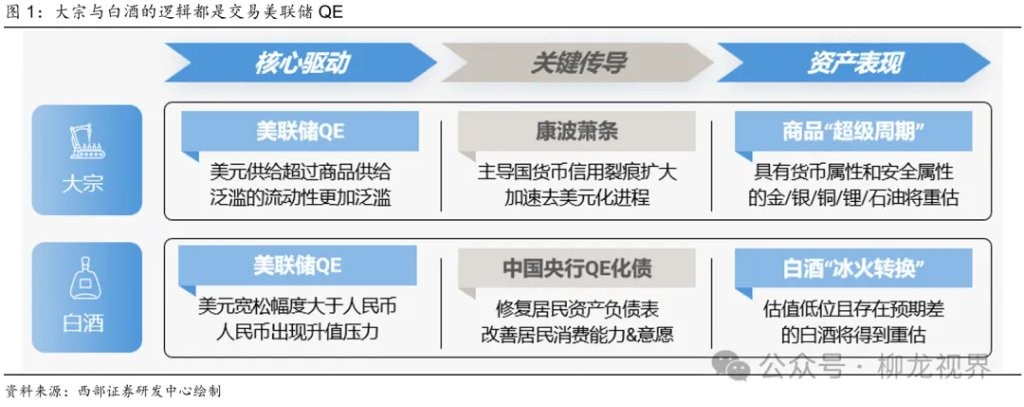
Continuing to chase high prices in commodities and bottom-fishing in liquor at low prices are based on the same underlying logic: (1) Chasing high prices in commodities is merely a reflection of the rampant dollar liquidity, which will become even more excessive, namely the Federal Reserve's QE in 2026; (2) Once the Federal Reserve implements QE, the People's Bank of China will also quickly engage in QE to monetize debt, and the rebound in liquor may surpass the post-pandemic release in October 2022 and the policy announcement in September 2024. A new cycle for liquor will be reborn during the current Kondratiev depression!

Core Views

1. The underlying logic of current commodities and liquor is interconnected: trading the Federal Reserve's QE

(1) During the Kondratiev depression, the underlying logic of the super cycle in commodities is trading the cracks in dollar credit, meaning that rampant dollar liquidity will become even more excessive. The Federal Reserve's QE in 2026 is an opportunity for accelerated dollar liquidity. (2) Once the Federal Reserve implements QE, the People's Bank of China will also quickly engage in QE to monetize debt, repairing the balance sheets of the real sector. At that time, the true 924 policy will be substantively implemented, and a new cycle in the liquor industry will officially begin.

2. The probability of the Federal Reserve's QE significantly increases by mid-2026

(1) Interest rate cuts are a core demand of the current Trump administration. Lowering interest rates will not lead to soaring inflation in the U.S.; rather, it can reduce inflationary pressures: Federal Reserve cuts rates → U.S. Treasury yields fall → cross-border capital flows out of the U.S. → various factor prices in the U.S. (PPI + CPI) will systematically decline.

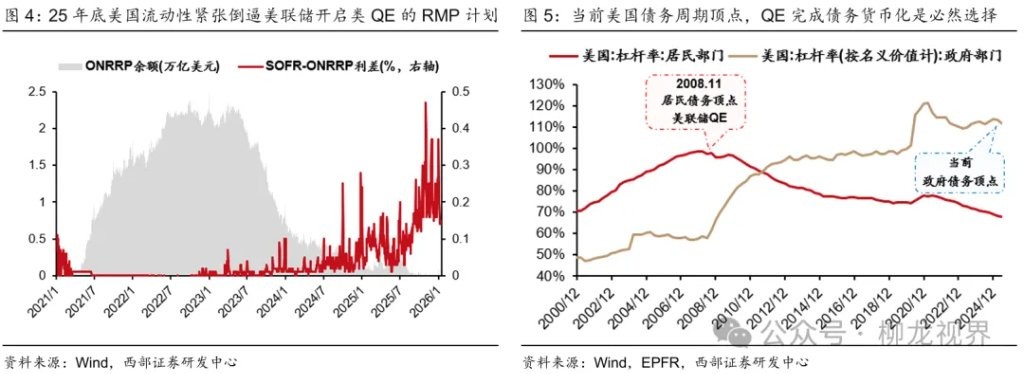
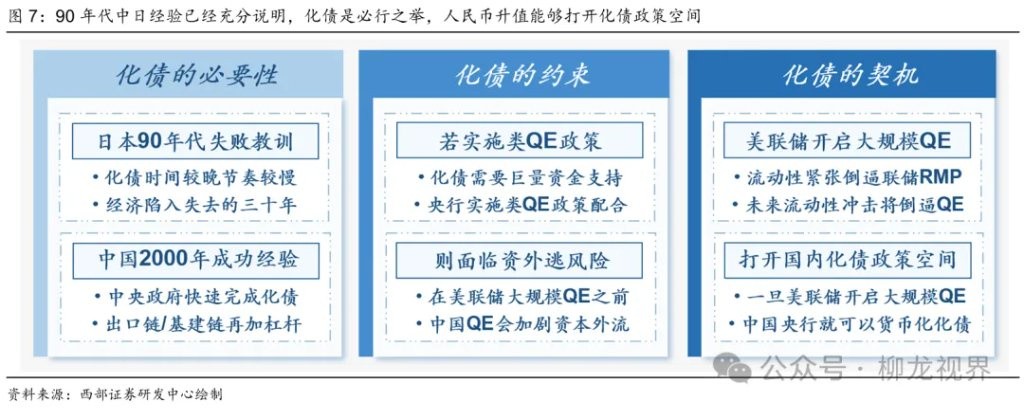
(2) Interest rate cuts are likely to force the Federal Reserve to initiate QE. Federal Reserve cuts rates → cross-border capital flows out of the U.S. → liquidity tightening in the U.S. market has already pressured the Federal Reserve's RMP (similar to QE). At the same time, the U.S. is already in the third phase of the debt cycle (monetization of national debt), making the Federal Reserve's QE to monetize debt an inevitable choice.

(3) Mid-2026 may be the best window for the Federal Reserve's QE. Since the Federal Reserve will ultimately have to initiate QE, the probability of the Federal Reserve starting QE will significantly increase after this year's change in the Fed Chair and before the midterm elections.

3. Once the Federal Reserve implements QE, the People's Bank of China will also monetize debt, ushering in a prosperous starting point in 2026

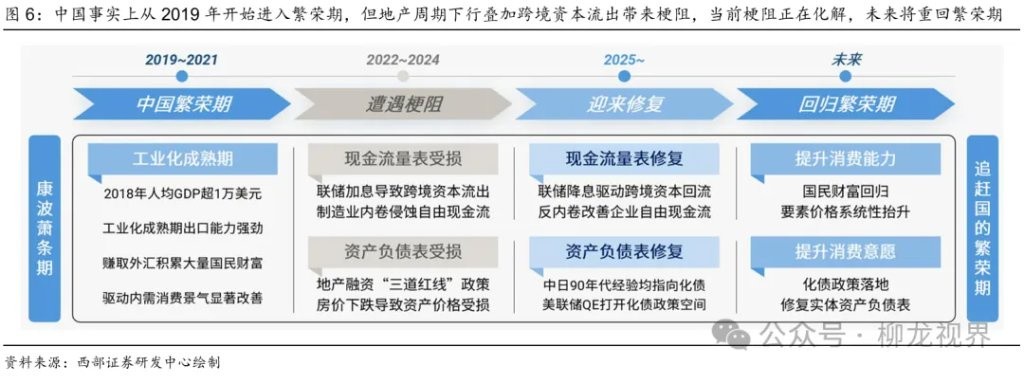
In 2018, China's per capita GDP surpassed $10,000, officially entering the mature stage of industrialization. The strong export capacity of the manufacturing sector has generated substantial national wealth, systematically improving domestic prosperity.

Therefore, in 2019, China had effectively entered this round of Kondratiev depression, serving as a period of prosperity for a catching-up country. However, this prosperity faced temporary obstacles from 2022 to 2024: (1) The Federal Reserve's aggressive interest rate hikes damaged the cash flow statements of China's real sector; (2) Housing price adjustments harmed the balance sheets of the real sector.

In 2026, we will witness: (1) The Federal Reserve cutting rates, the renminbi appreciating, and cross-border capital and national wealth returning to repair the cash flow statements of the real sector; (2) Once the Federal Reserve implements QE, the People's Bank of China will also quickly engage in QE to monetize debt, repairing the balance sheets of the real sector. At that time, China will return to the prosperous starting point of 2019

4. Baijiu Will Be Reborn in the Kondratiev Wave: A New Cycle of Baijiu is About to Start in 2026

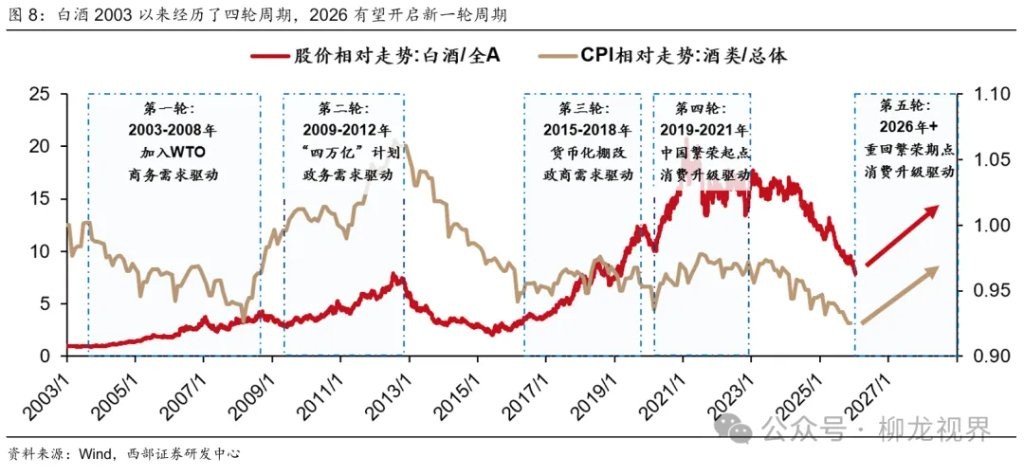
Since 2003, Baijiu has gone through four cycles: ① 2003-2008 driven by business demand after joining the WTO; ② 2009-2012 driven by government demand after the "4 trillion" stimulus; ③ 2015-2018 driven by political and business demand after the monetization of shantytown renovations; ④ 2019-2021 driven by consumption upgrades after China's actual prosperity period.

We judge that once the Federal Reserve starts QE in 2026, the People's Bank of China will also quickly engage in QE to repair the balance sheets of the real sector, and China will return to the prosperity starting point of 2019: a strong export capacity in manufacturing, generating a large amount of national wealth. The combination of Federal Reserve interest rate cuts and RMB appreciation will drive this national wealth to accelerate its return, and the upgrade in household consumption will also initiate a new cycle for Baijiu!

Once the Federal Reserve implements QE, the short-term rebound of Baijiu may exceed that after the pandemic was lifted in October 2022 and after the 924 policy in 2024. This is because, whether it was the lifting of pandemic restrictions or the announcement of the 924 policy, China's monetary policy was always constrained by the aggressive interest rate hikes of the Federal Reserve and the depreciation pressure on the RMB. Currently, with the Federal Reserve cutting interest rates and the RMB returning to an appreciation cycle, once the Federal Reserve engages in QE, the momentum for RMB appreciation will significantly strengthen, and the policy space for the domestic central bank to engage in QE will be completely opened.

5. The Moment of "Ice and Fire Transformation" in the Pro-Cyclical Sector is Approaching: Focus on Oil/Chemicals/Baijiu/Hengke

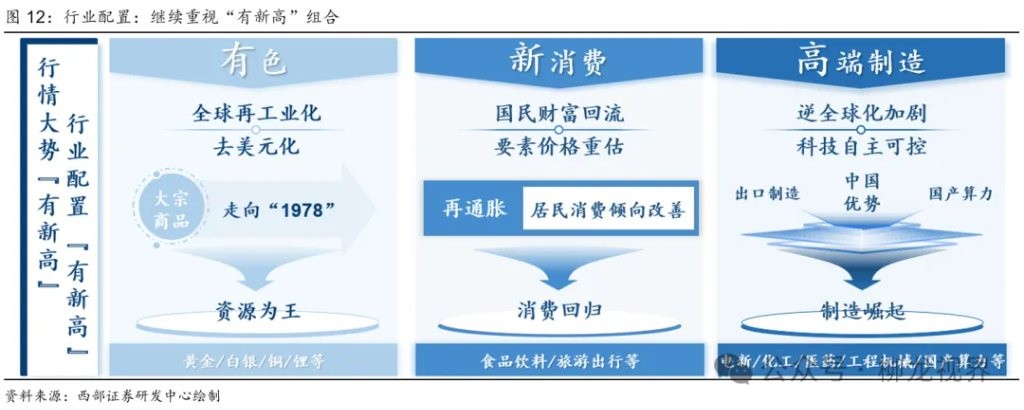
The Federal Reserve's QE in 2026 will become the "deciding factor" in the market: (1) The rampant dollar liquidity from the Federal Reserve's QE will further enhance the super cycle of commodities; (2) The Federal Reserve's QE will also completely open the policy space for the People's Bank of China to engage in QE, allowing China to return to the prosperity period of this Kondratiev wave after the current depression phase. The A-share market is expected to reach "new highs," and industry allocation suggestions continue with the【Have/New/High】combination—

【Have】Non-ferrous metals: "Moving towards 1978" (gold/silver/copper/lithium);【New】Consumption: The return of national wealth + expectations of debt monetization policies, leading to improved marginal consumption tendencies among residents and increased demand for mass consumption (food and beverages/travel);【High】End manufacturing: Under the background of cross-border capital return, sectors with export advantages such as power equipment/chemicals/pharmaceuticals/construction machinery, as well as domestic computing chains with latecomer advantages under the context of self-control.

Report Body

1 The Underlying Logic of Current Commodities and Baijiu is Interconnected: Trading the Federal Reserve's QE

The underlying logic of current commodities and Baijiu is interconnected, essentially trading the Federal Reserve's QE—

(1) During the Kondratiev depression phase, the underlying logic of the super cycle of commodities is to trade the cracks in dollar credit, meaning that rampant dollar liquidity will become even more abundant. In 2026, the Federal Reserve's QE will lead to accelerated dollar liquidity, reinforcing the super cycle of commodities during the Kondratiev depression phase, and commodities with monetary and safety attributes such as gold/silver/copper/lithium/oil will undergo systematic revaluation (2) Once the Federal Reserve implements QE, the People's Bank of China will also quickly engage in QE to manage debt, repairing the balance sheets of the real sector. At that time, the true 924 policy will be substantively implemented, improving residents' consumption capacity and willingness, and a new cycle in the liquor industry will officially begin.

2 The probability of the Federal Reserve QE significantly increases by mid-2026

Interest rate cuts are a core demand of the current Trump administration. Recently, the U.S. Department of Justice initiated criminal proceedings against Powell, which is a direct reflection of Trump's demand for interest rate cuts. For Trump, the benefits of cutting interest rates significantly outweigh the drawbacks:

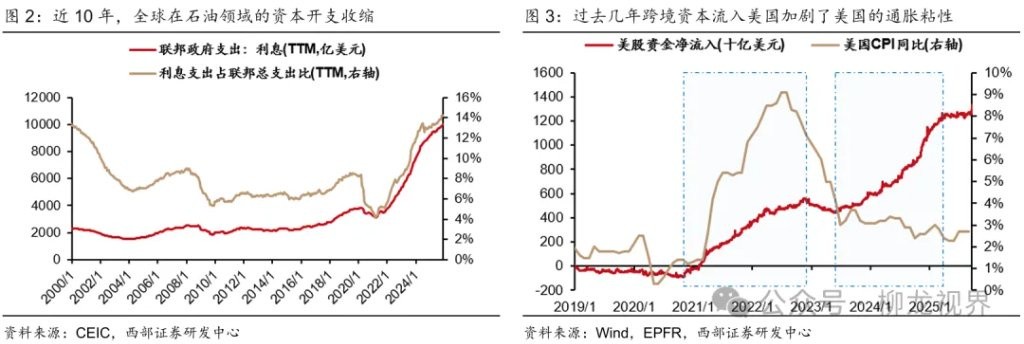
(1) Currently, the U.S. Treasury pays about $1 trillion in interest each year, and rapid interest rate cuts can alleviate the pressure of interest payments, maintaining its fiscal expansion policy;

(2) In recent years, due to high U.S. interest rates, cross-border capital has flowed into the U.S., exacerbating the stickiness of U.S. inflation. However, cutting interest rates will not lead to soaring U.S. inflation; instead, it can reduce inflationary pressures: Federal Reserve cuts rates → U.S. Treasury yields decline → cross-border capital flows out of the U.S. → various factor prices in the U.S. (PPI + CPI) will systematically decline.

Interest rate cuts are likely to force the Federal Reserve into QE. (1) Rate cuts lead to cross-border capital outflows, and U.S. commercial banks will need to take on more U.S. Treasuries, increasing liquidity risk. In December 2025, the Federal Reserve initiated a quasi-QE RMP plan due to liquidity tightness, and liquidity shocks in 2026 may force the Federal Reserve to further expand its balance sheet through QE; (2) The U.S. is currently in the third phase of the debt cycle (monetization of national debt), and completing debt monetization through Federal Reserve QE is an inevitable choice.

Mid-2026 may be the best window for Federal Reserve QE. Since the Federal Reserve will inevitably initiate QE, the probability of the Federal Reserve starting QE will significantly increase after this year's change in the chairmanship and before the midterm elections.

3 Once the Federal Reserve implements QE, the People's Bank of China will also engage in QE to manage debt, ushering in a prosperous starting point in 2026

In our December 28, 2025 article "The Cycle of Kondratieff: The Starting Point of Prosperity in 2026," we pointed out that in 2018, China's per capita GDP surpassed $10,000, officially entering a mature stage of industrialization. The strong export capacity of the manufacturing sector has generated substantial national wealth, systematically improving domestic prosperity Therefore, in 2019, China had actually entered the current Kondratiev wave depression period, which is the prosperity period for catching-up countries. However, this prosperity encountered temporary obstacles in 2022-2024: (1) The Federal Reserve's aggressive interest rate hikes have damaged the cash flow statements of China's real sector; (2) The adjustment of housing prices has harmed the balance sheets of the real sector.

In 2026, we will witness: (1) The Federal Reserve will lower interest rates, the renminbi will appreciate, and the return of cross-border capital and national wealth will be repairing the cash flow statements of the real sector; (2) Once the Federal Reserve implements quantitative easing (QE), the People's Bank of China will also quickly engage in QE to repair the balance sheets of the real sector. At that time, China will return to the prosperity starting point of 2019.

4 Baijiu Will Be Reborn in the Kondratiev Wave: A New Cycle of Baijiu Will Soon Start in 2026

Since 2003, baijiu has experienced four cycles. The QE by the Federal Reserve in 2026 will initiate a new cycle for baijiu—

(1) From 2003 to 2008, after China joined the WTO, business demand drove the first cycle of baijiu;

(2) From 2009 to 2012, the government demand driven by the "4 trillion" stimulus led to the second cycle of baijiu;

(3) From 2015 to 2018, the demand from politics and business driven by the monetization of shantytown renovations led to the third cycle of baijiu;

(4) From 2019 to 2021, the consumption upgrade after China's actual prosperity period drove the fourth cycle of baijiu;

We judge that: Once the Federal Reserve starts QE in 2026, the People's Bank of China will also quickly engage in QE to repair the balance sheets of the real sector, and China will return to the starting point of prosperity in 2019: a strong manufacturing export capacity, generating a large amount of national wealth. The Federal Reserve's interest rate cuts + renminbi appreciation will drive the accelerated return of this national wealth, and the upgrade of household consumption will also initiate a new cycle for baijiu.

The optimization of epidemic prevention policies in 2022 and the combination of the 924 policy in 2024 are opportunities for the cycle to restart, but both have been constrained by the pressure of the Federal Reserve's aggressive interest rate hikes and the depreciation of the renminbi, failing to truly complete debt monetization, and the baijiu cycle has also encountered obstacles—

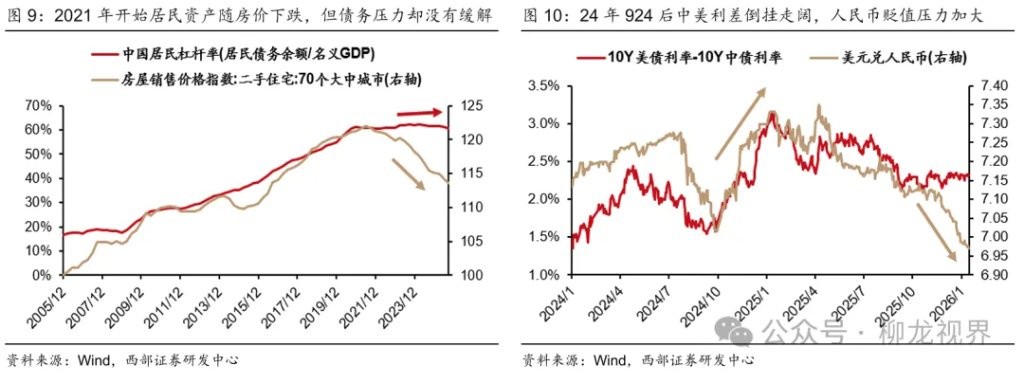
(1) The adjustment of epidemic prevention policies in 2022, but the Federal Reserve is still in the process of raising interest rates, and the domestic debt monetization process is relatively slow, which has led to a contraction of household assets along with the downturn in real estate, while debt pressure has not been alleviated accordingly, impairing consumption capacity and willingness, and the expected improvement in consumption has not materialized, preventing the baijiu cycle from starting; **

(2) The 924 policy package for 2024 aims to address debt, but subsequently, the widening of the US-China interest rate differential and increased pressure on the renminbi's depreciation led to the debt reduction policy in November 2024 not exceeding expectations. The household balance sheet remains unrepaired, and a new cycle for liquor has been postponed again.

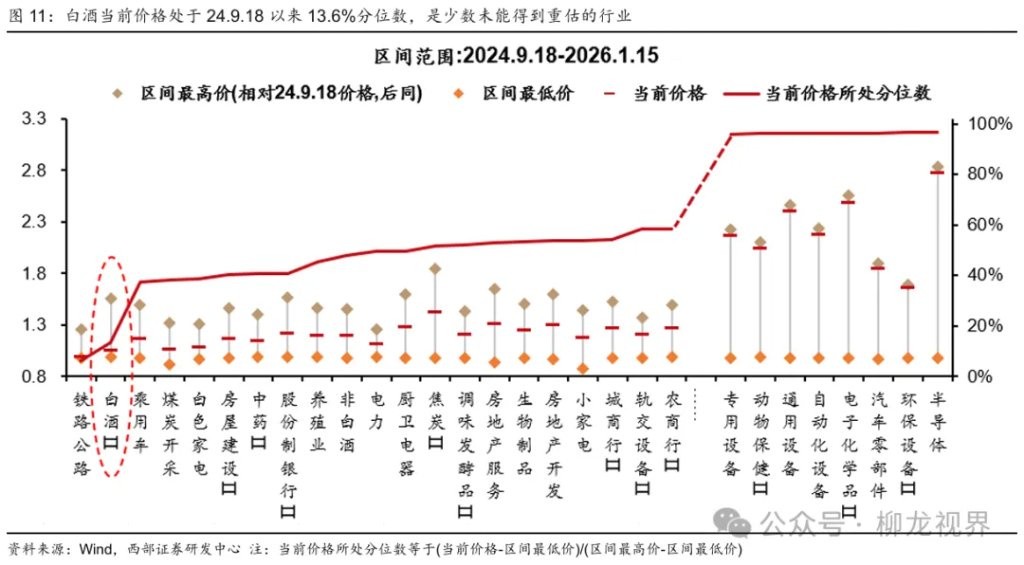
Currently, with the Federal Reserve cutting interest rates, the renminbi has returned to an appreciation cycle. Once the Federal Reserve implements quantitative easing (QE), the momentum for renminbi appreciation will significantly strengthen, and the policy space for domestic central bank QE to address debt will be fully opened, repairing household balance sheets and resolving the blockages from 2022 and 2024, truly initiating a new cycle for liquor. Therefore, once the Federal Reserve implements QE, liquor will become one of the most beneficial assets, with short-term rebound magnitude potentially exceeding that after the pandemic was lifted in October 2022 and after 924 in 2024.

5 The "Ice and Fire Transformation" Moment of the Pro-Cyclical Trend is Approaching, Focus on Oil/Chemicals/Liquor/Hengke

The 2026 Federal Reserve QE will become the "deciding factor" for the market: (1) The rampant dollar liquidity from Federal Reserve QE will further enhance the super cycle of commodities; (2) Federal Reserve QE will also completely open the policy space for the People's Bank of China to implement QE for debt reduction, bringing China back to the prosperity period of the current Kondratiev wave during the depression phase. The A-share market will "reach new highs," and industry allocation suggestions continue with the [Have/New/High] combination—

【Have】Non-ferrous metals: Under the narrative of global re-industrialization + de-dollarization, the annual cycle of Kondratiev guides commodities "towards 1978" (Gold/Silver/Copper/Lithium);

【New】Consumption: Federal Reserve QE will accelerate the return of national wealth + open domestic debt reduction policies, improving household marginal propensity to consume, leading to increased demand for mass consumption (Food and Beverage/Travel);

【High】End Manufacturing: Against the backdrop of cross-border capital return, sectors with export advantages such as Power Equipment/Chemicals/Pharmaceuticals/Engineering Machinery, and those with latecomer advantages under the context of self-controllability such as Domestic Computing Power Chain.

Risk Warning and Disclaimer

The market has risks, and investment requires caution. This article does not constitute personal investment advice and does not consider individual users' specific investment goals, financial conditions, or needs. Users should consider whether any opinions, views, or conclusions in this article align with their specific circumstances. Investment based on this is at one's own risk