Greenland triggers the risk of a tariff war between the US and Europe, Nasdaq futures drop over 1%, gold and silver hit new highs, copper prices approach 13,000

Affected by Trump's proposal to impose new tariffs on eight European countries, global market risk aversion has increased, with safe-haven assets like gold and U.S. Treasuries rising, while U.S. stock futures have declined. Trump threatened to impose tariffs on countries opposing his acquisition of Greenland, raising market concerns about a trade war. Spot gold has surpassed $4,690 per ounce, silver has reached a historic high, and copper prices are nearing $13,000 per ton. Meanwhile, S&P 500 and Nasdaq 100 index futures have fallen, and the U.S. dollar index has slightly declined. The South Korean stock market has risen due to a surge in artificial intelligence investment
On Monday the 19th, influenced by Trump's proposal to impose new tariffs on eight European countries, global market risk aversion heightened, with safe-haven assets like gold and U.S. Treasuries rising, while U.S. stock futures fell.
According to CCTV News, U.S. President Trump stated that he would impose a 10% tariff on eight European countries that opposed his acquisition of Greenland, which would increase to 25% after several months, until an agreement on the "complete and thorough purchase of Greenland" is reached, raising market concerns about a trade war.
The market reacted swiftly and dramatically:
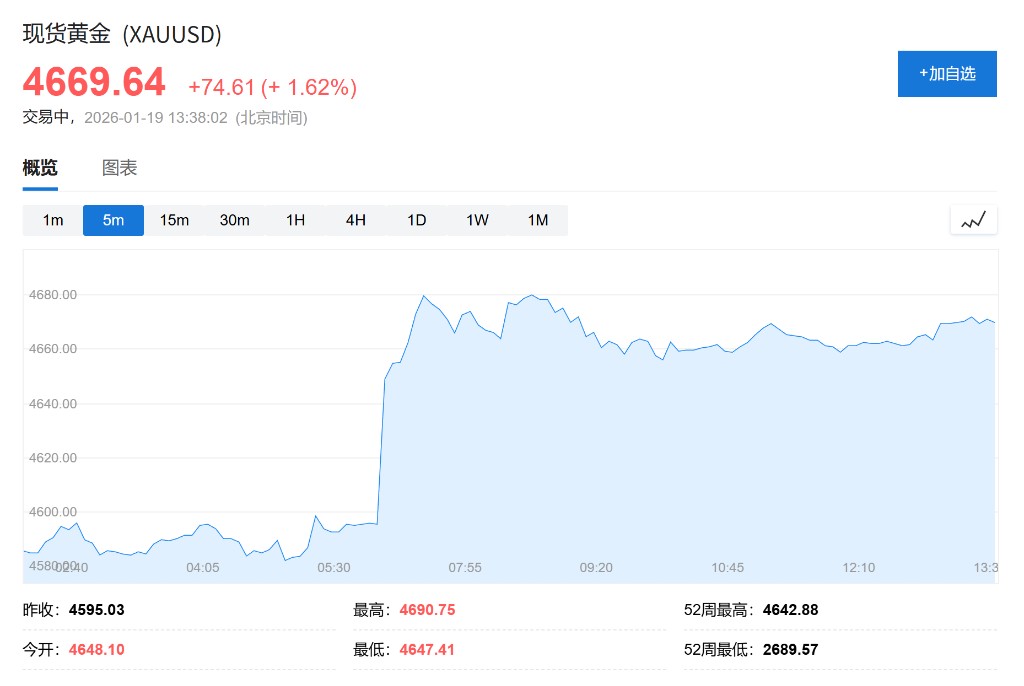
Spot gold broke through the $4,690 per ounce mark on Monday, hitting a new historical high, with an intraday increase of over 2%;
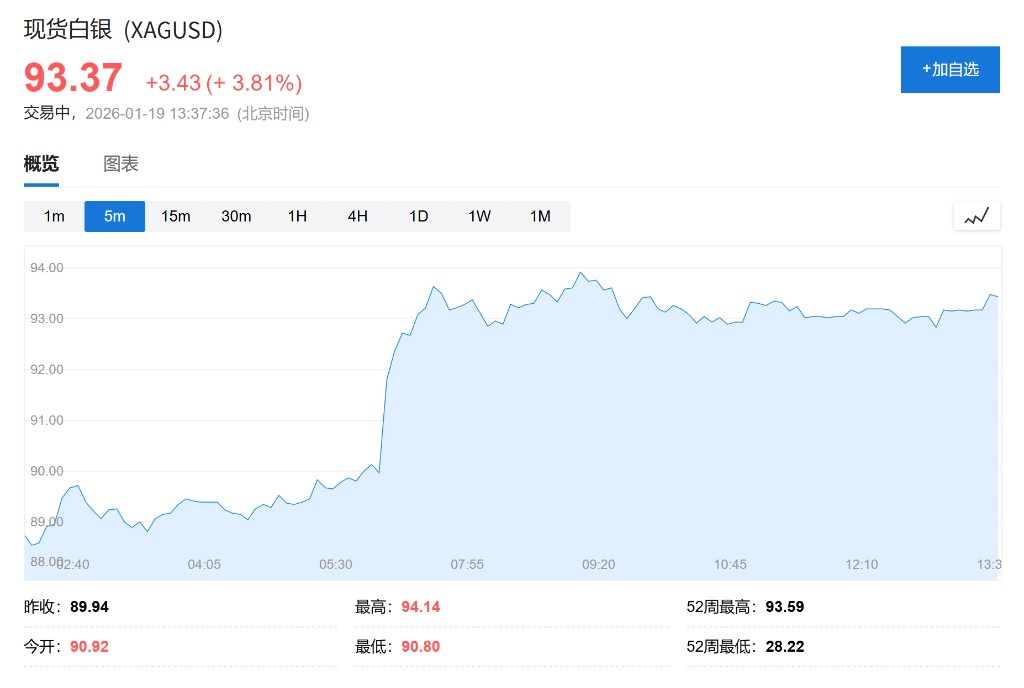
Spot silver also rose above $94 per ounce, setting a new historical high, with an intraday increase of over 4%;
Copper prices followed gold and silver, rising on Monday. Copper prices on the London Metal Exchange (LME) increased by 1.3%, approaching $13,000 per ton;
Meanwhile, risk assets came under pressure, with S&P 500 index futures dropping by as much as 0.9%, and Nasdaq 100 index futures falling by as much as 1.1%;
U.S. 10-year and 30-year Treasury futures both fell by 0.02%;
In the foreign exchange market, the U.S. dollar index fell by 0.2%, and the euro against the dollar rebounded to 1.1633;
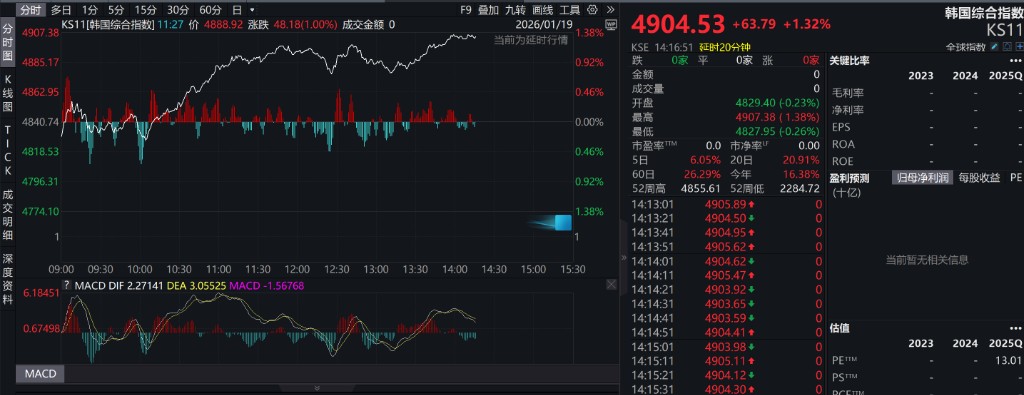
In the Asian market, the South Korean stock market moved independently, with the Seoul Composite Index (KOSPI) breaking through 4,900 points for the first time, rising 1.3%, mainly driven by the AI investment boom.
In terms of commodities, StoneX senior analyst Matt Simpson stated that geopolitical tensions provide another reason for gold bulls to push prices to new highs, with Trump's threats regarding Greenland viewed by the market as a substantive risk.
Silver performed even better than gold. OCBC strategist Christopher Wong pointed out that the medium-term narrative for silver remains constructive, supported by ongoing physical shortages, strong industrial demand, and safe-haven demand. However, he also cautioned that the recent significant decline in the gold-silver ratio may indicate a need for tactical caution in the short term.
Additionally, spot platinum rose by 0.9% to $2,348.32 per ounce, and palladium increased by 0.5% to $1,808.46 per ounce.
Notably, despite the trade war risks typically being unfavorable for industrial metals, copper prices rose against the trend on Monday. According to Bloomberg analysis, the rise in copper prices was mainly supported by a weaker dollar and Chinese economic data. Official data released by China on Monday showed that last year's GDP growth was 5%, in line with the government's target. Furthermore, demand driven by the AI boom and expectations of supply shortages also supported copper prices. Wu Kunjin, head of basic metals research at Minmetals Futures, stated, as market sentiment towards metals improves, copper is following the trends of gold and silver.
Regarding the U.S. and European stock markets, KCM Trade chief market analyst Tim Waterer believes that the tariff threats against NATO allies add new uncertainty to the international trade landscape, leading traders to adopt a cautious stance David Forrester, a senior strategist at Credit Agricole in Singapore, pointed out that Trump's threats have reignited the tendency to "sell America." However, he also mentioned that the market is paying attention to the so-called "TACO trade" (Trump Always Chickens Out), which anticipates that Trump may threaten first and then back down.
In the Asian market, the South Korean stock market is moving independently, mainly driven by the investment boom in artificial intelligence. However, the South Korean semiconductor industry is facing the huge shadow of U.S. tariff policies. According to reports from the Global Times citing foreign media, U.S. Secretary of Commerce Gina Raimondo warned that if semiconductor companies do not invest in factories in the U.S., they could face tariffs of up to 100%. This has created uncertainty for South Korean companies regarding their investment prospects in the U.S. South Korean Deputy Prime Minister and Minister of Economy and Finance Choo Kyung-ho told Reuters that the previously agreed $350 billion investment in the U.S. "is unlikely to start in the first half of this year," and the sharp decline of the won and the lack of clear tariff details have made the South Korean government and companies worried about large-scale capital outflows.
On the news front, Europe has quickly responded to Trump's tariff threats. According to Reuters, EU ambassadors reached a broad agreement on Sunday to increase efforts to dissuade Trump from implementing tariffs while preparing retaliatory measures.
Countries targeted by Trump's planned tariffs include Denmark, Norway, Sweden, France, Germany, the UK, the Netherlands, and Finland. Bloomberg reported that French President Emmanuel Macron may call for the activation of the EU's anti-coercion tool. Carsten Brzeski, global macro chief at ING Bank, warned in a report that if a full-blown trade war breaks out between the U.S. and Europe, there will only be losers, and the market no longer has "tariff certainty."
12:59
The South Korean Composite Stock Price Index has broken through 4900 points for the first time, rising 1.3% during the day.
12:35
Greenland has triggered the risk of a U.S.-EU tariff war, with Nasdaq futures falling over 1%, gold soaring close to the 4700 mark, and silver hitting a new high.
12:34
The Taiwan Stock Exchange Weighted Index rose 1% to 31,737.20 points.
12:09
The yield on Japan's 40-year government bonds rose 9.5 basis points to 3.895%, reaching a record high 10:32
The Nikkei 225 index fell 1% in early trading, closing at 53,412.88 points. The Tokyo Stock Exchange index fell 0.5% in early trading.
10:15
The Indonesian rupiah fell to 16,905 against the US dollar, the lowest since early April 2025.
9:50
The yield on Japan's 30-year government bonds rose by 10 basis points to 3.58%.
9:38
The Seoul Composite Index in South Korea briefly rose by 0.4%, reaching a record high of 4,860.84 points.
9:38
09:23
The US dollar expanded its decline against the Swiss franc, falling 0.5% to 0.7982.
The euro rose 0.27% to 1.1630 USD, rebounding from a seven-week low reached earlier in the session.
9:17
The US dollar fell to 157.55 against the Japanese yen, down 0.36% or 56 points during the day.
9:03
The yield on Japan's 10-year government bonds rose by 4 basis points to 2.22%.
9:00
The Taiwan Stock Exchange weighted index opened down 0.2% at 31,336.77 points.
8:30
The Nikkei 225 index fell 1.3%, closing at 53,248.91 points.
8:24
The yield on Japan's 10-year government bonds rose to 2.215%, the highest since February 1999.
7:07
Spot gold broke above the $4,650 per ounce mark, reaching a historic high. Spot silver rose over 2%, returning above $92 per ounce. This followed Trump's tariff threats regarding Greenland.
7:01
US stock futures opened lower, with S&P 500 futures down 0.8% and Nasdaq futures down 1.1%.
US 10-year Treasury futures rose by 5 points, and 30-year Treasury futures also rose by 5 points.
Spot gold rose over 0.9%, and spot silver rose 1.4%, returning above $91.
(From Wall Street Insight APP)
Risk Warning and Disclaimer
The market has risks, and investment requires caution. This article does not constitute personal investment advice and does not take into account the specific investment goals, financial situation, or needs of individual users. Users should consider whether any opinions, views, or conclusions in this article are suitable for their specific circumstances. Investment based on this is at your own risk.