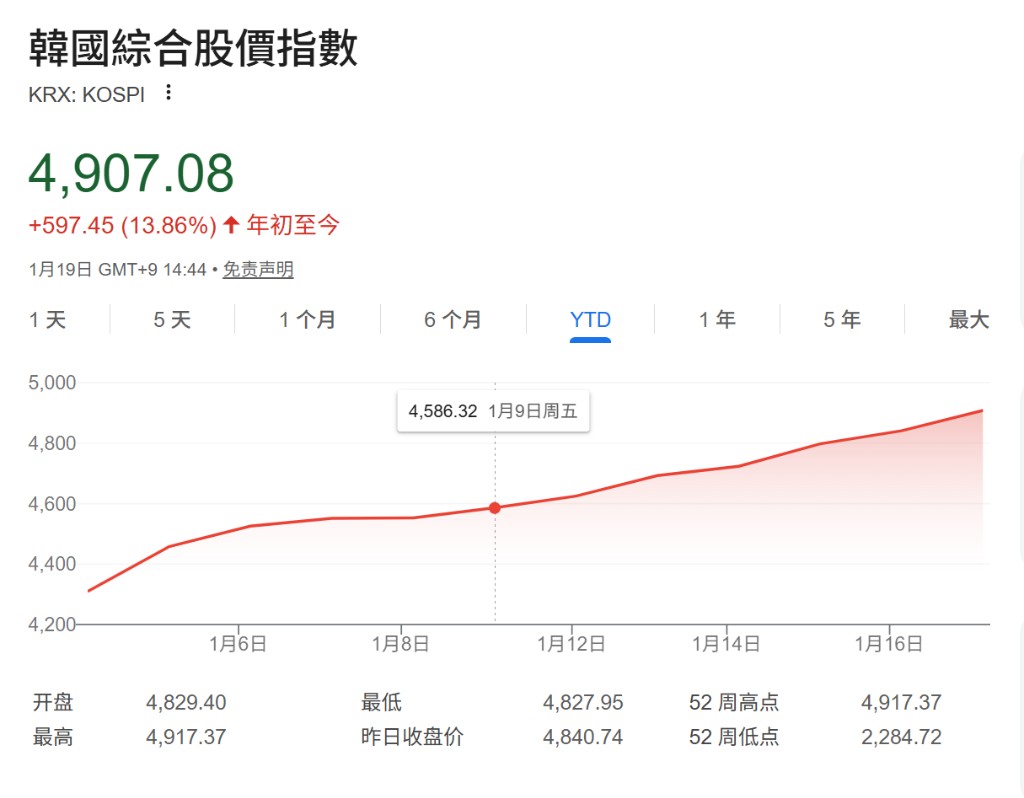
KOSPI in South Korea surpasses 4900 points—foreign capital increases, retail investors retreat, how much further can this round of market go?

The South Korean stock market is staging a classic "chip swap" drama. Overseas "smart money" is entering the market in large numbers, while retail investors are retreating. Nomura believes that against the backdrop of a surge in AI capital expenditures and continuous earnings upgrades, coupled with the sustained increase in foreign investment and reasonable valuations, the upward momentum of the South Korean stock market remains strong. As long as the logic of earnings upgrades is not falsified, 4900 points may just be a relay station in this bull market, rather than the endpoint
The current South Korean stock market presents a highly ironic liquidity structure: the market is soaring, but retail investors are retreating.
On Monday local time, the Seoul Composite Index in South Korea broke through 4,900 points for the first time, rising 1.3% during the day, with a year-to-date (YTD) increase of up to 15%, significantly outperforming other markets in Asia. However, this is a typical scenario of "institutional inflow, retail outflow."

According to information from the Wind Trading Desk, Nomura stated in a report on January 18 that the current momentum driving the market upward comes entirely from foreign investors and local institutions (mainly financial investments). In contrast, South Korean retail investors have been net sellers of stocks during this period.
This divergence is particularly evident in the flow of ETF funds. Since May 2025, offshore-listed Korean ETFs have consistently seen strong net inflows, with a cumulative amount exceeding $4 billion. This indicates that global capital is systematically increasing its positions in Korea through passive instruments, betting on its core position in the global technology supply chain.
What exactly are foreign investors buying?
Nomura's statistics show that while the overall trend is "foreign inflow, retail outflow," the funding dynamics at the individual stock level are more complex. Based on an analysis of fund flows for 193 stocks (from May 2025 to present), there are significant differences in the buyer composition for different leading stocks.
Market leaders Samsung Electronics and SK Hynix both show a net buying trend from multiple categories of buyers. Among them, Samsung Electronics is primarily driven by foreign investment, while SK Hynix is mainly supported by local institutions.
Certain sectors are entirely reliant on foreign-driven momentum. For example, the rise of HD Hyundai Heavy Industries and HD Hyundai is almost entirely driven by net purchases from foreign investors.
The spillover effect of AI capital expenditure
Nomura believes that the current rally in the South Korean stock market is not only driven by capital but also a reassessment of fundamentals. The Korean market is seen as one of the markets with the highest leverage in the AI theme.
Last week's performance from TSMC injected a strong dose of confidence into the market. Its capital expenditure budget for 2026 was raised to $52 billion to $56 billion (higher than Nomura's expectation of $45 billion to $50 billion). This directly confirms that structural AI demand remains strong until 2028-29, providing significant confidence support for South Korea's memory chip giants.
Currently, the earnings momentum in the South Korean stock market remains strong. The consensus earnings expectation for the MSCI Korea Index for the fiscal year 2026 has been revised up by 9.0% year-to-date (in contrast, the overall revision for Asia excluding Japan is only 2.6%). The market currently expects a compound annual growth rate (CAGR) of approximately 32% for South Korean companies' earnings from 2025 to 2027, a growth rate that far exceeds that of peers in the region
High Position Does Not Mean "Expensive"
Nomura emphasizes that, in terms of valuation, the South Korean stock market is not expensive at present.
Despite a surge in cash stock trading volume, the turnover velocity of KOSPI remains stable and is far below the levels seen during past market frenzy periods. This indicates that there are currently no obvious signs of speculative excess.
The expected price-to-earnings ratio (Forward PE) of the MSCI Korea Index is currently only 10.9 times. Considering the AI-driven memory supercycle and high profit growth rates, this valuation level remains within a reasonable range.
Nomura concludes that against the backdrop of a surge in AI capital expenditures and continuous upward revisions of earnings, coupled with sustained foreign investment and reasonable valuations, the upward momentum of the South Korean stock market remains strong. As long as the logic of earnings upgrades is not falsified, 4900 points may only be a relay station in this bull market, rather than the endpoint.
However, analysts also warn that despite strong fundamentals, the market still needs to be cautious of short-term macro events that could bring volatility:
U.S. Supreme Court (SCOTUS) ruling: The legal ruling regarding Trump's tariffs and the potential dismissal of Federal Reserve Chairman Powell remains undecided. If the court ruling favors the White House, it could trigger market concerns about Powell's dismissal, leading to short-term volatility.
Interest Rate Policy: The Bank of Japan (BOJ) is expected to maintain interest rates unchanged until 2026, which is a relatively stable signal for regional liquidity