


Benefiting from improved investment and tax policy dividends, CHINA TAIPING's net profit is expected to increase by over 215% in 2025

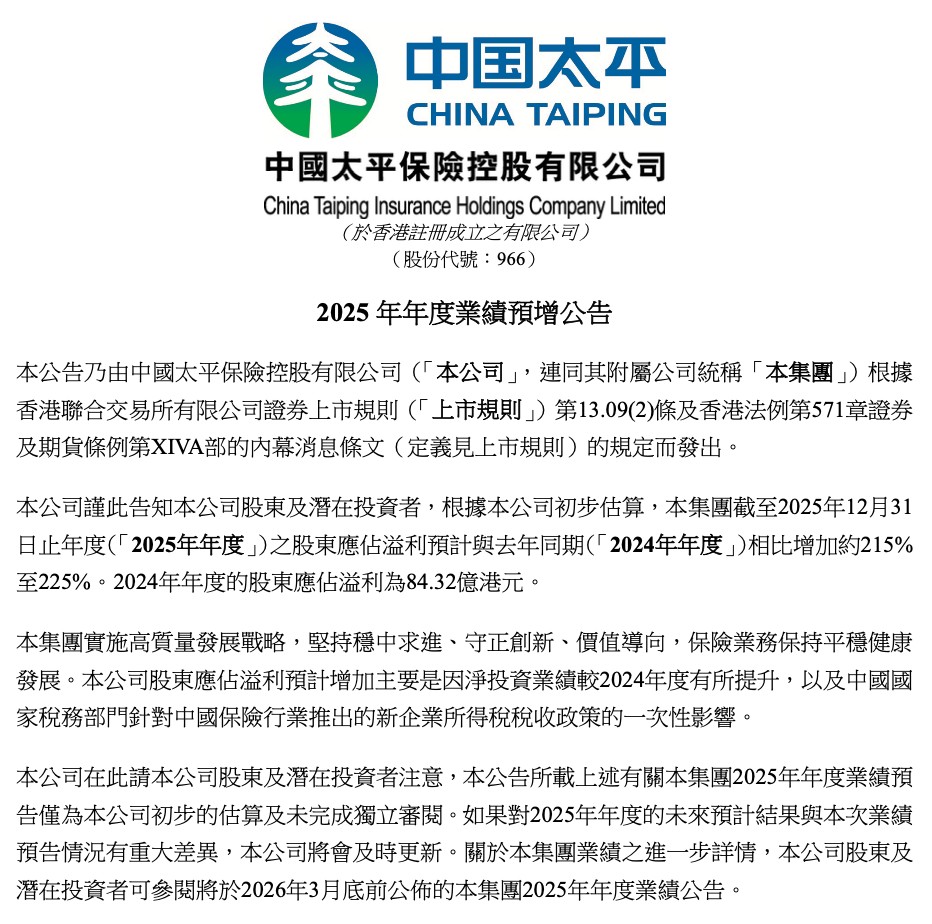
On January 19th, CHINA TAIPING released the first performance forecast among listed insurance companies. The company's net profit for the year 2025 is expected to increase significantly by 215% year-on-year
On January 19, CHINA TAIPING released the first performance forecast among listed insurance companies.
The company expects its net profit for the year 2025 to increase significantly by 215-225% year-on-year. Based on the 8.432 billion Hong Kong dollars for 2024, its net profit for 2025 is projected to soar to a range of 26.6-27.4 billion Hong Kong dollars.
For a large, established insurance company with substantial total assets, achieving more than double net profit growth within a year is undoubtedly a strong boost for the capital market.
However, beyond the astonishing growth figures, what is more worthy of investors' scrutiny is the logical composition of this performance.
CHINA TAIPING indicated that the profit surge is primarily attributed to the resonance of two dimensions: one is the improvement in net investment performance, and the other is the one-time impact of new tax policies from the Chinese tax authorities on the insurance industry.
This also indicates that the essence of CHINA TAIPING's current growth does not solely stem from an explosion in premium income on the liability side, but rather from a combination of asset-side recovery and policy dividends.
First, looking at the investment side, since the fourth quarter of 2024, the A-share market has undergone a significant valuation recovery, and the rise in the Shanghai Composite Index has directly enhanced the investment returns of insurance funds;
For CHINA TAIPING, which holds a large amount of equity assets, the release of this market beta return is evident.
Another key variable lies in tax policy. The announcement explicitly mentioned the "one-time impact of the new corporate income tax policy." This typically involves adjustments to the pre-tax deduction standards for insurance liability reserves or the recognition of deferred tax assets;
Although the profit release brought about by such policy adjustments is compliant and immediate, it has a significant "one-time" characteristic and does not represent a proportional leap in the company's recurring operational capabilities.
For investors, CHINA TAIPING's report card is undoubtedly positive, as it demonstrates that under the dual benefits of a warming capital market and policy support, the profit elasticity of leading insurance companies is rapidly being released.
If the profit surge at the group level relies more on the "timing" of the external environment, then the simultaneous appointment of the heads of its two core subsidiaries, life insurance and property insurance, completes the "harmony" for CHINA TAIPING.
At the end of 2025, CHINA TAIPING's subsidiaries, Taiping Life and Taiping Property Insurance, announced new leadership appointments on the same day:
In the life insurance sector, veteran Wang Xuze, who has been with Taiping for twenty years, officially takes over as the Party Secretary of Taiping Life and is proposed to be the General Manager;
In the property insurance sector, former General Manager Zhu Jie will no longer hold that position, passing the baton to former Deputy General Manager Peng Yunping.
These changes mean that the group's senior executives will no longer concurrently serve as heads of subsidiaries, but will instead delegate authority to a more professional internal team.
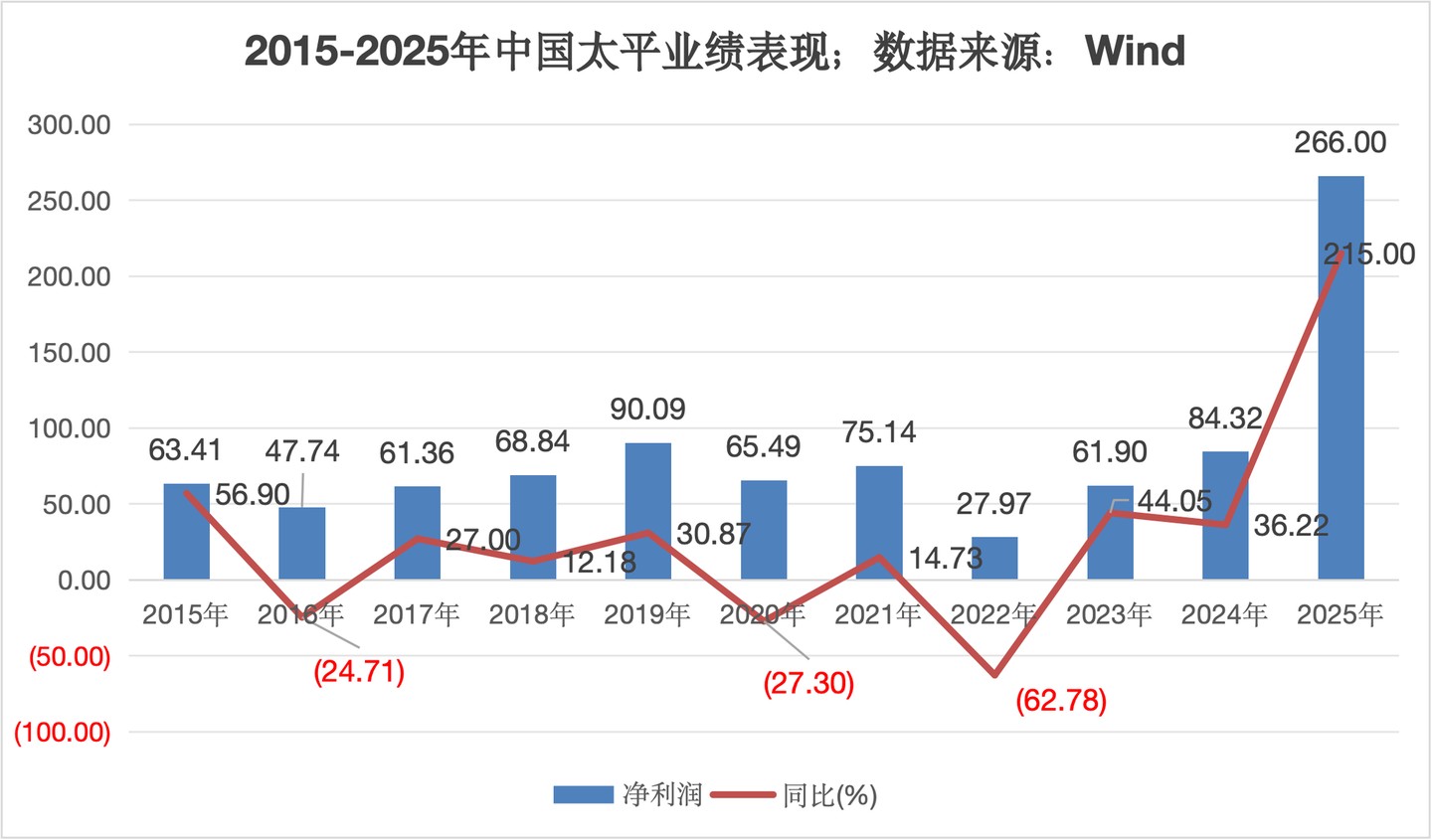
 As a performance forecast, the currently disclosed data is only a preliminary estimate and has not been finalized by the auditors. Considering the complexity of fair value measurement and reserve assessment in insurance accounting, the final figures may still vary.
However, to assess its long-term value, one should not only focus on the 200% growth rate but also pay attention to the real profit level after excluding one-time tax impacts in the official financial report at the end of March, as well as whether its core underwriting business has accumulated sufficient high-quality growth momentum beneath the "stable" statement.
After all, policy dividends are temporary, while endogenous momentum is lasting
