


Micron warns: The storage chip shortage triggered by AI is "unprecedented" and will last until after 2026

Micron Technology warns that the high-end storage chip shortage triggered by AI is "unprecedented." HBM capacity has been heavily occupied by AI accelerators, impacting the shipments of traditional consumer electronics such as smartphones and PCs, leading several manufacturers to lower their targets for next year. To ensure supply for strategic customers like NVIDIA, Micron has halted production of consumer-grade memory brands and accelerated expansion
Micron Technology pointed out that the surge in demand for high-end semiconductors driven by artificial intelligence infrastructure is triggering an "unprecedented" shortage of memory chips. The company warned that this supply tightness has continued to worsen over the past quarters and will extend beyond 2026.
Micron's Executive Vice President Manish Bhatia stated that the high bandwidth memory (HBM) required for AI accelerators "consumes the vast majority of the industry's available capacity, leading to severe shortages in traditional areas such as smartphones and personal computers."
The chip shortage has created a chain reaction. According to Jiemian, major smartphone manufacturers such as Xiaomi, Oppo, and Transsion Holdings have lowered their shipment targets for 2026 due to rising memory costs, with Oppo predicting a decline of up to 20%. Industry agency Counterpoint Research previously estimated that global smartphone shipments could decline by 2.1% in 2026 due to rising storage chip costs and capacity constraints.
The impact is continuing to expand, with personal computer manufacturers such as Dell also warning of potential shortages. Meanwhile, demand for storage chips in sectors such as consumer electronics, autonomous driving, and humanoid robots continues to rise, with multiple manufacturers beginning to compete for capacity supply beyond 2026.
AI Demand Reshaping Supply Dynamics
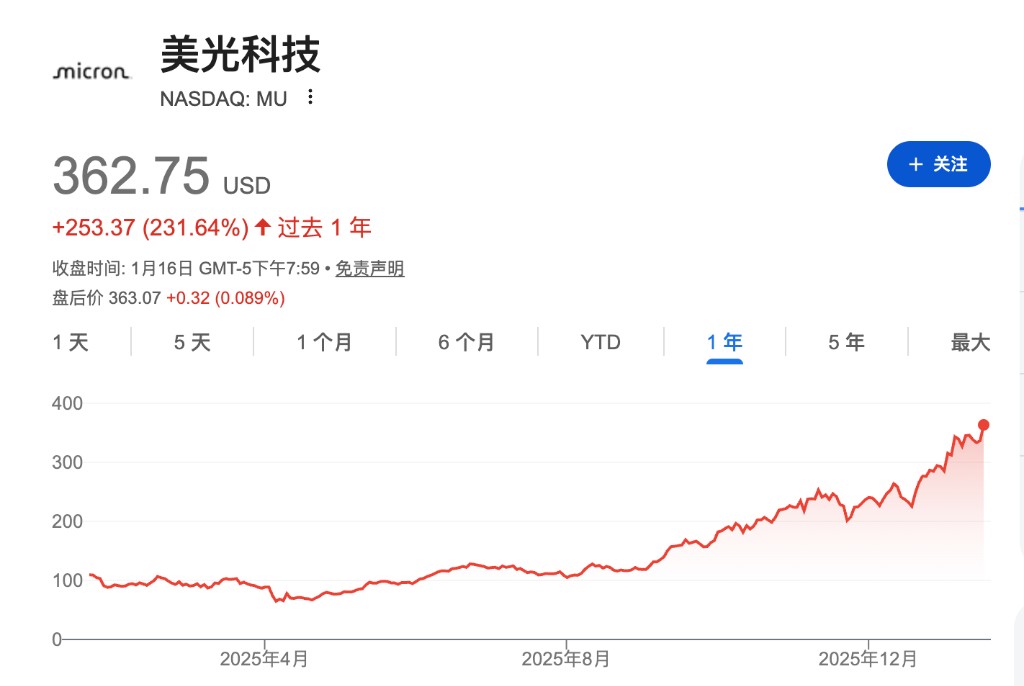
The stock prices of the three major global memory chip giants Micron, SK Hynix, and Samsung Electronics surged significantly in 2025 due to the explosion in AI demand. SK Hynix revealed that its chip capacity for 2026 is already sold out; Micron also stated that its high-end memory products for AI have been fully booked this year. Over the past year, Micron's stock price has risen over 231.6%.
To prioritize supply for strategic customers such as NVIDIA, Micron announced last December that it would terminate the business of its popular consumer memory brand Crucial. DRAM, as the core component for building high bandwidth memory (HBM), provides a critical computing environment for advanced processors from companies like NVIDIA and Intel, and is an important foundation for ensuring the efficient operation of AI accelerators.
Accelerating Capacity Expansion
The enormous demand for memory chips in the AI industry is accelerating Micron's capacity expansion process in the United States and Asia. On Saturday, Micron announced plans to invest $1.8 billion to acquire the site of an existing factory in Taiwan, which is a key production base for the chip manufacturer headquartered in Boise, Idaho.
This move will significantly shorten the construction cycle for the new factory. The company expects to achieve large-scale DRAM wafer production in the second half of 2027. Micron's Executive Vice President Manish Bhatia noted in an interview on Friday,
"Our sites in Asia will continue to evolve towards next-generation technologies, while the new wafer capacity will primarily focus on the U.S. mainland."
Currently, Micron is advancing several large-scale factory plans: its $100 billion project near Syracuse, New York, will build four DRAM wafer factories, each roughly the size of ten football fields, with the first wafers scheduled to roll off the line in 2030 At the same time, the company is expanding two wafer fabs next to its existing R&D facility in Boise, with the first Idaho plant expected to be operational in 2027, and the second one already in the planning stage. Additionally, the existing manufacturing facility in Virginia is also undergoing modernization and capacity enhancement.
These investments are an important part of Micron's commitment to relocating 40% of its DRAM manufacturing to the United States, a goal supported by the $6.2 billion funding from the CHIPS Act obtained in 2024, while also benefiting from a 35% tax credit during the construction period
