


Risk aversion sentiment rises in the Asia-Pacific market, Japan experiences a "double whammy" in stocks and bonds, South Korean stock market adjusts, gold and silver retreat

On Tuesday, the Asia-Pacific market was generally under pressure, with risk aversion causing the Nikkei 225 index to drop nearly 1%, and the yield on Japan's 40-year government bonds soared to a historic high of 4%. Yesterday, Seiko Noda announced that the Japanese House of Representatives election will be held on February 8: this will end the excessively tight fiscal policy. The South Korean stock market fell 1% after breaking through the 4900-point mark. In terms of commodities, silver fell by 1%, and gold slightly retreated
As the geopolitical turmoil surrounding "Greenland" continues to escalate and Japan's political scene unexpectedly faces "early elections," the dual uncertainty has impacted risk appetite in the Asia-Pacific markets on Tuesday, leading to sell-offs in multiple countries' stock and bond markets.
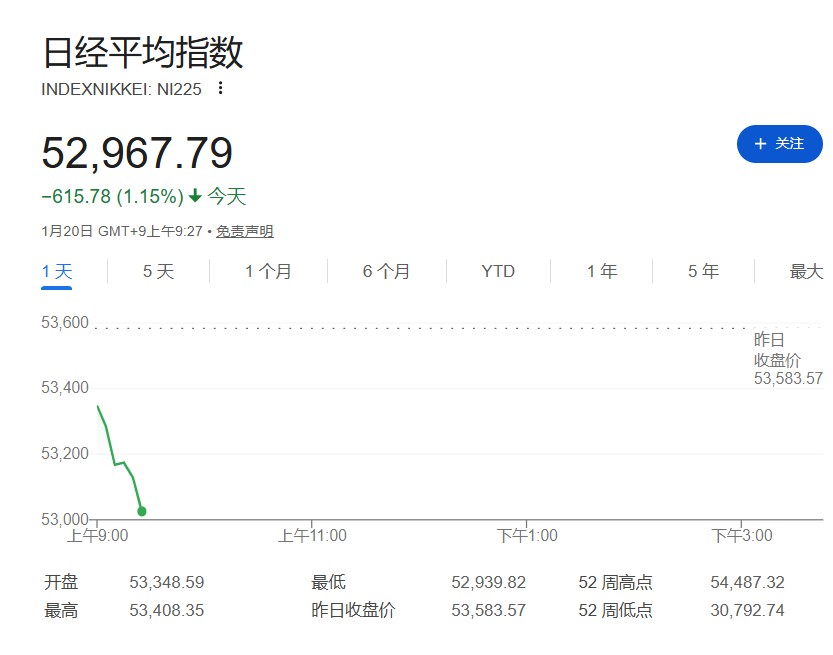
As the focus of the Asian market, Japan today experienced a brutal "double kill" in stocks and bonds. The Nikkei 225 index fell by 1% to 53,045.20 points, with the Tokyo Stock Exchange index following suit.
Additionally, the yield on Japan's 10-year government bonds rose by 3 basis points to 2.3%, the highest since February 1999. The yield on Japan's 40-year government bonds reached 4%, marking the first time since its issuance in 2007. Yesterday, High Minister Sanae Takaichi announced that the Japanese House of Representatives election will be held on February 8, signaling an end to overly tight fiscal policies.
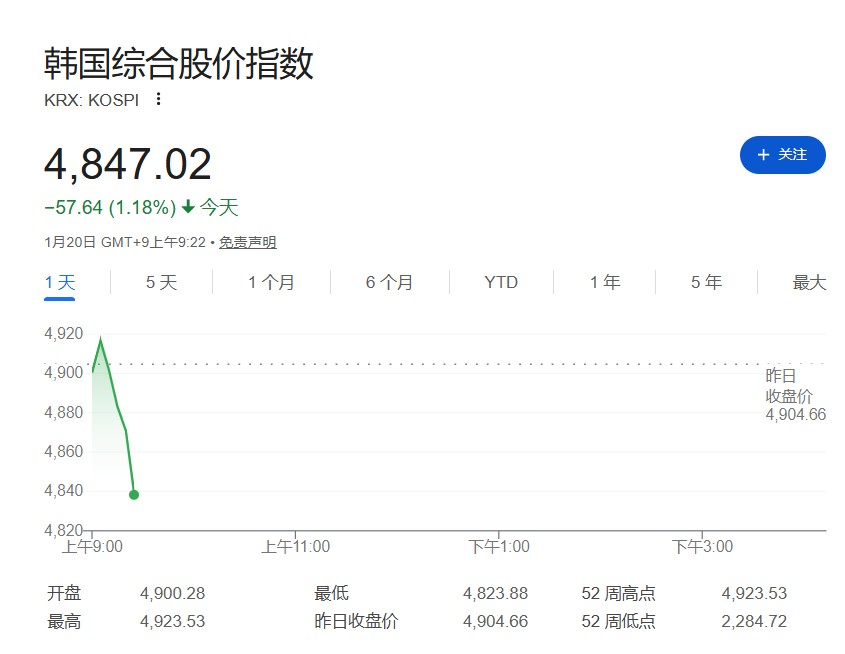
The South Korean stock market retreated, with the KOSPI index dropping 1% during the day. Yesterday, driven by expectations of a surge in AI capital expenditures, the KOSPI index briefly broke through the 4,900-point mark to reach a new high, with a year-to-date increase of 15%. Nomura Securities analysis pointed out that the South Korean stock market is undergoing a classic "chip swap": foreign capital, as "smart money," continues to increase positions through ETFs, while retail investors are retreating.
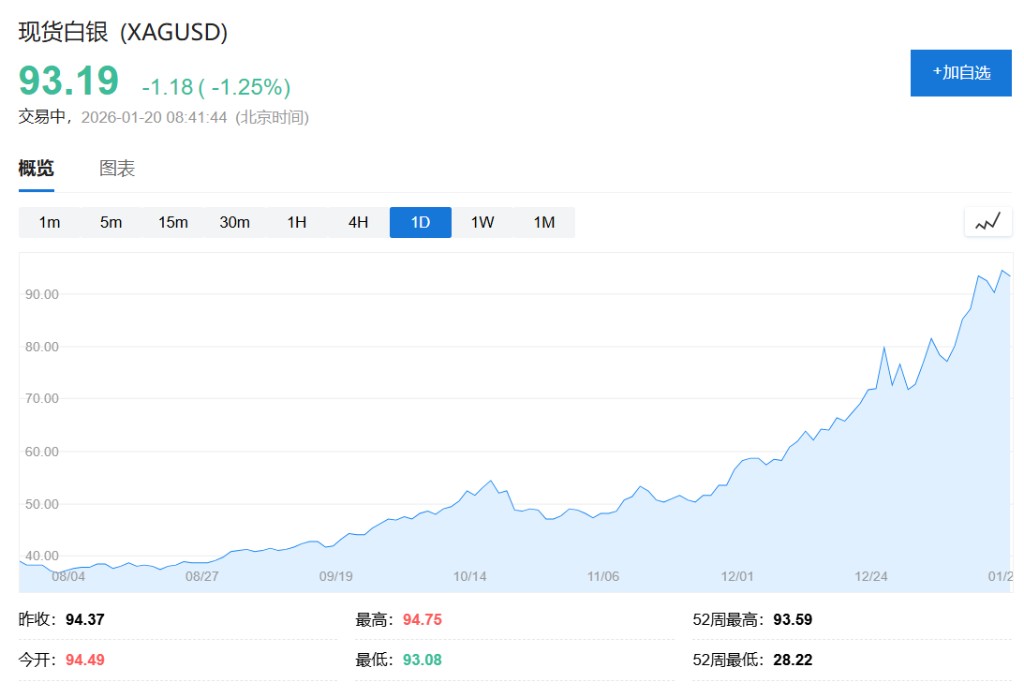
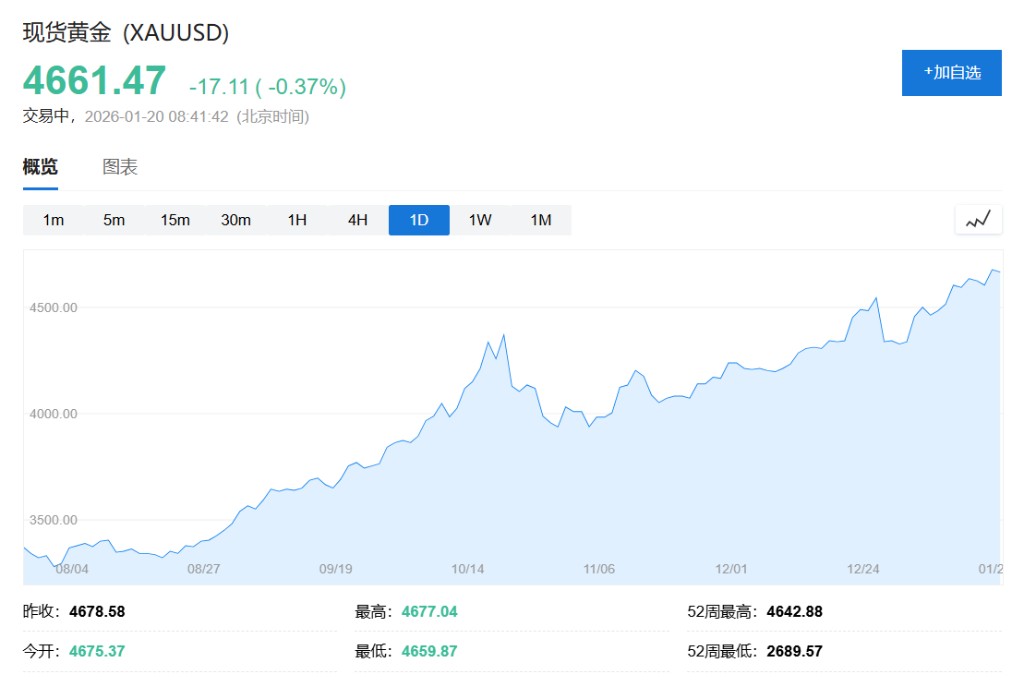
In the commodities sector, spot silver fell by 1.4% during the day, retreating from the previous historical high of $94.72 per ounce. Spot gold also saw a slight decline of 0.4%.
Furthermore, the yield on the 30-year U.S. government bonds rose by 3.8 basis points to 4.879%, reaching a new high since early September last year. The yield on the 10-year U.S. government bonds increased to 4.259%, also a new high since early September last year.
The "Greenland" Incident Continues to Escalate
The greatest source of market panic comes from across the Atlantic. Trump clearly stated on Saturday that if an agreement on the "complete purchase of Greenland" cannot be reached, the U.S. will wield the tariff stick.
According to CCTV News, U.S. President Trump stated that he would impose a 10% tariff on eight European countries that oppose his acquisition of Greenland, which will increase to 25% after several months, until an agreement on the "complete and thorough purchase of Greenland" is reached. In response, the eight European countries voiced that the U.S. tariff threat is "unacceptable," with French President Macron stating that if these threats are confirmed, European countries will respond in a united and coordinated manner As a result, U.S. stock futures weakened before the market opened, and risk-averse sentiment quickly spread to the Asia-Pacific markets. The Australian S&P/ASX 200 index fell by 0.46%, closing at 8,833.6 points; geopolitical tensions have once again put global capital on edge.
Japan "Will End Excessively Tight Fiscal Policy"
As the focus of the Asian markets, Japan today experienced a brutal "double kill" in stocks and bonds.
The core reason for the market turmoil was a significant statement made by Japanese Prime Minister Sanae Takaichi on Monday. According to Xinhua News Agency, Prime Minister Takaichi announced at a press conference that the House of Representatives would be dissolved on January 23, seeking voter authorization to continue governing, with elections scheduled for February 8. The current term for members of the Japanese House of Representatives was originally set to expire in October 2028.
Takaichi candidly stated at the press conference: "We will end excessively tight fiscal policy... We must break free from the constraints of excessive tightening and boldly invest in risk management."
Her commitment to abolishing the food consumption tax and increasing strategic fiscal spending was interpreted by the market as a signal of aggressive fiscal expansion. This directly led to a massive sell-off of Japanese government bonds, with yields soaring across the board.
The surge in bond yields has directly suppressed the valuation of equity assets. Despite Takaichi's attempts to boost the economy through stimulus policies, concerns about fiscal sustainability have temporarily taken precedence among investors
