


A high-profile short report is here! Capitalwatch accuses AppLovin of "advertising as money laundering," assisting "Chen Zhi and others in Southeast Asia's pig butchering schemes."

The report states that core shareholder Hao Tang transferred approximately 6.67 billion yuan of illegal fundraising from China’s TuanDai Network and established a money laundering network with Chen Zhi, the actual controller of Cambodia's Prince Group (a leader of a transnational criminal organization). The fraud funds were converted into advertising fees through Cambodia's super app WOWNOW and flowed into AppLovin, completing the "advertising is money laundering" closed loop. Its technical algorithms have been accused of assisting in the distribution of gambling and fraud software
The short-selling institution Capitalwatch has released a short-selling report targeting the U.S. Nasdaq-listed company AppLovin Corporation, accusing the company of systemic compliance risks and significant financial crimes related to its core shareholder structure. The report claims that AppLovin's major shareholder Hao Tang and his capital network are suspected of injecting illegal funds from China and Southeast Asia into the core of the U.S. capital market.
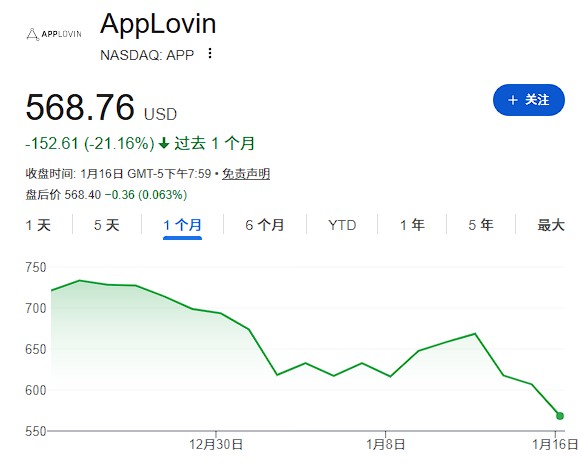
According to the latest report released by Capitalwatch, AppLovin not only has significant fraudulent concealment in SEC filings, but its management is also accused of turning a blind eye to anti-money laundering (AML) laws, objectively assisting the Prince Group, which has been classified by the U.S. Department of Justice (DOJ) as a transnational criminal organization (TCO), in legalizing assets.
The report alleges that Hao Tang is burdened with a financial black hole of billions of dollars from the Chinese P2P platform Tuandaiwang and is considered a target of judicial pursuit in China. The report states that AppLovin has become the final outlet for transnational crime leader Chen Zhi (the actual controller of the Prince Group) to launder assets, with illegal fundraising from Tuandaiwang and proceeds from Southeast Asian "pig-butchering" scams flowing into the U.S. stock market through this platform.
The report details a closed loop: Illegal funds are converted into advertising fees through the Cambodian super app WOWNOW, flowing into the AppLovin platform, and ultimately becoming legitimate dollar assets through revenue sharing and stock price appreciation. Capitalwatch claims that AppLovin's technology algorithms Array and AXON act as "digital weapons" in this process, assisting criminal groups in precisely targeting victims and distributing malware.
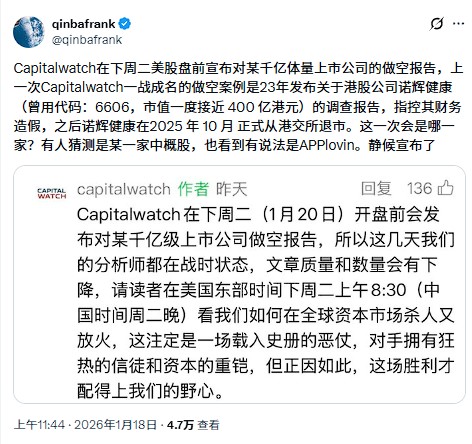
This short-selling has attracted significant market attention. As early as January 18, there were reports on social media platform X that Capitalwatch would release a report targeting a publicly listed company with a market capitalization of hundreds of billions, with speculation that the target might be AppLovin. Given that Capitalwatch's previous accusations of financial fraud against NuoHui Health ultimately led to the latter's delisting in 2025, investors are generally concerned that the accusations against AppLovin could trigger a regulatory storm.
Core Accusations: Sources of Illegal Funds and Money Laundering Network
The report presents multiple core accusations based on documents such as the judgment of the Bordeaux Court of Appeal in France, SEC 13G filings, and the DOJ's indictment against Chen Zhi.
The report states that the enormous wealth of AppLovin's major shareholder Hao Tang does not come from legitimate business accumulation, but is directly inherited from approximately 6.67 billion yuan (about 957 million USD) of illegal fundraising transferred before the collapse of the Chinese P2P platform Tuandaiwang The report also accuses Hao Tang of obtaining approximately 15 billion yuan (about 2.15 billion USD) in gambling money through transactions with "offshore gambling king" Yang Zhihui at the Macau gambling tables.
According to the report, during its operation, Tuandai Network illegally raised a total of 253.5 billion yuan (about 36.37 billion USD) from over 1.12 million retail investors. After the Dongguan Public Security Bureau issued a notice on March 28, 2019, Tuandai Network collapsed, and police investigations revealed an unpaid debt black hole of approximately 34.8 billion yuan (about 5 billion USD).
The report cites French court documents stating that during the critical window period before the funding chain of Tuandai Network broke (from February 2018 to March 2019), Hao Tang used a complex network of shell companies to assist Tuandai Network founder Tang Jun in transferring 632.89 million yuan (about 90 million USD) in illegal funds, with the actual indirect associated funds estimated to reach 957 million USD.
Family Conspiracy: Ling Tang and Key Clues
The report states that the French court ruling revealed that judicial audits found approximately 5.3 million yuan (about 760,000 USD) in illicit funds was transferred to a company account controlled by Hao Tang's "sister."
By cross-referencing SEC documents, the report found that a natural person named Ling Tang appears alongside Hao Tang on the shareholder list of AppLovin. Ling Tang holds approximately 20.49 million shares of AppLovin through Angel Pride Holdings Limited, accounting for 7.7%, making her the largest individual shareholder after Hao Tang and institutional investors.
The report points out that although SEC documents indicate Ling Tang holds Canadian nationality, her declared communication address is "Room 11, 22nd Floor, Global Trade Plaza, 61-63 Yung Kong Street, Cheung Sha Wan, Kowloon, Hong Kong," which is in the same block as the address declared by Hao Tang in the Discovery Key Investments documents (Room C, 5th Floor, Shun Cheong Industrial Building, 26 Yung Kong Street, Cheung Sha Wan, Kowloon, Hong Kong).
The report concludes that, combining the content from the French court records regarding the "sister" assisting in the transfer of funds, along with the synchronized large shareholding ratio of Ling Tang and Hao Tang in AppLovin, there is sufficient reason to conclude that Ling Tang is Hao Tang's sister, and the billions of dollars in shares held by Angel Pride Holdings are a key link in the Tang family's money laundering network.
Southeast Asian Criminal Network: Prince Group and Chen Zhi
The report states that if Tuandai Network provided the original capital for Hao Tang, then Cambodia's Prince Group provided a continuous cash flow supplement and money laundering infrastructure.
The report points out that Prince Group founder Chen Zhi was born in Fujian, China, and has become a Cambodian citizen, being the absolute core of the group. The U.S. Department of Justice and the UK government have officially designated Prince Group as a Transnational Criminal Organization (TCO), and Chen Zhi himself has been indicted by the U.S. District Court for the Eastern District of New York, accused of leading a transnational criminal network engaged in telecommunications fraud conspiracy and money laundering conspiracy According to the report, in the law enforcement action against Chen Zhi, the U.S. Department of Justice seized approximately $15 billion in cryptocurrency (mainly Bitcoin) related to him. The report states that this figure breaks the record for seizures by the Department of Justice, indirectly confirming the astonishing wealth accumulation capability of Prince Group as a global center for cybercrime.
The report states that, according to the indictment by the U.S. Department of Justice, Prince Group established multiple prison-like closed zones in Cambodia (such as Sihanoukville and the suburbs of Phnom Penh). These zones are often disguised as technology parks, resorts, or hotels.
The workforce within these zones is primarily composed of foreigners lured by high-paying jobs, whose passports are confiscated upon entry, and victims are forced to work for over ten hours a day under the supervision of armed guards to conduct "pig butchering" scams.
Capital Intersection: The Secret Intersection of Geotech Holdings
The report states that investigations found that Hao Tang and Chen Zhi are not unrelated parallel lines; the two have a deep trajectory overlap in the Hong Kong capital market.
The report points out that at the end of 2018, just before the crisis of Tuandai.com and when Hao Tang urgently needed to find offshore channels for funds, a change of control occurred at the Hong Kong-listed company Geotech Holdings.
A BVI company named Star Merit Global Limited initiated a mandatory unconditional cash offer to acquire control of the company. The sole shareholder of Star Merit Global Limited is Chen Zhi.
The report states that in the world of "shell stocks" in Hong Kong, Hao Tang and Chen Zhi occupy the same ecological niche. Geotech Holdings serves as Chen Zhi's listed platform in Hong Kong, aiming to capitalize on gray assets in Cambodia through the listed company.
Hao Tang, as a seasoned capital operator (former actual controller of Goldenway Group), provided capital channels and structural support in this process. The operational overlap during this specific time window proves the collaborative relationship between the two in the money laundering network.
Technical Conspiracy: Array and AXON as Criminal Tools
The report states that AppLovin's relationship with Prince Group is not limited to equity investment at the capital level; the company's two core technology products—Array and AXON algorithms—objectively serve as "digital weapons" for multinational criminal groups to execute online fraud and illegal gambling distribution.
The report points out that the Jinbei Group under Prince Group operates numerous illegal online casinos and scam applications (such as fake trading software disguised as MetaTrader).
Due to strict policy enforcement against gambling and malware by the Google Play Store and Apple App Store, these applications cannot be listed through legitimate channels and urgently need underground channels to bypass the "gatekeepers." AppLovin's Array product (and its component AppHub) provides them with the perfect solution. The report cites deep evidence from short-selling firm Culper Research and cybersecurity expert Ben Edelman, stating that the investigation shows AppLovin obtained system-level permissions on Android systems through commercial partnerships with mobile device manufacturers (such as Samsung and Xiaomi's overseas versions) and telecom operators (such as T-Mobile) by pre-installing software.
This means that AppLovin can "directly download" and install applications on users' phones without their knowledge, or simply by clicking an advertisement once.
The report states that code analysis by security researchers shows that AppLovin's SDK contains commands such as "InstallOnClose" and "IsAutoInstall," which effectively deprive users of their choices, turning victims' phones into "puppets" controlled by advertisers.
Money Laundering Closed Loop: "Advertising as Money Laundering" New Model
The report suggests that the deepest bond between Prince Group and AppLovin is not just a client relationship, but a money laundering closed loop based on digital advertising transactions—"The Ad-Tech Laundromat."
The report states that leveraging AppLovin's central position as a global advertising network, criminal groups have created a perfect path for money laundering.
Step One, Prince Group uses its network of shell companies (such as the aforementioned WOWNOW affiliated entities or shell companies registered in Singapore/Hong Kong) to open advertiser accounts on the AppLovin platform, with funds sourced from cryptocurrencies obtained through "pig-butchering" scams.
Step Two, Prince Group pays AppLovin hundreds of millions of dollars, nominally for purchasing advertising traffic.
The report states that investigations found WOWNOW, as a local lifestyle application primarily serving the Cambodian market, has advertising expenditures on AppLovin that are severely disproportionate to its market size. This excessive advertising expenditure is essentially a "fee" for money laundering and a vehicle for fund transfers.
Step Three, AppLovin recognizes the advertising revenue as legitimate income (recorded in its NASDAQ financial reports), and then settles the funds to overseas publisher accounts controlled by Prince Group in the form of "developer revenue sharing" or "advertising publishing fees."
The report states that at this point, the originally bloody scam funds have been transformed into legitimate remittances from a NASDAQ-listed company in the United States.
Compliance Crisis and Regulatory Risks
The report states that AppLovin is currently sitting on a compliance volcano. The short-selling firm Culper Research explicitly pointed out in its 2025 report that Hao Tang is not an ordinary financial investor, but a "bad actor" involved in "money laundering, human trafficking, and illegal gambling."
The report notes that according to NASDAQ listing rules and the U.S. Bank Secrecy Act (BSA/AML), if the funds of a major shareholder (with concerted action holding more than 10%) are proven to be criminal proceeds, the company faces delisting risks, and the related equity will be subject to judicial freezing The report claims that to cover their tracks, the company orchestrated a malicious "option hijacking":
Inducing employees to transfer options to a shadow company under Kylin, then forcibly confiscating equity after re-signing contracts, and finally terminating employees with discounted cash settlements.
The report states that this not only confirms the existence of its operations in China but also exposes the management's gang-like governance that plunders employee rights to sever legal and financial obligations.
The report issues the highest level of risk warnings to regulators and investors, recommending that the U.S. Department of Justice immediately freeze the AppLovin shares held by Hao Tang and Ling Tang through Discovery Key, Midterm Success, and Angel Pride. The SEC should enforce a legal audit of AppLovin's advertising revenue sources over the past five years, and CFIUS should re-examine whether AppLovin poses a national security threat.
The final recommendation for investors in the report is a "strong sell," stating that this is an empire built on quicksand, with its foundation buried under the tears of victims of Tuandai Network and the sweat and blood of Southeast Asian park slave laborers
