


The epic collapse of Japanese bonds, Wall Street: Is the Bank of Japan going to "emergency rescue the market"?

Affected by the aggressive tax cuts of Saito Harumi and the lack of funding sources, Japanese government bonds have encountered a "Truss-style" sell-off, with ultra-long-term yields soaring to record highs. Market concerns about the failure of fiscal discipline and inflation risks have led to fluctuations in stocks, bonds, and currencies. Analysts believe that the Bank of Japan may be forced to initiate emergency bond-buying interventions and accelerate the interest rate hike process to curb the out-of-control yields and restore market confidence in the policy mix
Japanese government bonds are facing an epic sell-off, with long-term bond yields soaring to record levels, primarily due to market investors' panic over Prime Minister Sanna Takashima's aggressive fiscal expansion plans and the inflation risks they entail.
On the 20th, the yield on Japan's 30-year government bonds rose by 26.5 basis points to 3.875%; the yield on Japan's 40-year government bonds increased by 27 basis points to 4.215%, setting a new historical high. The trigger for this sell-off was the government's promise to cut the consumption tax on food to win elections, without specifying the source of funding, which sharply heightened market concerns about Japan's fiscal discipline and government spending.
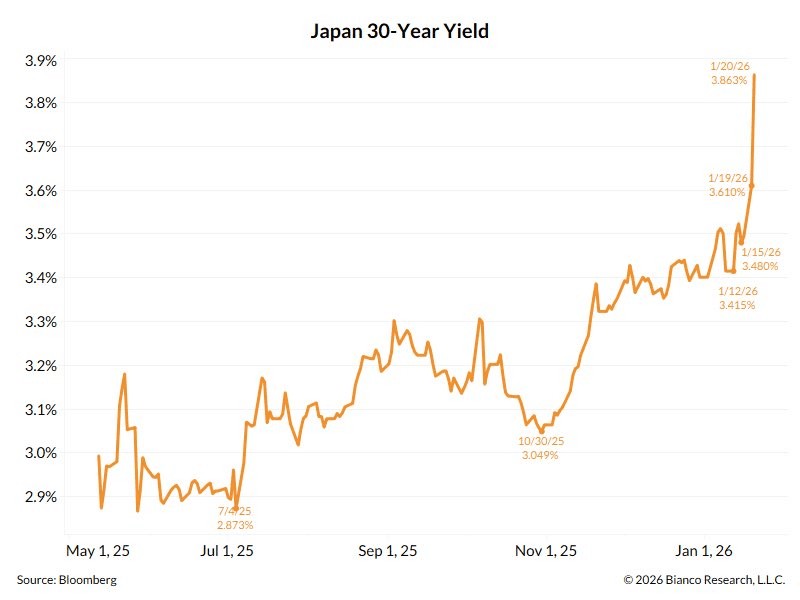
This bond market crash has begun to spill over into the stock and foreign exchange markets, putting immense pressure on the Bank of Japan. Analysts point out that to curb runaway yields, the Bank of Japan may be forced to accelerate its interest rate hikes or even initiate emergency bond purchases immediately to calm the market.
Strategists warn that the current market turmoil is reminiscent of the "Truss shock" in the UK, and if authorities do not quickly send clear signals on interest rates or intervene, volatility could worsen further and even spread to the global bond market.
"Truss Moment" Reappears?
The core of this round of market turmoil lies in the fear of "fiscal stimulus without funding support." Rinto Maruyama, a foreign exchange and interest rate strategist at SMBC Nikko Securities Inc., noted that Sanna Takashima appeared very aggressive at the press conference, proposing a consumption tax cut plan without a clear source of funding. He believes this is a "significant shock," and the market currently cannot see how the government plans to fund the proposed tax cuts. Although Japan's credit default swaps (CDS) have not risen sharply like during the UK's "Truss shock," yields continue to soar due to the lack of a clear funding source.
Katsutoshi Inadome, a senior strategist at Sumitomo Mitsui Trust Asset Management Co., stated that the bond market was "confused and surprised" by this announcement, leading to uncontrolled rises in yields. Shinji Kunibe, a global fixed income portfolio manager at Sumitomo Mitsui DS Asset Management Co., described the market's panic:
"What initially seemed like a routine 20-year government bond auction quickly turned into a crash, and everyone is glued to their screens. This looks like a warning from the market about fiscal expansion."
Wall Street Calls for Central Bank "Emergency Rescue"
In the face of ongoing sell-offs, Wall Street analysts believe that intervention by the Bank of Japan is imminent. Gareth Berry, a strategist at Macquarie Bank in Singapore, stated that if the plunge intensifies, the Bank of Japan may intervene and purchase Japanese government bonds. He pointed out that although Governor Kazuo Ueda has been reluctant to use this tool, he may soon have no choice "If the sell-off continues, especially if it spreads globally, we should see the Bank of Japan reactivating this tool, possibly even implementing it as early as tomorrow's routine operations."
Tadashi Matsukawa, head of bond investments at PineBridge Investments Japan Co., also believes that with interest rates rising so significantly, calls for the Bank of Japan to conduct emergency operations and for the Ministry of Finance to implement buybacks may intensify. He pointed out that although the issuance of ultra-long-term bonds decreased last year, the supply-demand situation has not improved.
Challenges to Monetary Policy Normalization
The market generally believes that the current fiscal situation makes the Bank of Japan's monetary policy appear overly accommodative. Simon Ballard, chief economist at First Abu Dhabi Bank, pointed out that the market is punishing the current policy mix, forcing investors to turn to stocks. He believes that relative to nominal growth and fiscal deficits, the Bank of Japan's policy is too loose. Ballard emphasized that with an inflation rate of 3%, wage growth of 5%, along with the supplementary budget for high rice prices and expectations of additional fiscal deficits in 2026, the current market pricing (two rate hikes) is far from sufficient; in fact, four rate hikes are needed.
Prashant Newnaha, senior Asia-Pacific rates strategist at TD Securities, stated that successive Japanese governments have underestimated the risks of rising interest rates and yen depreciation brought about by expansionary policies. The market is beginning to price this in by raising neutral rates and term premiums, which also explains why there is a lack of buyers in the Japanese government bond market. He warned that expansionary fiscal policy means that rising yields are likely to be persistent, and the yield on 40-year Japanese government bonds may further break through 4% in the coming months.
