


"The Big Blunder" led to a trillion-dollar copper market correction, did Nvidia fool everyone?

On January 19th, the A-share copper industry chain experienced a correction, with the sector index falling by 2.67% and institutional funds net outflowing 683 million yuan. This adjustment stemmed from a technical blog by NVIDIA, which incorrectly exaggerated the copper demand from data centers, leading to a significant downward revision of market expectations. After reaching a historical high, the London copper price quickly retreated, causing a sharp decline in the copper industry index, with leading stocks such as JIANGXI COPPER plummeting by 9.53%
On January 19, the A-share copper industry chain faced a precise strike. The sector index fell 2.67% in a single day, with institutional funds experiencing a net outflow of 683 million yuan. Leading stocks such as Jiangxi Copper (600362.SH) collectively plummeted at the opening—an adjustment that was anticipated but executed in the most severe manner.
The catalyst for the turbulence pointed directly to NVIDIA. A technical blog from the company that exaggerated copper demand for data centers by over 2,000 times had been widely circulated in the market for months, but NVIDIA quietly corrected it last Friday. Xiao ChuanKang, an analyst at Shanghai Steel Union's copper division, pointed out, "This is significantly different from previous market expectations, leading to a substantial downward revision of a demand hotspot that had been speculated upon."
On that Friday, the historically high London copper price fell in response, retreating 3.4% in a single day.
This was a violent correction of market perception; NVIDIA's blunder clearly pierced the short-term emotional bubble, forcing the market to reassess the true logic and fragile foundations behind the soaring copper prices.
"500,000 Tons of Copper" Blunder Triggers Market Turning Point
A regular technical article released by NVIDIA in May 2025 claimed that "a 1-gigawatt data center requires 500,000 tons of copper," which was widely cited in the market and became one of the proofs for the story of "AI computing power driving super copper demand."
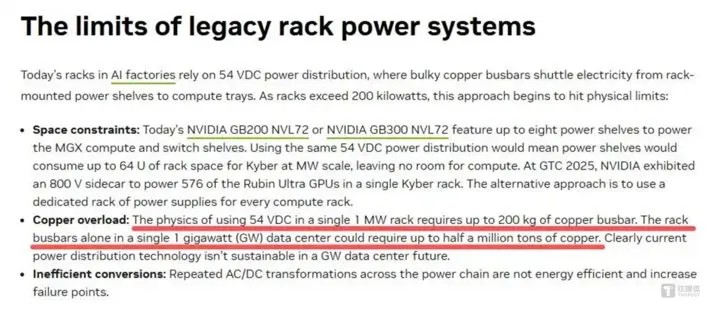
This data was initially referenced in many market research reports but was recently found to be erroneous. NVIDIA has now corrected the statement in the blog from "500,000 tons" to "200,000 kilograms"—the demand was exaggerated by over 2,000 times.

Once the data was corrected, the consequences were immediate. After reaching a historic high of $13,407 per ton on January 14, the three-month copper futures on the London Metal Exchange (LME) quickly reversed direction, experiencing significant declines over two consecutive days, with a cumulative drop of 3.4%, and breaking below the critical support of the 10-day moving average. The collapse of faith in the futures market quickly transmitted to the stock market, resulting in a brutal situation of mutual destruction within the A-share industry chain.
This was a "hard landing." Yesterday, the copper industry index plummeted 2.67% during trading, with institutional funds experiencing a net outflow of 683 million yuan. Shortly after the opening, leading stocks were in a bloodbath: Jiangxi Copper fell 9.53%, Yunnan Copper dropped 4.97%, and heavyweight stocks such as ShengTun Mining, Tongling Nonferrous Metals, and Baiyin Nonferrous Metals all saw declines exceeding 3.5%.
In terms of liquidity in the copper market, an important signal emerged: large funds have been flowing out for three consecutive days, with an accelerating outflow trend, and the capital in the copper market is simultaneously declining.
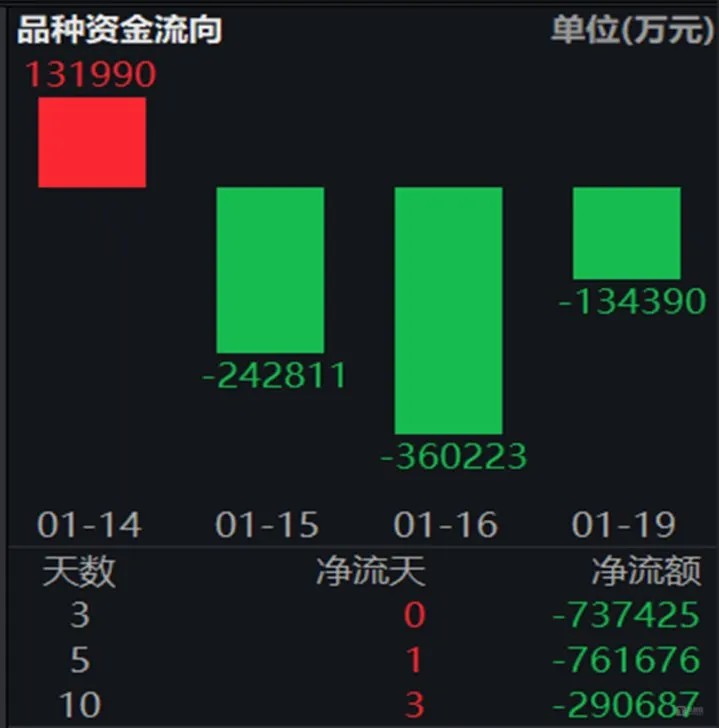 It can be seen that the speculative funds accumulated from the previous rise in copper prices have begun to exit, exacerbating the short-term correction pressure. Moreover, Shanghai copper has broken through key support levels, triggering stop-losses in algorithmic trading, which further amplified the decline.
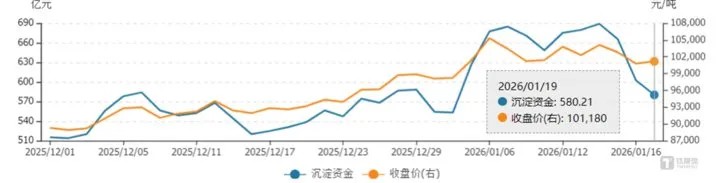
How to view the future market? Institutions warn: January may be the peak for the year
It is worth noting that this adjustment may just be the beginning. Institutional views indicate that the copper market will present a pattern of "high first, low later, high-level fluctuations" in 2026, with structural contradictions and macro variables dominating the price rhythm.
Supply constraints have become a short-term hard support, but the competition is intensifying. Xiao Jing, chief analyst of non-ferrous metals at Guotou Futures, publicly pointed out that the copper mine supply side is facing dual pressures. On one hand, large mines that are disrupted, especially in the first quarter of 2026, are unlikely to resume significant production; on the other hand, lower annual processing fees have intensified the competition between mining companies and smelters, prompting smelters in China and Japan to announce cuts in raw material capacity. She expects that due to these factors, the growth rate of global refined copper smelting in 2026 is expected to face significant downward pressure.
The market consensus is that copper prices will switch from a "narrative-driven" bull market model to a "supply-demand verification" high-level fluctuation model. The actual consumption recovery intensity after the Chinese New Year, the continuous changes in global visible inventory, and the supply disruption rates of major mines in Chile and Peru are all contributing factors.
On the other hand, tariff signals may become a turning point from "bull to bear." Currently, the "tariff concerns" that the market is focused on have eased somewhat, as Trump may have decided not to impose tariffs on rare earths, lithium, and key mineral resources. The market expects that the U.S. may impose a 15% import tariff on refined copper starting in 2027, in addition to the strengthening U.S. dollar index putting short-term pressure on the metal market.
"The second quarter of this year will be a turning point for copper market sentiment." Goldman Sachs, in its report, raised its LME copper price forecast for the first half of 2026 from $11,525 per ton to $12,750 per ton, citing that inventories outside the U.S. are tightening due to capital inflows and supply flowing to the U.S. However, the bank maintains its forecast of $11,200 per ton for the fourth quarter of 2026, indicating that copper prices will face significant correction pressure in the second half of the year.
Risk warning and disclaimer
The market has risks, and investment should be cautious. This article does not constitute personal investment advice and does not take into account the specific investment objectives, financial conditions, or needs of individual users. Users should consider whether any opinions, views, or conclusions in this article align with their specific circumstances. Investment based on this is at their own risk.
