"AI Honeymoon Period Ends"! Deutsche Bank: 2026 Will Be the Year of Life or Death for Independent Model Companies

Wallstreetcn
2026.01.20 12:20
portai
I'm PortAI, I can summarize articles.

Deutsche Bank pointed out that the "honeymoon period" for the artificial intelligence industry has ended, and 2026 will be a critical year for independent AI model companies. The market faces challenges of disillusionment, misalignment, and distrust, especially with concerns raised by OpenAI's high cash burn. Apple's choice of Google as a partner indicates increased competitive pressure on independent model manufacturers. The IMF warns that a reassessment of AI productivity expectations could lead to a decline in investment, affecting household wealth. Deutsche Bank believes that only a few companies will stabilize the market, while other smaller independent companies may face the fate of being acquired

Deutsche Bank bluntly stated that the "honeymoon period" for the artificial intelligence industry has ended. Although AI technology will persist, 2026 is expected to be the most challenging year for the industry, as the intertwining themes of disillusionment, misalignment, and distrust will put the market to a severe test.

According to the Wind Trading Desk, Deutsche Bank pointed out in its latest report on January 20 that this year will be a "make-or-break year" for independent AI model companies. Despite OpenAI receiving investment from SoftBank by the end of 2025 and seeking a high valuation, concerns have arisen in the market regarding its projected cash burn of up to $17 billion this year and the sustainability of its business model. Notably, Apple's decision on January 12 to choose Google over OpenAI as its AI product partner highlights the risks of diminishing moats and narrowing pathways that independent model manufacturers face when competing with tech giants.

The International Monetary Fund (IMF) has also issued a warning, indicating that a reassessment of expectations for AI productivity growth could lead to a decline in investment and trigger sudden adjustments in financial markets, thereby affecting household wealth. Deutsche Bank's analysis suggests that aside from a few companies like Anthropic that have established themselves with robust cash flow and enterprise-level products, smaller independent companies (such as Perplexity) may ultimately face acquisition by giants due to their inability to bear the accelerating costs of computing power.

The report summarizes the market tone for 2026 as "disillusionment," "misalignment," and "distrust." As enterprise users transition from pilot projects to production, technological limitations, high costs, and supply chain bottlenecks are replacing the earlier blind optimism. Investors need to be wary of the significant gap in the transition from "AI concepts" to tangible returns.

Disillusionment Approaches: Enterprise Applications Face "Jagged Boundaries"

Deutsche Bank noted in the report that while generative AI is transformative, its full impact will not be immediately apparent. As pilot projects enter the production phase, enterprise users are facing inherent limitations such as insufficient accuracy and difficulty in coping with unpredictable real-world environments. For many CEOs, the focus is more on substantial revenue growth or systemic operational fixes rather than merely improving efficiency in specific areas like coding.

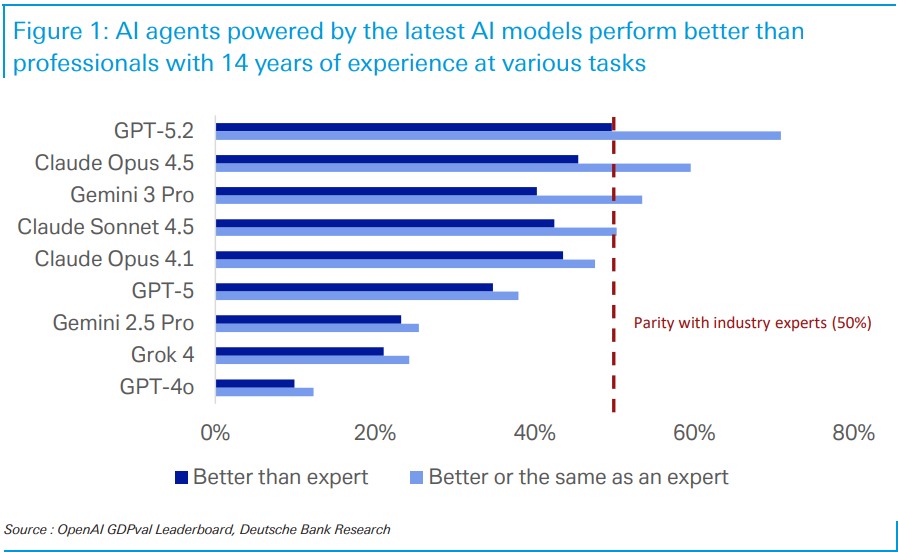
Although venture capital firms like Sequoia claim that "general artificial intelligence is here and now," Deutsche Bank believes that for most ordinary users, the current AI experience feels more like "switching to a more comfortable saddle" rather than upgrading from a horse to a tractor. Even though benchmarks like OpenAI's GDPval Leaderboard show that AI can solve work tasks, AI remains a tool that requires human guidance and interpretation when dealing with the complexities of the real world.

The difficulty of corporate integration is severely underestimated. The report emphasizes that most companies lack the high-quality data and integration capabilities required for general AI, not to mention the monitoring mechanisms in sensitive areas such as finance or healthcare. The so-called "jagged boundary" effect still exists, where AI excels at certain tasks but performs surprisingly poorly at others. This limits large-scale applications; although large enterprises have a higher usage rate, the path from pilot projects to generating positive returns remains tortuous for the broader market.

Supply-Demand Mismatch: Computing Power Bottleneck and Funding Dilemma for Independent Vendors

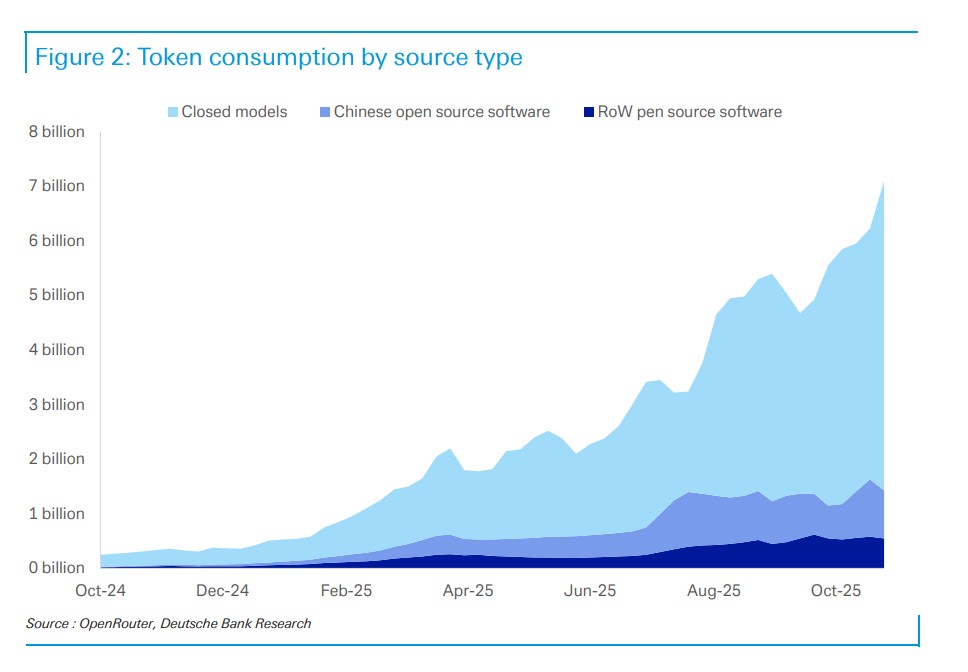
2026 will also be a year of severe "mismatch," with the imbalance between demand and capacity intensifying. Data from hyperscale cloud service providers like Google shows that token usage increased more than 100 times in the 18 months leading up to last October. However, the complexity of the supply chain means that a shortage of any one of the hundreds of thousands of components—from high-bandwidth memory and energy supply to engineering talent—could derail the process.

In this context, financial pressure will focus on private AI companies. Deutsche Bank points out that while hyperscale cloud service providers can fund investments through operating cash flow, independent model manufacturers are facing significant financial challenges. OpenAI has committed to investing $1.4 trillion in data center construction over the next few years, but its massive capital expenditures and relatively shallow moat put it at risk before its IPO.

Deutsche Bank specifically mentions that as reasoning and video generation become commonplace, the marginal cost of each interaction continues to rise. For smaller independent companies, the accelerating costs of computing power are almost unbearable. The report predicts that except for Anthropic, which may become an exception due to its lower cash burn rate and developer-friendly products, other independent vendors may be forced to seek refuge with hyperscalers before the end of this year.

Crisis of Trust: Geopolitical Games and Heightened Regulation

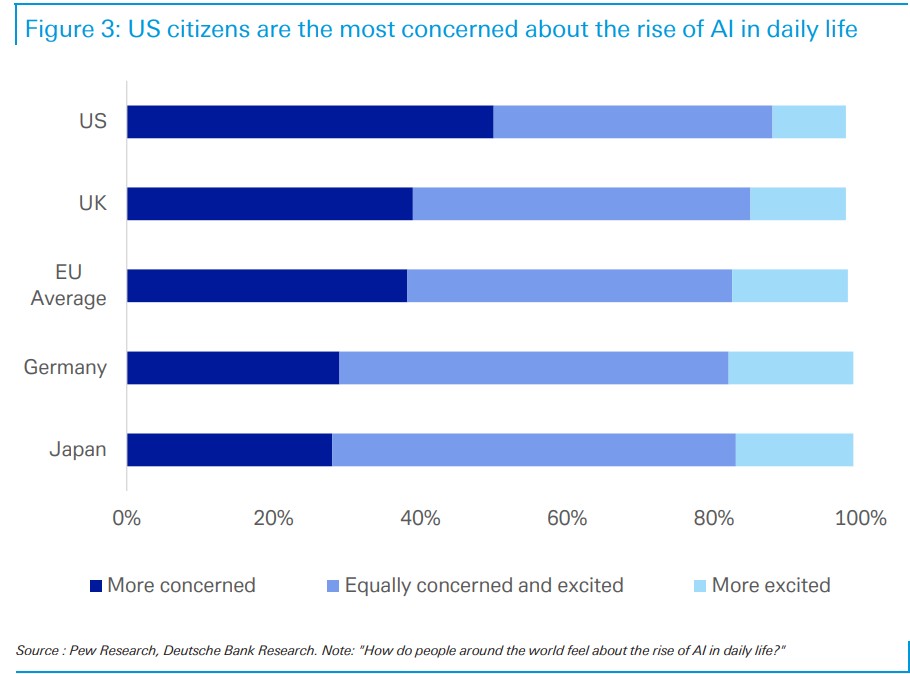
"Distrust" will be the third major theme throughout 2026. Legal disputes surrounding copyright, privacy, and data center locations will surge, and public anxiety over AI misuse will escalate from whispers to roars. Additionally, concerns about job displacement are intensifying; a Stanford study titled "Canary in the Coal Mine" indicates that since the launch of ChatGPT, the employment rate of recent graduates in AI-related positions has decreased by 16%.

Geopolitical competition will further complicate the market environment. Deutsche Bank pointed out that the AI race will have a profound impact on investments. The emergence of China's open-source model DeepSeek demonstrates the possibility of extracting value from low-cost chips, and China is expanding its leading advantage in affordable, accessible open-source models, which is attractive to cost-sensitive users.

At the same time, the United States is trying to maintain its dominance in the ecosystem through export controls, such as allowing NVIDIA to export H200 chips. However, the competition among governments to promote AI self-sufficiency is escalating. This global battle for standards, combined with the implementation of the EU's most stringent provisions of the AI Act, will require multinational tech giants to navigate regulatory minefields more cautiously by 2026.


The above exciting content comes from the Wind Trading Platform.

For more detailed interpretations, including real-time analysis and frontline research, please join the【 **Wind Trading Platform ▪ Annual Membership**】

![](https://wpimg-wscn.awtmt.com/3c4a713c-7a38-4582-9850-d0eabaf0e7ad.png)

Risk Warning and Disclaimer

The market has risks, and investment should be cautious. This article does not constitute personal investment advice and does not take into account the specific investment goals, financial situation, or needs of individual users. Users should consider whether any opinions, views, or conclusions in this article are suitable for their specific circumstances. Investment based on this is at their own risk.

![](https://wpimg-wscn.awtmt.com/61023b38-200c-4bb9-9180-d257ade84830.png)