Q4 performance exceeded expectations, but investors are more concerned about "why is Taiwan Semiconductor being so aggressive"?

Wallstreetcn
2026.01.20 12:46
portai
I'm PortAI, I can summarize articles.

Morgan Stanley pointed out that TSMC's significant increase in capital expenditure guidance is primarily aimed at seizing long-term demand for AI, addressing equipment supply tightness, and consolidating market share in advanced processes to avoid losing share in 2-3 years. The next catalysts will mainly revolve around the AI market, focusing on global cloud service providers' capital expenditure guidance, the expansion of the semiconductor market size, and the NVIDIA GTC conference to be held in March

TSMC's fourth-quarter financial report and guidance both exceeded market expectations, but investors' focus has shifted from the performance itself to deeper strategic issues. The world's largest foundry is facing questions from investors regarding its aggressive expansion strategy, including why it significantly raised its capital expenditure guidance and why such an extensive capacity layout is necessary.

According to Wind Information, Morgan Stanley analyst Charlie Chan and others pointed out in their latest research report that TSMC's stock price rose 4% in the two trading days following the earnings report, but investors are now raising more strategic questions rather than merely reacting to the performance. Morgan Stanley believes that in addition to strong AI semiconductor growth, potential supply tightness in equipment is also a reason for TSMC to aggressively book equipment or expand capacity. Otherwise, if demand meets customer expectations in 2-3 years, TSMC may face the risk of losing market share.

Furthermore, after TSMC reached a tariff agreement with the U.S. government, the market is concerned about whether the company will further increase its investments in the U.S. According to the agreement, Taiwan needs to directly invest $250 billion, and TSMC is expected to contribute a significant portion of that.

Behind Aggressive Capital Expenditure: Fully Protecting Market Share

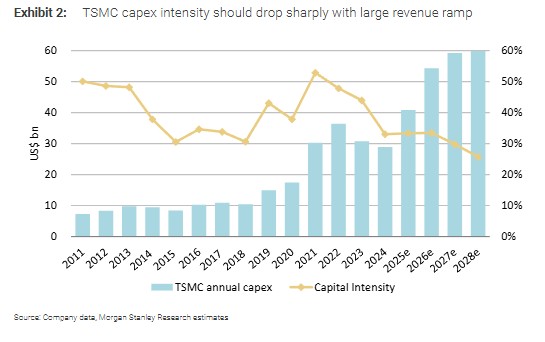
TSMC's capital expenditure guidance for 2026 is set at $52 billion to $56 billion, which is about $6 billion to $11 billion higher than market expectations, and this aggressive investment plan has sparked widespread discussion in the market.

Morgan Stanley believes that in addition to strong AI semiconductor growth, potential supply tightness in equipment is also a reason for TSMC to aggressively book equipment or expand capacity. Otherwise, if demand meets customer expectations in 2-3 years, TSMC may face the risk of losing market share.

Analysts point out that TSMC is accelerating infrastructure construction, including but not limited to the advanced packaging plants AP9 and AP10 being built on newly acquired land in the U.S. Even with an increase of $1 billion to $2 billion in infrastructure capital expenditure, the updated capital expenditure guidance remains aggressive. Therefore, it is not ruled out that TSMC may prepay part of the equipment costs to smooth out capital expenditures in 2026 and 2027.

It is worth noting that TSMC's capital intensity is expected to decrease significantly as revenue grows substantially. Although capital expenditure will reach a record high in 2026, the proportion of capital expenditure to revenue will significantly decrease as capacity is released in 2027-2028.

Capacity Expansion and Production Efficiency Improvement

TSMC's revenue guidance for 2026 indicates nearly 30% year-on-year growth, exceeding market expectations, and this upward adjustment is mainly attributed to improvements in production efficiency.

Analysts attribute the revenue guidance increase to enhanced production efficiency, as TSMC is pushing for more wafer output to meet customer demand. Analysts do not expect the company to raise wafer prices additionally mid-year.

TSMC has raised its long-term gross margin guidance from 53% to 56% and above, reflecting the company's confidence in AI opportunities and the sustainability of production efficiency improvements Morgan Stanley expects that even with increased capital expenditures, TSMC can easily achieve its target gross margin of over 56%. The company's strategy to enhance gross margins should be sustainable, including improving production efficiency, integrating mature process production, and outsourcing low-margin businesses. As a result, analysts have raised the gross margin assumption for 2026 to 63%.

Key Catalyst: AI Demand Drives Future Growth

The next key catalyst that investors are most focused on revolves around the AI market. Morgan Stanley believes that the following factors will be key drivers for TSMC's stock price:

Guidance on capital expenditures from global cloud service providers: The capital expenditure guidance from global cloud service providers (CSPs) in 2026 will directly impact TSMC's order visibility. Management has communicated directly with global CSPs to confirm that chip supply, rather than power supply, is the real bottleneck.

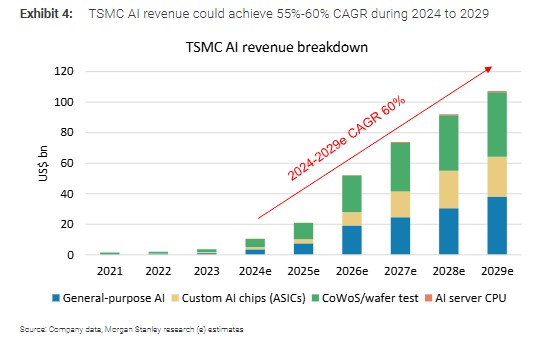
Expansion of the AI semiconductor market size: Morgan Stanley predicts that the global total addressable market (TAM) for AI semiconductors will grow from current levels to $550 billion by 2029. AI semiconductors already account for a high single-digit percentage of TSMC's total revenue in 2025, and this is expected to reach 20-25% in 2026.

NVIDIA GTC Conference: The NVIDIA GTC conference scheduled for March will provide important guidance on AI chip demand and may further validate TSMC's aggressive expansion strategy.

Quarterly performance of AI clients: The financial reports of major AI clients will directly affect the market's judgment on the sustainability of AI semiconductor demand, which is crucial for TSMC to maintain a high level of capital expenditure.

TSMC has raised its revenue growth expectations for AI semiconductors from 45% to a compound annual growth rate (CAGR) of 55-59% (2024-2029), approaching Morgan Stanley's 60% forecast.

The company has raised its overall revenue growth outlook from 20% to 25% (CAGR for 2024-2029). Management has communicated directly with global cloud service providers during the earnings call, confirming that power supply may not be the bottleneck, but chip supply is.

Analysts believe that AI semiconductors already account for a high double-digit percentage of revenue in 2025, and considering their growth exceeds the company's average level, a share of 20-25% in 2026 is possible. Even assuming moderate growth for PC and smartphone semiconductors, and a 30-40% growth for general servers and networking, "doubling AI semiconductor revenue" is also a reasonable assumption.

Regarding U.S. investments, according to the tariff agreement reached between Taiwan and the U.S., $250 billion in direct investment is required, and TSMC is expected to contribute a significant portion of this. A year ago, the company announced plans to invest $165 billion in the U.S. by 2030, with 30% of its 2nm and below capacity located in the U.S. Analysts believe TSMC will accelerate its capacity expansion in the U.S. to meet customer demand, and the company has mentioned purchasing larger plots of land in Arizona during the earnings call. According to TrendForce, the new park may add five wafer fabs, as well as new advanced packaging plants AP9 and AP10

Preferred Stock: Target Price NT$ 2088

Taiwan Semiconductor Manufacturing Company (TSMC) maintains its leading position in the advanced process foundry sector, and management is confident about the trend in market share.

Regarding foundry competition, management stated that advanced process foundry services take years to mature, and TSMC remains confident in its market share trajectory. Analysts believe that reflecting strong AI capital expenditure guidance, TSMC remains their preferred stock.

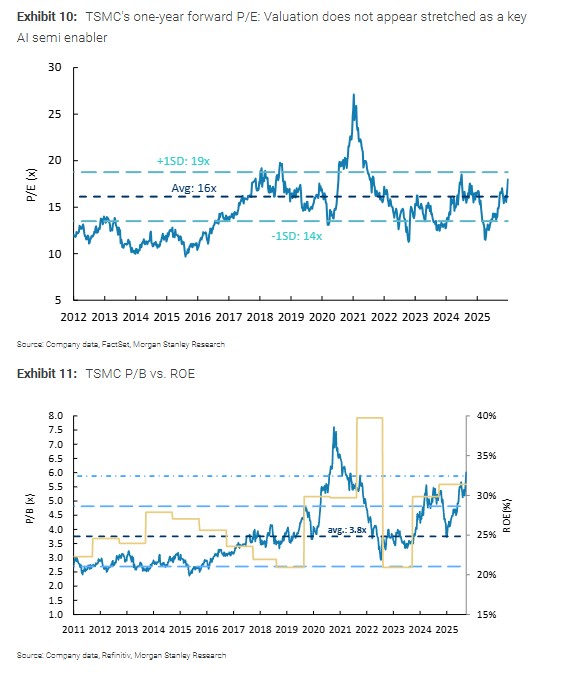
From a valuation perspective, TSMC's current stock price is 15 times the analysts' forecast for earnings per share in 2027, close to the average forward price-to-earnings ratio of 16.5 times since 2018. Analysts consider this level very attractive.

Morgan Stanley continues to use the residual income valuation method to derive a 12-month target price of NT$ 2088, with key assumptions including a cost of equity of 9.2% (beta of 1.2, risk premium of 6.0%, risk-free rate of 2.0%), a medium-term growth rate of 10.5%, and a terminal growth rate of 4%.

Analysts point out that reflecting enhanced bargaining power, long-term gross margin expansion, and sustainable AI semiconductor demand, the stock is expected to be repriced to an implied target price-to-earnings ratio of about 19 times for 2027. TSMC dominates the foundry services sector, benefiting from breakthroughs in EUV technology and materials, new technological trends such as AI-driven global semiconductor revenue growth, and increased demand for leading process nodes