Robot Spring Outlook: Mass production moment is approaching, Tesla has completed factory inspection

Tesla has completed its factory audit and is expected to enter mass production in 2026, with domestic companies likely to see a significant increase in shipment volumes. OpenAI has issued a request for proposals to hardware manufacturers, planning to accelerate the development of the robotics industry and recruit a team focused on humanoid robots, marking its return to this field. The CES exhibition shows that 2026 will be the inaugural year for the realization of robotic narratives, with suppliers accelerating their shift towards the humanoid robot supply chain
Tesla recently completed a factory audit and is set to enter mass production in 2026.
Domestic leading enterprises are guiding high growth, and shipment volumes are expected to rise significantly.
A new industrial storm is on the brink. How should we understand and layout the value of the industrial chain?
1. What Happened? Accelerated Global Competition
OpenAI has issued a request for proposal (RFP) to hardware manufacturers in the U.S., covering components such as chips, motors, packaging materials, and data center cooling equipment. OpenAI's Chief Global Affairs Officer compared AI to a "catalyst for America's re-industrialization," stating that the company believes the development speed of the robotics industry will exceed some expectations.
Wall Street Journal previously mentioned that a report from September 2025 indicated that OpenAI is forming a new team focused on humanoid robots and has hired several researchers with expertise in humanoid robot control algorithms. Job postings show that the company is looking for experts with remote operation and simulation experience, which are key technologies for training humanoid robots. The job description at that time clearly stated that the team "focuses on unlocking general robotic technology and driving AGI-level intelligence in dynamic real-world environments." A mechanical engineer position required applicants to have "experience designing mechanical systems for mass production (over 1 million units)," hinting at its ambitions for large-scale production.
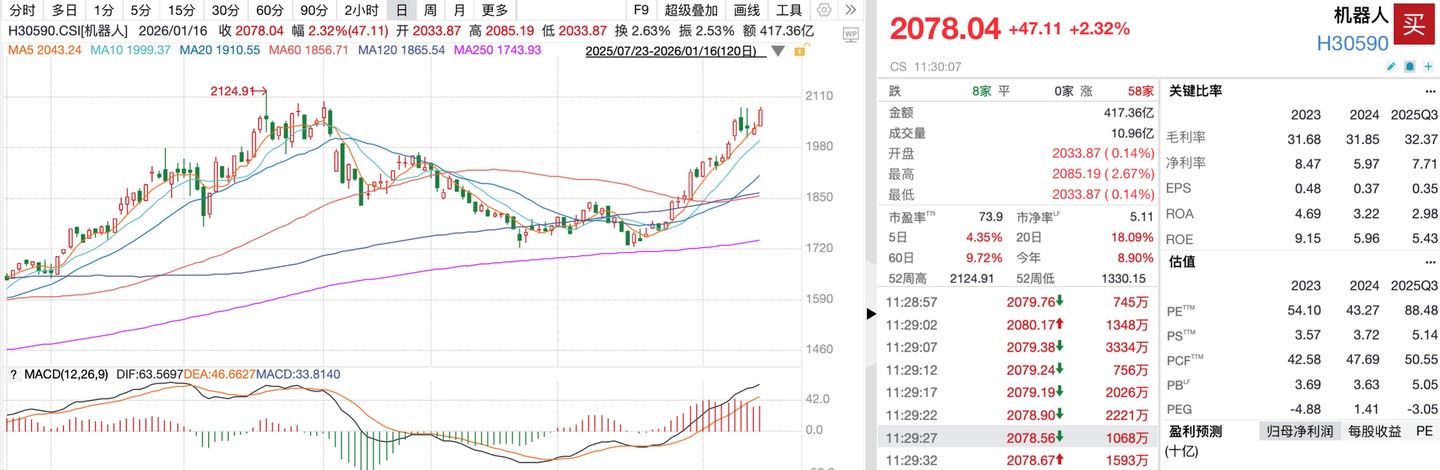
This marks a significant strategic return for OpenAI after disbanding its robotics department in 2021 and will put it in competition with companies like Tesla, Google, and Figure in the humanoid robotics arena. The FOMO atmosphere in the robotics industry between China and the U.S. is becoming increasingly intense.
Source: WIND
In addition to OpenAI, the recently concluded CES exhibition also signals this major trend—the year 2026 is set to be the year of the humanoid robot narrative. Suppliers have accelerated their shift towards the humanoid robot supply chain, following a path similar to electric drive assemblies: providing both integrated solutions and underlying components.
For example, Schaeffler showcased an integrated planetary gear actuator for robots at CES: a compact integration of a two-stage planetary gearbox + motor + encoder + controller. This unit features high thermal stability, a torque range of 60–250 Nm, and very low backdrive capability, able to withstand external forces and prevent accidental reversal of drive components, making it suitable for continuous operating conditions.
Hyundai Mobis also announced that it will supply actuators for Boston Dynamics' Atlas, aiming to enable robots to be manufactured using automotive-scale supply chains. When the supply chain begins to "automobilize," it is often not the concepts that are priced first, but the penetration and scalability of key components. Currently, actuators account for about 60% of the Bill of Materials (BoM), making it a battleground for competitors In the chip segment, NVIDIA still dominates, with its Jetson Orin or Thor's performance and ease of use having conquered companies like 1X, Agility, Apptronik, Boston Dynamics, Figure AI, Mentee, (currently) NEURA, UBTECH, and Unitree.
In contrast, Tesla and XPeng insist on self-research and development.
Qualcomm has also launched its next-generation solution, the Dragonwing IQ10 Series.
In the short term, the commercial model issues faced by robots currently seem to have two paths for resolution—
① Keenon Robotics (China): It already holds 40% of the global service robot market share, with approximately 100,000 units exported overseas; product prices range from below 10,000 to about 100,000, focusing on strong task customization. Its robots have a lifespan of 8 years, significantly higher than the industry average of 3–5 years.
② Deep Robotics focuses on industrial inspections: It measures coverage distance (up to 63km) and can perform 24/7 autonomous patrol monitoring in hazardous areas such as substations, power plants, and oil and gas facilities; in emergency scenarios, it is used for disaster relief, firefighting, and toxic gas detection, employing replaceable batteries to reduce charging friction.
The future logic for cost reduction in the industry also appears smooth—volume increases dilute costs + improved supplier bargaining. Some companies claim costs have dropped from “200,000 to 100,000” dollars, with plans to reduce to “50,000” dollars in the “next few years.” Boston Dynamics and Hyundai announced a goal of achieving an annual production capacity of 30,000 units by 2028;
Mobileye disclosed after acquiring Mentee: If the annual production is 50,000 units, the manufacturing cost of a simplified design (without tendon drive systems) is about “20,000/unit”; if the annual production is “100,000 units,” the cost can be halved to “10,000/unit,” aiming for ramp-up by 2028.
II. Why is it important? 2026 is the "eve of mass production" for embodied intelligence.
According to industry communications, Tesla, the leading robot manufacturer, has completed its preliminary factory audit in China. Companies like Top Group, Sanhua Intelligent Control, Hengli Hydraulic, Shuanghuan Transmission, Zhejiang Rongtai, and Mingzhi Electric have made it to the core supplier list.
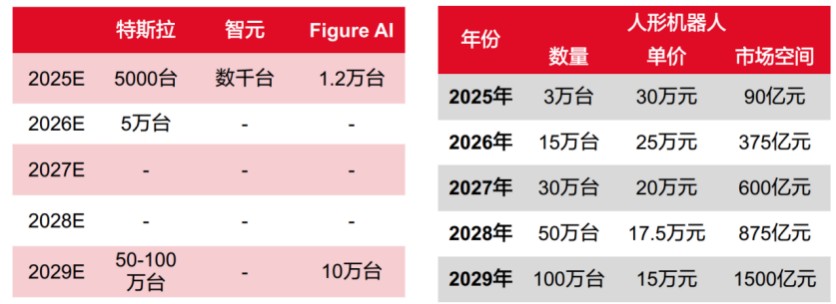
At the beginning of 2026, the global humanoid robot industry is at a delicate and exciting critical point: overseas giants are violently shifting from “sample testing” to “million-unit capacity planning,” while the domestic supply chain has achieved a “small trial” at the scale of thousands, leveraging extreme business capabilities and engineering advantages.
As the absolute barometer of the industry, Tesla's Optimus has completed the leap from prototype to small-batch trial production line.
① Progress status: The main manufacturers now have a preliminary assembly line, and the demand for components has shifted from “single product experiments” to “intermittent small-batch procurement.”
② Strategic blueprint: Musk has clearly planned to start building a super factory with an annual production capacity of 1 million units by the end of 2026 to early 2027. This means that 2026 will be the “life-and-death speed” for the supply chain to finalize the point solution and prepare for capacity ramp-up Unlike the cautious and gradual approach overseas, Chinese humanoid robot companies are accelerating their entry into the market.
① Shipment Status: By 2025, mainstream domestic manufacturers have begun to fulfill billions of yuan in orders, with shipment volumes reaching thousands of units.
② Cluster Effect: Component clusters centered around the Yangtze River Delta and the Pearl River Delta are replicating the rise of smartphones and electric vehicles from years past.
Investment Trilogy: Business → Technology → Cost Reduction
① Short-term (2026): Focus on business capabilities. Who can obtain the first batch of designated orders through sample approval?
② Mid-term (2026-2027): Focus on original technology. Who can develop planetary roller screws or IMUs that meet high-performance requirements?
③ Long-term (2028+): Focus on cost reduction capabilities. As the industry enters a manufacturing attribute, extreme cost-performance ratio will determine the final market share.
Industry Thinking Framework
① Core Components: The "Precision War" of Screws and Motors
Planetary Roller Screw: Known as the "muscle fibers" of humanoid robots. Currently, global production capacity is concentrated in a few companies from Europe, America, and Japan, with significant room for domestic substitution.
Frame-less Torque Motor: Requires extremely high power density. Domestic companies like Mingzhi Electric and Dingzhi Technology are accelerating their catch-up in the high-performance field.
② Sensors: The "Five Senses" of Robots
Six-Dimensional Force Sensor: The core of dexterous hands, with a rapidly increasing domestic production rate.
IMU (Inertial Measurement Unit): The "little brain" that helps robots maintain balance, with its value continuously rising as computational algorithms are integrated.
③ Reducers: The "Conduction Device" of Power
Harmonic Reducer: Although partially replaced by planetary reducers in the Optimus scheme, it remains irreplaceable in delicate areas such as dexterous hands.
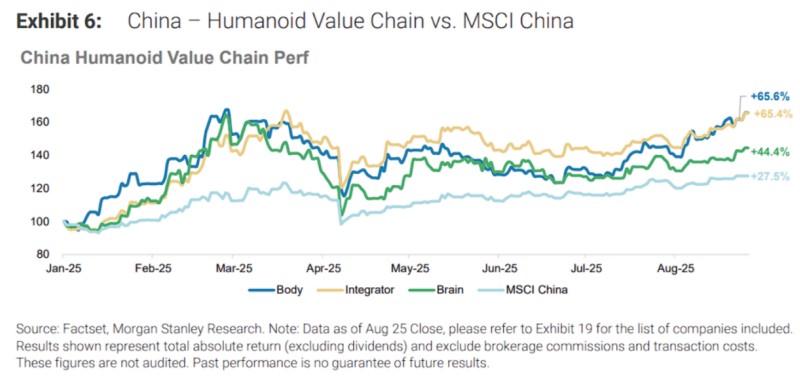
Humanoid robots are not "oversized toys," but rather the "ultimate form of industrial civilization." By 2026, we are expected to witness for the first time in human history the large-scale delegation of complex physical interaction tasks to entities beyond carbon-based life. Morgan Stanley predicts that the global humanoid robot market will reach $211 billion by 2035, $1.2 trillion by 2040, and soar to $5 trillion by 2050.
This means that the robotics industry will replace the automotive industry, becoming the largest industry in the world, and the competitive value behind it is self-evident.
Source: Morgan Stanley
III. What to Focus on Next? Investment, Mass Production, and Costs
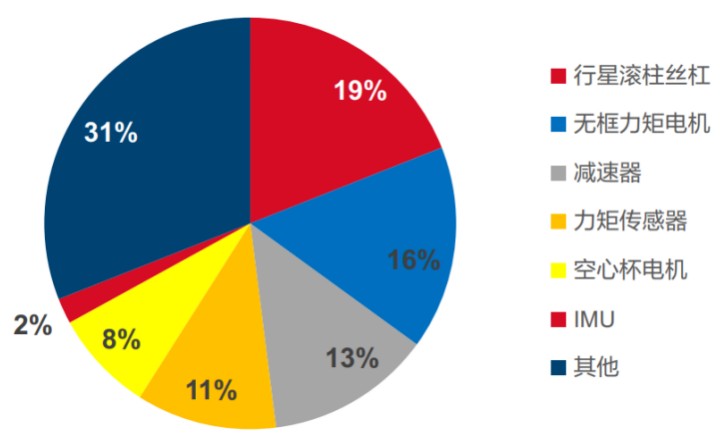
The hardware cost of humanoid robots is extremely high. In its core cost structure:
① Actuators: Account for about 40%-50%, including frame-less torque motors, planetary roller screws, harmonic reducers, etc.
② Sensing System: Account for about 15%-20%, especially high-precision tactile and six-dimensional force sensors, which are key to achieving "dexterous hands." ③ Dexterous Hands: This is the core distinction of humanoid robots from industrial arms, with a very high value for a single hand.
Elon Musk stated that after visiting the Optimus laboratory and seeing Optimus V3, no one would remember that Tesla once manufactured cars; they would only remember Optimus and its plan to produce 1 billion such products. This will become the most transformative technological product in human history.
Source: Wall Street Insight, Donghai Securities
We believe that whether it is the strategic narrative of macro competition or the micro funds brought by the capital market, it indicates that the competition between robots in China and the U.S. will become more intense by 2026. In addition to leading manufacturers, domestic upstream component companies will be a certain beneficiary segment. In terms of value proportion, planetary roller screws, frameless torque motors, reducers, torque sensors, and hollow cup motors are the most clearly beneficial segments. 
Risk Warning and Disclaimer
The market has risks, and investment requires caution. This article does not constitute personal investment advice and does not take into account the specific investment goals, financial situation, or needs of individual users. Users should consider whether any opinions, views, or conclusions in this article are suitable for their specific circumstances. Investment based on this is at one's own risk.