Bridgewater's Dalio warns: Trump's policies may trigger a "capital war"

Wallstreetcn
2026.01.20 14:35
portai
I'm PortAI, I can summarize articles.

Ray Dalio believes that escalating trade tensions and increasing fiscal deficits may undermine external confidence in U.S. debt, prompting investors to turn to hard assets like gold. He suggests that investors allocate 5% to 15% of their typical portfolios to gold as a key hedging tool

Ray Dalio, the founder of global hedge fund giant Bridgewater Associates, warned on Tuesday that U.S. President Trump's policies could lead other governments and investors to reduce their investments in U.S. assets, triggering a "capital war." This billionaire investor.

In a speech on Tuesday, the 20th, at the World Economic Forum in Davos, Switzerland, Dalio stated that escalating trade tensions and increasing fiscal deficits could undermine external confidence in U.S. debt, prompting investors to turn to hard assets like gold. He reiterated the importance of diversified investments, suggesting that investors allocate 5% to 15% of their portfolios to gold as a key hedging tool.

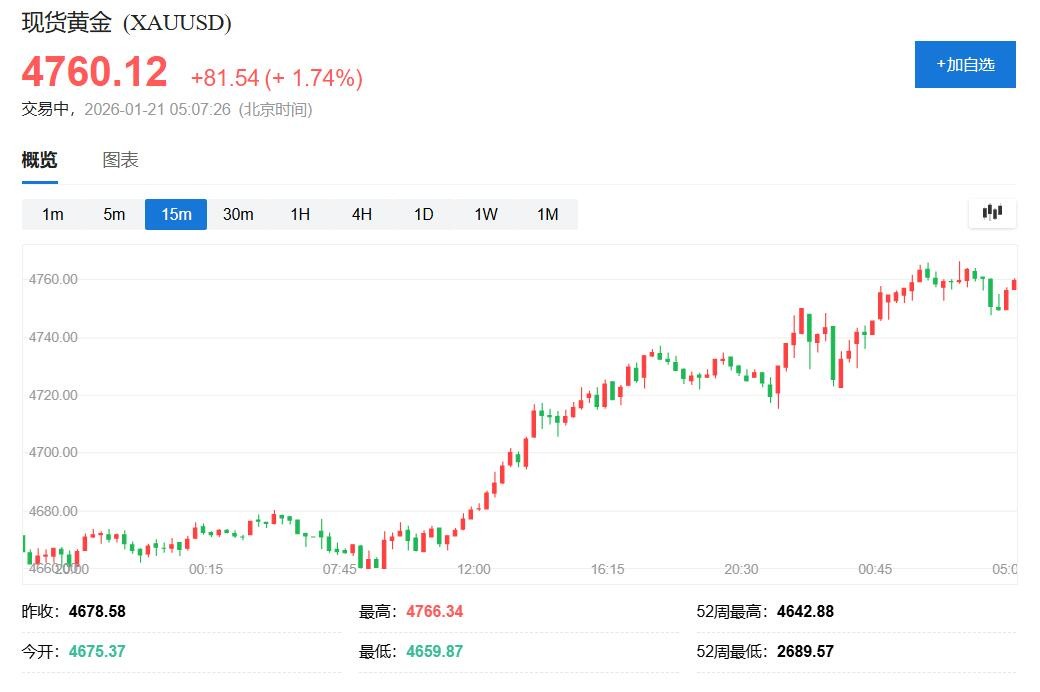
On the day of Dalio's speech, U.S. stock futures saw gold reach a historic intraday high for the second consecutive day. Spot gold rose above $4,750 for the first time in history, gaining about 1.7% during the day, reflecting a rush of investors into safe-haven assets amid the potential for a tariff war between the U.S. and Europe.

According to CCTV News, Trump stated on Saturday, January 17, that starting February 1, he would impose a 10% tariff on all goods exported to the U.S. from Denmark, Norway, Sweden, France, Germany, the UK, the Netherlands, and Finland until an agreement is reached for the "complete and total purchase of Greenland." This approach, which directly links tariffs to territorial transactions, was quickly deemed unacceptable political coercion by European parties.

Wall Street institutions have issued warnings about the potential consequences of this "capital war." Deutsche Bank, in its latest research report, pointed out that Europe, as one of the largest "creditors" of the U.S., holds over $8 trillion in U.S. assets. If Europe decides to "weaponize" capital, the dispute will no longer be limited to tariff skirmishes but will escalate into a capital-level conflict that directly impacts U.S. Treasury securities.

"Capital War" Risks Emerge, Gold is the Key Hedge

Dalio stated to the media on Tuesday:

"The trade deficit and trade war have another side, which is capital and capital wars. If you consider these conflicts, you cannot ignore the possibility of a capital war. In other words, people may no longer be as eager to buy U.S. Treasury bonds and other assets as they once were."

Dalio is concerned that, in the erosion of trust, countries holding large amounts of dollars and U.S. Treasury bonds may become less willing to finance the U.S. deficit. Meanwhile, as the U.S. continues to issue large amounts of debt, a weakening of confidence on both sides could lead to serious problems.

Dalio pointed out: "We know that holders of dollars and the U.S., which needs dollars, are both worried about each other. If other countries hold dollars, they worry about each other, and we are issuing a lot of dollars, that will be a big problem."

Dalio noted that there have been multiple historical cases of economic conflicts escalating from trade to capital flows and currency disputes. "When you face conflicts, international geopolitical conflicts, even allies do not want to hold each other's debt. They are more inclined to turn to hard currencies. This is logical, it is a fact, and it has been seen throughout world history." Ray Dalio reiterates the importance of diversified investments, believing that investors should not overly rely on any single asset class or country. He emphasizes that gold is a key hedging tool during times of financial stress, suggesting it should account for 5% to 15% of a typical investment portfolio.

Dalio stated, "When other assets perform poorly, gold performs well. It is an effective diversification tool."

Europe's Countermeasures

Wall Street institutions are assessing the potential countermeasures Europe may take and their impact on capital markets. According to Goldman Sachs analysis, there are three tiers of response paths the EU may consider.

The mildest option is to suspend the previously negotiated EU-U.S. trade agreement. This agreement requires approval from the European Parliament, and in the current context, several European Parliament members have clearly stated that "the conditions for approval are not met at this time."

The second option is to utilize the prepared list of reciprocal countermeasures from last year to impose tariffs on U.S. goods. EU leaders are discussing the possibility of imposing tariffs on U.S. goods worth €93 billion (USD 108 billion).

The most impactful option is the third one—initiating the Anti-Coercion Instrument (ACI). This tool is specifically designed to respond to "third countries attempting to coerce the EU or its member states through economic means." Unlike traditional tariffs, the ACI allows the EU to take a range of non-tariff countermeasures, including investment restrictions, limitations on access to public procurement markets, taxation of foreign assets and services, and even measures related to digital services and intellectual property.

Deutsche Bank Warns: "USD 8 Trillion at Stake"

Deutsche Bank's latest strategy report points out that the U.S. has up to USD 8 trillion in asset exposure in Europe, including substantial direct investments and financial assets. If the dispute escalates to the capital level, this scale far exceeds the impact of the trade deficit.

Deutsche Bank's analysis suggests that if the EU activates the ACI tool, tightening regulations, conducting tax investigations, or even restricting profit repatriation on these USD 8 trillion in U.S. assets would disproportionately impact American businesses. "While the U.S. may have the upper hand in a trade war, in a capital war, the deeply intertwined financial assets give Europe substantial countermeasures," Deutsche Bank stated.

According to data from the U.S. Treasury, the total amount of U.S. assets held by the EU exceeds USD 10 trillion, with the UK and Norway holding even more such assets. These assets include U.S. Treasury bonds and stocks, some of which are held by public sector funds, the largest being Norway's USD 2.1 trillion sovereign wealth fund.

Implementation Barriers and Market Impact

However, most strategists believe the likelihood of Europe taking extreme measures is low. A research team led by Carsten Brzeski at ING noted that the EU can hardly force European private sector investors to sell dollar assets; it can only attempt to incentivize investment in euro assets.

Juckes from Société Générale stated on Monday that European public sector investors in U.S. assets may stop increasing their holdings or start selling, but the situation would need to escalate significantly for them to harm investment performance for political purposes.

Deutsche Bank also warns the market not to overlook the risk of a "capital war" impacting the pricing of U.S. domestic assets. "If the safety of USD 8 trillion in assets is threatened by geopolitical risks, it could lead to hindered capital repatriation or a surge in risk aversion, causing significant fluctuations in the U.S. Treasury yield curve under the pressure of inflation expectations and growth concerns." Goldman Sachs estimates that if a 10% tariff is ultimately implemented, it will cause the affected countries' real GDP to decline by about 0.1% to 0.2%, with Germany being relatively more impacted. If the tariff rate rises to 25%, the GDP impact could expand to 0.25% to 0.5%. However, regarding inflation, Goldman Sachs believes the impact of tariffs on inflation is "very small," mainly because the weakening demand itself has a price-suppressing effect.

This Monday, market tensions have already emerged, with U.S. stock futures, European stock markets, and the U.S. dollar under pressure, while gold, safe-haven currencies like the Swiss franc and the euro have become the main beneficiaries, indicating that the "sell America" trade may be making a comeback