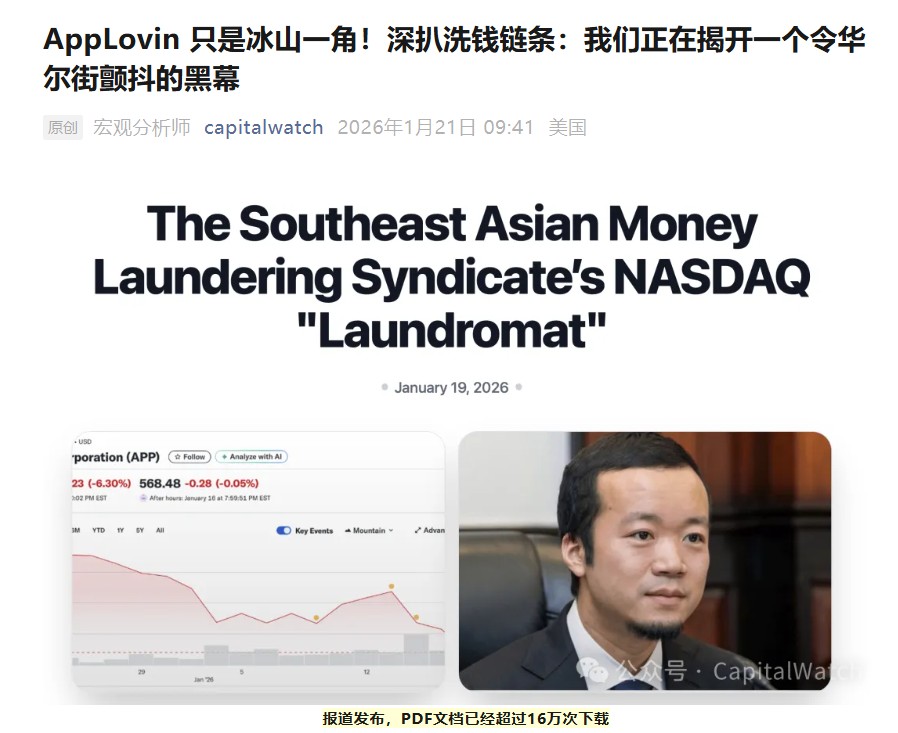
Capitalwatch strikes again: AppLovin is just the tip of the iceberg in the money laundering industry chain, with a dozen other companies involved, and "nuclear-level" materials have been submitted to regulators

Shorting AppLovin is just the "appetizer." Capitalwatch has revealed explosive news, stating that illegal funds originating from China's "TuanDaiWang" have been injected into dozens of U.S. listed companies, and they have obtained "nuclear-level" evidence that has been handed over to U.S. regulatory agencies. The agency hinted that "the best is yet to come," suggesting that more listed companies will face short-selling attacks
Wall Street Watch mentioned yesterday that the short-selling organization Capitalwatch released a bombshell report accusing AppLovin's core shareholder Hao Tang of colluding with the leader of a multinational crime organization to convert illegal funds into advertising fees flowing into AppLovin through the Cambodian super app WOWNOW, completing a money laundering loop.
Just one day later, Capitalwatch dropped another bombshell, stating that the accusations against AppLovin are merely the tip of the iceberg of a vast money laundering network. The focus of the organization's investigation is not solely on AppLovin but on tracking the flow of illegal funds from the Chinese P2P platform "TuanDai Wang." They found that these funds were injected into more than a dozen U.S. listed companies, including AppLovin, through a complex underground network.
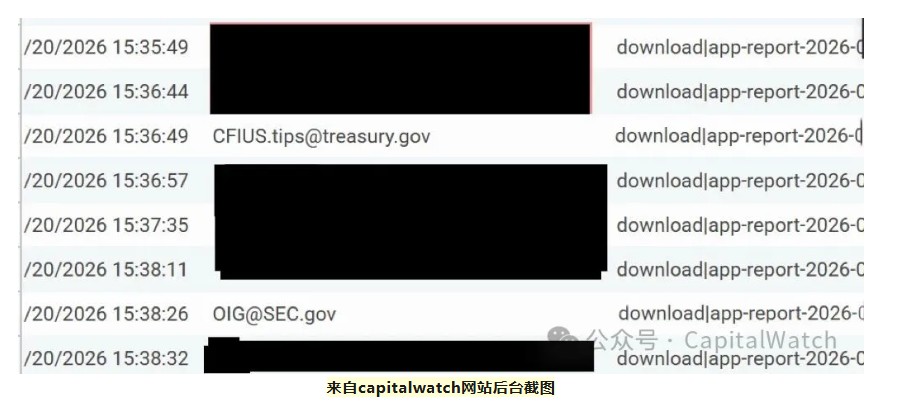
Capitalwatch claims to hold key evidence that has been submitted to regulators and has stated, "The best is yet to come." The U.S. Securities and Exchange Commission (SEC) and the Committee on Foreign Investment in the United States (CFIUS) downloaded the original report released yesterday.

Tracking the Flow of Funds from "TuanDai Wang," Involving Dozens of U.S. Listed Companies
In a recently published article titled "AppLovin is Just the Tip of the Iceberg! Digging Deep into the Money Laundering Chain: We Are Uncovering a Dark Secret That Will Shake Wall Street," Capitalwatch's macro analyst elaborated on the background of this short-selling action. The article pointed out that the organization's initial target was not AppLovin but rather "tracking the flow of funds."
According to Capitalwatch, their team discovered astonishing funding routes while tracing the illegal transfer of billions of dollars from the now-defunct Chinese P2P platform "TuanDai Wang." The article states: "These illegal funds were transferred out of the country through underground banks in China; they were split into countless small amounts and underwent complex structured processing; ultimately, this 'dirty money' was injected into more than a dozen U.S. listed companies."

The analyst candidly stated in the article: "AppLovin is just one piece of this huge money laundering puzzle. There are more than a dozen companies intricately linked to this, and our team is working day and night to trace these leads." This statement suggests that Capitalwatch's short-selling action may just be the beginning of a series of actions, and more U.S. companies may face similar compliance scrutiny in the future.
"Nuclear-level" Evidence Has Been Submitted to U.S. Regulators
In response to market questions about "why not disclose more original evidence," Capitalwatch stated that it holds highly sensitive "nuclear-level" original materials, but has chosen not to disclose these documents for legal prudence and to protect the safety of informants.
However, the agency made it clear that this batch of "nuclear-level" materials has entered the regulatory view. The article stated: "We have formally submitted the complete evidence chain, which has been organized and cataloged, to U.S. regulatory authorities." To substantiate this claim, Capitalwatch included a screenshot in the article showing access records from IP addresses of U.S. government agencies.

Analysts emphasized in the article: "Backend data shows that the U.S. SEC and CFIUS downloaded our original report yesterday." Capitalwatch believes that although the regulatory process is slow, "once it rolls over, it will crush all lies."
Response to Stock Price Increase: Short-term Fluctuations Cannot Mask Evidence Authenticity
In response to the phenomenon of AppLovin's stock price rising instead of falling after the short-selling report was released, Capitalwatch appeared quite calm. Analysts wrote in the article: "This was all within our expectations."
Capitalwatch believes that AppLovin, as a company with algorithm-driven and exponential growth, possesses a strong moat and capital counterattack capability. "In the face of accusations, the first reaction of giants is always to use all resources to maintain stock prices," the article stated, "short-term fluctuations in stock prices cannot mask the authenticity of the evidence."
The agency reiterated that its position does not imply that AppLovin's management is necessarily colluding, but pointed out that "the capital market should not become a safe haven for dirty money." Capitalwatch stated that even if the management is unaware, if the source of funds is confirmed to involve money laundering, the company will still face significant legal and delisting risks.
Core Event: The Logic of the "Advertising is Money Laundering" Accusation
The trigger for this incident originated from Capitalwatch's deep short-selling report released yesterday.
Wallstreetcn reported that the report accused AppLovin's core shareholder Hao Tang (allegedly linked to China's Tuandai Network) and Chen Zhi, the actual controller of Cambodia's Prince Group (allegedly the leader of a transnational crime organization), of constructing a money laundering network.
The report detailed the so-called "Ad-Tech Laundromat" model: illegal funds are converted into advertising fees through the Cambodian app WOWNOW, flowing into the AppLovin platform, and ultimately becoming legitimate U.S. dollar assets through revenue sharing and stock price appreciation. Additionally, the report accused AppLovin's technology algorithms Array and AXON of objectively assisting in the distribution of gambling and fraud software Capitalwatch stated at the end of its latest response: "This battle has just begun. The best is yet to come."