


Japanese voters and the bond market, Sanae Takaichi can only choose one!
Kawasaki Saimi is facing a difficult choice between "pleasing voters" and "soothing the market." To win the election, she promised to suspend the food consumption tax, but this broke the market's expectations for her fiscal discipline, directly triggering a wave of government bond sell-offs (with the 40-year yield historically breaking 4%). This dilemma not only threatens the stability of Japan's debt but may also force Japanese capital to flow back from the global market, causing a chain reaction
Japanese Prime Minister Sanae Takaichi is facing the most challenging dilemma of her political career: should she please voters to win the early election on February 8, or tighten fiscal policy to calm the increasingly turbulent bond market? As Takaichi attempts to fulfill her commitment to "responsible fiscal expansion" through tax cuts and stimulus spending, the Japanese government bond market is sending strong warning signals. This game not only concerns Japan's economic outlook but may also trigger a chain reaction in global financial markets.
According to the Financial Times, in a bid to gain voter support in the election, Takaichi promised this week to suspend the food consumption tax for two years, a measure expected to cost about 5 trillion yen (approximately $32 billion). This move, which breaks expectations of fiscal discipline, quickly triggered market panic, failing to fully establish voter confidence and instead angering bond investors, leading to the Japanese 40-year government bond yield, seen as a market barometer, breaking the key psychological barrier of 4% for the first time.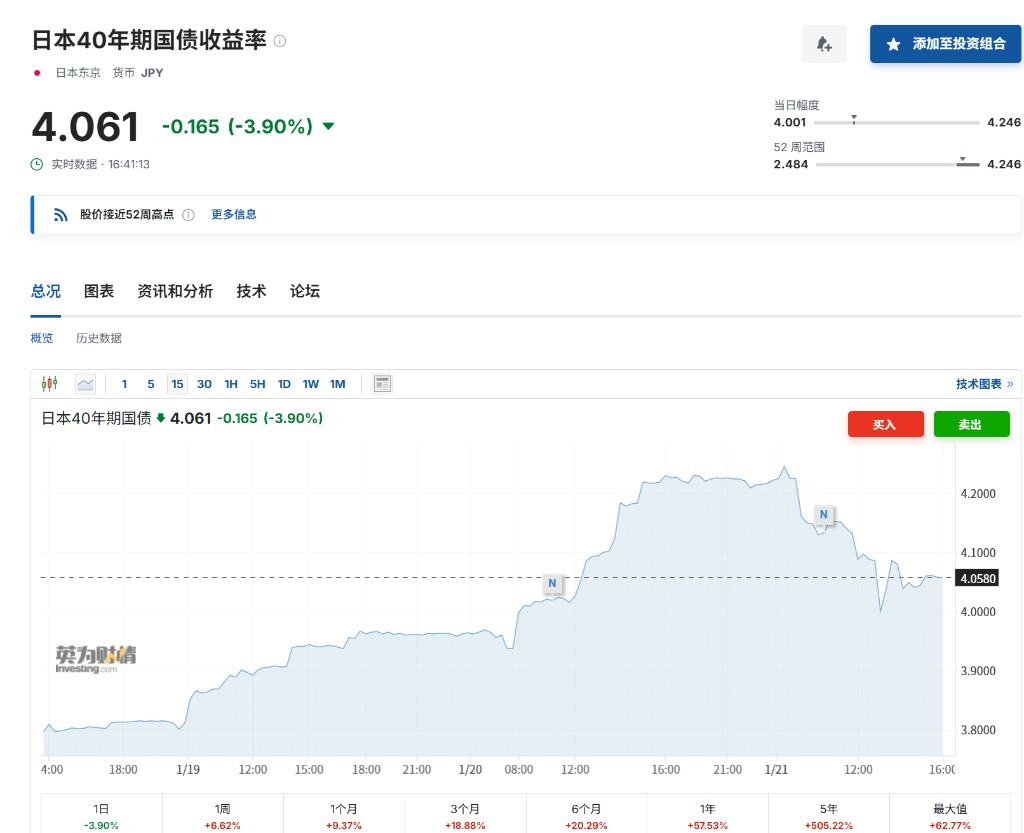
The market's violent reaction highlights investors' extreme concerns about Japan's fiscal sustainability. Fund managers warn that if Takaichi achieves an overwhelming victory in the election, market trust in her fiscal discipline may further collapse, potentially triggering a sell-off in Japan's third-largest debt market globally. More seriously, as domestic yields in Japan soar, Japanese institutional investors may accelerate the repatriation of funds from overseas, impacting the global long-term bond market.
Although Japanese Finance Minister Shunichi Suzuki argued at the Davos Forum that Japan's basic fiscal balance in 2025 would perform the best among G7 countries and attempted to soothe the market through "prudent spending," traders pointed out that once the election call is made, the concept of "responsible fiscal expansion" has already gone bankrupt in the eyes of the market. While the Bank of Japan's policy interest rate remains below inflation, the loss of control over long-term yields indicates that the market is re-pricing Japan's sovereign risk.
The Epicenter of the Global Bond Market and Capital Repatriation Risks
As Takaichi's aggressive fiscal plans advance, Japanese government bond yields are undergoing a historic revaluation. In addition to the 40-year bond yield breaking 4%, the benchmark 10-year Japanese government bond (JGB) yield recently surpassed 2%, reaching a new high not seen in over a quarter of a century. The 20-year and 30-year bond yields have also set new records, with the 30-year Japanese bond yield exceeding that of German bonds of the same maturity and approaching the levels of Spanish bonds.
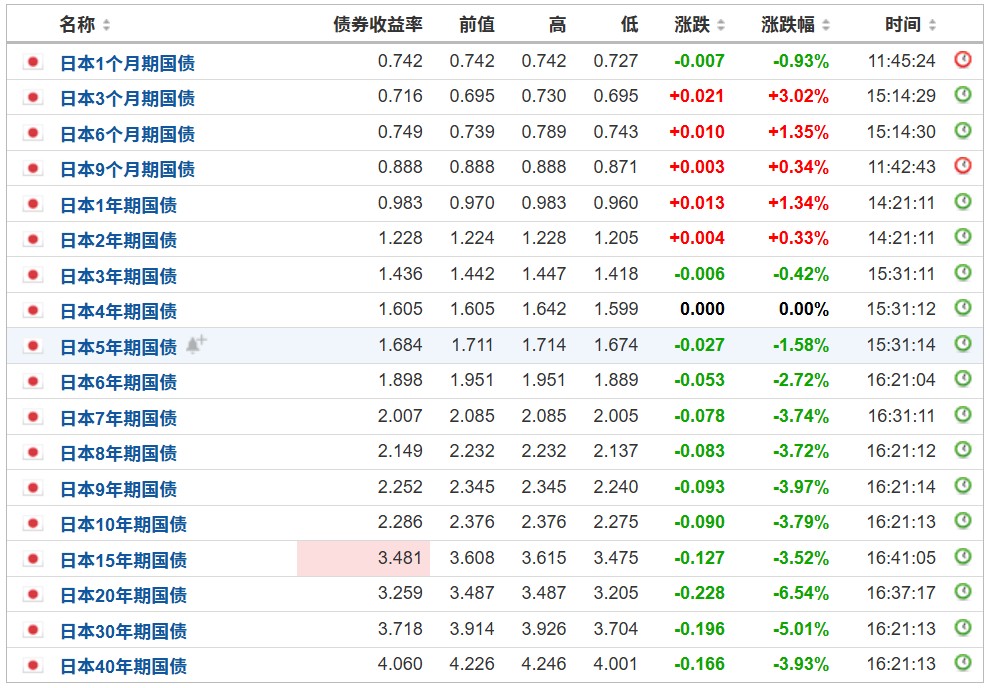
This surge in yields has raised alarms among global investors. Mike Riddell, a fund manager at Fidelity International, pointed out that the enormous yield attractiveness is prompting large Japanese investors to sell overseas assets and repatriate funds back home. This trend of capital repatriation is harming the performance of long-term bonds in other regions globally. **
For a long time, investors have questioned the debt sustainability of France, the UK, and the US, and now this scrutiny has turned to Japan. Although Rain Yin, a sovereign analyst at S&P Global Ratings, stated that as long as growth remains healthy, the rating agency is relatively calm about Japan's debt levels and has taken fiscal weakness into account, the market does not buy it. Not only has the nominal yield risen, but investors are beginning to reassess the sustainability of Japan's debt burden, which is as high as 250% of GDP, under aggressive fiscal policies.
The "High Market Trade" Faces Reversal and Yen Dilemma
The shift in market sentiment also signals that the so-called "high market trade" may be coming to an end. Previously, investors bet that the high market government's spending plans would lead to a weak yen, rising stock markets, and higher long-term bond yields. However, Takahide Kiuchi, an executive economist at Nomura Research Institute, warned that the continued rise in long-term yields is beginning to have a negative impact on the economy and financial markets, which could lead to a reversal of the previous trading logic.
The extreme weakness of the yen has reached the warning line for government intervention, but this has put policymakers in a dilemma: intervening in the foreign exchange market or raising interest rates to support the yen will further push up yields, thereby offsetting the growth effects brought about by fiscal stimulus. Citigroup's foreign exchange strategist, Takashima Osamu, pointed out that Kishi Sanae's stance on the weak yen is changing from previous tacit approval to a defensive posture, suggesting that she may have to support the Bank of Japan in ending decades of ultra-loose policies and moving towards interest rate normalization.
Robert Dishner, a senior portfolio manager at Neuberger Berman, believes that defending the currency through interest rate hikes is a difficult task, as this will directly increase financing costs and may stifle the economic growth that fiscal expansion attempts to achieve.
Fiscal Discipline Game Under Election Pressure
Kishi Sanae's policy shift is largely seen as an electoral strategy. Barclays economist Naohiko Baba analyzed that the tax commitments announced by Kishi Sanae on Monday mark a significant policy reversal; she had previously been firmly opposed to cutting the consumption tax, but was forced to change course in the face of similar commitments from the opposition.
Although Nicholas Smith, a strategist at CLSA, believes that Kishi Sanae is a "policy geek" who fully understands the severity of the issues, the market is more concerned about how campaign promises will translate into actual policies after the election. The fiscal pressure facing Japan comes not only from domestic welfare spending but also from the increasing defense budget, as well as the need to underwrite $550 billion in investments in the US over the next three years under a tariff agreement with the US.
As Takahide Kiuchi stated, cutting the consumption tax as an electoral strategy is straightforward for voters, but if this requires financing through cuts in other expenditures or increases in other taxes, it merely shifts the burden onto the general public, "there's no such thing as a free lunch." **The current market turmoil indicates that investors are voting with their feet; they are not only questioning whether Kishi Sanae can fulfill her promises but also the future of Japan's finances **
