


The most optimistic time in a long while! Intel's stock price soars on the eve of earnings report

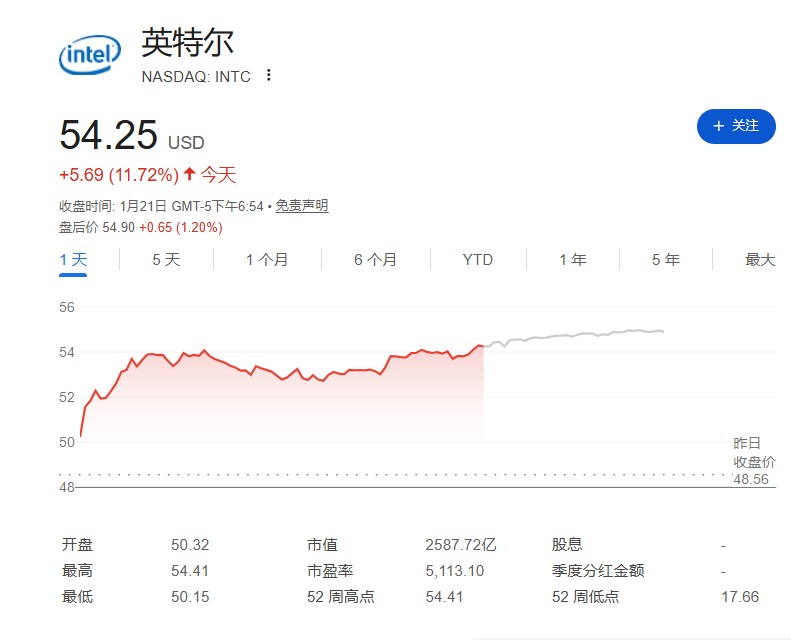
Thanks to the explosive demand for data centers and strategic investments from the U.S. government and giants like NVIDIA, Intel's stock price soared 11%, reaching a four-year high, with a market value exceeding $250 billion. Not only are server CPUs facing sellouts and price increases, but the company's foundry ambitions and progress on the 18A process are also the focus of market attention. Even though there are still concerns in the PC market, Wall Street has placed heavy bets on its recovery logic
After experiencing several years of strategic missteps and market share loss, chip giant Intel is regaining Wall Street's favor thanks to strong expectations for data center demand and substantial external investments.
Ahead of the highly anticipated quarterly earnings report, Intel's stock surged over 11% on Wednesday, breaking through its highest point since January 2022. This strong performance pushed the company's market value above $250 billion for the first time since 2022. Following an 84% increase last year, the stock has risen about 35% since the beginning of 2026, with a cumulative increase of 149% over the past 12 months.
The sharp reversal in market sentiment is mainly driven by optimistic expectations for Intel's data center business and recognition of the aggressive reform measures by its new CEO, Pat Gelsinger. Ryuta Makino, an analyst at Gabelli Funds, stated in an interview with Reuters:
“I think this is the most optimistic people have felt about the company in a long time; the recent dynamics are very favorable.”
Wall Street generally believes that the earnings report set to be released after the market closes on Thursday will be a key test of Intel's recovery.
In addition to performance expectations, Intel is benefiting from a broad rebound in the semiconductor sector and strong endorsements from external strategic investors. Key stakeholders, including the U.S. government and NVIDIA, strengthened the company's balance sheet through investments last year. On Wednesday, the chip sector saw a broad rally, with competitor AMD rising about 8% and Micron Technology up 7%. Additionally, overall market sentiment was boosted by U.S. President Trump's statement that he would not use military force to acquire Greenland.
Surge in Data Center Demand and Return of Pricing Power
The core driver of renewed investor interest in Intel is the strong recovery in its server chip sales. Analysts point out that although NVIDIA's GPUs dominate AI workloads, large tech companies still need to purchase a significant amount of Intel's traditional server CPUs while rapidly building data centers.
According to estimates from FactSet and LSEG, Intel's revenue from data center and AI businesses is expected to surge nearly 29% to about $4.4 billion. KeyBanc analysts upgraded Intel's stock rating to equivalent to "buy" earlier this month and set a target price of $60. They noted that Intel's server CPUs may have sold out this year, indicating that prices are likely to rise.
“We expect that excess data center demand from hyperscale cloud providers will be a significant tailwind this year,” KeyBanc analysts wrote in their report. Ryuta Makino expressed a similar view, believing that server CPU prices will see at least double-digit increases in 2026, which forms an important support for Intel's bullish logic.
Giant Investments and Ambitions in Foundry Business
Intel's "turnaround" relies not only on product sales but also benefits from the restructuring of its capital structure and the vision for its foundry business. Under the leadership of CEO Pat Gelsinger, the company has significantly improved its financial situation by introducing external capital.
According to CNBC, after investing $8.9 billion last year, the U.S. government has become Intel's largest shareholder. This move is partly due to Intel being the only domestic company in the U.S. capable of manufacturing advanced chips. Additionally, AI chip leader NVIDIA invested $5 billion last year, becoming one of its top shareholders; SoftBank also invested $2 billion. NVIDIA and Intel have reached an agreement to work on integrating Intel's CPUs into NVIDIA systems.
In the foundry sector, Intel is trying to establish itself as the world's second-largest chip foundry, after TSMC. The company has recently been heavily promoting its 18A manufacturing process, which is seen as comparable to TSMC's 2-nanometer process. Although this business is still seeking major customers, NVIDIA and Broadcom have conducted manufacturing tests, sparking market speculation about future orders.
Concerns in the PC Market and Margin Pressure
Despite the optimistic market sentiment, Intel's fundamentals are not without flaws. Analysts expect the company's total revenue in the fourth quarter to decline by 6% year-on-year to $13.4 billion.
In the personal computer (PC) sector, Intel faces a mixed situation. Although it has launched the "Panther Lake" chip using the 18A process, revenue in this segment is expected to grow only 2.5% to $8.21 billion. Analysts warn that rising memory prices driven by global shortages may increase laptop costs, thereby suppressing demand. Furthermore, Intel continues to lose market share in the PC market to AMD and Arm-based designs.
Margin pressure is also a concern. Due to the high costs of repairing its manufacturing business, the adjusted gross margin for the fourth quarter is expected to decline by about 6 percentage points to 36.5%. Reuters reports that while the yield of the 18A process is improving month by month, currently only a small portion of chips meet customer standards, and there remains uncertainty regarding the scale of commercial production
