China's supply chain determines the winner of the global Robotaxi competition!

Morgan Stanley believes that the Chinese supply chain, with a cost reduction of 30% and a 40% acceleration in IPOs, will become a key enabler of global L4+ autonomous driving, especially in areas such as hardware and lidar. The bank predicts that driven by policy support and technological competition, the compound annual growth rate of Robotaxi sales in China is expected to exceed 70% over the next five years
Morgan Stanley's latest research shows that, driven by the global technology race, regulatory support for autonomous driving in China will strengthen, and the number of Robotaxis operating on the roads is expected to double. Chinese supply chain companies will become early beneficiaries due to their cost and efficiency advantages.
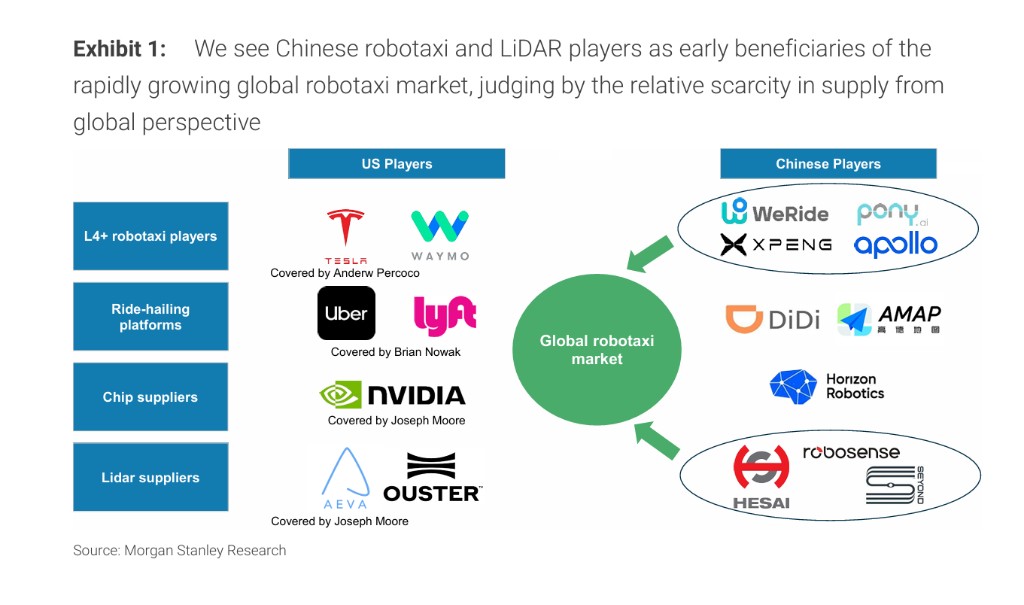
According to news from the Chasing Wind Trading Desk, analyst Tim Hsiao from the bank predicted on the 21st that China's Robotaxi sales will have a compound annual growth rate of over 70% in the next five years, with upside risks greater than downside risks. The Robotaxi ecosystems in China and the United States have established a leading position in the global L4+ autonomous driving field through a more complete industrial chain.
From a global market perspective, 10 to 15 million active vehicles on taxi and ride-hailing platforms provide over 70 million trips daily. Excluding the 40% market share long dominated by domestic companies in the U.S. and China, the remaining 60% of the global market—especially the high-cost developing markets—will become strategic strongholds. Over 120,000 taxis and ride-hailing vehicles in the Middle East present significant opportunities, while markets in Europe and ASEAN, such as Singapore, may gain the most significant benefits from the proliferation of L4+ technology.
Morgan Stanley believes that, from the perspective of global supply scarcity, Chinese hardware manufacturers—especially Robotaxi and lidar companies—will be early beneficiaries.

Timing Window Determines Market Landscape
Morgan Stanley emphasizes that seizing the market opportunity is crucial. Major Robotaxi companies not only hope to establish a foothold in their domestic markets but also aspire to enter the global market.
The bank pointed out that companies that can be the first to remove drivers from the top 1% of the 15 million vehicles on global taxi and ride-hailing platforms could see their market value multiply, while second entrants are likely to fall into homogeneous competition. This "winner-takes-all" market characteristic is driving major global Robotaxi companies to accelerate their layouts.
Aside from China and the U.S., where domestic companies will long dominate, the remaining 60% of the global market share has become the focus of competition. The generally high driver costs in developing markets provide a stronger economic incentive for autonomous driving technology.
China's Supply Chain Advantages Highlighted
Beyond technological advancements, pursuing cost-effectiveness and scalable operations is becoming a more daunting challenge. Morgan Stanley's research shows that while improving vehicle utilization and reducing operational costs require establishing strategic alliances with local partners, continuously lowering bill of materials (BoM) costs and rapid expansion will still heavily rely on Chinese solutions.
According to the bank's estimates, the Chinese supply chain can save about 40% in time to market and 30% in costs. By 2026, the cost advantage of Chinese solutions could reach $30,000 to $35,000. This cost and efficiency advantage will lead global Robotaxi companies to increasingly collaborate with the Chinese supply chain to seize market potential and unit economic benefits, viewing it as a key driver for achieving L4+ autonomous driving Morgan Stanley believes that the continuous decline in material costs and the ability to rapidly scale up are the core competitive advantages of Chinese supply chain companies.
Based on the judgment of relatively scarce global supply, Morgan Stanley believes that Chinese hardware manufacturers will be the first to benefit, particularly Robotaxi and lidar companies.
The firm believes that Hesai Technology and WeRide are expected to stand out in the competition. Starting rapidly from China, they are becoming the development path for Chinese autonomous driving companies