AI demand is realized but supply will reach a "lowest point," Intel's Q1 guidance is disappointing, and it plummeted over 10% in after-hours trading | Earnings Report Insights

In Q4, Intel's revenue decreased by 4% year-on-year but still exceeded analyst expectations, with EPS increasing by 15%, significantly surpassing expectations. Revenue from data center and AI businesses exceeded expectations, growing by 9%. During the quarter, the company completed a $5 billion stock sale to NVIDIA. The 18A process node became the first leading process node to achieve mass production in the U.S. The CEO stated that demand is "quite strong," and the company exhausted most of its inventory in Q4, while manufacturing yields did not meet standards. Building the foundry business will take time, and foundry customers will make decisions in the second half of the year; the company's restructuring will take years. The CFO mentioned that the weak Q1 guidance is partly due to "supply needed to meet seasonal demand not being fulfilled," with supply issues peaking in Q1 and improving in Q2 and beyond. Customers for the 14A technology will emerge in the second half of the year
Intel's total revenue and adjusted EPS earnings in the fourth quarter of last year exceeded expectations, with artificial intelligence (AI) related business achieving mid-single-digit growth, validating the judgment that AI Agents are driving a recovery in server CPU demand. However, the company provided a weak first-quarter guidance due to supply bottlenecks, leading to a sharp decline in stock price after hours.
The financial report shows that Intel's revenue in the fourth quarter turned from growth to decline year-on-year, but the drop was not as severe as Wall Street's expectations, thanks to a 9% year-on-year increase in revenue from the Data Center and AI (DCAI) business, which offset the impact of the accelerated decline in the personal computer (PC) business. Intel's guidance for both revenue and profit in the first quarter fell short of market expectations.
The financial report reveals Intel's current core contradiction—demand is rising, while supply has become a constraining variable. Intel's management stated that supply availability will drop to a low point in the first quarter and will only gradually improve in the second quarter. This judgment aligns with Morgan Stanley's forward-looking view that "capacity bottlenecks are a double-edged sword."
Commentators believe that Intel is striving to restore its technological advantage, but issues with manufacturing yield have become the latest setback, presenting execution challenges for the company.
Intel CEO Eric Wu stated in an interview that demand is "quite strong," but the company is struggling to address manufacturing yield issues, saying, "Our yield and production have not met my standards; we need to improve." He revealed that the company exhausted most of its inventory in the fourth quarter and indicated during the earnings call that building the foundry business will take time, with foundry customers making decisions in the second half of the year, and the company's rebuilding will take years.
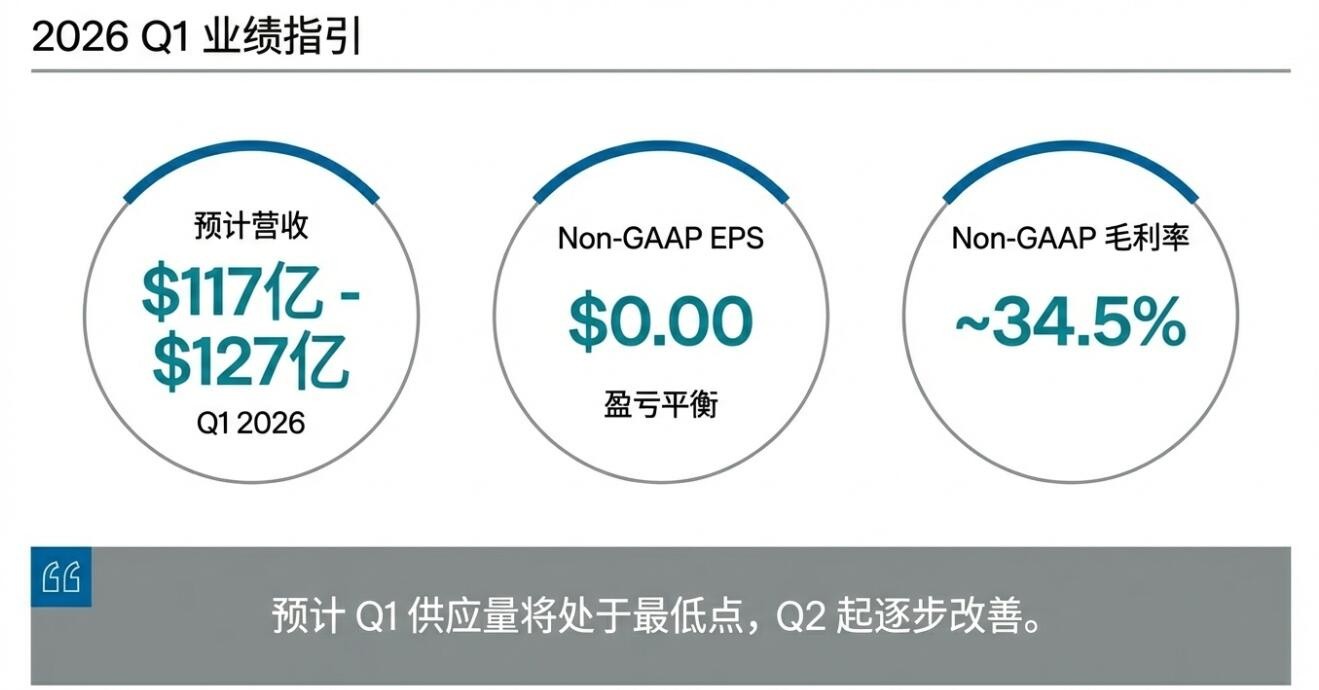
Intel's Chief Financial Officer David Zinsner pointed out that supply in the first quarter will drop to "the lowest point," and "there will be improvements in the second quarter and beyond." Zinsner told the media that part of the weak first-quarter guidance is due to "supply needed to meet seasonal demand not being fulfilled," and noted that supply issues will peak in the first quarter.
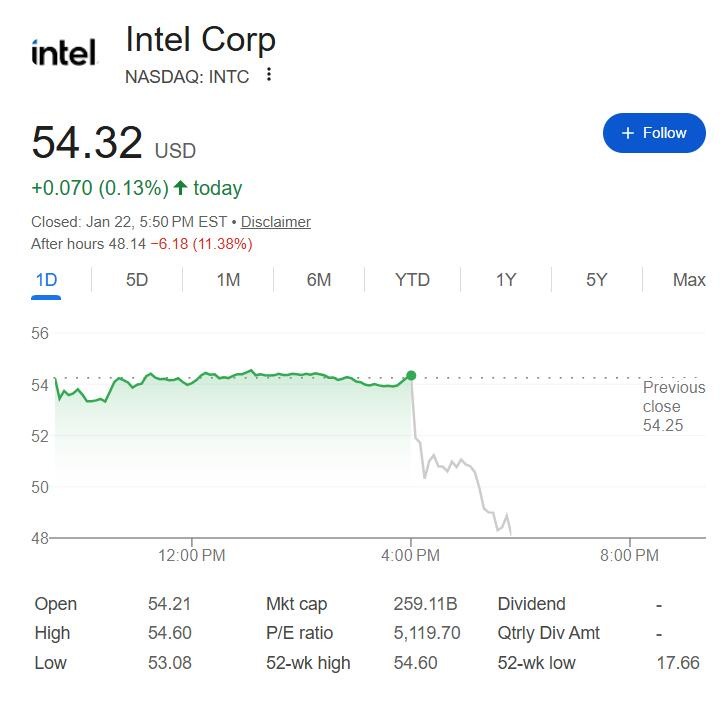
After the company's performance and guidance were announced, Intel's stock price, which had risen 0.1% on Thursday, plummeted after hours, dropping over 4% shortly after the earnings report was released, and continued to decline, with after-hours losses expanding to over 10%.

As of Thursday's close, Intel's stock price has reached a new high not seen since January 2022 for two consecutive days, having accumulated an increase of about 47% since the beginning of 2026 and nearly 150% over the past 12 months. This strong performance is mainly attributed to optimistic expectations for the data center business and market recognition of the aggressive reform measures implemented by Eric Wu since he took office in March last year. High-profile investments from the U.S. government, NVIDIA, and SoftBank have also driven the stock price.
Last year, Intel and NVIDIA reached an agreement to jointly develop multi-generational custom data center and PC products aimed at the hyperscale data center, enterprise, and consumer markets. NVIDIA also agreed to invest $5 billion in Intel's common stock. The latest Intel financial report disclosed that the transaction to sell $5 billion of common stock to NVIDIA was completed in the fourth quarter On January 22nd, Eastern Time, after the U.S. stock market closed, Intel announced its financial data for the fourth quarter of 2025 and performance guidance for the first quarter of 2026.
1) Key Financial Data:
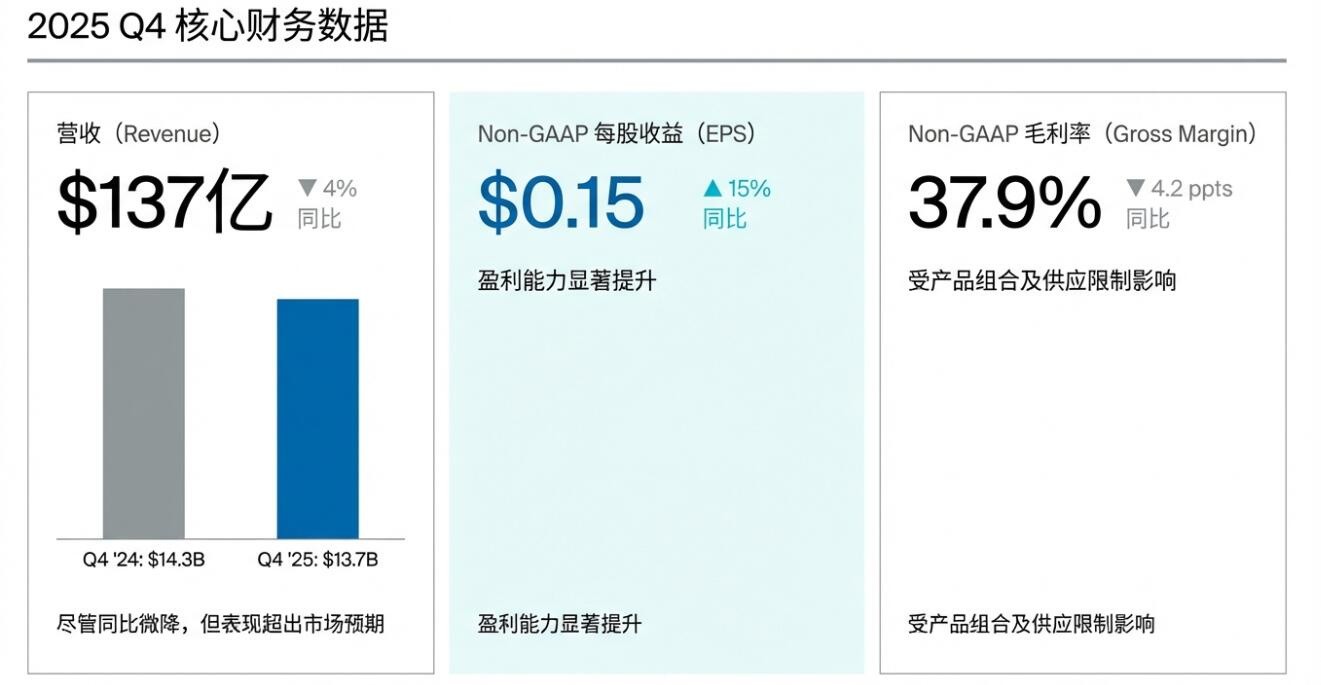
Revenue: Fourth quarter revenue was $13.67 billion, a year-on-year decrease of 4.1%, analysts expected $13.43 billion, and Intel's guidance was between $12.8 billion and $13.8 billion, with a year-on-year increase of 3% in the third quarter.
EPS: The adjusted earnings per share (EPS) for the fourth quarter on a non-GAAP basis was $0.15, a year-on-year increase of 15.4%, analysts expected $0.087, and Intel's guidance was $0.08, with an EPS of $0.23 in the third quarter.
Gross Margin: The adjusted gross margin for the fourth quarter was 37.9%, analysts expected 36.5%, Intel's guidance was 36.5%, compared to 40.0% in the third quarter and 42.1% in the same period last year.
Operating Margin: The adjusted operating margin for the fourth quarter was 8.8%, analysts expected 6.29%, compared to 11.2% in the third quarter and 9.6% in the same period last year.
2) Segment Business Data:
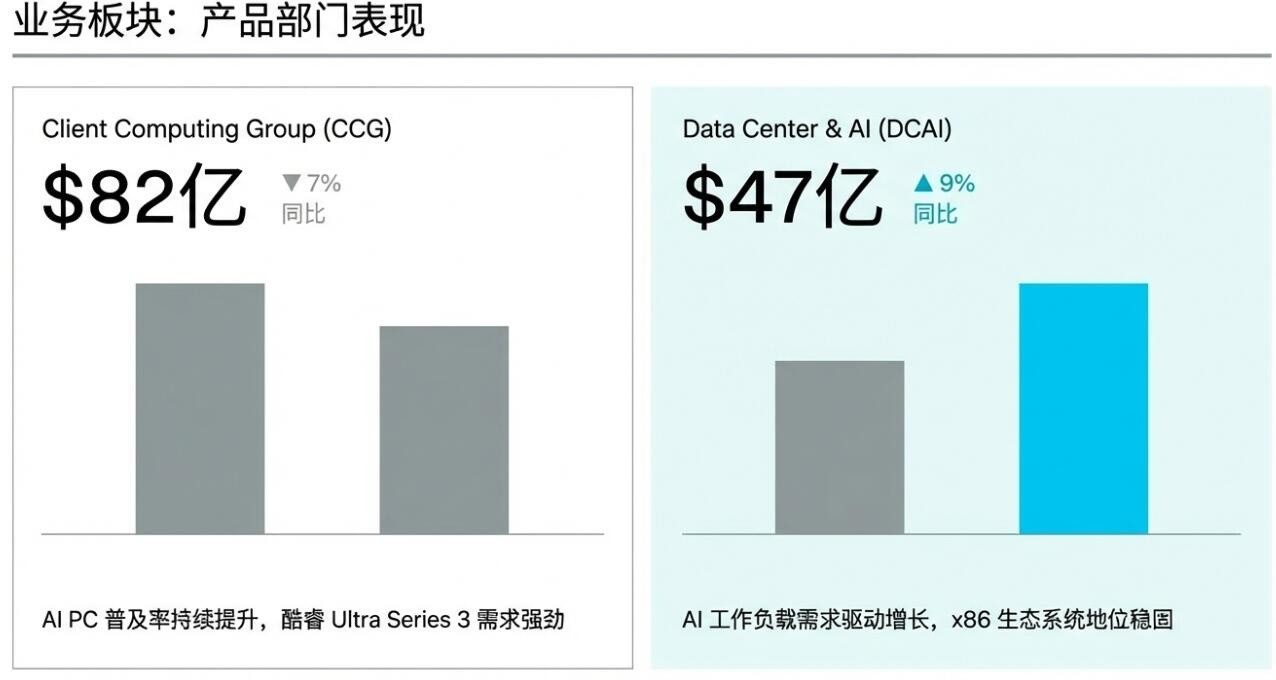
CCG: Client Computing Group (CCG) fourth quarter revenue was $8.19 billion, a year-on-year decrease of 6.6%, analysts expected $8.3 billion, with a year-on-year increase of 5% in the third quarter.
DCAI: Data Center and Artificial Intelligence (DCAI) fourth quarter revenue was $4.74 billion, a year-on-year increase of 8.9%, analysts expected $4.42 billion, with a year-on-year decrease of 1% in the third quarter.
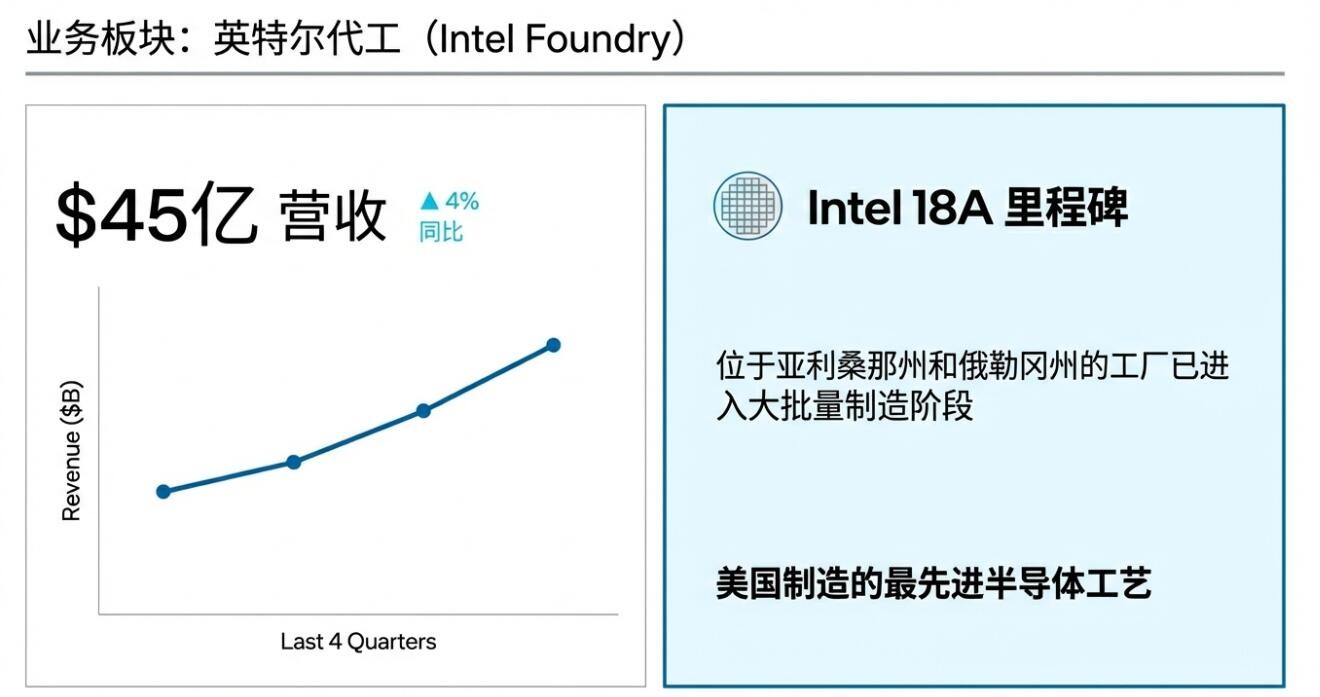
Foundry: Foundry business (Intel Foundry) fourth quarter revenue was $4.51 billion, a year-on-year increase of 3.8%, analysts expected $4.36 billion, with a year-on-year decrease of 2% in the third quarter.

3) Performance Guidance:
Revenue: Expected first quarter revenue is between $11.7 billion and $12.7 billion, analysts expected $12.56 billion.
EPS: Expected first quarter adjusted EPS is zero, analysts expected $0.08.
Gross Margin: Expected first quarter adjusted gross margin is 34.5%, analysts expected 36.5%.
Fourth Quarter Performance Stronger than Expected but Still Reporting Losses
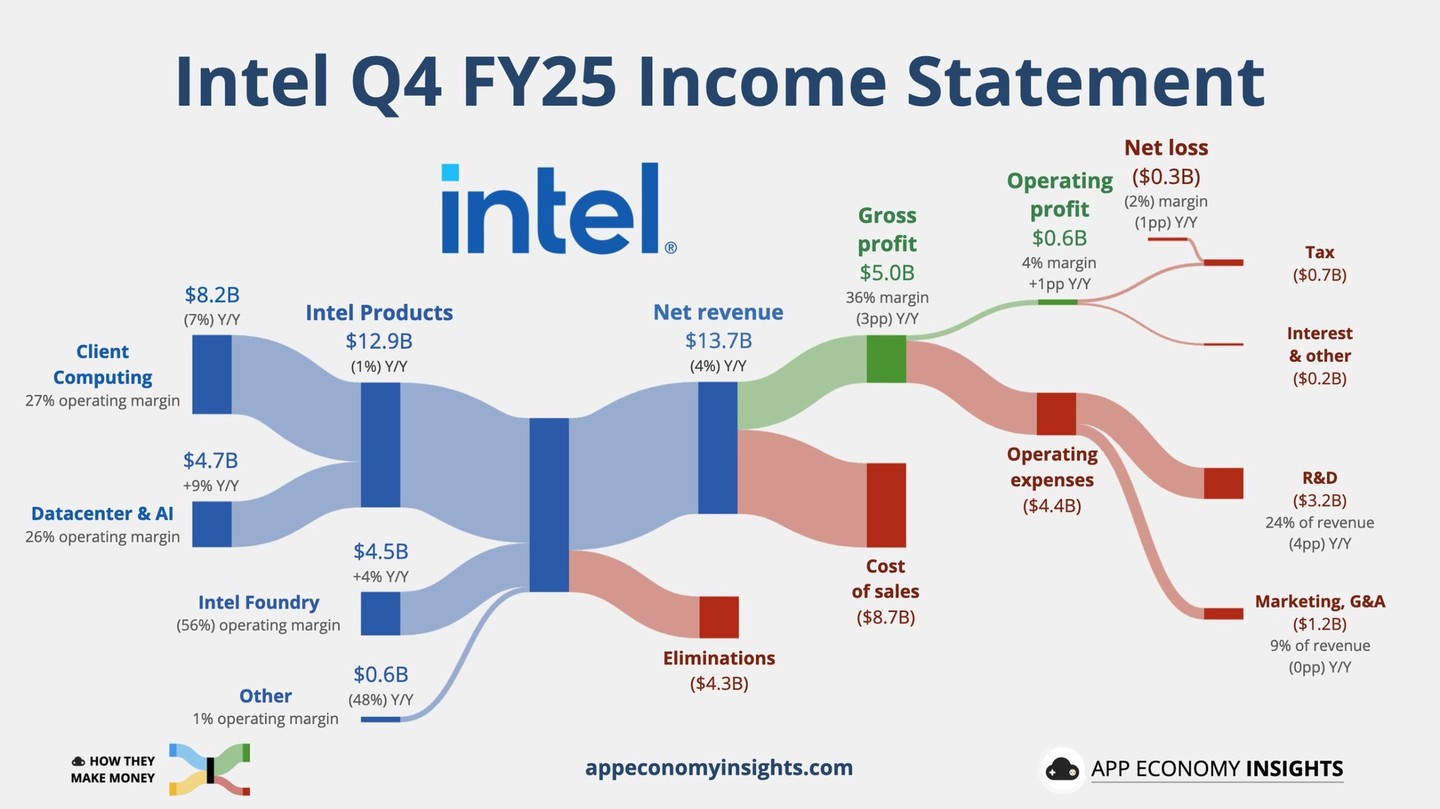
Intel's fourth quarter revenue decreased by 4.1% to $13.7 billion, slightly above analysts' average expectation of nearly $13.4 billion. The adjusted EPS was $0.15, nearly 82.3% higher than analysts' expectation of about $0.09. However, the company reported a net loss of $600 million, equivalent to a loss of $0.12 per share, compared to a net loss of $100 million in the same period last year.
By segment, the Client Computing Group (CCG) revenue was nearly $8.2 billion, slightly below analysts' expectations of $8.3 billion. The Data Center and AI Group (DCAI) revenue was $4.7 billion, exceeding the expected $4.4 billion, with a year-on-year growth of 9%. The Intel Foundry Services revenue was $4.5 billion, a year-on-year increase of 3.8%, and this segment currently relies almost entirely on orders from Intel's product divisions.

Chen Liwu stated in the earnings report: "Our priorities are clear: enhance execution, revive engineering excellence, and fully leverage the tremendous opportunities that AI brings to all our businesses." He emphasized at this month's CES that Intel's CPUs have become increasingly important due to the construction of AI systems.
Although the overall performance in the fourth quarter exceeded market expectations, Intel's full-year revenue for 2025 is still expected to be $53 billion, about $25 billion lower than the peak revenue of $78 billion set in 2021. The company announced earlier this month that processors based on the Panther Lake design are now available in devices, marking the first products using the 18A process.
Supply Bottlenecks Weigh on First Quarter Guidance
The earnings guidance indicates that Intel expects a first-quarter revenue midpoint of $12.2 billion, lower than analysts' expectations of nearly $12.6 billion; it expects an EPS of zero, while analysts expect $0.08; and it anticipates an adjusted gross margin of 34.5%, below analysts' expectations of 36.5%. The company expects adjusted operating expenses of about $16 billion, higher than the anticipated $15.93 billion.

Intel attributes the weak first-quarter guidance primarily to supply shortages caused by manufacturing yield issues. Chen Liwu stated in an interview that the company is working to resolve manufacturing problems but has exhausted most of its inventory in the fourth quarter. Chen Liwu said:
"Ultimately, Intel is facing execution challenges. As a team, we are focusing on improving this. Frankly, our execution needs to improve."
Manufacturing yield refers to the percentage of usable chips produced by a factory, and this metric directly impacts capacity and costs. Supply shortages have made it difficult for Intel to meet customer demand, causing it to miss market opportunities arising from the surge in AI-related demand.
Zinsner stated that customers for the company's next-generation 14A technology will emerge in the second half of this year. He mentioned that the company is unlikely to publicly announce customer information, "Once we secure customers, we need to start investing capital in 14A, and then you will know."
Intel's management clearly attributes the pressure to supply rather than demand and expects gradual improvement starting in the second quarter. This statement aligns closely with Wall Street's expectation that the first quarter will mark a low point for capacity For the market, this means that short-term financial performance may struggle to sustain expectations, but if supply improves in the second quarter, Intel's performance elasticity is still expected to be released.
The 18A Strategic Milestone Has Arrived, Economic Viability Still to Be Verified
18A is the keyword that has been repeatedly emphasized in this earnings report. Intel announced that this process has achieved high-volume manufacturing in Arizona and Oregon, becoming the first leading process node to be mass-produced in the United States.
From a strategic perspective, this progress indicates that Intel has moved from "roadmap commitment" to "substantive delivery," which also explains why the market has repriced its process capabilities ahead of the earnings report. However, from a financial standpoint, 18A is still in the investment phase: yield ramp-up, initial costs, and capacity constraints continue to pressure gross margins.
This aligns with Wall Street institutions' forward-looking judgments on Intel's earnings report—18A determines medium- to long-term competitiveness, rather than short-term profit elasticity. The real test lies in whether yield, costs, and external customer confidence can improve simultaneously over the next few quarters.
Improvement in Foundry Business Revenue, but "Trust Issues" Remain Unresolved
Foundry business revenue in the fourth quarter was $4.5 billion, a year-on-year increase of 4%, with annual revenue growth of 3%, demonstrating some resilience against the backdrop of differentiation in the overall semiconductor industry.

At the same time, the company disclosed the completion of a $5 billion equity transaction with NVIDIA and initiated cooperation at the system level. This move was seen by the market as a "strategic endorsement" ahead of the earnings report, significantly improving the balance sheet.
However, the core challenges of the foundry business remain unchanged. The earnings report shows that this business is still operating at a loss; the current reality of tight capacity has also raised doubts among potential external customers about whether Intel can simultaneously meet "in-house + foundry" demands. This is precisely the risk point that investment banks have repeatedly emphasized.
Overall, this earnings report validates the AI trend but also exposes the constraints faced by Intel. The demand for AI agents is indeed driving a recovery in server CPUs, the 18A process has completed a critical milestone, and the foundry business is beginning to have capital and technical support; however, capacity, yield, and execution pace remain the core variables determining whether Intel can convert its "story" into "performance."