The start of 2026 is turbulent, and top traders at Goldman Sachs lament: these 15 trading days feel like "years"

From the U.S. military actions against Venezuela to tariff threats, from shifts in regulatory policies to the sharp fluctuations in Japanese government bonds, the amount of information the market has digested in a short period is exceptionally large. Amidst these upheavals, the S&P 500 index has still risen 1% year-to-date. Goldman Sachs expects that against the backdrop of a recovery in mergers and acquisitions and stock issuance activities, as well as a resurgence in retail and corporate buying, the S&P 500 index is still expected to reach 7,800 points by 2026
Despite only 15 trading days having passed in 2026, the market has experienced a series of intense policy shocks and geopolitical events, making investors feel that time has stretched far beyond that. Goldman Sachs' chief trader John Flood pointed out that the amount of information the market has digested in a short period is exceptionally large, from U.S. military actions against Venezuela to tariff threats, from regulatory policy shifts to severe fluctuations in Japanese government bonds.
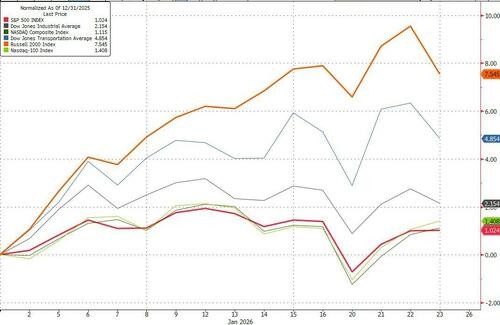
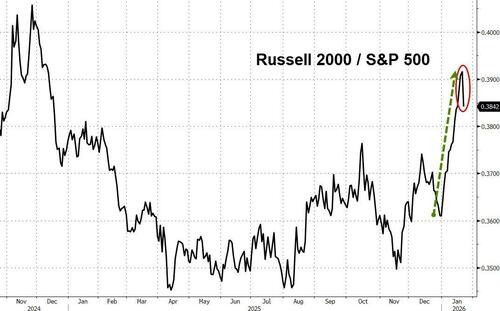
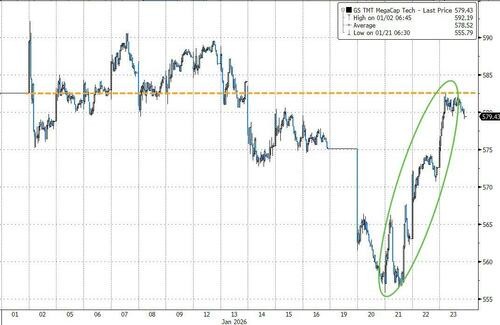
However, amidst this turmoil, the S&P 500 index has still risen 1.02% year-to-date, with significant improvement in market breadth indicators. The energy, materials, and consumer staples sectors are leading the way, while technology stocks have fallen by 1.34%. The Russell 2000 index has outperformed the S&P 500 for 14 consecutive trading days, setting the longest record since 1996.


This expansion of market breadth is viewed by Goldman Sachs as a healthy signal for the U.S. stock market. Institutional investors significantly increased their positions in December last year, particularly in the healthcare and financial sectors, but this also means that positions in 2026 no longer constitute an upward driving force. Asset management companies' cash levels have fallen to historical lows, with total exposure reaching a peak level of 302%.
Goldman Sachs expects that against the backdrop of a recovery in corporate mergers and acquisitions and stock issuance activities, as well as a resurgence in retail and corporate buying, the S&P 500 index is still expected to reach 7,800 points in 2026.
Drivers of Market Breadth Expansion
Goldman Sachs interprets the improvement in market breadth as a healthy signal for the U.S. stock market and expects this trend to continue. The bank's portfolio strategy research team points out that from a fundamental perspective, the improvement in market breadth stems from the expanding set of opportunities facing investors.
The drivers of these opportunities include an improved economic growth outlook and a friendly Federal Reserve policy, while the earnings outlook for some large technology stocks faces additional uncertainty. However, the likelihood of a collective valuation "catch-up" decline for large technology stocks is low, which is a positive signal for the U.S. stock market.
The sector's current forward price-to-earnings ratio is 27 times, with a premium relative to other S&P 500 constituents at the 24th percentile over the past decade. Although the free cash flow multiple remains high and has room for further adjustment, the current PEG ratio of 1.4 is nearly on par with the lows at the end of 2022. Goldman Sachs expects that the significant divergence in valuations and returns for large technology stocks will continue, with the upcoming fourth-quarter earnings reports and capital expenditure guidance becoming key catalysts for the sector.
From a capital flow perspective, the recent expansion of market breadth also reflects a continued shift in investors' portfolios towards diversification. A slight adjustment in the allocation of the S&P 500 index could have a huge impact on smaller indices For example, transferring 1% of the market capitalization of the S&P 500 to the Russell 2000 would be equivalent to 19% of the market capitalization of that small-cap index.
Institutional Positions Reach Extreme Levels
Goldman Sachs pointed out that throughout 2025, institutional investor positions have been a tailwind for the U.S. stock market price trends, as institutional investors hesitated to increase long positions after Trump announced reciprocal tariffs. Asset management companies, sovereign wealth funds, and hedge funds have essentially been waiting for a significant pullback as a buying opportunity, but such a pullback has never materialized.
However, in December last year, these institutions invested heavily, particularly in the healthcare and financial sectors. Institutional investor positions will no longer be a tailwind in 2026. The cash levels of asset management companies are currently at historical lows.
Goldman Sachs' prime brokerage book (combined systematic and fundamental strategies) shows a total exposure of 302% (in the 100th percentile for 1-year, 3-year, and 5-year lookback periods), with a net exposure of 82% (98th percentile for 1-year lookback, 99th percentile for 3 years, and 80th percentile for 5 years).
Goldman interprets this as a significant increase in long positions recently, but the short squeeze risk remains extremely high. The bank's most shorted basket index has risen 18% this year, dragging down the performance of systematic hedge funds. Goldman Sachs' prime brokerage performance data shows that global fundamental long-short hedge funds have risen 3.08% this year, while systematic strategies have only increased by 0.23%.
Optimistic About the Transportation Sector
Goldman Sachs remains particularly optimistic about the U.S. transportation sector. This sector has performed poorly during the years of decline following the pandemic, when demand fell and supply was excessive. Recently, supply has begun to exit the market, with more than five well-known trucking companies filing for bankruptcy in the past few months, and the government is also cracking down on illegal drivers, leading to reduced supply and improved pricing.
Additionally, this sector is seen as a beneficiary of artificial intelligence applications, as companies can increase productivity, gain market share, and accomplish more work with fewer personnel. C.H. Robinson is a typical representative in this regard, but the market is beginning to recognize that other companies may also benefit.
Currently, we are in the core period of earnings season, and the outlook appears good, with the low threshold for year-on-year earnings growth of 7% for the S&P 500 in the fourth quarter expected to be surpassed again. Retail and corporate buying seems to have fully returned this year, and the mergers and acquisitions and stock issuance markets have performed well so far.
Considering these factors, Goldman Sachs believes that the S&P 500 index still has a feasible path to reach 7,800 points in 2026