When and why will Japanese government bonds and the yen reach a turning point?

UBS's latest report points out that the recent surge in Japanese government bond yields and the weakness of the yen are mainly due to the market's excessive reaction to inflation expectations, rather than a deterioration in fiscal fundamentals. The report indicates that Japanese inflation will fall to around 1.5% by mid-year, at which point real interest rates will rise significantly, becoming a key turning point for the trends of Japanese bonds and the yen. The institution assesses that Japan will not repeat a UK-style bond market crisis, and as the new fiscal year begins in April, domestic funds may flow back from overseas, further supporting Japanese assets
UBS's latest global strategy report points out that the recent sharp rise in Japanese Government Bond (JGB) yields has significantly exceeded what can be explained by fiscal fundamentals, with the core driver being the market's repricing of inflation expectations. The bank believes that current inflation will fall to around 1.5% by mid-year, which will become a key turning point for JGBs and the yen.
According to the Wind Trading Desk, the report indicates three key signals for investors: first, this volatility is not a systemic risk event similar to the UK's 2022 "Truss crisis," and the Japanese stock market remains resilient, especially avoiding panic selling in interest rate-sensitive sectors; second, with the attractiveness of JGB yields increasing, it is expected that after the new fiscal year starts in April, domestic funds in Japan may return from overseas bond markets on a large scale, reallocating to Japanese government bonds; finally, the decline in inflation will drive real interest rates up, thereby supporting the yen, as real interest rates have a more significant impact on exchange rates compared to nominal interest rate differentials.
Fiscal fundamentals are not the culprit; the yield increase has been "excessive"
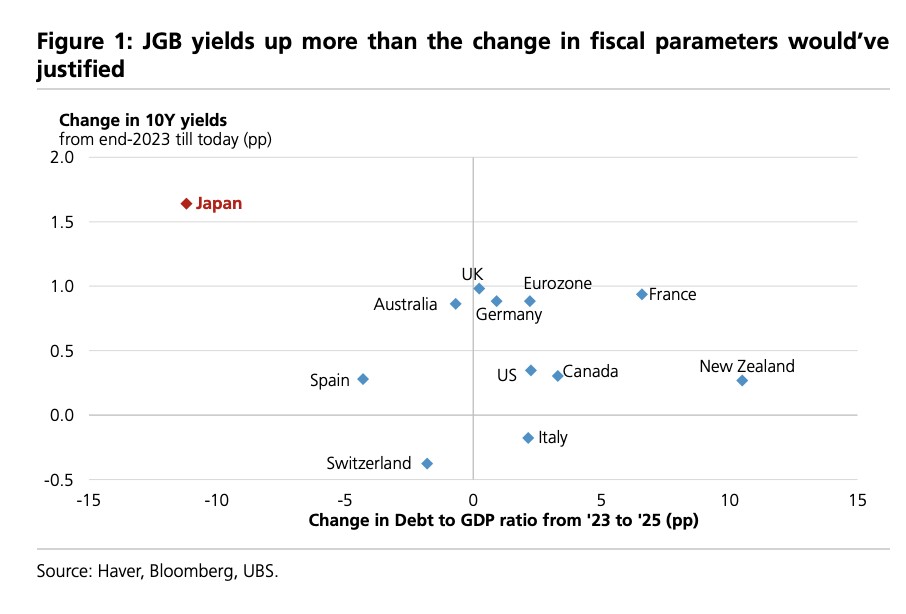
Despite market concerns about Japan's fiscal situation, recent data shows that the sharp fluctuations in JGB yields are clearly disconnected from actual fiscal fundamentals.
From a fiscal health perspective, Japan is in a better position than most developed economies. Since 2023, its public debt-to-GDP ratio has decreased by 11 percentage points, while the overall ratio for developed economies has increased by 2 percentage points. It is expected that by 2026, Japan's fiscal deficit as a percentage of GDP will be only around 2%, significantly lower than the average level of 4.9% for developed economies. Additionally, Japan's government interest expenditure accounts for 1.3% of GDP, which is also far below the average of 3.3% for developed economies.

However, despite relatively robust fiscal indicators, the increase in JGB yields has recently surpassed that of all major developed bond markets. The core reason for this "disconnection" lies in changes in market structure and liquidity: the trading volume that caused the market's sharp fluctuations on January 20 was less than $280 million, reflecting insufficient market depth; at the same time, the Bank of Japan has been continuously reducing its holdings of government bonds, leading to a disruption in the price discovery mechanism in the absence of key pricing entities, amplifying short-term volatility.
Inflation expectations are the core driving force, but cooling is imminent
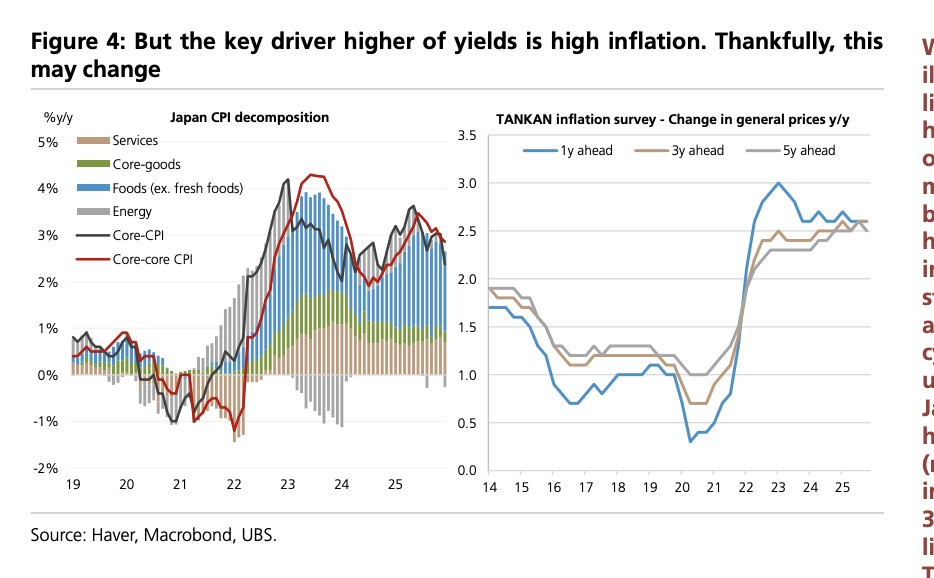
UBS analysis points out that the recent surge in JGB yields is primarily driven by market inflation expectations, rather than fiscal deficit pressures. Current inflation in Japan is mainly driven by structural factors such as food prices (e.g., rice), while potential service sector inflation remains at a moderate level of around 1%.
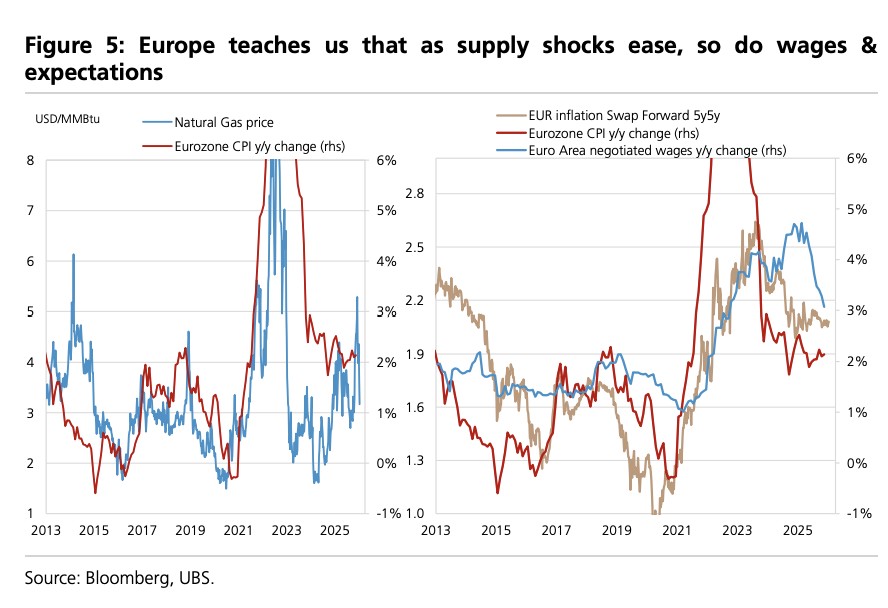
Looking ahead, the bank expects Japan's core inflation rate to fall to around 1.5% by mid-year. Referring to European experience, as supply shocks (such as fluctuations in energy and food prices) gradually dissipate, the overall decline in inflation will lead to a synchronous decrease in inflation expectations and wage growth.

In summary, if inflation cools as expected, its effect will be more effective in enhancing real yields than the Bank of Japan's interest rate hike policy, thereby providing crucial support for Japanese government bonds and the yen.
Yen Pricing Logic Changes: Real Interest Rates Matter More Than Nominal Interest Rate Differentials
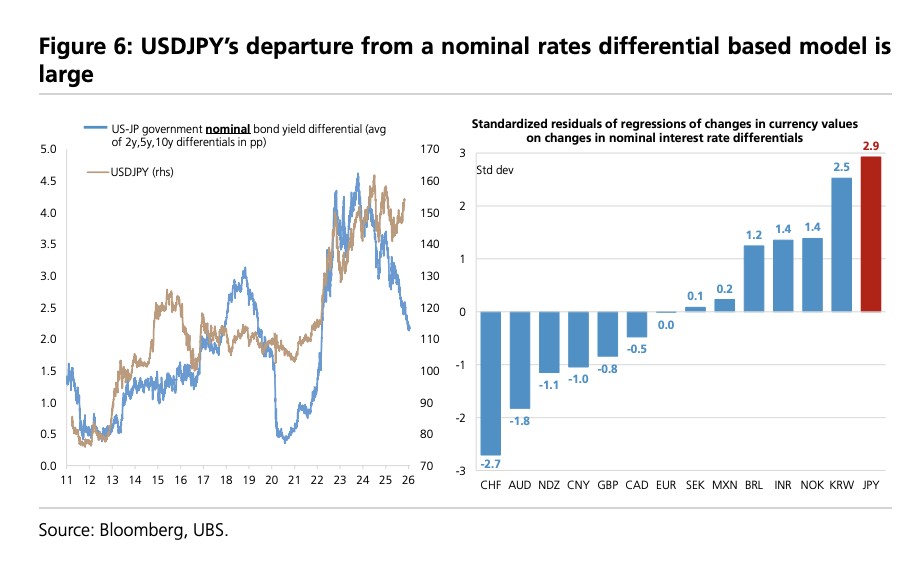
Recently, the traditional correlation between the yen and the nominal interest rate differential between Japan and the U.S. has broken down, with the real interest rate differential becoming the core anchor for its pricing. Models show that based on the nominal interest rate differentials for 2-year, 5-year, and 10-year terms, the theoretical value of USD/JPY should be around 118; however, if calculated using the real interest rate differential, its value is approximately 155, which closely aligns with the current market exchange rate. 
This difference reflects that the market is closely monitoring Japan's inflation trends and the potential threat to monetary policy independence. If inflation falls as expected in the future, real interest rates will correspondingly rise, providing crucial support for the yen exchange rate.
In terms of policy response, UBS analysis points out that the effects of unilateral foreign exchange interventions are often short-lived. In contrast, if Japan and the U.S. can coordinate actions and implement joint interventions (similar to the operational model in June 1998), it is expected to stabilize the exchange rate market more effectively.
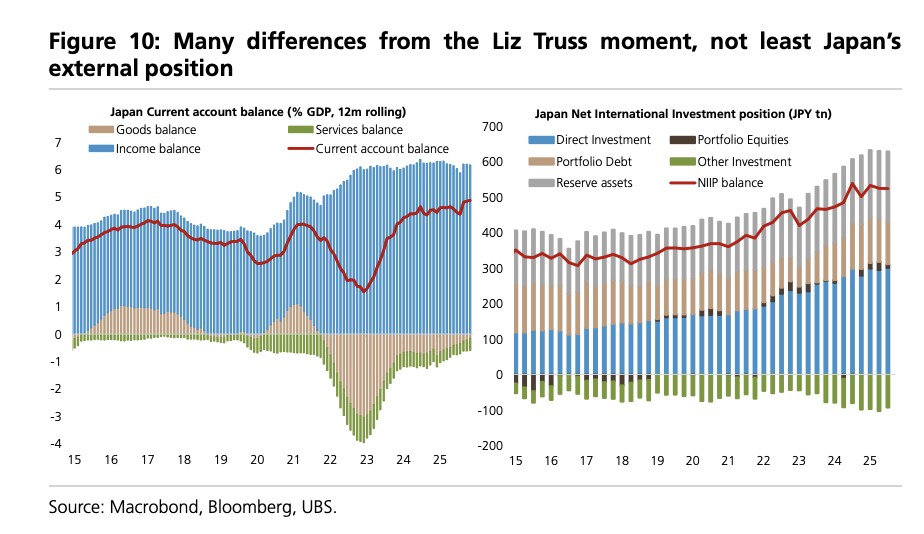
This is not the UK's "Truss moment"; Japan's external position remains robust
In response to market concerns that Japan may repeat the UK government bond crisis of 2022, UBS points out significant differences in key fundamentals and market reactions between the two:
Japan holds a massive net international investment position, accounting for +92% of GDP, while the UK had a -2.6% during its crisis; at the same time, Japan maintains a current account surplus of 4.8% of GDP, whereas the UK was in a deficit at that time. The robustness of the external asset-liability structure provides Japan with a stronger buffer.

From a market performance perspective, the UK crisis at that time showed a "double hit" in stocks and bonds, while Japan's stock market, especially interest-sensitive sectors such as real estate and construction, is performing strongly and significantly outperforming the market, reflecting that the market does not have systemic doubts about Japan's sovereign credit.
The Real Risk: Capital Repatriation in Japan and the "Hot Outside, Cold Inside" of the Stock Market
The main spillover risk currently facing the global bond market does not stem from foreign investors selling Japanese government bonds, but is more likely to come from a large-scale repatriation of domestic funds from overseas bond markets in Japan. UBS points out that as Japanese government bond yields have surpassed global bond yields after currency hedging, domestic institutional investors in Japan may significantly adjust their allocations in the new fiscal year (starting April 1), shifting funds from overseas bonds to the domestic government bond market.
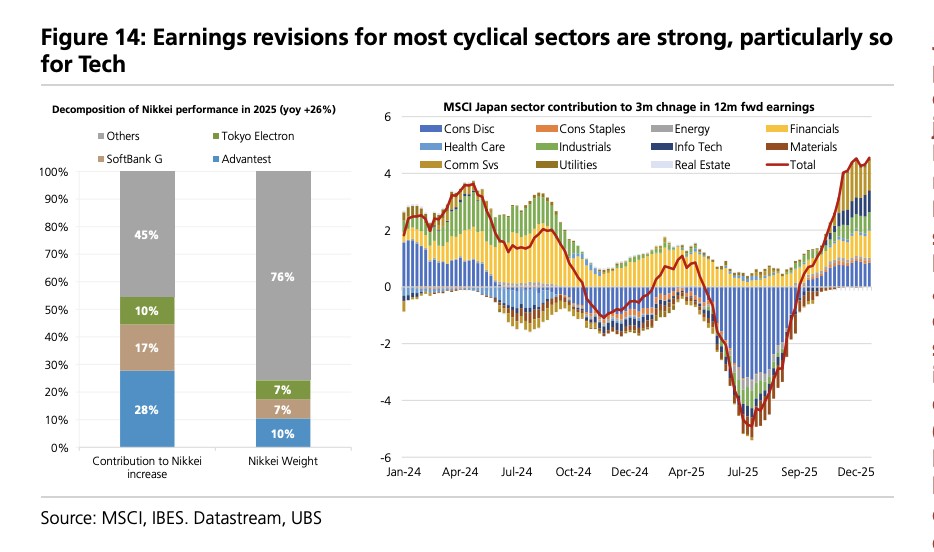
In terms of the stock market, the Japanese market shows a clear structural differentiation. Since 2025, only three stocks have contributed about 55% of the rise in the Nikkei 225 index, indicating a high concentration in the market. At the same time, this round of market performance is entirely driven by foreign investors and corporate buybacks, while domestic individual and institutional investors remain net sellers. This "hot outside, cold inside" funding pattern also reflects the cautious attitude of local investors towards the expectation of persistently rising inflation.