


Trump threatens tariffs, South Korean stocks open lower, Hyundai Motor briefly drops nearly 5%

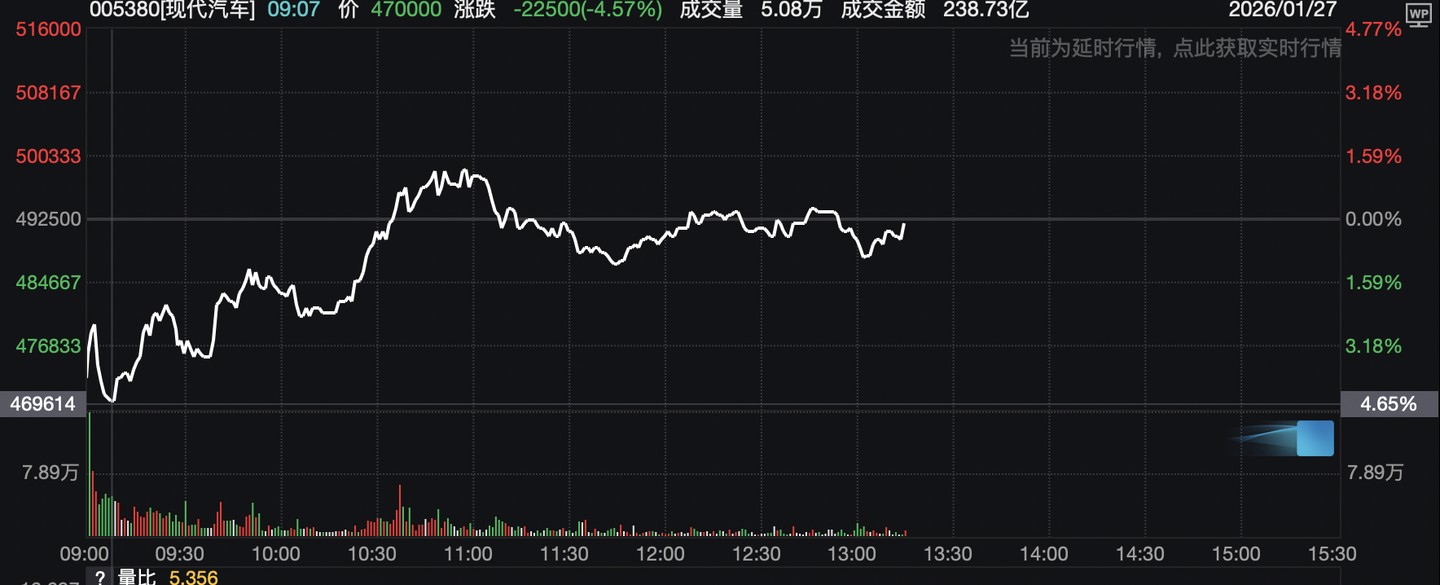
On the 26th local time, Trump announced that the tariff rates on South Korean automobiles, pharmaceuticals, and timber would be raised from 15% to 25%. This move caused South Korean automotive stocks to open significantly lower today; Hyundai's stock price plummeted by as much as 4.77% during the session, before the decline narrowed. The company is the largest importer of South Korean new cars in the United States
According to CCTV News, Trump announced on the 26th local time that he would raise the tariff rates on South Korean automobiles, pharmaceuticals, and timber from 15% to 25%. This move caused South Korean automotive stocks to plummet significantly at the market open today, but the decline later narrowed.
Trump stated on Truth Social that due to the South Korean legislature's failure to approve the trade agreement reached with the United States last summer, he would raise the tariffs on South Korean automobiles, timber, pharmaceuticals, and all other corresponding tariffs from 15% to 25%.
As the largest automobile exporter to the U.S. from South Korea, Hyundai's stock price fell by as much as 4.77% during trading but later recovered some losses. Kia's stock dropped nearly 3.5%, while Hyundai Mobis fell by 5%.
The South Korean presidential office stated that the U.S. government has not formally notified South Korea about the tariff increase. South Korean presidential advisors will hold a meeting with relevant ministries to discuss countermeasures.
Trade Agreement Stalemate
Trump questioned South Korea's sincerity in fulfilling its commitments in his post. He stated that he reached a "significant agreement beneficial to both countries" with South Korean President Lee Jae-myung on July 30, 2025, and reaffirmed the terms of the agreement during his visit to South Korea on October 29. However, the South Korean legislature has yet to approve its implementation.
According to reports, in the trade agreement announced last July, Trump agreed to impose a comprehensive tariff of 15% on South Korean imports. At that time, Trump also stated that South Korea had agreed to provide the United States with $350 billion in investments, which would be owned and controlled by the U.S., with the U.S. selecting the investment areas.
South Korea is one of the largest exporters of goods to the United States. According to data from the Office of the U.S. Trade Representative, the total value of goods imported from South Korea by the U.S. reached $131.6 billion in 2024.
Automotive Stocks Plummet at Open, Later Narrow Decline with Index Rise
On Tuesday morning, South Korean automotive stocks were severely impacted. Hyundai and Kia opened down 4% and 5%, respectively. However, both stocks later significantly narrowed their declines, with Hyundai down 0.2% and Kia still down 1.15% as of the time of writing.
Hyundai is the largest manufacturer importing new cars from South Korea to the United States. The potential impact of this tariff threat on the company has raised market concerns, but investor sentiment stabilized afterward.
Despite the turbulence in the automotive sector, the tariff threat does not seem to have undermined overall confidence in the South Korean stock market. The Kospi index reversed its downward trend, rising by 1.4%, while the small-cap index Kosdaq also increased by 0.4%, buoyed by gains in chip stocks.
South Korea Discusses Countermeasures
Trump's unilateral power to impose tariffs faces legal challenges. The U.S. Supreme Court held hearings last November on a case challenging the legality of Trump's unilateral tariff imposition, with judges expressing skepticism about whether he has the authority to impose such tariffs without congressional authorization The Supreme Court has not yet made a ruling on the case.
The South Korean Embassy in Washington has not yet commented on Trump's statement. According to reports, the South Korean presidential office stated that the U.S. government has not formally notified South Korea about the tariff increase. South Korean presidential advisors will hold meetings with relevant ministries to discuss response measures related to the tax increase
