


Deutsche Bank Commodity Outlook: In a structural bull market, a gold price of $6,000 is a "reasonable range," and the silver market is unlikely to stay detached from gold for long
Geopolitical turmoil and uncontrolled debt are the underlying logic for allocating precious metals. The rapid growth in demand for gold from central banks and ETFs has driven gold prices to continue rising. Deutsche Bank believes that any short-term pullback in gold should be viewed as a buying opportunity. Although silver is currently boosted by demand from China and India, its long-term gains will be constrained by gold prices as the gold-silver ratio reverts to the mean
The normalization of global geopolitical turmoil and the expected growth of government debt have led to a bull market for gold. Although silver may benefit in the short term from investment enthusiasm and continued inflows from China and India, it is expected that the gold-silver ratio will eventually revert, limiting silver's long-term gains compared to gold.
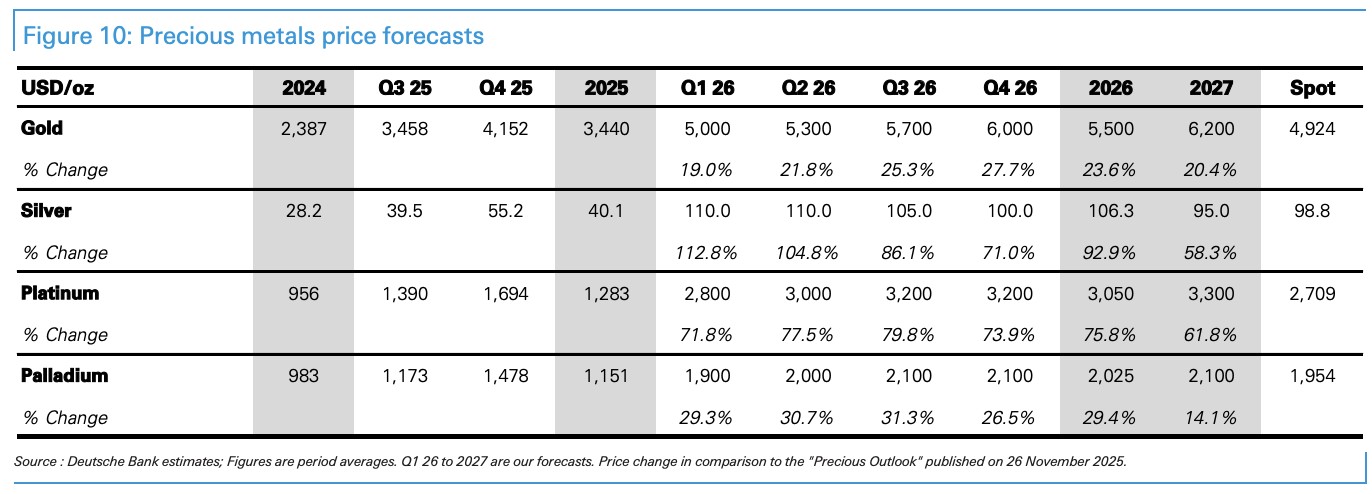
According to the Wind Trading Desk, Deutsche Bank mentioned in its 2026 Commodity Outlook report released on January 26 that the normalization of global geopolitical turmoil and the growth of government debt will continue to support precious metal prices. Against the backdrop of a weakening dollar, a structural imbalance in supply and demand is likely to push gold to $6,000 per ounce this year. The report also noted that any pullback of around 10% should be viewed as a buying opportunity.
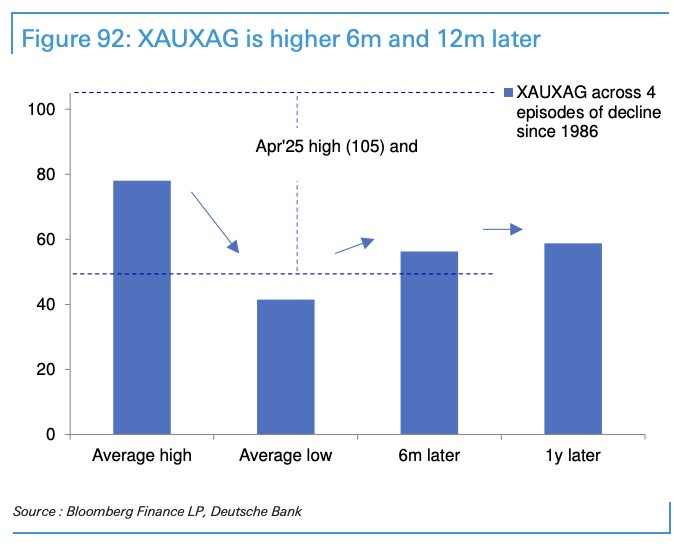
Regarding silver, Deutsche Bank assesses that since December, there has been new Asian investment demand for the "white metal," and the absolute price of silver may be higher; however, historically, the XAUXAG (gold-silver ratio) tends to mean revert rather than completely reverse after significant fluctuations. Deutsche Bank's path assumption is that by 2027, the gold-silver ratio will return to 65, with silver around $95 per ounce.
Macroeconomic Background: Normalization of Geopolitical Turmoil and Uncontrolled Debt
The Deutsche Bank report points out that geopolitical turmoil has shown a trend of normalization. This heightened uncertainty in the global environment has directly led to the demand for supply chain independence among countries, thereby increasing costs. More critically, great power competition has intensified resource nationalism and the hoarding of strategic resources.
For precious metal investors, the underlying support logic comes from fiscal deterioration. High military spending is worsening long-term government debt expectations (NATO member countries have agreed to increase military spending to 5% of GDP by 2035; Japan aims for defense spending to reach 2% of GDP under the leadership of Prime Minister Fumio Kishida).
The International Monetary Fund (IMF) has pointed out that by 2029, the ratio of global government debt to GDP could rise to 100%, and in adverse scenarios, it could even reach 123%. Deutsche Bank noted that this macroeconomic background, combined with the expected continued depreciation of the dollar before the end of 2026, forms the underlying logic for allocating precious metals and physical assets.
Gold: Supply Shortages Drive Long-Term Gold Price Increases
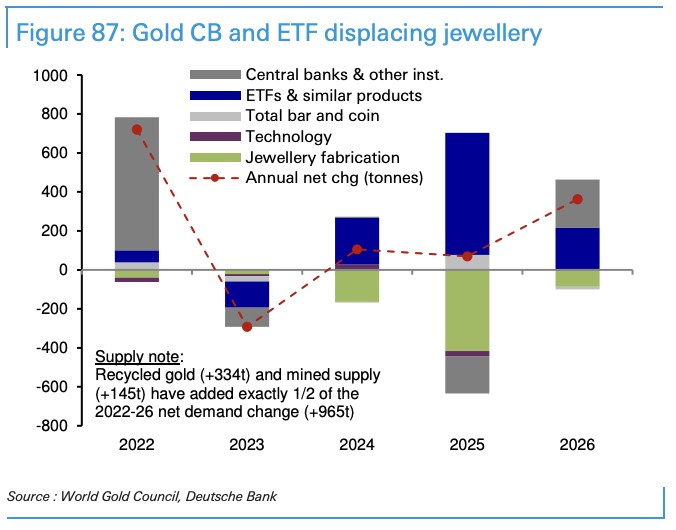
The demand for gold from central banks and ETFs is rapidly increasing. According to the Deutsche Bank report, between 2022 and 2026, the net growth in gold demand from central banks and ETFs (965 tons), recycled gold (334 tons), and incremental mine supply (145 tons) can only meet half of the demand, resulting in a significant supply-demand gap.
It is noteworthy that in the fourth quarter of 2025, official demand data from the International Monetary Fund showed that countries like Finland, Brazil, and Poland had the strongest gold purchasing power for the year, indicating that central bank gold purchases are no longer limited to traditional emerging markets.
Even if global gold jewelry consumption in 2026 is only two-thirds of that in 2021, this demand has been completely replaced by central banks, ETFs, and physical gold bar and coin demand. In 2025, ETF gold holdings saw their first net inflow in five years, and the asset management scale of ETFs relative to gold prices remains at a conservative level, indicating that there is still room for further increases
The upward trend of gold is sustainable, and short-term pullbacks should be viewed as buying opportunities. Deutsche Bank believes that the motivation for investors to increase their gold holdings differs from the anti-inflation demand of the 1980s, and is instead based on concerns about the risk of freezing dollar assets, the need for non-dollar asset allocation, and expectations of long-term government debt growth. These structural factors are more persistent than cyclical factors and are less likely to lead to a sharp drop in gold prices like in the 1980s after inflation subsided.
However, Deutsche Bank points out that gold may have formed a crowded long position, and a short-term pullback of around 10% similar to what occurred in 2025 may happen, but such pullbacks should be viewed as buying opportunities.
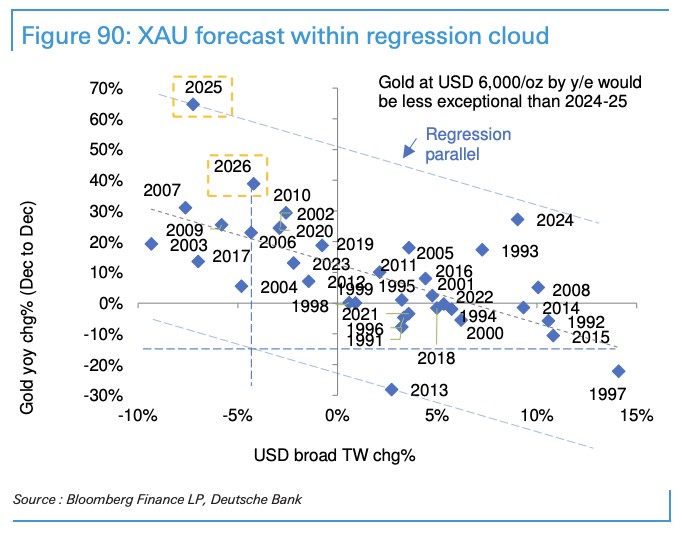
Deutsche Bank's regression model indicates that under general scenarios, this year's gold price will rise to $6,000 per ounce. In an optimistic scenario, the price will rise to $6,900 per ounce; in a pessimistic scenario, if the dollar unexpectedly strengthens, the lower limit for gold prices will be $3,700 per ounce.
Silver: Expected to continue rising in the short term, but long-term constrained by mean reversion of the gold-silver ratio
Demand growth from China and India. Deutsche Bank notes that the Reserve Bank of India announced that starting from April 2026, silver will be allowed as collateral for loans (similar to gold), which will significantly enhance silver's status as a household savings tool; against the backdrop of a weakening rupee, there may be a wave of imports hoarding (especially considering the potential restoration of a 15% tariff, with the current rate at 6%).
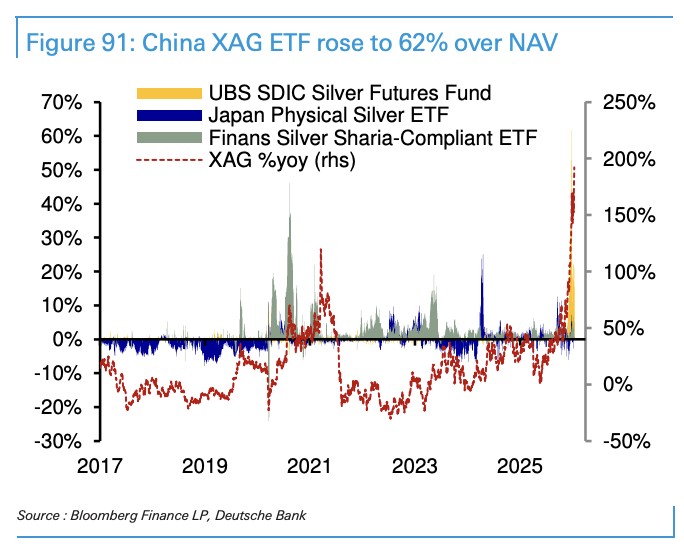
At the same time, China has strengthened the tax collection on capital gains and dividends from overseas investments, which may prompt funds to shift towards precious metal investments domestically; this corresponds with the record premium of Chinese silver ETFs at the end of 2025.
Industrial demand faces headwinds but is difficult to reverse in the short term. According to Deutsche Bank citing Bloomberg, the photovoltaic industry has deepened its reliance on silver, with the material cost of silver in solar cells rising from 14% last year to 29%. Price increases are forcing the industry to seek alternatives (to save silver), but this is a slow process. Even considering that recycled silver supply may increase (expected to reach 350-450 tons by 2026), it is unlikely to fully offset the surge in investment demand.
In the long run, the gold-silver ratio will eventually revert. Deutsche Bank's report shows that since 1986, the gold-silver ratio has experienced five significant declines (related to U.S. recessions) and four significant increases, with each extreme deviation returning to the mean without reversing the trend. The report predicts that the gold-silver ratio may further approach the 32 times level of 2011 in the short term (equivalent to a gold price of $5,000 and a silver price of $156), but will ultimately return to a level of 65 by 2027, corresponding to a silver price of about $95 per ounce
Risk Warning and Investment Insights
Deutsche Bank's report points out that the main risk in the gold market is that positions may already be very heavy but not visible. The rise in three-month implied volatility indicates that the market expects the actual volatility over the next week to rise towards peak levels seen in 2025, which experienced multiple 10% short-term corrections. However, Deutsche Bank believes that this adjustment should be viewed as a tactical buying opportunity.
For silver, the report reminds investors to pay attention to two signals: changes in borrowing rates and the trend of gold prices. The currently high borrowing rates and Deutsche Bank's bullish outlook on gold support the judgment that silver may continue to rise in the short term this year, but if these two factors reverse, silver prices may face significant correction risks.
Overall, the conclusion of the Deutsche Bank report is: the structural bull market foundation for gold is more solid, and a target price of $6,000 is reasonable; while silver may continue to benefit from investment enthusiasm in the short term, the eventual return of the gold-silver ratio will limit its long-term gains relative to gold. For allocation-type investors, gold provides a more sustainable value storage function; for trading-type investors, close attention should be paid to the technical indicators of the gold-silver ratio and changes in industrial demand
