Simulated chip recovery? Texas Instruments expects Q1 revenue to grow sequentially, marking the first time in sixteen years

Wallstreetcn
2026.01.28 06:36
portai
I'm PortAI, I can summarize articles.

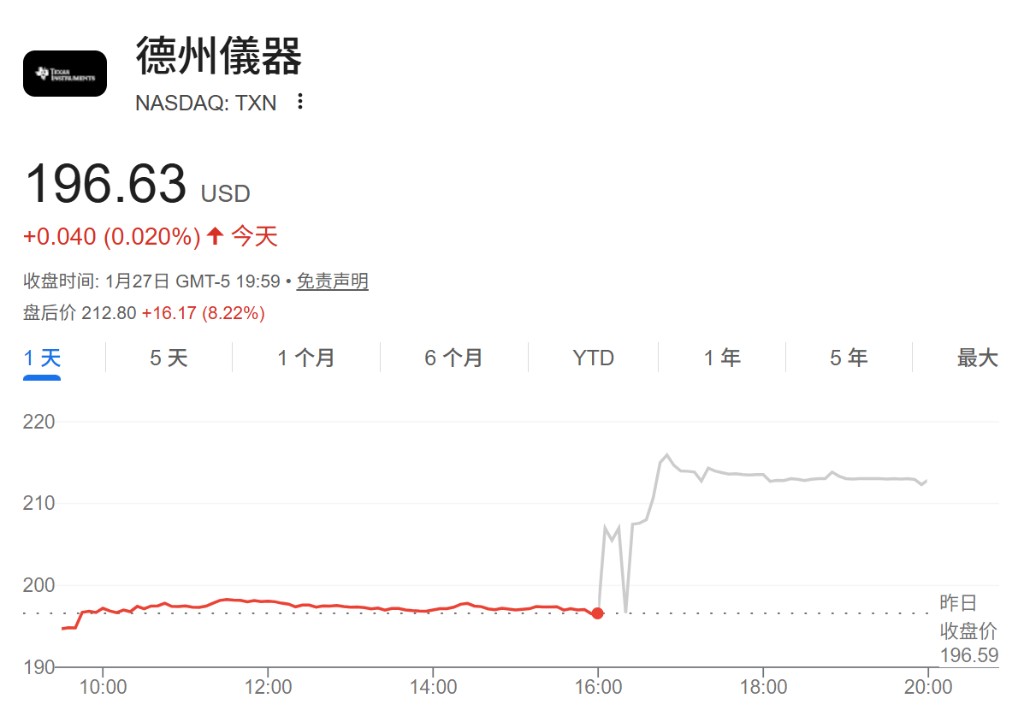
Texas Instruments jumped 8% after hours on Tuesday. The company's earnings report provided an optimistic outlook, expecting a quarter-over-quarter revenue growth in Q1. This "year-over-year quarter-over-quarter growth" signal is not common in the company's history. Analysts view this as an important signal of demand recovery, believing it supports the market's core optimistic logic regarding the company's future cash generation capability

Texas Instruments provided a rare outlook for quarter-on-quarter growth, reinforcing expectations that demand for analog chips is recovering, which directly boosted its stock price.

Texas Instruments jumped 8% in after-hours trading on Tuesday. The company's earnings report provided an optimistic guidance, expecting first-quarter revenue to be between $4.32 billion and $4.68 billion, which, based on the midpoint of the guidance, would be higher than the fourth-quarter revenue of $4.42 billion.

This signal of "cross-year quarter-on-quarter growth" is not common in the company's history. Cantor Fitzgerald analyst Matthew Prisco pointed out that this kind of quarter-on-quarter growth from the fourth quarter to the first quarter of the following year "has not occurred in 16 years," and described the earnings report as "surprisingly positive." Matthew Prisco views this as an important signal of demand recovery, believing it supports the market's core optimistic logic regarding the company's future cash generation capabilities.

However, the optimistic sentiment is not unanimous. Bernstein analyst Stacy Rasgon believes the performance is "decent," but simultaneously warns that the pace of recovery may be slower than some investors expect, and the visibility from short lead-time orders is limited. Jefferies analyst Blayne Curtis stated that the analog recovery seems to be "stuck in a range," with the company's more significant incremental growth coming from data center-related businesses.

Revenue Generally Meets Expectations, EPS Slightly Below Consensus

In terms of financial data, Texas Instruments reported fourth-quarter revenue of $4.42 billion, which is generally close to consensus expectations. Earnings per share were $1.27, which is 2 cents lower than consensus expectations.

The company stated in its earnings report that this earnings per share "includes a 6-cent downward adjustment," which was not included in the company's initial performance guidance.

For bulls, free cash flow remains a key variable in the valuation framework.

Matthew Prisco stated that this earnings report supports the view that the company will generate $9 billion to $10 billion in free cash flow next year, which is a core component of its bullish logic.

Cautious investors, however, focus more on rhythm and certainty. Stacy Rasgon pointed out that capital market expenditures should decline this year, which will benefit free cash flow, but he also believes that the recovery is not "rocket-like" upward, and the quality of short-term improvements needs to be further observed in conjunction with order structures.

Rasgon emphasized that "much of the upside comes from short lead-time orders," which means there is limited visibility on subsequent trends, and there is a risk of demand being pulled forward, thereby affecting future performance elasticity.

Blayne Curtis added that the recovery of analog chips remains moderate, but the company's contributions from data centers are more substantial and are now easier to break down and identify in the earnings report. This structural change is affecting investors' judgments about the sources and sustainability of Texas Instruments' growth