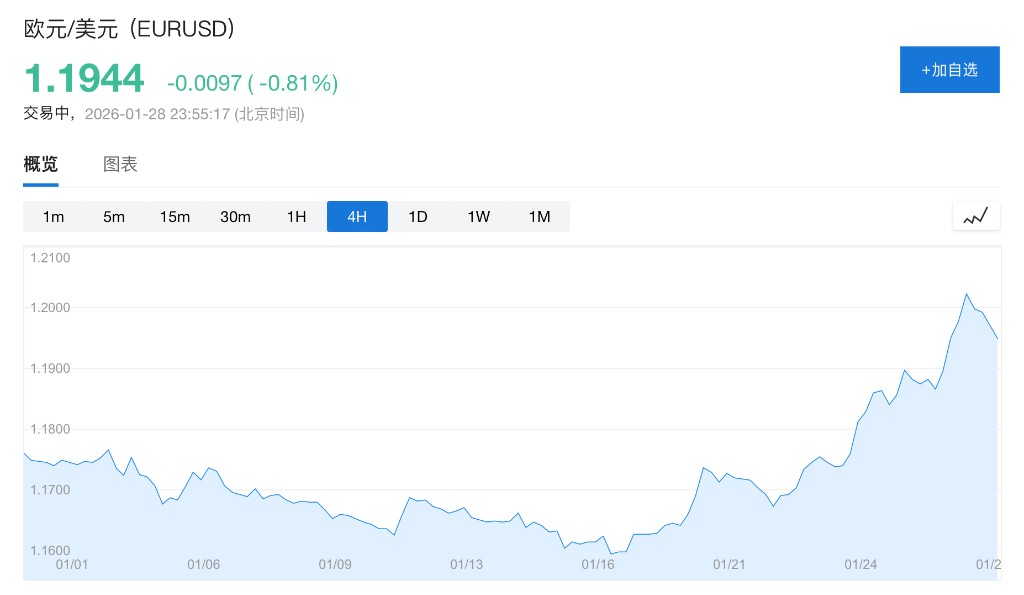
The euro breaks above the 1.20 mark, reaching a five-year high, as the bullish frenzy leaves the European Central Bank "in a dilemma."

The euro exchange rate has broken through the 1.20 mark, reaching a nearly five-year high, with bullish sentiment in the market. Some options are betting that it will rise to 1.25 USD by the end of June. This round of appreciation, mainly driven by a weak dollar, is placing the European Central Bank in a policy dilemma: on one hand, a stronger euro could suppress inflation by lowering import prices, potentially shaking its tightening stance; on the other hand, if the economic fundamentals themselves support the strengthening of the currency, the central bank may find it difficult to easily shift to easing. Policymakers are closely monitoring the exchange rate, and there are divergent expectations in the market regarding their policy response
The euro has continued to strengthen recently, breaking through the psychological barrier of 1.20 USD and reaching a new high since 2021. This round of appreciation, primarily driven by the weakening of the dollar, is placing the European Central Bank in a tricky policy dilemma.
The rapid appreciation of the euro will suppress inflation by lowering import costs, directly impacting the European Central Bank's core mission of maintaining price stability, forcing decision-makers to weigh conflicting objectives: Should they consider shifting to a looser policy due to the euro's suppressive effect on inflation, or should they maintain the current tightening stance to ensure lasting price stability while enduring the additional pressure on the economy from the excessive strengthening of the currency?
Market sentiment clearly leans towards continuing to be bullish on the euro. Activity in the options market is lively, with short-term bets reaching multi-month highs, and some long-term contracts even betting that the euro will rise to 1.25 USD by the end of June.

Investors Increase Bullish Bets
According to forex traders familiar with the trading situation, macro investors and hedge funds have significantly increased their bullish euro options positions this week. Data from custodial trusts and settlement companies show that about one-tenth of the euro options traded in the past week aimed to bet on the euro breaking above 1.25 USD by the end of June.
Chris Turner, head of forex strategy at ING, pointed out:
“The strengthening of the euro is one of the factors threatening the European Central Bank's neutral policy outlook. Recent price movements suggest that dovish policymakers may have reason to worry that a stronger euro could lead to inflation rates failing to reach the lower bound of the target range.”
Steven Barrow, head of G-10 currency strategy at Standard Chartered, looks at longer-term trends. He believes that, given time, the euro could rise to the range of 1.25 to 1.30 USD. The premise for achieving this goal is a stronger performance of the European economy, accompanied by large capital inflows into its assets.
European Central Bank Closely Monitors Exchange Rates
There are signs that the decision-makers at the European Central Bank are paying close attention to the euro's exchange rate movements. François Villeroy de Galhau, a member of the governing council and the governor of the French central bank, reiterated that the central bank does not have an exchange rate target but will assess the impact of the euro's appreciation when formulating policies.
In Austria, central bank governor Martin Kallia also pointed out that the central bank must pay attention to any further strengthening of the euro. His statement came before Trump's comments on the weak dollar this week, which subsequently boosted the euro.
In fact, the euro's exchange rate has long raised alarms among decision-makers. Last year, European Central Bank Vice President Luis de Guindos stated that a euro above 1.20 USD could pose challenges to monetary policy. Bloomberg strategist Vin Ram noted:
“The strengthening of the euro has caught the attention of some within the European Central Bank, but it is not yet enough to halt its upward momentum. The erratic nature of U.S. policymaking is prompting investors to sell dollars, while the European currency is better positioned to absorb these capital flows compared to market concerns about Japan's fiscal situation.”
There Are Discrepancies in Policy Impact
Valentin Marinov, head of foreign exchange strategy at Crédit Agricole, pointed out that the key to future trends lies in the driving force behind the euro's appreciation. If this rise is not driven by sustained capital inflows into European equity and bond markets, central banks may view it as a matter to be cautious about. At the same time, this situation may also rekindle discussions about enhancing the euro's global status as an alternative to the dollar.
Marinov stated:
"I wouldn't be surprised if Lagarde qualifies the recent significant rise of the euro against the dollar when discussing the vision of a 'global euro' next week. To some extent, the European Central Bank should be mindful of the wishes it has made."
However, not all market observers believe that exchange rate fluctuations will directly alter the monetary policy path. Laura Cooper, global investment strategist and head of macro credit at Nuveen, believes:
"Although policymakers may verbally express concerns about the rapid appreciation of the euro, it will be very difficult to translate that into actual easing policy actions when domestic economic fundamentals already support the strengthening of the local currency. To truly shift towards a rate cut guidance, core inflation and broader inflation expectations need to clearly and persistently fall below 2%."
Roberto Cobo García, head of foreign exchange strategy at Banco de España in Madrid, also expressed a similar view:
"As long as we avoid disorderly and sharp fluctuations, we believe that a stronger euro will not trigger a significant dovish policy response like it did in early 2025. The magnitude and speed of exchange rate fluctuations are also important factors influencing the central bank's assessment."