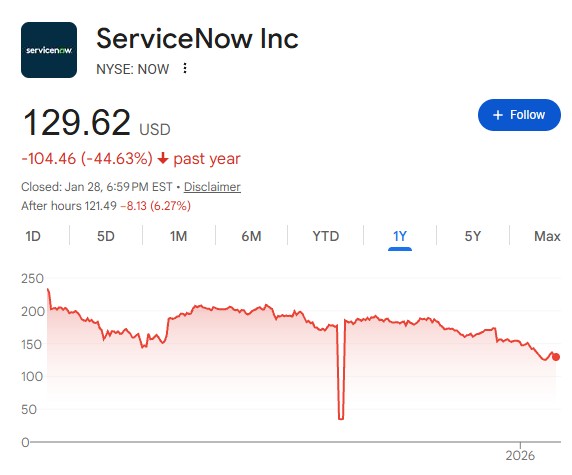
The quarterly report and guidance both exceeded expectations, yet the software giant ServiceNow is still being sold off by the market, overshadowed by the impact of AI

Wallstreetcn
2026.01.29 00:23
portai
I'm PortAI, I can summarize articles.

ServiceNow's quarterly performance exceeded expectations across the board, with subscription revenue increasing by 21% and the contract value of its AI product Now Assist surpassing $600 million. However, market anxiety over generative AI disrupting traditional software remains high, leading to a 6% drop in stock price after hours, which has plummeted 45% over the past year

Software giant ServiceNow reported better-than-expected quarterly results and sales guidance, but this failed to alleviate investors' concerns about the potential disruption of its business model by artificial intelligence, as the stock price continued to decline in after-hours trading.

In the recently concluded fourth quarter, ServiceNow's subscription revenue grew by 21% to $3.47 billion; the adjusted earnings per share were $0.92, both figures exceeding Wall Street expectations. As of December 31, the number of customers with annual contract values exceeding $5 million increased from 553 in the previous quarter to 603, indicating steady expansion of its large customer base.

The company expects subscription revenue for the current quarter to be approximately $3.65 billion, above analyst expectations. Additionally, a key metric measuring recent bookings—the current remaining performance obligations (cRPO)—is expected to grow nearly 23% this quarter, also faster than anticipated.

However, the positive news from the earnings report failed to boost market sentiment, with the stock price falling about 6% in after-hours trading. Previously, ServiceNow's stock price had already dropped 45% over the past 12 months, a decline that far exceeds many tech peers.

This sell-off highlights the market's severe skepticism about the prospects of traditional application software leaders, as investors worry that generative AI will reshape the industry landscape, thereby weakening the market positions of established giants like ServiceNow, Salesforce, and Adobe.

Management Defends Company's AI Strategy

In the face of market skepticism, ServiceNow CEO Bill McDermott vigorously defended the company's AI strategy.

He emphasized that ServiceNow is not just an application provider that has added some AI features, but rather a key platform for enterprises to apply AI in their operations. He revealed that the company's main generative AI product, Now Assist, has exceeded expectations, with its annual contract value surpassing $600 million by the end of December.

To enhance its AI capabilities, ServiceNow allows customers to use most major AI models within its tools. On Wednesday, the company announced an expansion of its relationship with Anthropic PBC to provide greater access to its Claude model. The week prior, ServiceNow also announced a three-year agreement aimed at strengthening its ties with OpenAI.

In addition to organic growth, ServiceNow is also seeking expansion through large-scale acquisitions. Last month, the company announced its largest acquisition ever, acquiring cybersecurity startup Armis for $7.75 billion, with the deal expected to close in the second half of this year. In response to speculation that the acquisition was driven by "necessity," McDermott denied this, stating it was aimed at expanding into new markets. He noted that after acquiring Armis, the company believes there are no other significant market gaps that need to be filled At the same time, the company's board of directors announced an additional $5 billion stock repurchase plan, primarily aimed at managing dilution effects. The company announced its first repurchase plan in May 2023 and expanded it in early 2025.

Although management is trying to rebuild confidence through strong performance and strategic expansion, long-term market concerns about technological disruption remain dominant.

RBC Capital Markets analyst Matthew Hedberg pointed out that while the financial report and guidance largely met or even exceeded expectations, the decline in stock price was unexpected, reflecting a profound divergence in the current market's valuation logic for the software industry