


世界黃金協會:全球黃金需求首破 5000 噸,散户和機構成購金主力
The World Gold Council shows that the pace of gold purchases by central banks will slow by one-fifth to 863 tons in 2025, and it is expected that the amount of gold purchased will further decline slightly to 850 tons in 2026. Meanwhile, retail and institutional investors have become the dominant force in gold purchases, with investment demand surging 84% to a record 2,175 tons, and gold ETF holdings increasing by 801 tons, ending four consecutive years of outflows
The World Gold Council released a report on Thursday indicating that global gold demand will exceed 5,000 tons for the first time in 2025, reaching a historical high of 5,002 tons. Investment demand has replaced jewelry consumption as the largest source of demand, with retail and institutional investors becoming the dominant forces in gold purchases.
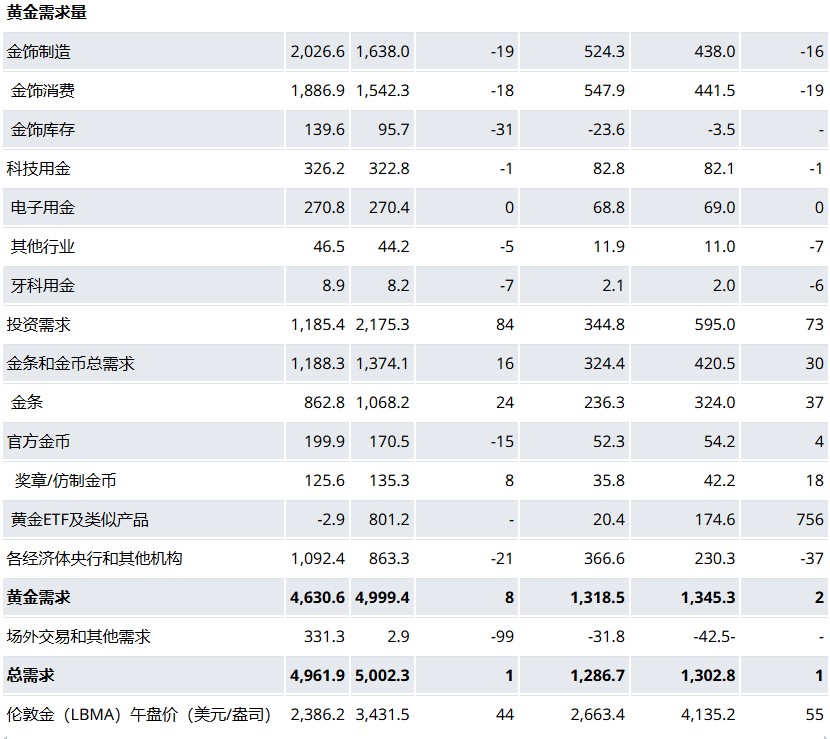
Central banks' gold purchases slowed by one-fifth to 863 tons, down from the more than 1,000 tons purchased annually from 2022 to 2024. Meanwhile, investment demand surged by 84% to a record 2,175 tons, with gold ETF holdings increasing by 801 tons, ending four consecutive years of outflows. The purchase volume of gold bars and coins jumped 16% to 1,374 tons, marking a 12-year high.
John Reade, Chief Strategist of the World Gold Council, stated:
Central banks may have played a very important role in this trend in 2022 and 2023, but now other factors have taken the lead. The biggest question this year will be whether investment demand can remain strong enough to sustain the strength of the gold market.
This shift in demand structure occurs against the backdrop of gold prices repeatedly hitting new highs. In 2025, gold prices are expected to achieve the best annual performance since 1979, rising 64% over the year and setting historical records in 53 trading days. On Wednesday, gold prices first broke through $5,300 per ounce, having risen 22% this year. The total value of global gold demand surged to $555 billion, a year-on-year increase of 45%.
Explosive Growth in Investment Demand Reshapes Market Dynamics
The explosive growth in investment demand in 2025 has completely transformed the demand structure of the gold market. Total investment demand soared by 84% to a historical high of 2,175 tons, surpassing jewelry consumption for the first time to become the largest demand category.
Gold ETFs attracted 801 tons of inflows in 2025, marking the second-highest annual increase in history, reversing the trend of outflows that persisted from 2021 to 2024. The purchase volume of gold bars and coins reached 1,374 tons, the highest level in over a decade. Demand from China and India was particularly strong, with retail investment demand in China surpassing jewelry consumption for the first time.
In addition to the turmoil caused by declining interest rates and tariffs, the weakening confidence in major developed market currencies has also been a key catalyst for the surge in investment demand. Attacks on central bank independence and rising sovereign debt have undermined investor confidence in major currencies, driving funds toward gold as a safe haven.
Central Bank Gold Purchases Slow but Remain Historically High
Central banks and other sovereign institutions purchased 863 tons of gold in 2025, a 21% decrease from the previous year, and below the astonishing pace of over 1,000 tons annually from 2022 to 2024. The World Gold Council expects central bank gold purchases to further decline slightly to 850 tons in 2026.
Despite the slowdown in purchases, the levels remain high by historical standards. The large-scale gold purchases by central banks in 2022 and 2023 were key factors driving gold prices to double over more than three years. The World Gold Council noted that after the rise in gold prices from 2022 to 2025 and the active purchases by central banks, the proportion of gold in global foreign exchange reserves is now approaching levels seen in the early 1990s The report states that the central bank's purchasing behavior is largely undisclosed, and therefore not included in the published statistical data. The World Gold Council's estimates are based on the gold purchase data from official central bank reports and the assessment of unreported purchases by consulting firm Metals Focus. The report adds that "many central banks manage gold outside of the formal reserve framework, and some central banks may target quantity rather than value, making it ineffective to determine a single 'saturation point' for total demand."
Rising Gold Prices Hit Jewelry Consumption Demand Hard
The continuous rise in gold prices has significantly impacted jewelry demand. Global gold jewelry demand is expected to decline by nearly one-fifth to 1,542 tons by 2025, with the Chinese market dropping 24%, reaching its lowest level since 2009. The World Gold Council predicts that record-high gold prices will continue to suppress jewelry demand in 2026.
Despite the decline in demand, thanks to rising gold prices, the total value of global gold jewelry demand still grew by 18% year-on-year, reaching a record $172 billion, indicating that global consumers' interest in gold jewelry has not completely faded. As gold prices rise and economic uncertainty persists, investors are increasingly favoring gold bars over jewelry.
On the supply side, mine gold production increased by 1% to 3,672 tons, and recycled gold supply grew by 3% to 1,404 tons. Despite fluctuations in the consumer electronics sector, the demand for gold in technology remains stable due to the ongoing growth of artificial intelligence-related applications.
Record-high gold prices may put pressure on certain demand categories, and the World Gold Council expects jewelry demand to remain weak in 2026, with central bank gold purchases also expected to decline slightly. Whether the market can maintain its strength will depend on whether the safe-haven demand from retail and institutional investors can continue to offset the slowdown in demand from other sectors
