Apple conference call: More personalized Siri will be launched this year, storage price increase +3nm capacity tightness becomes Q2 gross profit pressure

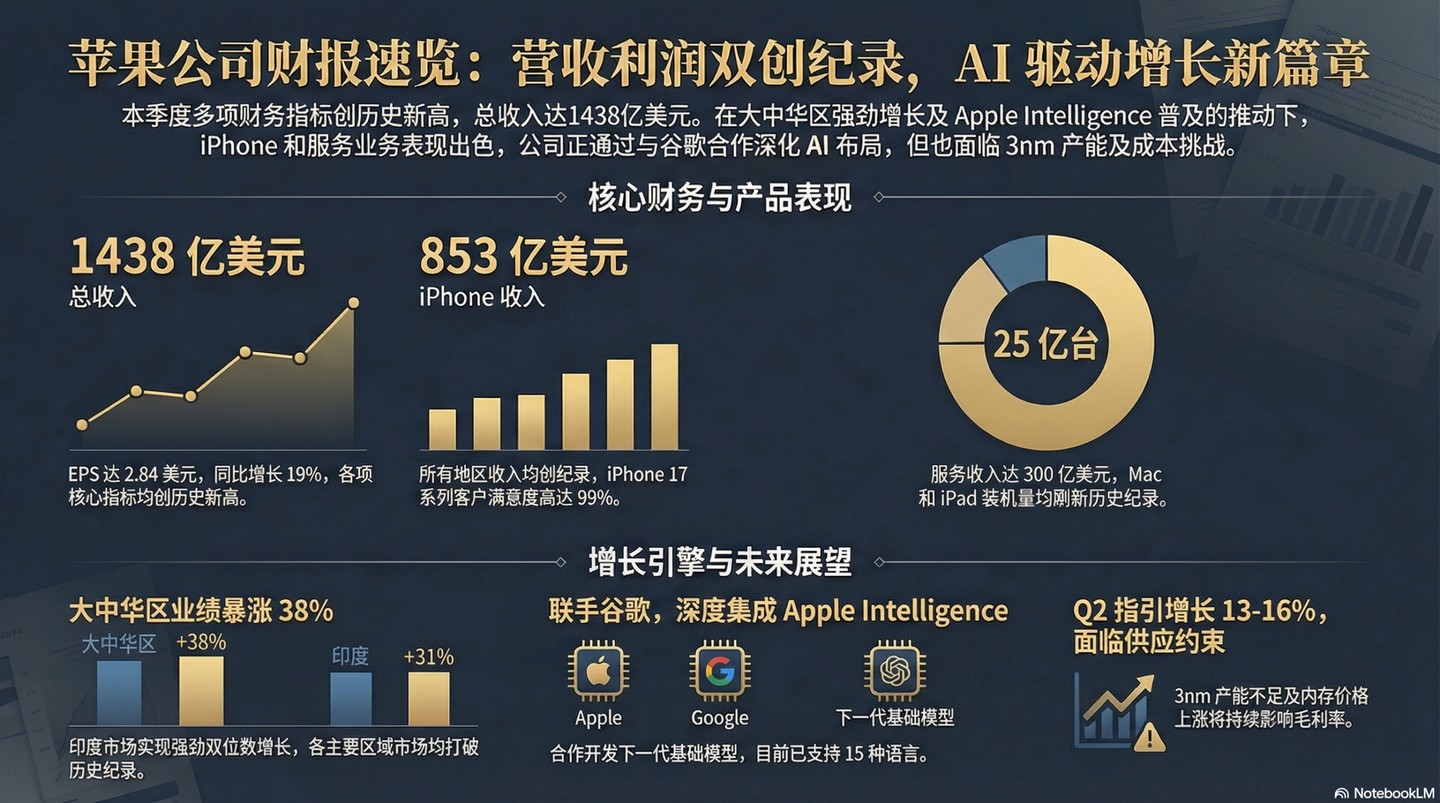
Apple delivers its best quarterly report ever: revenue of $143.8 billion and iPhone revenue of $85.3 billion both hit record highs, with a 38% growth in Greater China. The company expects double-digit revenue growth in the next quarter but warns that constraints in advanced node production such as 3nm and rising memory prices may suppress supply and gross margin. In terms of AI, Apple announced a partnership with Google to develop the next generation of foundational models, with a personalized Siri set to launch "this year."

On January 29, Apple Inc. released its Q1 FY2026 earnings report (for the period ending December 27, 2025), showing that total revenue, iPhone revenue, service revenue, and several other metrics reached historic highs. Against the backdrop of global tech stocks betting on "AI + hardware upgrades," the market's focus on Apple's holiday season financial report centered on three key points: whether the upgrade strength of the iPhone 17 can continue, whether demand in China has truly rebounded, and whether Apple can maintain its profit margins and supply rhythm amid rising memory prices and tight advanced process capacity.
More notably, CEO Tim Cook announced during the earnings call that Apple is collaborating with Google to develop the next-generation Apple foundational model, which will power a more personalized Siri to be launched this year. This collaboration marks a significant shift in Apple's AI strategy, with Cook stating:
"We believe Google's AI technology will provide the strongest foundation for the Apple foundational model, and we are confident that this collaboration will unlock a wealth of experiences and innovate in key ways."
iPhone ignites super cycle, all regions hit historic highs
The biggest surprise this quarter came from the iPhone. Revenue from this product line reached $85.3 billion, a year-on-year surge of 23%, setting a new record. Cook described the enthusiasm for the iPhone 17 series as "staggering" and "extraordinary" during the call. Particularly, the ultra-thin iPhone Air and the performance powerhouse 17 Pro series directly drove record revenues across all global regions.
The iPhone 17 series has become the strongest and most popular product line in history. According to a survey by 451 Research, customer satisfaction for the iPhone 17 series in the U.S. reached 99%. Cook emphasized the product's multiple attractions: "This is the perfect combination of performance, battery life, camera system, and design."
Strong demand has led to supply chain constraints. Cook admitted that due to the astonishing performance in the December quarter far exceeding expectations, the company's channel inventory is currently very lean.
"We are in a supply catch-up mode to meet extremely high customer demand. It is currently difficult to predict when supply and demand will balance."
Greater China "soars" 38%, shattering rumors of weak demand
Previously, the market was most concerned about the performance in Greater China, which turned out to be the biggest surprise this quarter. Revenue from Greater China grew by 38% year-on-year, completely dispelling previous concerns about weak demand in the Chinese market.
Cook revealed that this was the best quarter for iPhone performance in China’s history, with not only record upgrades but also double-digit growth in "switching users" from the Android camp. Foot traffic in offline stores surged, with the iPhone capturing the top three spots in smartphone sales in urban areas of China This data strongly proves that Apple's dominance in the high-end market remains solid.
Official Announcement of Partnership with Google, Completing the AI Strategic Puzzle
In the highly anticipated AI field, Apple has finally released a "big move." Cook officially confirmed on the conference call that Apple is collaborating with Google to develop the next generation of "Apple Foundation Models."
This collaboration will directly support a more personalized Siri to be launched later this year. Cook stated that Google's AI technology will provide the strongest foundation for Apple's foundation models, which also puts an end to market speculation about whether Apple would "go it alone" or "leverage partnerships" in the generative AI field. As a result of this news, market confidence in Apple's AI monetization path has significantly increased.
Supply Bottlenecks and Rising Storage Prices: The Growing Pains
Despite impressive performance, Apple is also facing "the troubles of happiness." Chief Financial Officer Kevan Parekh pointed out that due to demand far exceeding expectations, the iPhone is currently in a state of severe supply constraints, which is expected to continue into the next quarter. Cook explained that,
The bottleneck mainly comes from insufficient capacity at the 3nm advanced process node for producing the latest SoC chips.
Additionally, management has also warned of a significant increase in storage chip prices. Although the impact on gross margin for Q1 of fiscal year 2026 is limited, it is expected to have some impact on Q2. However, thanks to the increased proportion of high-end models and economies of scale, Apple still provided a strong gross margin guidance for Q2 (48%-49%).
Full Transcript of Apple's Q1 Fiscal Year 2026 Earnings Call
Event Date: 2026/01/29
Company Name: Apple
Event Description: Q1 Fiscal Year 2026 Earnings Call
Source: Apple
Presentation Segment
Suhasini Chandramouli, Investor Relations:
Good afternoon, everyone, and welcome to Apple's Q1 Fiscal Year 2026 earnings conference call. I am Suhasini Chandramouli, the Director of Investor Relations. Today's call will be recorded. First to speak today is Apple CEO Tim Cook, followed by CFO Kevan Parekh. After that, we will open the call for analyst questions.
Please note that some of the information you hear today will constitute forward-looking statements, including but not limited to discussions regarding revenue, gross margin, operating expenses, other income and expenses, taxes, capital allocation, and future business outlook.
These statements involve risks and uncertainties that may cause actual results or trends to differ materially from our forecasts, including risks related to macroeconomic conditions, tariffs and other measures, and the potential impact of legal and regulatory proceedings on the company's business and operating performance. For more information, please refer to the risk factors discussed in Apple's most recent 10-Q and 10-K reports, as well as the 8-K filing and accompanying press release submitted to the U.S. Securities and Exchange Commission (SEC) today More information will also be included in the 10-Q report we will submit tomorrow for the quarter ending December 27, 2025, as well as in other reports and documents we submit to the SEC. Apple does not undertake any obligation to update any forward-looking statements; these statements are only valid as of the date they are made.
Now I will hand the call over to Tim for his opening remarks.
Tim Cook, CEO:
Thank you, Suhasini. Good afternoon, everyone, and thank you for joining the call. I am proud to say that we have just completed a "record-breaking" quarter. We reported the best quarter in the company's history: revenue of $143.8 billion, a year-over-year increase of 16%, exceeding our expectations. The demand for iPhone has been "incredible," with revenue increasing 23% year-over-year, setting historical records across all geographic segments.
Our services business also set a historical revenue record, up 14% year-over-year; earnings per share (EPS) reached a historic high of $2.84, with a strong year-over-year growth of 19%. We set historical revenue records in the Americas, Europe, Japan, and other regions in Asia-Pacific, achieving growth in the vast majority of markets we track. We continue to build momentum in emerging markets, including India, where we achieved strong double-digit revenue growth. Revenue in Greater China also grew 38% year-over-year, driven by iPhone; iPhone set records for upgrade users and achieved double-digit growth among switchers (users switching from other brands).
Apple's performance in the December quarter reflects our steadfast commitment to innovation, dedication to serving customers, and our mission to "create the best products and services in the world." Next, I will take a deeper look at the performance of our product lines, starting with the iPhone.
As I mentioned earlier, the iPhone had an outstanding quarter: revenue reached a historic high of $85.3 billion, a year-over-year increase of 23%. This is the strongest iPhone product line we have ever had and the most popular generation to date. Throughout the quarter, customer enthusiasm for the iPhone was extraordinary. Users are excited about everything it can do.
The iPhone 17 Pro and 17 Pro Max deliver the ultimate iPhone experience: the best performance and battery life in iPhone history, the most advanced camera system, and stunning design. The iPhone Air is our thinnest and lightest smartphone to date, integrating powerful capabilities into an ultra-slim and sleek design; the iPhone 17 is a truly outstanding upgrade achieved at an exceptional price-performance ratio.
Next is the Mac. Mac revenue for the December quarter was $8.4 billion. We are pleased to see that the installed base of Macs has reached a historic high; nearly half of the customers purchasing Macs are new users of the product. The 14-inch MacBook Pro with M5 has made significant leaps in AI performance, thanks to the new generation GPU architecture and faster neural engine From the consumer and enterprise-facing, globally popular MacBook Air to the compact yet powerful Mac mini, each of our Macs offers unique value to users. With the recent launch of Apple Creator Studio available on Mac, iPad, and iPhone, creators have more tools at their disposal: whether it's creating amazing music or turning their devices into video production studios, everything is more intuitive.
Meanwhile, iPad revenue for the December quarter was $8.6 billion, a year-over-year increase of 6%, with the number of upgraded users reaching a record high. We are proud of our strongest iPad product line to date: from the A16-powered, extremely popular iPad to the iPad Air with astonishing versatility, and the incredibly powerful iPad Pro equipped with M5—featuring an extremely thin and lightweight design. It's no wonder the iPad continues to be the world's most popular tablet.
In the wearables, home, and accessories segment, revenue was $11.5 billion. With the Apple Watch Ultra 3 and Apple Watch Series 11, users are utilizing a full suite of health and wellness features to help them achieve their health goals. In a recent survey, we found that more and more users reported wearing their watches to bed, allowing them to check their sleep scores each morning and find ways to improve their sleep quality. Apple Watch reminders have also facilitated important conversations between users and their doctors, such as discussions about potential signs of high blood pressure. These are just a few of the many ways Apple Watch helps people live healthier lives.
The feedback for AirPods Pro 3 has been outstanding. Customers rave about its rich, immersive sound quality, unparalleled active noise cancellation, and significantly enhanced, almost "weightless" comfort. Features like real-time translation are also changing the way people communicate: helping users connect across languages in real-time, making everyday conversations more natural and easier to use. All these innovations together create a powerful and personalized experience; the enthusiasm we see reflects how strongly AirPods Pro 3 resonates with customers.
Across all product categories, we see very high customer satisfaction, and we are proud to report that our installed base has reached a new record, with over 2.5 billion active devices. In this quarter, we are also pleased to see that among supported iPhones, most users are actively utilizing the capabilities of Apple Intelligence. Since the launch of Apple Intelligence, we have introduced dozens of features, including writing tools and "cleanup," available in 15 languages. These AI experiences are personalized, privacy-focused, and seamlessly integrated across our platforms, relevant to what users do every day. We are embedding intelligence into more product experiences that people already love, making each experience more powerful and worry-free
One of our most popular features is "visual intelligence," which helps users learn and accomplish more based on the content on their iPhone screens, making it faster to search between apps, take action, and answer questions. As I mentioned earlier, we've also heard many exciting stories: people are seamlessly communicating across different languages with real-time translation. These are just a part of the many powerful AI features that are helping users do extraordinary things with our products; our products are the best AI platform in the world to date. This is largely thanks to the exceptional computing power and performance of Apple silicon.
Building on our efforts in AI, we are also collaborating with Google to develop the next generation of Apple Foundation models. This will help drive future Apple Intelligence features, including a more personalized Siri launching this year. We are incredibly excited about the many new experiences that will be unlocked in the future.
Next, let's talk about our services business. We achieved a historic revenue record of $30 billion, up 14% year-over-year. The services business also set historic revenue records in both developed and emerging markets. Apple TV is experiencing strong momentum: viewership in December increased by 36% year-over-year. This is not surprising, as shows like "Pluribus" are creating cultural moments that audiences love. Anticipation is building for upcoming new works, such as "Cape Fear," created by Steven Spielberg and Martin Scorsese. We are also pleased to announce that "Ted Lasso" will return for its fourth season this summer.
Over the past six years since its launch, we are thrilled by the growing enthusiasm of Apple TV audiences and grateful for the accolades that have come with it—most recently at the Critics Choice and Golden Globe Awards. To date, Apple TV productions have won over 650 awards and received over 3,200 nominations, including the recent announcement of the Oscar nomination for Best Picture for the film "F1, the Movie." Speaking of F1, we are also about to welcome a new season of F1 racing; for F1 fans in the U.S., Apple TV will be the place to watch every practice, qualifying, sprint, and grand prix. MLS fans will also be able to subscribe through Apple TV to watch every regular season and playoff game this year, and we look forward to the kickoff in the coming weeks.
Looking back, 2025 was an excellent year for the services business: we launched amazing new features and broke multiple records. Apple Music's listening and new subscriptions reached all-time highs. Last year, Apple Pay reduced fraud losses for our partners by over $1 billion, and we brought it to more markets than ever before. Last year, we welcomed over 850 million users to the App Store on average each week—making it the safest and most innovative app marketplace in the world Since 2008, developers' cumulative revenue on our platform has exceeded $550 billion.
In retail, we continue to bring a "magical" experience to customers around the world, and we are pleased to achieve the best performance in retail history this quarter. We opened our fifth store in India in December and plan to open a new store in Mumbai soon. Wherever we are, we see ourselves as part of a larger whole. Therefore, we implement our values in everything we do: this means partnering with places like Vietnam to bring cleaner water to rural areas; celebrating the new graduates of developer academies from Brazil, Indonesia, South Korea, and more; using recycled materials to 3D print titanium cases for the Apple Watch, making it more environmentally friendly without sacrificing quality; and much more.
We are particularly proud of our work supporting innovation in the United States. Last year, we committed to investing $600 billion over four years in key industries such as advanced manufacturing, chip engineering, and artificial intelligence. In the ongoing process of increasing our long-term investment in the U.S., we have supported nearly 500,000 jobs through thousands of suppliers across all 50 states. In the year since making our initial commitment, we have made significant progress. Today, we are shipping servers that support Apple Intelligence from our new manufacturing facility in Houston. Through our advanced manufacturing program, we are working with Corning in Kentucky to produce 100% of the cover glass used in iPhones and Apple Watches. We are collaborating with Micron, which has broken ground on a new advanced chip packaging and testing facility; we are also continuing to push for the establishment of an end-to-end chip supply chain in the U.S., with $20 billion in chips procured in the U.S. by 2025. Through the Apple Manufacturing Academy in Detroit, we have been training U.S. businesses and innovators in the latest smart manufacturing and artificial intelligence technologies. The academy has only been open for six months but has already had an extremely positive impact: businesses are working alongside Apple engineers to enhance productivity, efficiency, and quality in their supply chains.
As I mentioned at the outset, this has been an extraordinary quarter for Apple in many ways. We are excited about the unprecedented innovation opportunities that the coming year will bring and will enrich users' lives step by step. There are so many things to look forward to in the coming weeks and months, and I am very confident that our best work is still ahead of us.
Now, I will hand the call over to Kevan.
Kevan Parekh, Senior Vice President and Chief Financial Officer:
Thank you, Tim, and good afternoon, everyone. Our revenue for this quarter was $143.8 billion, a year-over-year increase of 16%, marking our best quarter in history. Globally, we set historical revenue records in both developed and emerging markets. We achieved double-digit year-over-year growth in most of the markets we track, including the United States, Latin America, Western Europe, Greater China, India, and South Asia
Product revenue was $113.7 billion, a year-on-year increase of 16%, primarily driven by double-digit growth in iPhone sales, setting a new historical record. As Tim mentioned, thanks to our strong customer loyalty and satisfaction, our active device install base has surpassed 2.5 billion units, reaching all-time highs across all product categories and geographic regions.
Service revenue was $30 billion, a year-on-year increase of 14%. This performance remains broad-based, achieving double-digit growth in nearly all markets we track.
We set historical revenue records in advertising, cloud services, music, and payment services, with the App Store and video business also reaching records in the December quarter.
The overall gross margin for the company was 48.2%, above the upper limit of our guidance range, with a quarter-on-quarter increase of 100 basis points, primarily driven by favorable product mix and economies of scale.
The product gross margin was 40.7%, with a quarter-on-quarter increase of 450 basis points, also driven by favorable product mix and economies of scale.
The service gross margin was 76.5%, with a quarter-on-quarter increase of 120 basis points, primarily driven by structural factors.
Operating expenses were $18.4 billion, a year-on-year increase of 19%, in line with the range we previously provided, primarily driven by increased R&D investments.
Net profit was $42.1 billion, with diluted earnings per share of $2.84, a year-on-year increase of 19%. Both net profit and diluted earnings per share set historical highs. These extremely strong business performances also drove us to achieve record operating cash flow, reaching $53.9 billion.
Next, I will provide more details on each revenue category.
iPhone revenue was $85.3 billion, a year-on-year increase of 23%, primarily driven by the iPhone 17 series. The iPhone performed strongly globally, setting historical revenue records in multiple markets we track, including the United States, Greater China, Latin America, Western Europe, the Middle East, Australia, and South Asia, while also setting a record in India for the December quarter.
The active install base of iPhones grew to a historical high, setting new records for upgrade users both overall and in several countries, including the United States, mainland China, Japan, and India. According to a recent survey by WorldPanel, the iPhone is the best-selling model in the United States, first-tier cities in China, the United Kingdom, Australia, and Japan. Customers are very fond of the latest iPhone product line. According to measurements from 451 Research, the latest customer satisfaction for the iPhone 17 series in the United States is 99%.
Mac revenue was $8.4 billion, a year-on-year decrease of 7%. As we mentioned in our last conference call, we faced a very challenging year-on-year comparison due to the release of the M4 MacBook Pro, Mac mini, and iMac during the same period last year Nevertheless, we continue to achieve growth in several emerging markets, including Brazil, India, Malaysia, and Vietnam. As Tim mentioned earlier, the installed base of Macs has reached a new all-time high, with nearly half of the customers purchasing Macs being new users. In the United States, customer satisfaction for Macs is 97%.
iPad revenue was $8.6 billion, a year-over-year increase of 6%, primarily driven by the iPad Pro with M5 and the iPad with A16. We continue to attract new users. In fact, this quarter, more than half of the customers purchasing iPads were new users. This has driven the iPad's installed base to a new all-time high, while the number of upgrade users has also reached a new high. According to the latest report from 451 Research, customer satisfaction for iPads in the United States is 98%.
Revenue from wearables, home, and accessories was $11.5 billion, a year-over-year decrease of 2%. This quarter, we encountered supply constraints with AirPods Pro 3, and we believe that without these constraints, this category would have achieved growth overall. The installed base of wearables has reached a new all-time high, with more than half of the customers purchasing Apple Watches being new users. In the United States, customer satisfaction is 96%.
Service revenue reached a historic high of $30 billion, a year-over-year increase of 14%. As mentioned earlier, we set historical revenue records in advertising, music, payment services, and cloud services, with paid subscription users achieving double-digit growth. We remain confident in the future of our services business. With an installed base of over 2.5 billion active devices, we have an extremely solid foundation for new growth.
This quarter, the number of transaction accounts and paid accounts both reached historic highs, and customer engagement continues to improve. We are also continuously enhancing service quality and expanding service breadth. From the digital ID feature in Wallet (allowing users to create IDs using U.S. passport information and store them in Wallet) to the newly added ad placements in App Store search, we provide advertisers with more ways to drive downloads through search.
Next, let's talk about enterprise business. Enterprises continue to expand their Apple device footprint to enhance productivity while maintaining security. Snowflake has deployed over 9,000 Mac devices company-wide, establishing Macs as the primary laptops for all business units, thereby improving performance and reducing support ticket numbers.
AstraZeneca is deploying over 5,000 iPad Pros with M5 for its pharmaceutical sales team to fully leverage AI capabilities, including Apple Intelligence, during daily meetings with clinicians. In Mexico, the country's largest retailer, Coppel, has recently added MacBook Airs, while its iPad device count has exceeded 10,000 units
Next, let's talk about cash position and capital return plans. At the end of this quarter, we held $145 billion in cash and cash equivalents. We repaid $2.2 billion in maturing debt and reduced $6 billion in commercial paper, bringing total debt to $91 billion. Therefore, the net cash at the end of the quarter is $54 billion.
This quarter, we returned nearly $32 billion to shareholders, including $3.9 billion in dividends and equivalents, as well as $25 billion through the repurchase of 93 million shares of Apple stock in the open market.
Looking ahead to the March quarter, I will review our performance guidance, which contains forward-looking information. It is important to emphasize that our assumptions are based on: the global tariff rates, policies, and their applicability remaining unchanged as of this conference call, and no further deterioration in the global macroeconomic outlook.
We expect overall company revenue for the March quarter to grow 13% to 16% year-over-year, and this guidance includes our best estimate of iPhone supply constraints. We expect the year-over-year growth rate for services revenue to be similar to that of the December quarter. We anticipate a gross margin of 48% to 49%. We expect operating expenses to be $18.4 billion to $18.7 billion, similar to the December quarter, with year-over-year growth primarily driven by higher R&D investments.
We expect other income and expenses to be approximately $100 million (excluding the impact of market value changes of minority equity investments), with a tax rate of about 17.5%. Finally, the board has declared a cash dividend of $0.26 per share, which will be paid to shareholders of record on February 9, 2026.
Questions And Answers
Operator:
Of course. We will now take the first question from Amit Daryanani from Evercore.
Amit Daryanani, Analyst:
Okay, I have two questions. First, the market is currently very focused on the impact of memory on OEMs. I would like to ask you to discuss, when you first raised the gross margin guidance for the March quarter:
First, how confident are you in securing the memory supply needed to ensure shipments?
Second, how will the rise in memory prices reflect in Apple's cost model over time?
Tim Cook, CEO:
Yes, Amit, hello, this is Tim. Let me take a step back and address both of your questions in one go, starting with the supply constraints and memory issues mentioned by Kevan in his remarks
First of all, we are very excited about the customer response to the latest iPhone product line, and frankly, it far exceeded our expectations, with iPhone growth of 23%. This result has led to very low channel inventory at the end of the December quarter, as the demand level is extremely impressive. Based on this, we are currently in a state of catching up on supply to meet the extremely high customer demand.
We are indeed facing supply constraints at the moment, and at this stage, it is difficult to predict when supply and demand will be able to rebalance. These constraints mainly come from the availability of capacity at the advanced process nodes used in our SoC. Currently, our flexibility in the supply chain is lower than normal, partly due to the significantly higher-than-expected demand I just mentioned.
From a memory perspective, to answer your question, the impact of memory on Q1, which is the December quarter gross margin, is very limited. We do expect memory to have a more noticeable impact on gross margin in Q2, which has already been included in the 48% to 49% guidance provided by Kevan earlier.
As for after Q2, we clearly will not provide guidance beyond the current quarter, but we do see memory pricing in the market rising significantly. As always, we will evaluate a range of response options. I hope this gives you a complete perspective.
Amit Daryanani, Analyst:
Thank you very much, Tim, these explanations are very clear. My second question is about the strong performance in the Chinese market. This is very close to your historical highest revenue in China. What is driving this growth? And is the growth rate seen in the December quarter sustainable? Thank you.
Tim Cook, CEO:
Certainly. The Greater China region grew 38% year-over-year, primarily driven by iPhone, where we set a record for the highest iPhone revenue in history, marking the best iPhone quarter in the history of Greater China.
This is entirely driven by customer enthusiasm for the iPhone 17 product line. I also want to tell you that in this quarter, foot traffic in our retail stores in China grew strong double digits year-over-year. It has been an outstanding quarter.
Our install base in Greater China and mainland China has reached an all-time high, and we have also set a record in the number of upgrading users, while achieving strong double-digit growth in switching users.
According to Worldpanel's survey, the iPhone was among the top three smartphones in first-tier cities in China this quarter. Overall, all of this is primarily driven by product strength and positive customer feedback on the products.
Additionally, in terms of non-iPhone products, most customers purchasing Mac, iPad, and Apple Watch are still new users of those products, which is a very positive sign. According to the same survey, the iPad is the best-selling tablet in first-tier cities in China
According to Counterpoint's data, the MacBook Air was the best-selling laptop model in the December quarter, while the Mac mini was the best-selling desktop. Overall, the Chinese market had an outstanding quarter, and we are incredibly pleased about it.
Suhasini Chandramouli, Investor Relations:
Excellent. Thank you, Amit. Operator, please connect the next question.
Operator:
The next question comes from Erik Woodring of Morgan Stanley.
Erik Woodring, Analyst:
Very good, thank you for answering my question. Tim, congratulations on announcing the partnership with Google; we are all looking forward to the products you will launch later this year. When I think about your AI strategy, it’s clear that this will bring additional costs, and we see these reflected in operating expenses.
Can you help us understand the upside revenue potential that AI brings? Many of your competitors have already integrated AI into their devices, but it’s still unclear how much incremental monetization AI has brought. Apple has always been very disciplined in its investments, and you have differentiated products, so how do you plan to monetize through AI? And what is the timeline for realizing ROI? Then I have a brief follow-up.
Tim Cook, CEO:
What I would say is that we are integrating intelligence into more features that people love, and doing so in a personalized and privacy-focused way throughout the operating system. I believe this can create tremendous value and open up a range of opportunities for our products and services.
And we are also very pleased with our partnership with Google.
Erik Woodring, Analyst:
Very helpful.
Tim Cook, CEO:
We— we are very pleased with it.
Erik Woodring, Analyst:
Okay, thank you, Tim. My follow-up is, now that you have more time and data to assess this cycle, can you talk about the key drivers behind the strong performance of the iPhone? If you could only choose one or two most critical factors, what would they be? And how do you view the sustainability of these factors?
Tim Cook, CEO:
I think it varies for different user groups, depending on the devices they were originally using. But it’s always a combination of a series of factors: display, camera, performance, the brand new selfie camera, design—this design is very well-loved by users. It is the combination of all these factors that has created a very strong product cycle, which is reflected in our performance for the December quarter
Erik Woodring, Analyst:
Great, thank you, Tim, and best of luck to you all.
Tim Cook, CEO:
Thank you.
Suhasini Chandramouli, Investor Relations:
Great. Thank you, Erik. Operator, please connect the next question.
Operator:
The next question comes from Michael Ng of Goldman Sachs. Please go ahead.
Michael Ng, Analyst:
Very good, good afternoon. Thank you for taking my question. I have two questions as well. First, it's encouraging to hear your revenue growth guidance of 13%–16% for the March quarter. I would like to understand if there are any year-over-year comparisons we should pay special attention to as we think about the various product categories?
I know you launched the M4 MacBook Air, iPhone 16E, A16 iPad, and M3 iPad Air in the same quarter last year. Can you tell me if these will create significant year-over-year pressure, or is the impact not significant under the current new product cycle? Thank you.
Kevan Parekh, Senior Vice President and Chief Financial Officer:
Yes, Mike, this is Kevan. How are you? Thank you for your question.
I wouldn’t say there are any particular year-over-year comparison issues worth highlighting. As you recalled, last quarter we mentioned that the Mac faced very difficult year-over-year comparisons, but currently, there is no situation reaching the level we emphasized in our guidance at that time.
Therefore, I think this is just a continuation of the strong product cycle we are currently seeing, which is certainly also affected by the supply constraints I mentioned in my prepared remarks and that Tim referred to earlier.
Michael Ng, Analyst:
Great. My second question is about the services business. Advertising performed strongly this quarter. I would like to ask about new growth opportunities in advertising. I know you have added new ad placements in App Store search. Could you elaborate a bit more on this direction? And do you have plans to expand advertising in other products like Maps or TV? Thank you.
Tim Cook, CEO:
Certainly, Michael. If I look at it from a holistic perspective, as we mentioned, we are seeing very good, broad performance across our services business, covering advertising, music, payment services, and cloud services, all of which have set historical revenue records.
Therefore, I think we see good opportunities across multiple service categories, and we continue to roll out new service features. We mentioned the new digital ID feature added to Wallet, and you also mentioned the new ad placements in App Store search, which we are very excited about as it provides advertisers with more ways to be discovered
So I believe we will continue to seek opportunities to create more value for users while also creating more opportunities for Apple. As we mentioned, we have reached the important milestone of 2.5 billion active devices, which provides very exciting opportunities for our services business.
Michael Ng, Analyst:
Great, thank you for sharing, Kevan.
Kevan Parekh, Senior Vice President and Chief Financial Officer:
Okay, thank you.
Suhasini Chandramouli, Investor Relations:
Thank you, Mike. Operator, please connect to the next question.
Operator:
The next question comes from Ben Reitzes of Melius, please go ahead.
Ben Reitzes, Analyst:
Hey, everyone, how's it going lately?
Tim Cook, Chief Executive Officer:
Hi, Ben.
Ben Reitzes, Analyst:
Hi, Tim. My first question is still about the partnership with Google. I want to understand how you made this decision, especially regarding AI and Siri. Are there revenue-sharing opportunities similar to the search business? Thank you.
Tim Cook, Chief Executive Officer:
We fundamentally believe that Google's AI technology provides the most capable foundation for Apple Foundation Models. We believe that through this partnership, we can unlock a wealth of experiences and innovate in significant ways.
We will continue to operate on the device side and run in private cloud computing while maintaining our industry-leading privacy standards.
As for the specific arrangements with Google, we will not disclose related details.
Ben Reitzes, Analyst:
Well, I figured you would say that. My second question is about gross margin. I have to say, I am really shocked. Tim, hats off to you for achieving 48%–49%.
How did you manage to do this in the face of rising memory prices like NAND? Is it due to product mix improvement, increased service proportion, or rising service gross margins? How did you maintain 48%–49% under these circumstances?
Kevan Parekh, Senior Vice President and Chief Financial Officer:
Yes, Ben, this is Kevan. How are you? Let me start with the Q1 gross margin. We achieved 48.2% in Q1, slightly above the upper limit of the guidance we provided, with a quarter-over-quarter increase of 100 basis points
If you look at this performance, we mentioned that it is driven by a favorable product mix. You know, when we have a strong product cycle and the pricing performance of the iPhone is good, it usually brings about a more favorable structure and scale effects.
We are currently in a strong iPhone cycle, as Tim described, which is reflected in the product gross margin, with a quarter-over-quarter increase of 450 basis points.
The services business is also continuing to contribute, achieving double-digit growth, which is an important factor.
In terms of guidance, the range we provided is similar to the December quarter, which will have some favorable and offsetting factors. We expect the services proportion to continue to increase, which typically happens from Q1 to Q2, but it will also be partially offset by seasonal leverage decline.
Overall, we feel good about the guidance of 48%–49%.
Ben Reitzes, Analyst:
That's great. Thank you.
Suhasini Chandramouli, Investor Relations:
Okay, thank you, Ben. Operator, please go to the next question.
Operator:
The next question comes from David Vogt of UBS.
David Vogt, Analyst:
Great, thank you for taking my question. Tim or Kevan, if we zoom out a bit, can you help us understand how you view the overall smartphone market demand, especially in the context of memory price trends?
We have also heard concerns from some other OEMs and component suppliers, including issues with component availability, and whether potential pricing actions to offset rising costs might impact demand.
I know you won't provide full-year guidance, but how do you view these different factors and what they might mean for overall smartphone market demand for the remainder of the year, and ultimately for iPhone demand?
Tim Cook, CEO:
On the supply side, I have previously commented on the supply constraints for Q2, which has already been reflected in the revenue guidance provided earlier by Kevan.
As I mentioned, these constraints come from capacity at advanced process nodes, essentially due to Q1 iPhone growth of 23%, far exceeding our internal expectations, and for a period of time, the flexibility of the supply chain has been relatively limited.
As for after Q2, I don't want to comment much on supply because it is the result of various factors that are constantly changing in the industry.
Regarding memory pricing, I have also commented on that before.
On the demand side, we believe based on the information we have, we gained market share in the December quarter. Clearly, the overall market did not grow by 23%, so we feel good about that But I don't want to predict how the future market will react; that's very difficult.
David Vogt, Analyst:
Understood. Then I will take the risk to ask, you mentioned earlier that you would consider a range of options to address the memory pricing issue. How should we understand the role of long-term agreements (LTA) in the current market? Is this a viable option, or is it more about spot purchases? Just trying to better understand the market dynamics.
Kevan Parekh, Senior Vice President and Chief Financial Officer:
It's a range. We won't get more specific than that. There are different levers that can be used, and how effective they are will depend on the situation, but there are indeed a range of options.
David Vogt, Analyst:
Okay, thank you.
Kevan Parekh, Senior Vice President and Chief Financial Officer:
Hmm.
Suhasini Chandramouli, Investor Relations:
Great, thank you, David. Operator, please connect the next question.
Operator:
The next question comes from Wamsi Mohan of Bank of America.
Wamsi Mohan, Analyst:
No problem, thank you. Tim, in the services business, you achieved a 14% growth, and you mentioned that the App Store set a record in the December quarter. However, third-party data shows that the App Store's growth has significantly slowed, possibly only 7%, which differs from the 14% you mentioned.
Can you confirm this? If true, what are the driving factors? And what measures might you take in the future to reverse this trend? I have a follow-up.
Kevan Parekh, Senior Vice President and Chief Financial Officer:
Wamsi, this is Kevan. What we want to reiterate is that in this quarter, the App Store set a quarterly record.
As you know, we do not provide specific performance details for individual service lines. But overall, we have achieved broad growth across different service categories and regions, setting historical records in both developed and emerging markets, with double-digit growth in both.
Therefore, we will not provide more specific information at the segment level for the services business.
Wamsi Mohan, Analyst:
Okay, thank you, Kevan. Now back to the memory pricing issue. Historically, Apple rarely uses pricing as a lever unless there are extreme fluctuations in the foreign exchange market. But in the current unprecedented rise in memory prices, could pricing become a lever you are willing to consider?
Tim Cook, Chief Executive Officer:
I don't want to speculate on this issue.
Wamsi Mohan, Analyst:
Okay, thank you.
Tim Cook, CEO:
Um.
Suhasini Chandramouli, Investor Relations:
Thank you, Wamsi. Operator, please connect the next question.
Operator:
The next question comes from Samik Chatterjee of JPMorgan.
Samik Chatterjee, Analyst:
Hello, thank you for taking my question. The first question is about your capital expenditures in the first quarter, which have slowed compared to the previous quarter.
I would like to understand if your collaboration with Google on Gemini and Apple Foundation Models' next-generation models will have any short-term impact on your plans to use Apple private cloud computing? I know you emphasize the importance of private cloud in the long term; will this collaboration bring any changes? I have a follow-up.
Kevan Parekh, Senior Vice President and Chief Financial Officer:
Sure, I'm Kevan. As Tim mentioned, we won't provide further details on the collaboration with Google.
Regarding capital expenditures, as you know, we adopt a hybrid model, so capital expenditures may fluctuate and are not always directly related to business performance.
Capital expenditures include several components, such as equipment molds, facilities, retail investments, and data centers. We use a combination of our own and third-party capacity for data centers.
Therefore, it's difficult to draw conclusions from a single quarter's CapEx. Last year, we did build out for the private cloud computing environment, which was reflected in the December quarter.
Samik Chatterjee, Analyst:
Understood. My follow-up is about product gross margins. You mentioned that the improvement in product gross margins was mainly driven by product mix. Can you specify the structural differences between the iPhone 17 and 16? Did tariffs play a role? And what are your expectations for tariffs in the next quarter?
Kevan Parekh, Senior Vice President and Chief Financial Officer:
There are several aspects here. First, regarding overall product gross margins, we mentioned that they are driven by favorable product mix and economies of scale. Given the current iPhone cycle is very strong, this favorable aspect may be higher than in previous cycles.
Secondly, Q1 typically reflects the impact of new product cost structures, but this time we saw that the structural and scale effects offset this impact.
Regarding tariffs, we previously indicated an impact of about $1.4 billion for the December quarter, and the actual results were roughly at that level
Samik Chatterjee, Analyst:
Thank you.
Suhasini Chandramouli, Investor Relations:
Very good, thank you, Samik. Operator, please connect to the next question.
Operator:
The next question comes from Krish Sankar of TD Cowen.
Krish Sankar, Analyst:
Hello, thank you for answering the questions. The first question is for Tim. You mentioned earlier the collaboration between Gemini and Apple Foundation Models. How should we understand the functional division between Apple's own models and third-party models? Will Apple Foundation Models evolve into different tiers within the AI software stack? I have a follow-up.
Tim Cook, CEO:
You should think of it as a collaboration. We will continue to advance our own work independently, but the support for personalizing Siri will come from our collaboration with Google.
Krish Sankar, Analyst:
Understood. My follow-up is, given that memory shortages are affecting both the smartphone and PC markets, and Apple has stronger purchasing power, do you see this as an opportunity to increase iPhone and Mac market share and squeeze competitors?
Tim Cook, CEO:
I don't want to comment further on that. We have mentioned that in the December quarter, iPhone gained market share, and we also believe that Mac will gain share in the full year of 2025. We are very satisfied with our positioning.
Krish Sankar, Analyst:
Thank you, Tim.
Tim Cook, CEO:
Hmm.
Suhasini Chandramouli, Investor Relations:
Thank you, Krish. Operator, please connect to the next question.
Operator:
The next question comes from Atif Malik of Citi.
Atif Malik, Analyst:
Hello, thank you for answering my question. The first question is for Tim. Some industry observers are comparing the iPhone 17 upgrade cycle to that of 2020-2021 when iPhone 12 users began to upgrade. Do you agree with this view? And how does Apple Intelligence impact the upgrade rate?
Tim Cook, CEO:
I believe every iPhone cycle has its uniqueness, and I won't compare it to any specific cycle. The iPhone 17 series is a unique product that combines several highly attractive features and has performed exceptionally well.
Kevan Parekh, Senior Vice President and Chief Financial Officer:
I would like to add that we have a large and diverse installed base, and this product has resonated strongly across multiple user groups.
Atif Malik, Analyst:
Thank you. A follow-up question regarding supply constraints. You typically have priority capacity at your foundries, so it's somewhat surprising to hear about limitations on advanced packaging. How long do you expect these constraints to last? To what extent will they affect your ability to meet real demand?
Tim Cook, CEO:
It's difficult to accurately estimate real demand when we cannot meet all of it.
It's important to clarify that the constraints primarily stem from 3-nanometer and other advanced process nodes, which is the core reason for the supply limitations in Q2. This directly results from the 23% growth in Q1, which far exceeded expectations, while supply chain flexibility is limited in the short term.
I don't want to predict when supply and demand will return to balance.
Atif Malik, Analyst:
Very helpful, thank you.
Suhasini Chandramouli, Investor Relations:
Thank you, Atif. Operator, please connect to the next question.
Operator:
The next question comes from Aaron Rakers of Wells Fargo.
Aaron Rakers, Analyst:
Thank you. The first question is about the Indian market. You mentioned strong demand in China, but also referenced India. Can you talk about the development of the iPhone in the Indian market and the opportunities you see in this vast market?
Tim Cook, CEO:
We set a quarterly revenue record in India during the December quarter, achieving quarterly records in iPhone, Mac, and iPad, with our services business also reaching an all-time high.
India is the second-largest smartphone market in the world and the fourth-largest PC market, and our market share remains relatively low, so the opportunities are immense. Most customers purchasing Apple products are still new users.
Kevan Parekh, Senior Vice President and Chief Financial Officer:
We also achieved strong double-digit growth in our installed base in India.
Aaron Rakers, Analyst:
A follow-up question regarding in-house chip development. Do you believe that deepening your in-house silicon capabilities is an underestimated gross margin lever? Will you further internalize more silicon capabilities in the future?
Tim Cook, CEO:
Apple Silicon is a huge transformative advantage.
Kevan Parekh, Senior Vice President and Chief Financial Officer:
In-house silicon not only brings cost advantages but also differentiation and roadmap control, positively impacting gross margins.
Aaron Rakers, Analyst:
Thank you.
Suhasini Chandramouli, Investor Relations:
Thank you very much. Operator, please connect the last question.
Operator:
The last question comes from Richard Kramer of Arete Research.
Richard Kramer, Analyst:
Tim, how do you view the evolution of AI between the edge and the cloud? And do you have enough data center capacity to support the widespread application of Siri without significantly increasing CapEx?
Tim Cook, CEO:
We believe that both edge and private cloud computing are equally important, and this is one of our differentiation advantages. As for capacity, we have done our utmost to plan and build.
Richard Kramer, Analyst:
You mentioned 2.5 billion active devices, but Apple Intelligence only supports starting from the iPhone 15 Pro. Can you roughly talk about the proportion of currently AI-enabled devices in the installed base? Does this affect the pace of AI rollout?
Kevan Parekh, Senior Vice President and Chief Financial Officer:
We will not provide specific numbers, but this is a continuously growing proportion.
Richard Kramer, Analyst:
Well, I still have to give it a try. Thank you.
Suhasini Chandramouli, Director of Investor Relations:
Okay. Thank you, Richard. The replay of today's conference call will be available on Apple Podcasts for two weeks and will also be provided as a live stream on apple.com/investor, and can be listened to via phone. The phone replay number is 866-583-1035. Please enter the confirmation code 890-2968, then press the pound key. These replays will be available around 5:00 PM Pacific Time tonight. Media members with other questions can contact Josh Rosenstock at 408-862-1142, and financial analysts can contact me, Suhasini Chandramouli, at 408-974-3123. Thank you all again for participating today
Operator: Today's meeting is concluded. We thank you for your participation