


Western Digital conference call: 2026 production capacity sold out, long-term contracts signed until 2028, AI inference is reshaping the HDD valuation system
Thanks to the "scissors effect" of price increases and declining costs, Western Digital's gross margin soared to 46.1%, with incremental gross margin expectations reaching 75%. CEO Irving Tan revealed that capacity for 2026 is already sold out, and long-term contracts have been signed with three of the top five customers until 2027-2028. Irving Tan emphasized that AI inference applications will drive structural growth in HDD demand, as the inference process generates massive new data that needs to be stored at low cost
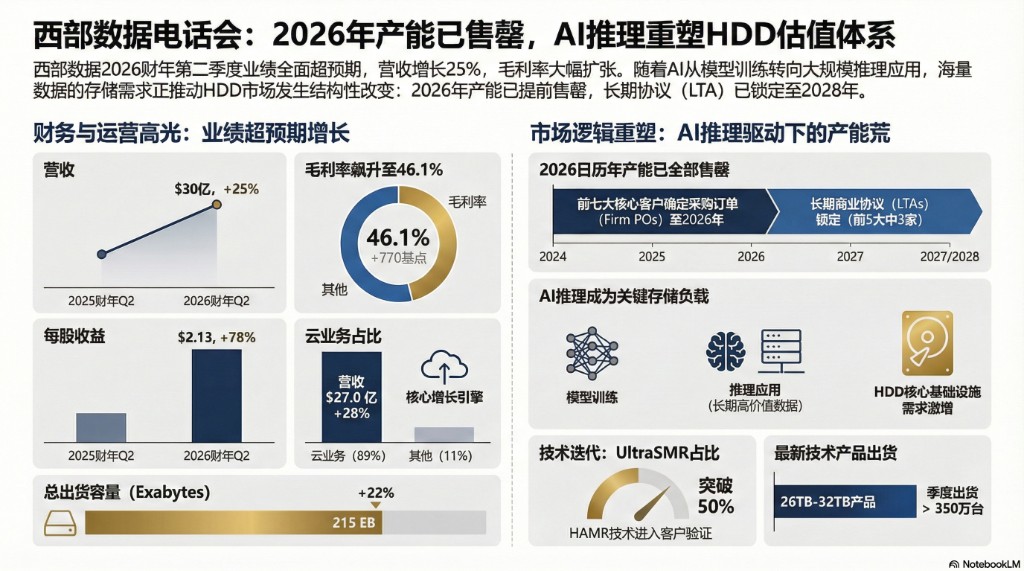
On January 29, Western Digital released its Q2 fiscal year 2026 financial report, with revenue reaching $3.02 billion and adjusted earnings per share of $2.13, both exceeding market expectations.
The financial report shows that Western Digital's net profit for Q2 reached $1.84 billion, approximately $4.73 per share, representing a 210% increase compared to $594 million ($1.27 per share) in the same period last year.
Despite the impressive financial data, the stock price fell nearly 3% in after-hours trading. Analysts believe that Western Digital's stock price had already surged over 60% in January, and the good news being fully priced in, along with profit-taking, led some investors to choose to "sell the fact" after the strong earnings report was announced.
In the subsequent earnings call, management expressed their views on the limits of "capacity ceilings" and "pricing power." CEO Irving Tan directly pointed out that the capacity for 2026 has been fully sold out, with some customers even signing long-term supply contracts extending to 2028.
Profit Surge, CFO Confirms 75% Incremental Margin
The financial report shows that the company's Q2 gross margin skyrocketed by 770 basis points year-on-year to 46.1%, with Q3 guidance further raised to 48%.
Wells Fargo senior analyst Aaron Rakers directly "crunched the numbers" on-site:
Based on the guidance of 47%-48%, your incremental margin seems to be maintained at a high level of 70% or even 75%. Can this kind of high profit continue?
CFO Kris Sennesael confirmed the analyst's calculations:
Aaron, your math is good. The incremental margin is indeed around 75%.
He explained that this is partly due to the increase in price per TB (up 2-3% last quarter) and partly due to the decrease in manufacturing costs (10% year-on-year decrease in cost per TB).
This widening "scissors gap" indicates that Western Digital is in a golden period of profit harvesting.
Analysts Question Long-Term Contract Details, CEO Reveals Contracts Extend to 2028
In the context of a market environment where both NAND and HDD are in short supply, Morgan Stanley analyst Erik Woodring directly questioned management during the Q&A session, asking whether they were too hasty in signing long-term agreements (LTA), potentially sacrificing future price increase benefits:
Given the tightness of the market and inflation, did you have enough patience to extract better economic benefits when signing orders for 2027?
In response, Western Digital CEO Irving Tan gave an extremely confident reply. He revealed that the company has not only secured all firm purchase orders (Firm POs) for the entire 2026 calendar year from its top seven customers but has also broken industry norms by signing cross-cycle long-term contracts with three of its top five customers, two of which extend to 2027 and one even to 2028. **
Tan emphasized:
These customers have seen a structural value shift... it's not just about locking in volume, but also an acknowledgment of future pricing.
Later, in response to TD Cowen analyst Eddie's follow-up question about whether "long-term contracts lock in prices," CFO Kris Sennesael confirmed:
These long-term agreements include both price and quantity conditions.
Technical Route Dispute, HAMR Validation Forced to Advance
On the technical roadmap, the market has been concerned about the commercialization progress of HAMR (Heat-Assisted Magnetic Recording) technology.
Evercore analyst Amit Daryanani's team and Mizuho Securities' Vijay Rakesh continuously questioned the progress of HAMR and the impact of related costs on gross margins.
Faced with extreme supply pressure, CEO Irving Tan announced a key strategic adjustment: the customer validation timeline for HAMR has been advanced by six months from the original plan, with the first large-scale customer validation actually starting this month (January 2026).
Tan also reassured the market regarding concerns about the transition between old and new technologies, emphasizing that even when HAMR begins mass production, its gross margin in the initial phase can be "neutral or even beneficial" compared to the existing ePMR technology, and will not drag down the company's overall profitability.
AI Narrative Reconstruction, From Training to Inference, A New Story for HDD
In response to the common misconception that AI only benefits HBM and SSD, BNP Paribas analyst Karl Ackerman raised a question:
HDD shipments are usually linked to traditional servers; can the explosion of AI servers really drive HDDs to break the long-term low-growth fate?
CEO Irving Tan provided an insightful industry response.
He pointed out that the market is undergoing a qualitative change, with the AI value chain shifting from "model training" to "inference applications." Training requires fast data (HBM/SSD), but the inference process generates massive new data that needs to be stored at low cost.
Tan stated:
Large-scale data centers, as savvy economists, are redirecting a large amount of inference data back to HDDs, which is structurally beneficial for HDDs.
Western Digital's Q2 FY2026 Earnings Call Minutes (AI-assisted summary):
Host:
Good afternoon, thank you for your patience. Welcome to Western Digital's Q2 FY2026 earnings call. Currently, all participants are in listen-only mode. We will conduct a Q&A session shortly. (Operator instructions) Just a reminder, this call is being recorded. Now, I will turn the meeting over to Mr. Ambrish Srivastava, Vice President of Investor Relations. You may begin.
Ambrish Srivastava, Vice President of Investor Relations:
Thank you, good afternoon everyone. Joining me today are Western Digital's Chief Executive Officer Irving Tan and Chief Financial Officer Kris Sennesael.
Before we begin, please note that today's discussion will include forward-looking statements based on management's current assumptions and expectations, which are subject to various risks and uncertainties. These forward-looking statements include expectations regarding our product portfolio, business plans and performance, current market trends, and future financial performance. We do not undertake any obligation to update these statements. Please refer to our recent 10-K annual report and other documents we have filed with the U.S. Securities and Exchange Commission (SEC) for more information on the risks and uncertainties that could cause actual results to differ materially from those anticipated.
In our prepared remarks, unless otherwise noted, all comments will be based on non-GAAP results for continuing operations. A reconciliation table between non-GAAP and comparable GAAP financial metrics has been included in the press release and other materials that have been posted in the investor relations section of our website at investor.wdc.com.
Finally, I would like to point out that when we use terms like "we," "our," and similar expressions, we are referring only to Western Digital and not speaking on behalf of the entire industry.
Now, I will turn the meeting over to Irving for his opening remarks. Irving?
Irving Tan, Chief Executive Officer:
Thank you, Ambrish, good afternoon everyone, and thank you for joining us today.
The growth and impact of artificial intelligence continue to accelerate across numerous industries. As generative AI models become the norm and agentic AI scales to drive business productivity, AI is increasingly becoming a true strategic driver of business transformation.
AI inference has also begun to gain traction, becoming a true AI workload in many respects, deployed in chatbots, virtual assistants, and customer relationship management tools. Innovations in physical AI are also rapidly accelerating, driven by advancements in autonomous vehicles and robotics, generating increasingly larger multimodal models.
In all these scenarios, data serves as the fuel driving the entire AI process from training to inference, enabling more powerful models and more accurate inference results. As more data is generated and the value of data increases, storage demand is expanding at an astonishing rate. With the expansion of AI capabilities, cloud business is also continuing to grow, both of which are driving the exploration and demand for higher-density storage solutions.
In this AI and cloud-dominated new era, Western Digital has taken a customer-centric approach to manage this strong demand, working closely with hyperscale customers to ensure the reliable, high-capacity hard drives are delivered at scale, providing them with optimal performance and total cost of ownership (TCO). We are achieving this by continuously focusing on increasing the aerial density of our hard drives, accelerating our HAMR and ePMR roadmaps, and driving customers to accelerate the adoption of higher-capacity hard drives and UltraSMR technology
In the last quarter, our latest generation of ePMR products shipped over 3.5 million units, offering up to 26TB of CMR and 32TB of UltraSMR capacity, which reflects strong customer confidence and widespread adoption. We have also initiated certification work for HAMR and next-generation ePMR products with various hyperscale customers. These hard drives will provide customers with the higher capacity and better total cost of ownership they seek.
Additionally, we are continuing to accelerate innovation in HAMR technology. To this end, we recently acquired relevant intellectual property, assets, and talent, which will help us develop internal laser capabilities. Similarly, in the last quarter, we launched a platform supporting UltraSMR in collaboration with software ecosystem partners, expanding the adoption of UltraSMR to a broader customer base. Compared to traditional hard drives, these platforms offer significantly higher storage density, delivering hyperscale data center-level performance to customers and making large-scale data analysis more sustainable and efficient.
Our strategy has indeed resonated with customers, as reflected in longer-term agreements and greater visibility into their needs. We have signed firm purchase orders with our top seven customers covering the entire calendar year of 2026. We have also established solid commercial agreements with three of our top five customers, two of which extend to the end of the calendar year 2027, and one to the end of the calendar year 2028. These agreements demonstrate the deep trust we have built with our customers and their confidence in our ability to meet their EB-level storage needs.
Next week, on February 3rd, we will hold an Innovation Day event in New York, where we will share updates on the roadmap for HAMR and ePMR products, as well as more details on the core innovative technologies we are developing to enhance hard drive performance, energy efficiency, and throughput. We will also provide updates on our financial models.
To implement our strategy of incubating new growth points based on intellectual property and core capabilities, last month we announced a strategic investment in Colab, combining our expertise in materials science and precision manufacturing with Colab's groundbreaking approach to quantum hardware design. Our aim is to advance next-generation nano-manufacturing processes through collaboration with Colab to improve the performance, reliability, and scalability of qubits.
Looking ahead, we see positive momentum continuing and will remain focused on supporting our customers' EB-level storage needs while completing the certification and launch of next-generation ePMR and HAMR hard drives.
Now, I will hand it over to Kris to share our second-quarter performance and third-quarter outlook.
Kris Sennesael, Chief Financial Officer:
Thank you, Irving, and good afternoon, everyone. Western Digital has once again achieved strong quarterly financial performance, reflecting the rigorous execution of our entire organization and our ability to meet the growing demands of customers in the AI-driven data economy.
In the second quarter of fiscal year 2026, revenue was $3 billion, driven by strong demand for nearline hard drives, representing a 25% year-over-year increase. Earnings per share were $2.13. Both revenue and earnings per share exceeded the upper limit of our guidance range We delivered 215 exabytes (EB) of data to customers, a year-on-year increase of 22%. This includes over 3.5 million units of the latest generation ePMR hard drives, totaling 103 EB, with capacities of up to 32TB.
Cloud business accounted for 89% of total revenue, amounting to $2.7 billion, driven by strong demand for high-capacity nearline product offerings, a year-on-year increase of 28%.
Client business accounted for 6% of total revenue, amounting to $176 million, a year-on-year increase of 26%.
Consumer business accounted for 5% of total revenue, amounting to $168 million, a year-on-year decrease of 3%.
The gross margin for the second fiscal quarter was 46.1%, an increase of 770 basis points year-on-year and 220 basis points quarter-on-quarter. The improvement in gross margin reflects the ongoing shift in the product mix towards high-capacity hard drives, as well as our strict cost control in manufacturing bases and the entire supply chain.
Operating expenses were $372 million. As a percentage of revenue, operating expenses decreased by 120 basis points quarter-on-quarter, primarily due to operational leverage from the model. Operating income was slightly above $1 billion, with an operating margin of 33.8%. Interest and other expenses were $45 million, and the effective tax rate for the second fiscal quarter was 15.1%. Considering the diluted share count of 378 million shares, earnings per share were $2.13, a year-on-year increase of 78%.
Turning to the balance sheet. As of the end of the second fiscal quarter, cash and cash equivalents were $2 billion, with total liquidity of $3.2 billion, including undrawn revolving credit facilities. Total debt was $4.7 billion, with net debt at $2.7 billion, and net leverage to EBITDA was well below 1x.
Operating cash flow for the second fiscal quarter was $745 million, with capital expenditures of $92 million, resulting in strong free cash flow of $653 million, with a free cash flow margin of 21.6%. In this quarter, we paid $48 million in dividends and increased stock repurchases to $615 million, repurchasing 3.8 million shares of common stock. Since the initiation of the capital return program in the fourth quarter of fiscal year 2025, we have returned $1.4 billion to shareholders through stock repurchases and dividend payments.
Additionally, today we announced that the board has approved a quarterly cash dividend of $0.125 per share, to be paid on March 18, 2026, to shareholders of record as of March 5, 2026.
Now I turn to the outlook for the third quarter of fiscal year 2026. We expect revenue to be $3.2 billion, plus or minus $100 million. At the midpoint, this reflects approximately 40% year-on-year growth. Gross margin is expected to be between 47% and 48%. We expect operating expenses to be between $380 million and $390 million. Interest and other expenses are expected to be approximately $50 million. The tax rate is expected to be around 16%. Therefore, we expect diluted earnings per share to be $2.30, plus or minus $0.15, based on approximately 385 million non-GAAP diluted shares outstanding.
In summary, Western Digital has achieved another strong quarter, with performance exceeding expectations. Our guidance for the next quarter highlights the continued favorable trends in our business, as well as our rigorous approach to free cash flow, capital returns, and creating long-term value for shareholders
Now, let's begin the Q&A session. Ambrish?
Ambrish Srivastava, Vice President of Investor Relations:
Thank you, Kris. Host, the floor is now open for questions. To ensure we can hear as many analyst questions as possible, please ask one question at a time. After we answer, we will give you the opportunity to ask a follow-up question.
Host:
Ladies and gentlemen, we will now begin today's Q&A session. (Operator instructions) Our first question today comes from Aaron Rakers of Wells Fargo.
Question: Aaron Rakers
Thank you for the question. Regarding gross margin, your guidance of 47% to 48% roughly indicates that you are maintaining about a 70% to 75% incremental margin. My question is, how do you view the sustainability of this incremental margin? Or conversely, how do you see the cost per TB declining over the next few quarters? Thank you.
Answer: Kris Sennesael
Yes, Aaron, thank you for your question. First, I am very pleased with the performance of the gross margin; we achieved a gross margin of 46.1%, an increase of 220 basis points quarter-over-quarter and 770 basis points year-over-year. Our guidance of 47% to 48%, with a midpoint of 47.5%, represents a year-over-year increase of 740 basis points.
I believe your calculation is accurate. The incremental gross margin is around 75%. As I mentioned earlier, I am very comfortable with an incremental gross margin above 50%, and 75% is clearly above 50%. There are two aspects to gross margin: one is the pricing environment, and the other is the cost environment. In terms of pricing, we see a stable environment, with prices per TB flat or slightly increasing. In fact, last quarter, the average selling price (ASP) per TB increased by 2% to 3%. This clearly indicates the value we continue to provide to our customers.
On the cost side, the team has executed very well. We continue to drive customers towards higher-capacity drives, which gives us a cost advantage. At the same time, we have also executed very well in reducing manufacturing costs and overall supply chain costs. Last quarter, the cost per TB decreased by about 10% year-over-year. Overall, we believe that in the coming quarters and beyond, we will be able to continue driving gross margin expansion.
Host:
The next question comes from Erik Woodring of Morgan Stanley.
Question: Erik Woodring
Thank you for the question. Irving, given the tightness in the HDD market and the significant increase in NAND prices, could you discuss your level of patience in signing procurement orders extending to 2027 for better economic benefits? Has this approach made any difference in economic benefits compared to last year?
Answer: Irving Tan
Thank you, Erik. As we have emphasized, our capacity for the calendar year 2026 is essentially sold out, and we have secured procurement orders with our top seven customers We have also signed long-term agreements (LTA) with two of them covering until 2027, and with another one covering until 2028. These LTAs combine EB volume and pricing.
Regarding pricing, first, it is important to recognize that our customers are seeing a structural shift in the value we provide, particularly in terms of the impact on total cost of ownership (TCO), as the business increasingly shifts towards reasoning applications that can be commercialized. Therefore, the pricing we offer reflects the value we create for them. As Kris mentioned, we expect to maintain a stable pricing environment in the future, which gives us the opportunity to better support their supply and demand needs with higher capacity hard drives while providing better TCO value for customers, thus capturing more value.
Question: Erik Woodring (follow-up question)
Kris, I would like to understand how you are handling the equity in SanDisk. Do you still plan to monetize it before the February 21 deadline? More importantly, how do you intend to utilize these proceeds?
Answer: Kris Sennesael
Yes, Erik. We still hold 7.5 million shares of SanDisk and plan to monetize them before the one-year anniversary of the spin-off. It is likely to be done through a transaction similar to the previous one, namely a debt for equity swap. Therefore, the proceeds will be used to further reduce debt.
Host:
The next question comes from C.J. Muse of Cantor Fitzgerald.
Question: Christopher Muse
Thank you for the question. Can you talk about how customer collaboration and contracts have evolved in this tight supply environment?
Answer: Irving Tan
Yes, CJ, thank you. Over the past year, we have been very focused on developing a more customer-centric approach. We have shifted our organizational focus towards our large hyperscale customers, establishing dedicated teams for each of them. This has deepened our relationships in terms of technology roadmap development and demand visibility, resulting in our ability to sign longer-term LTAs with them.
We look forward to sharing the innovations we are providing to support future AI workload demands at next week's Innovation Day. Overall, the relationships have indeed improved. They see the value we provide, which has led to the structural changes in pricing we are seeing and longer-term contracts. Ultimately, we want to ensure a fair value exchange, providing them with predictable pricing, as they are also concerned about the high volatility at certain levels in the storage space, while ensuring sustainable value creation for both parties.
Question: Christopher Muse (follow-up question)
Following up on the SanDisk stock question, can you talk about your plans afterwards? Is it more focused on stock buybacks or other areas?
Answer: Irving Tan
Since we announced a $2 billion stock repurchase authorization in May 2025, we have been focused on stock buybacks. We have utilized $1.3 billion of that plan to repurchase approximately 13 million shares, and we will continue to use the plan without hesitation.
Host:
The next question comes from Wamsi Mohan of Bank of America.
Question: Unidentified Participant
I am Ashley, asking on behalf of Wamsi. Congratulations on your performance. My question is about the UltraSMR mix. Given your orders and LTAs, what is the trend of the UltraSMR mix? How significant is the impact of this mix change on future gross margins?
Answer: Irving Tan
That's a great question, Ashley. Last quarter, UltraSMR accounted for over 50% of our nearline product mix. We expect that percentage to increase. One important way we support the growth in customer demand is by pushing them towards higher-capacity drives, and transitioning to UltraSMR is a key part of that. Our top three customers have fully adopted UltraSMR, and two to three more are in the process of adoption. Therefore, the share of UltraSMR in our total nearline EB shipments will continue to increase.
This is very important for us because, first, we can better meet customer demand. UltraSMR offers a 20% capacity increase over CMR and a 10% increase over the industry-standard SMR. Equally important, from a gross margin perspective, UltraSMR is a software-based solution, which is very beneficial to our margins. A higher UltraSMR mix will benefit both our customers and our profitability.
Host:
The next question comes from Asiya Merchant of Citigroup.
Question: Unidentified Participant
I am Mike, asking on behalf of Asiya. My question is, can you provide more information on yield and reliability? Does this have any impact on the decline in cost per bit?
Answer: Irving Tan
Thank you, Mike. Our ePMR products continue to perform well in terms of yield, staying in the low 90% range. In terms of reliability and quality, we have received very positive feedback from customers. Last quarter, we delivered over 3.5 million flagship ePMR drives, which demonstrates their confidence in the reliability and quality of the products. Regarding cost decline, as yields improve, costs continue to decrease. Additionally, the increase in the UltraSMR mix among these new products is also a driving factor for cost reduction.
Question: Unidentified Participant (follow-up question)
Can you talk about the progress of your Rochester Testing and Integration Center? And how are you leveraging these efforts to accelerate the transition for existing customers?
Answer: Kris Sennesael
We updated some information in our prepared remarks; we previously indicated that we would start HAMR certification in the first half of the 2026 calendar year, but we have actually moved this timeline forward. This month, we have begun the certification of HAMR hard drives. Additionally, we have also started the certification of the next generation ePMR hard drives. The Rochester lab plays a key role in ensuring we complete the certification smoothly and quickly. We look forward to sharing more updates on the ePMR and HAMR product roadmap on Innovation Day on February 3rd.
Host:
The next question comes from Amit Daryanani at Evercore.
Question: Unidentified Participant
I’m Hannah, asking on behalf of Amit. I would like to know if there are any significant investments related to HAMR currently accounted for in cost of goods sold (COGS) or operating expenses? As HAMR moves into mass production, will these costs decrease or normalize?
Answer: Irving Tan
We have been researching HAMR for 10 years, and the engineering team is making good progress. We will continue to advance these projects and innovate to improve performance and capacity. Regarding gross margin, HAMR has not yet entered mass production, but we are confident that once it does, its impact on gross margin will be neutral to positive. Even during the expected mass production of HAMR starting in early 2027, our capital expenditures as a percentage of revenue will remain in the range of 4% to 6%.
Host:
The next question comes from Karl Ackerman at BNP Paribas.
Question: Karl Ackerman
Thank you. AI is expected to drive a cyclical recovery in traditional server front-end. In your case, since hard drive shipments are highly correlated with traditional server demand, and new hard drives also bring content enhancements, do you think AI demand can help you exceed the long-term low 20% EB growth compound annual growth rate (CAGR)?
Answer: Irving Tan
Thank you, Karl. Over the past few quarters, we have indeed seen EB growth in the low 20% range. We believe that as the value of AI shifts from model training to inference, it will create more data. To deliver inference, more data needs to be stored. From our conversations with customers, it is clear that inference will drive a significant demand for data storage, which is very favorable for the future of HDDs.
Question: Karl Ackerman (follow-up question)
Back to HAMR, it sounds like you have at least accelerated the process for your first major customer. Given the strong demand for EB capacity from hyperscale data centers, can you talk about the interest from other customers beyond the first one?
Answer: Kris Sennesael
As we mentioned, we have started certification with a hyperscale customer this month, and we will soon initiate certification with another one.
Host:
The last question comes from Krish Sankar at TD Cowen.
Question: Unidentified Participant
I am Eddie, asking on behalf of Krish. You mentioned that there are three LTAs covering 2027 and 2028 based on quantity rather than price. I would like to know why these contracts do not lock in prices, especially in a situation where supply is very tight. Is it that the customers are unwilling to lock in prices, or do you want to retain flexibility?
Answer: Kris Sennesael
Thank you for the question. To clarify, we have two LTAs covering until 2027 and one LTA covering until 2028. These LTAs include terms for both price and quantity.
Host:
This concludes the conference call. Thank you for your participation. You may disconnect now
