


In 2025, with the entry of Chongqing State-owned Assets, China Merchants Renhe Life Insurance's net profit "quadruples."
In the context of a low-interest-rate environment and industry transformation, China Merchants Renhe Life Insurance, backed by two giants, China Merchants Group and China Mobile, delivered a
In the context of a low-interest-rate environment and industry transformation, China Merchants Renhe Life Insurance, backed by the two giants China Merchants Group and China Mobile, delivered a report in 2025 that shows clear signs of expansion.
According to the latest disclosed solvency report for the fourth quarter of 2025, China Merchants Renhe Life Insurance has officially entered the "trillion yuan club":
As of the end of 2025, its total assets reached 108.1 billion yuan, an increase of approximately 18.4% compared to the end of the previous year; this leap in scale also marks a new coordinate for this insurance company, which was established only eight years ago, in the market competition.
Behind the growth in scale is an explosive release of profits, with China Merchants Renhe Life Insurance achieving a cumulative net profit of 672 million yuan in 2025, a year-on-year surge of 411%, and the return on equity (ROE) soaring from 2.24% to 8.69%.
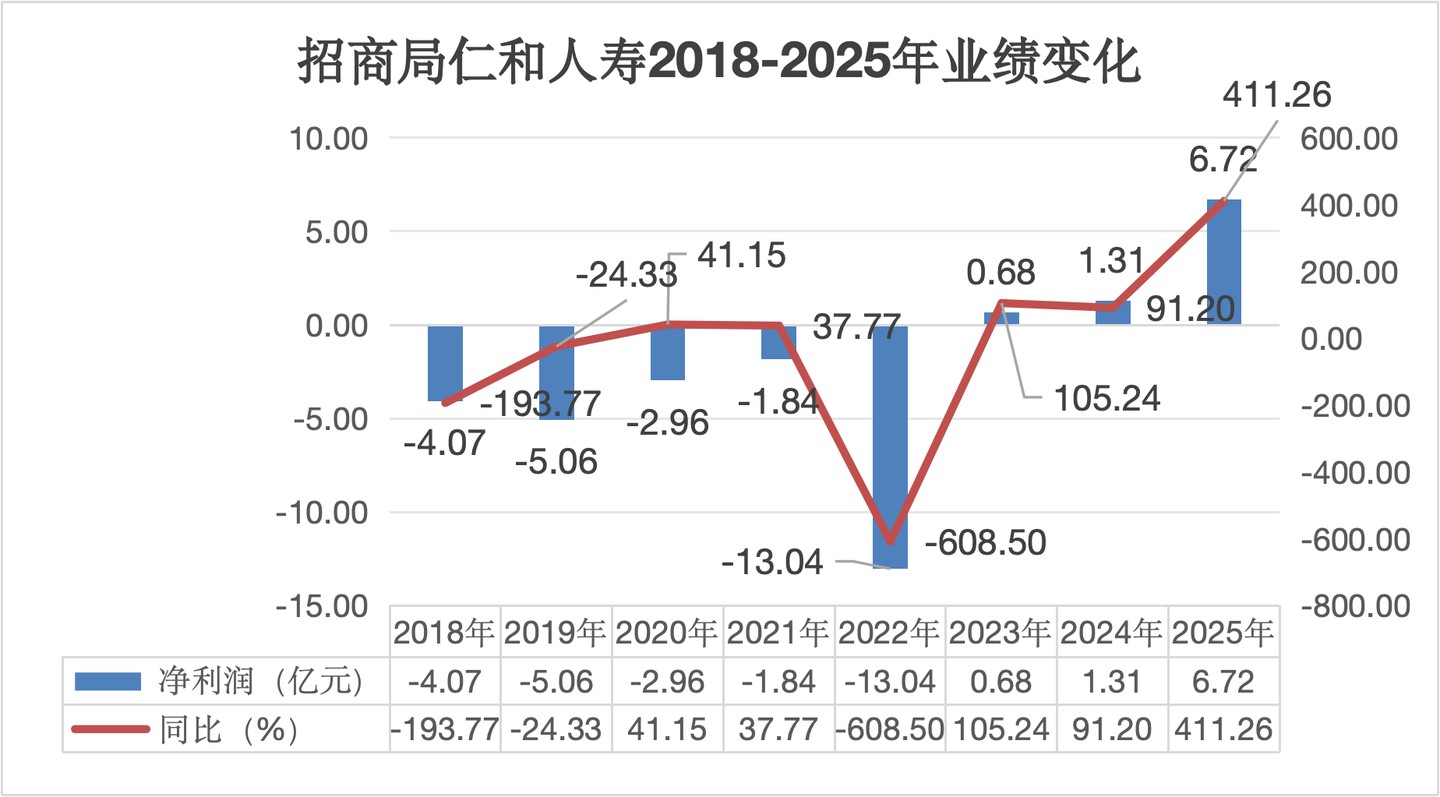
From a financial performance perspective, the company seems to have emerged from the loss cycle of its startup phase and entered the fast lane of profit harvesting.
However, amid the "dual carnival" of scale and profits, attention must still be paid to the trend of the capital adequacy ratio.
The report shows that by the end of 2025, the core solvency adequacy ratio of China Merchants Renhe Life Insurance fell to 96.18%, a significant decline from 128.47% at the end of 2024;
The main reason for this change is the rapid accumulation of business liabilities, with recognized liabilities rising from 7.65 billion yuan to 9.53 billion yuan.
At the same time, affected by the second phase of the solvency II rules and market conditions, the future surplus of policies included in core Tier 1 capital decreased from 1.17 billion yuan to 520 million yuan, resulting in a certain degree of erosion of the capital base.
In response to the "bleeding" of core capital, China Merchants Renhe Life Insurance demonstrated financial planning capabilities in the fourth quarter.
In November 2025, the company issued 1.3 billion yuan in capital supplement bonds, with a coupon rate of only 2.40%, and simultaneously redeemed 800 million yuan of old debt issued in 2020, which had a high interest rate of 4.95%;
This financial alchemy of "issuing new to repay old" not only brought the company an additional 500 million yuan in subordinate capital but also achieved a dual optimization of capital structure and cost control by saving approximately 20 million yuan in interest expenses annually.
On the investment side, China Merchants Renhe Life Insurance exhibited a strong defensive stance.
The investment return rate for 2025 was 5.22%, slightly lower than the previous year's 5.47%, but its asset allocation logic was clear: significantly increasing holdings of government bonds to 31.05 billion yuan;
In a declining interest rate cycle, this "locking in profits" action, while sacrificing some liquidity (cash ratio dropped to 0.67%), has built a moat for long-term stable returns.
Another noteworthy change lies in the shareholder register.
Beijing Zaichuan Technology Co., Ltd. plans to transfer its 3.79% stake to Chongqing Yufu Holding Group and Chongqing Linkong Development Investment Group, which means that a strong state-owned enterprise background from Chongqing will be introduced into the shareholder camp of China Merchants Renhe Life Insurance Extending from the Shenzhen headquarters to the southwest market, this cross-regional collaboration at the shareholder level may indicate China Merchants Renhe Life Insurance's new ambitions in its business landscape.
Despite achieving a stunning turnaround with assets exceeding 100 billion by 2025, challenges still objectively exist.
According to the company's forecast, the core solvency adequacy ratio may further drop to 83.55% in the next quarter. Against the backdrop of having used more than half of the capital replenishment bond quota, whether it will alleviate capital pressure through shareholder capital increase in the future will be key to observing its subsequent growth momentum.
Amid the impulse for expansion and the red line of capital, China Merchants Renhe Life Insurance is attempting to find a more sustainable balance point
