Don't just focus on Azure! Morgan Stanley supports Microsoft: cRPO increased by over 39% + Copilot is about to explode, the company's long-term growth logic remains unchanged

Wallstreetcn
2026.01.30 07:15
portai
I'm PortAI, I can summarize articles.

Microsoft's stock price hit its largest decline since 2020 due to Azure's growth slightly missing expectations, but Morgan Stanley believes that investors are overly focused on a single metric while ignoring the broader growth picture. Azure's limitations are due to supply shortages rather than weak demand, with a 39% surge in cRPO and the impending inflection point for Copilot indicating strong momentum ahead. With excellent margin expansion and a 21% EPS growth, Morgan Stanley believes Microsoft's valuation is severely undervalued, maintaining a target price of $650

As Microsoft's stock price experiences its largest single-day drop since 2020, Morgan Stanley firmly stands on the buy side. Despite the Azure growth rate falling short of market expectations leading to a sell-off, Morgan Stanley believes that investors are overly focused on a single metric while neglecting the broader growth picture: a giant with over $240 billion in revenue achieving a 15% constant currency growth, an operating margin expansion of 160 basis points to 47%, a 21% EPS growth, and a 39% year-on-year growth in cRPO (remaining contract obligations) indicating a stronger future.

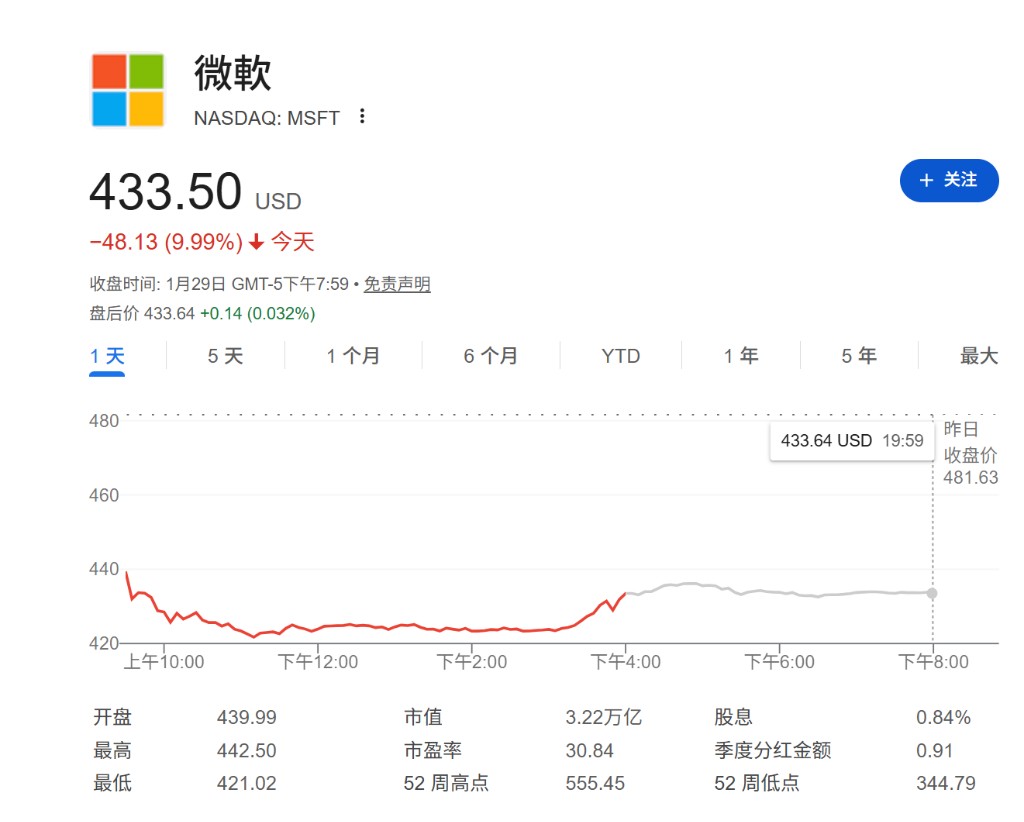
Microsoft's fiscal Q2 2026 results released on Wednesday showed that Azure's constant currency growth rate was 38%, just 1 percentage point above the company's guidance, and below the 2-3 percentage points expected by investors. This result disappointed the market, with Microsoft's stock price plunging over 12% at one point and ultimately closing down 9.99% at $433.50, marking the largest closing drop since March 2020.

However, Morgan Stanley maintains its "overweight" rating on Microsoft with a target price of $650. According to reports from the trading desk, Morgan Stanley analyst Keith Weiss pointed out in a report on the 29th that Microsoft's remaining performance obligations (cRPO) grew 39% year-on-year, with total commercial RPO reaching $625 billion, a year-on-year increase of 110%. Even excluding the large contracts with OpenAI, RPO still grew by 28%, indicating strong broad-based commercial demand. CFO Amy Hood emphasized during the earnings call, "Customer demand continues to exceed our supply capabilities."

Morgan Stanley believes that based on an expected CY27 price-to-earnings ratio of about 21 times, the revenue durability reflected in Microsoft's bookings and the profit margin expansion potential demonstrated this quarter are still underestimated by the market. Weiss wrote in the report:

"For a stock currently trading at 21 times our CY27 EPS expectations, a 21% constant currency EPS growth should support the stock price."

Azure constrained by supply rather than demand, management prioritizes long-term layout

Microsoft CFO Amy Hood repeatedly emphasized supply constraint issues during the earnings call, rather than weak demand. "Our customer demand continues to exceed our supply capabilities," Hood stated, "If I allocated all the GPUs that just came online in Q1 and Q2 to Azure, that KPI growth would exceed 40%."

Morgan Stanley pointed out that this reveals the true limiting factor for Azure's growth. In a supply-constrained environment, Microsoft's ability to exceed expectations largely depends on the speed of capacity expansion, which may change less than investors imagine. More importantly, Microsoft management is making allocation decisions, balancing between Azure growth and first-party applications like M365 Copilot and internal R&D demands. "Although investors may be dissatisfied with recent impacts, we believe this is the right long-term decision," Weiss wrote in the research report. Morgan Stanley believes that the M365 Commercial Cloud business remains the cornerstone of Microsoft's commercial success, and M365 Copilot can transform Microsoft from a productivity solutions provider into a major user interface for enterprise AI.

Microsoft's guidance for Azure in the third fiscal quarter is a constant currency growth of 37-38%, which means it is flat quarter-over-quarter or only down 1 percentage point, an impressive performance given the difficult year-over-year comparison of 4 percentage points. Morgan Stanley expects that if it can achieve a slight outperformance to around 39%, Azure's growth rate may actually accelerate.

The turning point for M365 Copilot is approaching; 15 million paid seats are just the beginning

The constant currency growth of 14% for M365 Commercial Cloud may seem flat compared to the previous two quarters, but the driving factors behind it are undergoing a critical shift. Microsoft disclosed that it currently has 15 million paid M365 Copilot seats, with daily active users increasing tenfold year-over-year, and the total number of M365 commercial users has exceeded 450 million.

Morgan Stanley pointed out that although the growth rate of seats has slowed to 6%, the 14% sustained growth means ARPU has become a core contributor. More importantly, in the second fiscal quarter, E5 upgrades were the main driver of ARPU growth, but in the third fiscal quarter's forward guidance, Copilot is listed as the primary driver of ARPU growth, "this marks a turning point."

According to Morgan Stanley's CIO survey report released on January 14, 80% of CIOs indicated that their organizations are using or expect to use M365 Copilot in the next 12 months, up from 72% in the second quarter survey. The penetration depth is expected to reach 36% of users in the next 12 months, up from the previous 31%.

Based on 15 million paid seats and considering bulk discount factors, this could mean an annual run rate revenue of over $3 billion. Management stated, "This is still in the early stages of the M365 Copilot product cycle," and Morgan Stanley's survey results "strongly support the acceleration of adoption."

Profit margins exceed expectations and guidance is raised, revenue base becomes broader

Microsoft's gross margin for this quarter was 68.0%, exceeding market expectations by 80 basis points; operating margin reached 45.6%, exceeding market expectations by 150 basis points, and expanded approximately 160 basis points year-over-year. Operating expenses grew only 4% in constant currency, demonstrating excellent cost control.

More importantly, Microsoft raised its full-year operating margin guidance from "essentially flat" to "slightly up." The cloud gross margin was 67%, although it decreased by 1 percentage point quarter-over-quarter, it exceeded the 66% guidance, as efficiency improvements were offset by increased AI investments and rising usage.

Commercial bookings grew by 228% in constant currency, benefiting from OpenAI's large commitments, but the data shows that OpenAI accounts for 45% of the commercial RPO balance, meaning over $340 billion comes from other customers, which grew 28% year-over-year. The weighted average RPO term increased from about 2 years to about 2.5 years, and this figure is the risk-adjusted net value "A 39% total cRPO growth indicates a robust growth outlook for the future, while 28% reflects a broad commercial strength base," Weiss summarized in the report. He emphasized that attention should not be solely focused on the Azure single metric, but rather on the revenue durability reflected in the booking volume.

Valuation Undervalued, Target Price Maintained at $650

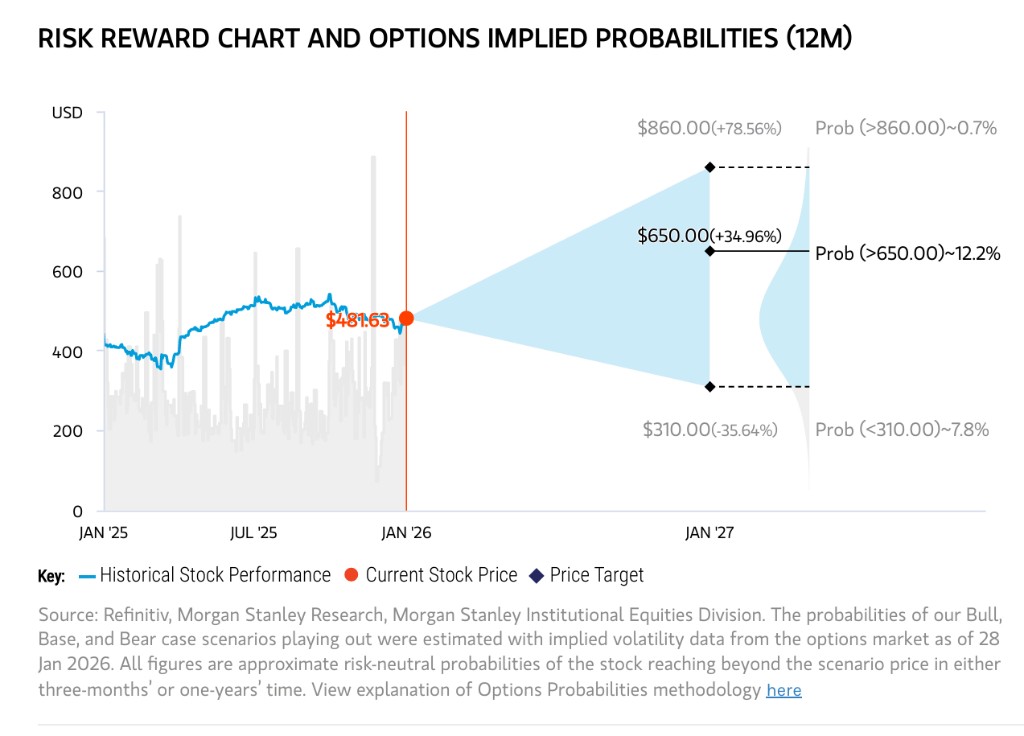
Morgan Stanley maintains its target price for Microsoft at $650, based on a 31x CY27 EPS of $21.17, slightly down from the previous 32x valuation, but the EPS expectation has been raised from $20.65. This valuation is comparable to large software peers, and while the 1.6x PEG ratio is at a premium to peers, Morgan Stanley believes Microsoft's strong positioning and excellent execution justify this premium. As of the time of writing, Microsoft's stock price has fallen to $433 per share.

Morgan Stanley's bull case scenario gives a target price of $860, based on a 36x CY27 EPS of $23.76; the bear case scenario is $310, based on a 16x CY27 EPS of $19.17. The EPS compound annual growth rate from FY24 to FY27 is 19.5% under the baseline scenario.

"For a company with a revenue base exceeding $240 billion, maintaining a 15% year-on-year growth, and an operating margin expansion driving a 21% constant currency EPS growth, a 39% year-on-year cRPO growth suggests that future growth could be even stronger. Although Azure fell short of market expectations by 1 percentage point, with a 21x CY27 EPS valuation, the market seems to have missed the bigger picture," Weiss stated.

Morgan Stanley views Microsoft as favorably positioned in cloud adoption and AI, with a large distribution channel and installed customer base, and margin expansion supporting EPS growth. "In the medium to long term, double-digit revenue growth, disciplined operating expenses, and strong capital returns will lead to sustained mid-to-high double-digit total returns."