


Precious metals crash, dollar rises! Wall Street wants to understand: Is Waller "friend or foe"?
Global markets faced the "Walsh Shock" on Friday, with gold and silver experiencing their largest single-day declines in decades, while the dollar surged. Walsh, once a well-known "inflation hawk," has recently shifted to calling for interest rate cuts but remains fixated on balance sheet reduction. Wall Street is puzzled, "Who is the real Kevin Walsh?" On one hand, the market is gripped by panic over liquidity tightening due to Walsh's advocacy for "balance sheet reduction"; on the other hand, there is a belief in his "market wisdom" and ability to maintain central bank independence
On Friday, Wall Street experienced a thrilling asset repricing. Faced with the prospect of former Federal Reserve Governor Kevin Warsh possibly leading the Federal Reserve, investors found themselves deeply conflicted: is this new chairman a "friend" or "foe" to the market?
The market's confusion was directly reflected in the dramatic price fluctuations. On Friday, silver briefly fell over 30%, marking the largest single-day drop since March 1980; gold briefly dropped 11%, representing the worst day since January 1980. Meanwhile, the U.S. dollar index surged 0.9%, the yield on 10-year U.S. Treasury bonds rose to 4.24%, the S&P 500 index dipped 0.4%, while the more liquidity-sensitive Russell 2000 index fell 1.5%.
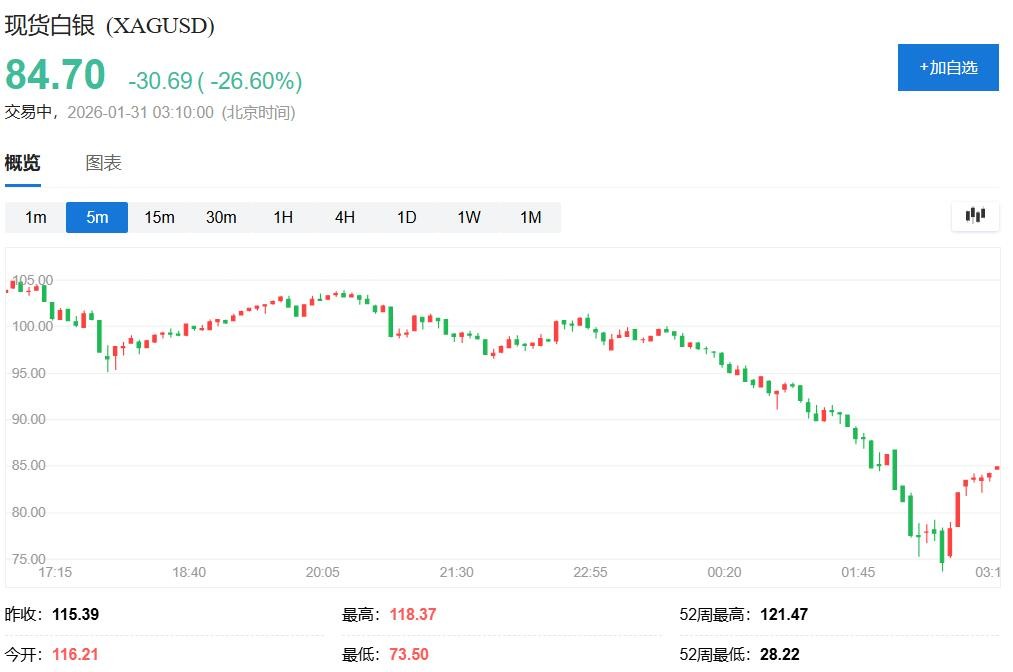
The core of this chain reaction lies in Warsh's seemingly contradictory policy stance. On one hand, he calls for the Federal Reserve to cut interest rates more quickly, while on the other hand, he firmly advocates for reducing the Federal Reserve's massive balance sheet (i.e., "quantitative tightening").
Priya Misra, a fixed income portfolio manager at JP Morgan Asset Management, candidly pointed out the market's concerns: "People are reacting to his comments about the balance sheet needing to shrink. This will have a very significant impact on risk assets."
For the market, while interest rate cuts are certainly a positive, if accompanied by aggressive balance sheet reduction, liquidity will be drained. This is the deep logic behind Friday's market performance, where "safe-haven assets (gold/U.S. Treasuries) were hit hard alongside risk assets, while only the dollar strengthened."
The Shadow of Quantitative Tightening: Concerns for Risk Assets
Wall Street's biggest worry is Warsh's attitude towards the Federal Reserve's balance sheet.
Warsh served as a Federal Reserve Governor from 2006 to 2011, during which he was known as an "inflation hawk," believing for years that low interest rates and large-scale bond purchases would fuel rising prices. Although his recent comments have shifted towards supporting quicker interest rate cuts, his insistence on reducing the balance sheet has led some investors to believe this could undermine the stimulative effects of rate cuts.
Currently, the Federal Reserve has just begun to expand its balance sheet again by purchasing short-term government bonds to ease pressure in the overnight lending market. If Warsh reverses this trend after taking office, market liquidity will face a test.
Support from Big Names: He is a "Pragmatist"
Despite the market's vote with its feet, the top investment circles on Wall Street have not uniformly turned bearish. Many seasoned investors believe Warsh's greatest value lies in his "independence." Compared to the "loose monetary flagbearer" previously demanded by President Trump, Warsh is seen as a suitable candidate who can withstand political pressure and maintain central bank independence.
Rob Arnott, founder of Research Affiliates, stated: "Warsh is a pragmatist. He will be a voice of reason, which will have a calming and soothing effect on the market." Hedge fund mogul Paul Tudor Jones praised Kevin Warsh, stating that he is "very market savvy." Jones believes, "In a context where debt exceeds 100% of GDP and the deficit rate reaches 6%, he is the perfect candidate to guide us through potential challenging times."
Pimco Chief Investment Officer Dan Ivascyn also reassured the market, saying: "The market will feel comfortable with this choice; he will demonstrate enough independence."
The Logic Reversal of "Currency Depreciation Trade"
From a trader's perspective, Friday's market revealed another shift in logic. The previous historical highs in gold and silver largely reflected the market's loss of confidence in the dollar and U.S. assets (i.e., the "currency depreciation trade").
However, Warsh's emergence seems to have reversed this expectation. The strong rebound of the dollar on Friday, coupled with the collapse of precious metals, suggests that investors are retracting this "vote of distrust." Peter Boockvar, Chief Investment Officer of OnePoint BFG Wealth Partners, summarized the uncertainty of this complex sentiment with a pun:
"Will the real Kevin Warsh please stand up?"
All current market fluctuations are essentially betting on "who is the real Kevin Warsh." His policy stance is complex and difficult to discern: he was once a well-known "inflation hawk," recently shifted to calling for interest rate cuts, yet has always been preoccupied with balance sheet reduction. This complexity renders any simple "dovish" or "hawkish" label inadequate.
It is worth noting that even if Warsh takes office, he cannot unilaterally set policy.
While the Federal Reserve Chair has significant influence, he is still constrained by the committee's voting mechanism. Currently, there are divisions within the Fed; this week, the Federal Open Market Committee (FOMC) voted to keep interest rates unchanged, but the two governors appointed by Trump, Waller and Mulaney, voted against it, supporting a 0.25 percentage point cut.
Some investors point out that if the U.S. experiences frequent disagreements between the central bank leadership and the committee on interest rate decisions, similar to the UK, it would signify a major change and could pressure the market due to increased uncertainty in future decisions.
Clearly, Wall Street needs more time to digest the complex signals brought by this potential new chair
