OpenAI, Anthropic, Google "Three Kingdoms Kill", Microsoft "Quietly Making Money" | a16z Latest Report

Wallstreetcn
2026.02.02 08:48
portai
I'm PortAI, I can summarize articles.

The annual survey report released by the well-known Silicon Valley venture capital firm a16z shows that OpenAI remains the leader in the enterprise AI market, with 78% of CIOs using its technology, while Anthropic's penetration rate is rapidly increasing, reaching 44%. Microsoft holds an advantage in enterprise applications with its deeply embedded products. Corporate spending on AI large models continues to rise and is expected to increase significantly this year. The report indicates that the market is accelerating towards an oligopoly structure composed of OpenAI, Anthropic, and Google

The well-known Silicon Valley venture capital firm a16z recently released its third annual survey report on 100 CIOs from the world's top 2000 companies, revealing several key topics in the enterprise AI competition: the market is accelerating towards an oligopoly, and corporate spending continues to accelerate.

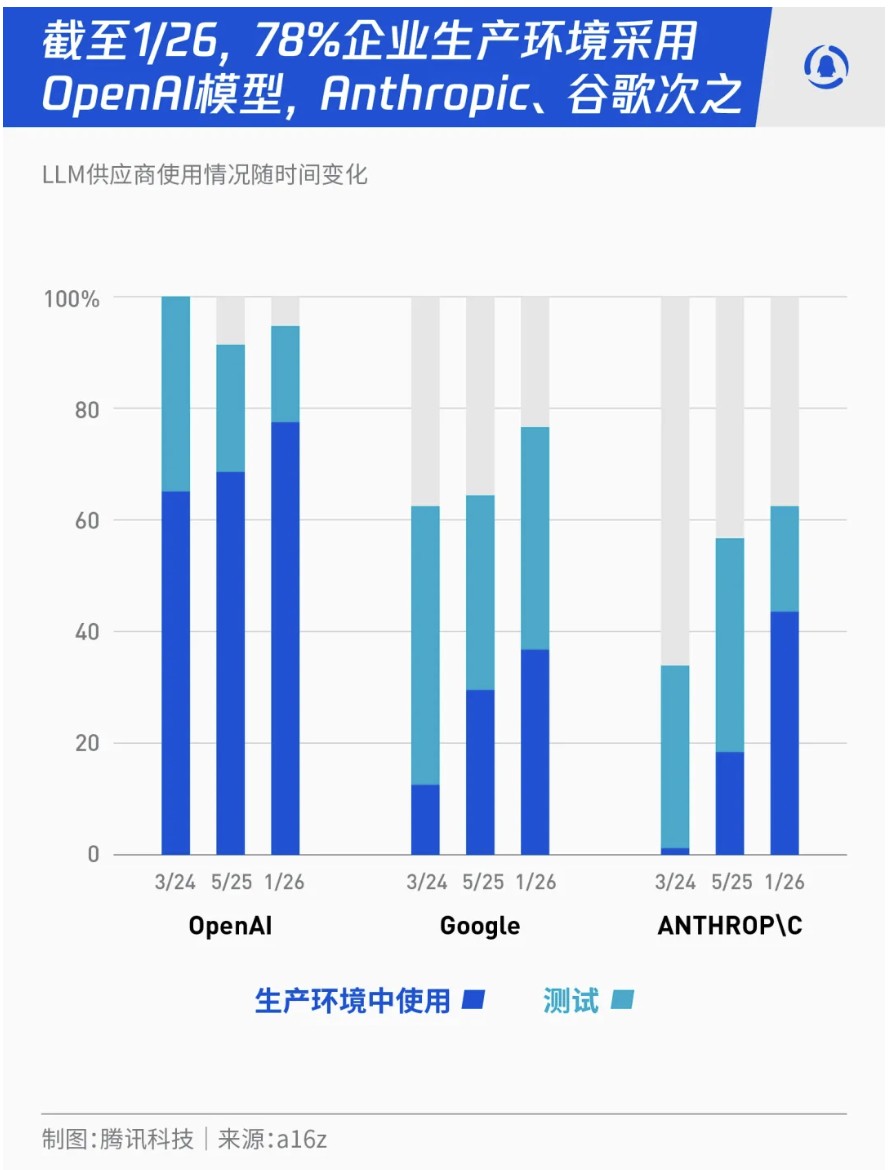
The core findings of the report indicate that OpenAI remains the clear market leader, with 78% of surveyed CIOs using its technology, but the momentum of the challengers is very strong, especially Anthropic, which has achieved significant growth in enterprise penetration in a short period.

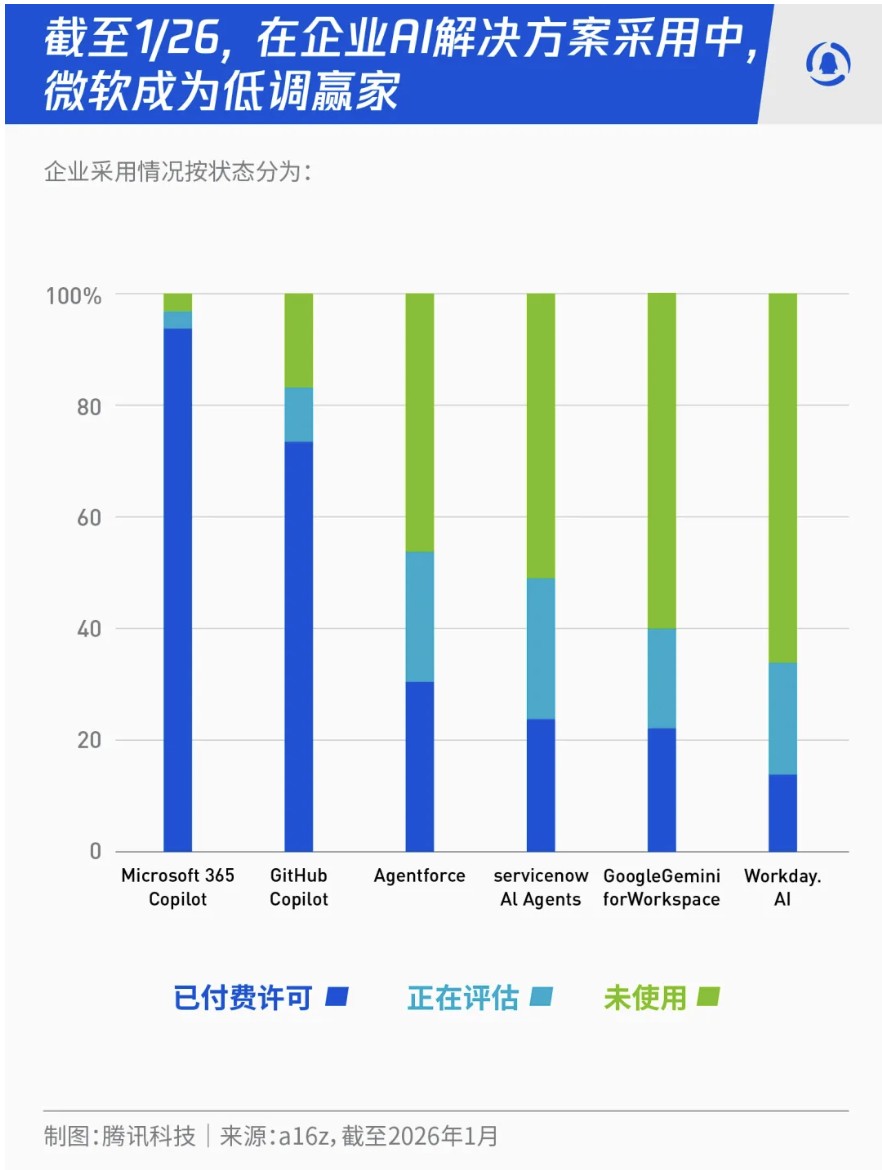
However, in the practical application of enterprise-level solutions, the real winner is Microsoft.

With products deeply embedded in enterprise workflows, such as Microsoft 365 Copilot and GitHub Copilot, along with corporate clients' natural preference for trust, integration, and procurement convenience, Microsoft holds a significant advantage.

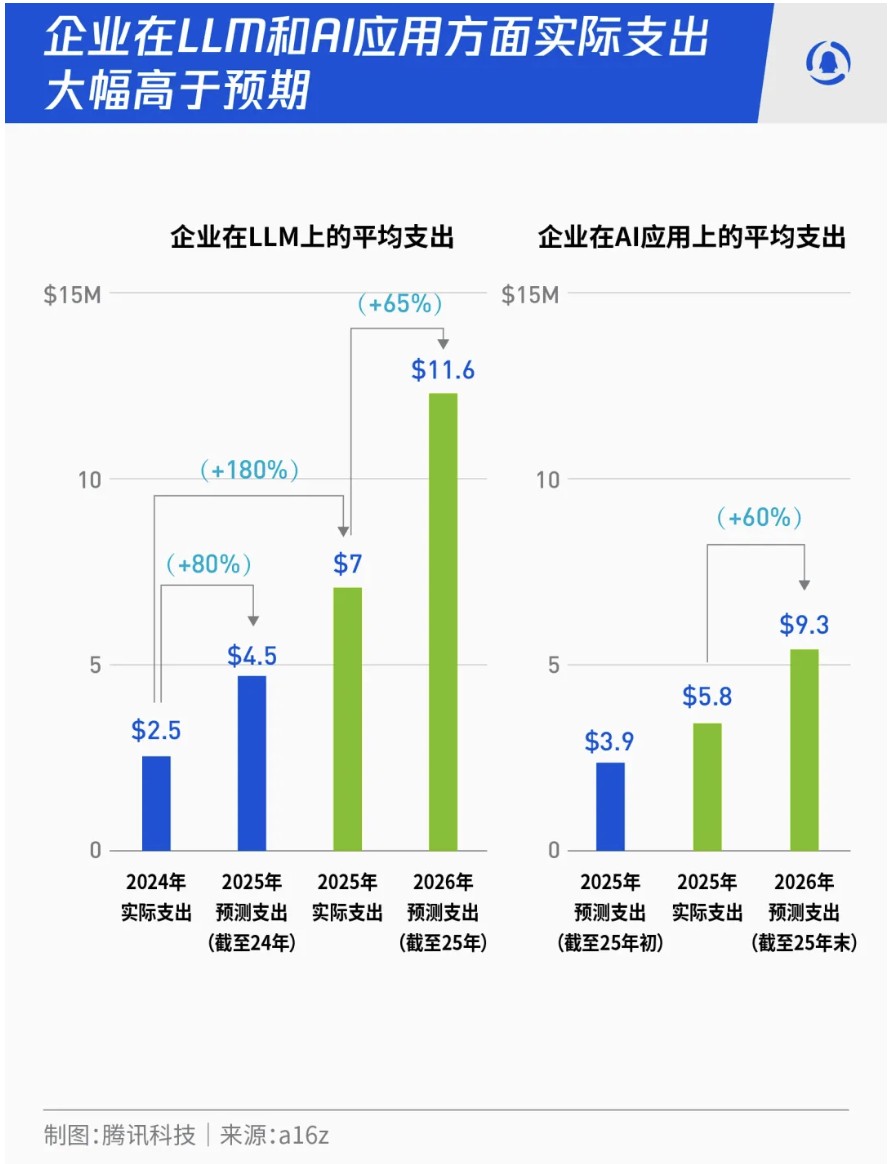
Meanwhile, companies are continuously increasing their investments with real money. Data shows that the average spending on AI large models by enterprises has rapidly grown over the past two years and is expected to continue to increase significantly this year.

Here are the four core findings from the a16z report:

01 Model Competition: OpenAI Leads, Anthropic and Google Follow Closely

In the realm of enterprise AI models, OpenAI remains an unavoidable name.

According to the survey, as many as 78% of the surveyed CIOs are using OpenAI's models in production environments. However, the market is not static; changes are occurring, and the most vigorous challenger comes from Anthropic.

Data shows that since May 2025, Anthropic's enterprise penetration rate has surged by 25%, making it the fastest-growing player. Currently, 44% of enterprises are using its models in production, and if we include testing environments, this percentage exceeds 63%.

Even the share of enterprise wallets (budget allocation) tells the same story: OpenAI still holds about 56% of the majority, but its share is steadily being eroded by Anthropic and Google Gemini. Respondents generally expect this trend to continue into 2026.

In simple terms, a "Three Kingdoms" oligopoly structure composed of OpenAI, Anthropic, and Google is forming. These three companies are all growing rapidly, sharing an ever-expanding pie, but the battle for market share among them is already "smoky."

02 Application Implementation: Microsoft Becomes the "Silent Winner"

While public discourse is keen on discussing the model showdown between OpenAI and Anthropic, the survey data points to an "unexpected winner" that many have overlooked—Microsoft Data shows that most AI applications among the Global 2000 companies are still implemented through existing giants like Microsoft.

Products under Microsoft, such as Microsoft 365 Copilot lead in enterprise chat scenarios, and GitHub Copilot dominates in enterprise coding. Companies choose them not solely because of cutting-edge technology, but for more practical considerations.

65% of surveyed companies explicitly stated that they prefer existing solutions like Microsoft, with highly consistent reasons: trust, seamless integration with existing systems, and simplicity in the procurement process.

This indicates that in the enterprise market, the practicality of “easy to use, worry-free, and integrable” often carries more weight than the allure of “latest and flashiest” technology.

However, the report also points out that this does not mean startups have no opportunities. Companies are equally eager for faster innovation and more flexible AI-native solutions, leaving openings for challengers.

03 The "Application Apocalypse" is Overstated

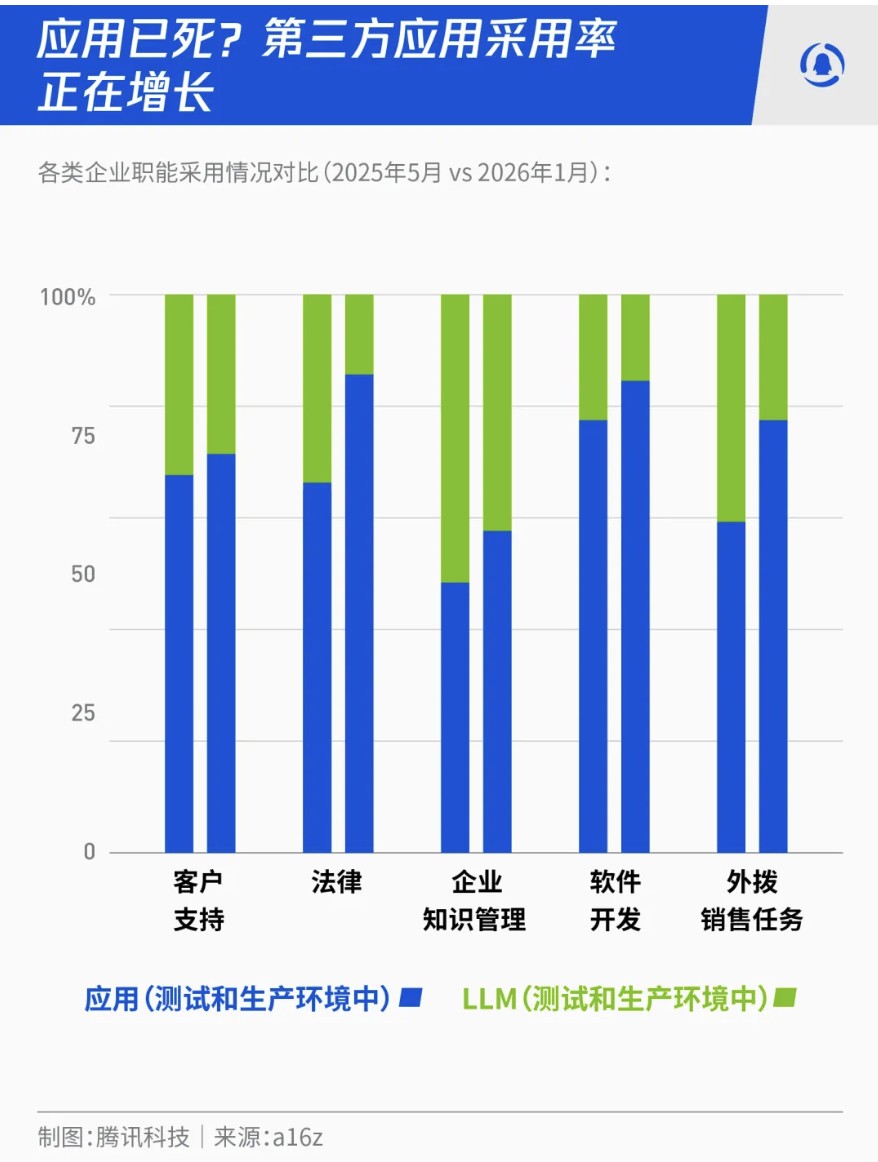
There has been ongoing debate about whether enterprises should build their own AI capabilities or directly procure applications. A popular viewpoint suggests that as foundational model capabilities enhance, third-party applications will lose their space.

But a16z's survey report found that this "Application Apocalypse" is severely overstated.

On the contrary, data shows that enterprises are continuously turning to procure third-party applications, even in traditionally self-developed areas like knowledge management and workflow automation, many companies plan to shift from "doing it themselves" to purchasing mature packaged solutions.

The logic behind this is that mature third-party applications can provide deep contextual capabilities that enterprises find difficult to build quickly on their own, and can bring more practical business results by intelligently leveraging the advantages of different models. This competition between "self-development" and "procurement" is far from over.

04 The Spending Truth: Enterprises are Spending Faster than Expected

The most direct reflection of the AI market's heat is the real money that enterprises are spending.

One of the core findings of this survey is that the actual growth rate of the market far exceeds everyone's expectations, including the enterprises and suppliers involved.

Specifically, over the past two years, the average spending of enterprises on AI large models has surged from about $4.5 million to approximately $7 million. Their budget for this year is even more aggressive, expecting to grow by about 65% again, reaching an average of approximately $11.6 million Corporate spending on AI applications follows this trajectory as well, with actual expenditures far exceeding budgets. Companies expect to spend an average of approximately $3.9 million, but in reality, they have spent nearly $6 million.

These figures indicate that enterprise-level AI is no longer a "trial" project, but has entered the fast lane of scaled and normalized investment. The intensity and durability of demand prove that this is not a fleeting trend.

Risk Warning and Disclaimer

The market carries risks, and investment should be approached with caution. This article does not constitute personal investment advice and does not take into account the specific investment goals, financial situation, or needs of individual users. Users should consider whether any opinions, views, or conclusions in this article align with their specific circumstances. Investment based on this is at one's own risk.