Leveraged ETFs drop 60% in two days! Silver becomes a "retail investor graveyard," with Reddit speculators in despair

The silver market has experienced extreme volatility, with prices dropping over 40% within three days, resulting in significant losses for retail investors. Although there was a 9% rebound on Tuesday, the market turmoil has led to a $150 billion decrease in market capitalization, particularly impacting leveraged ETFs. The reasons for this crash include the nomination of the Federal Reserve Chairman and increased margin requirements, with analysts warning that such extreme fluctuations are "an accident waiting to happen." Retail investors injected a record amount of funds into silver ETFs in January, leading to intensified speculation
The historic surge in the silver market has recently encountered a severe reversal, evolving into a crash that caught retail investors off guard. Driven by a speculative frenzy, the volatility of this precious metal once rivaled that of "Meme stocks" during the COVID-19 pandemic, but then quickly turned downward, erasing massive market value and severely impacting retail investors who entered at high prices.
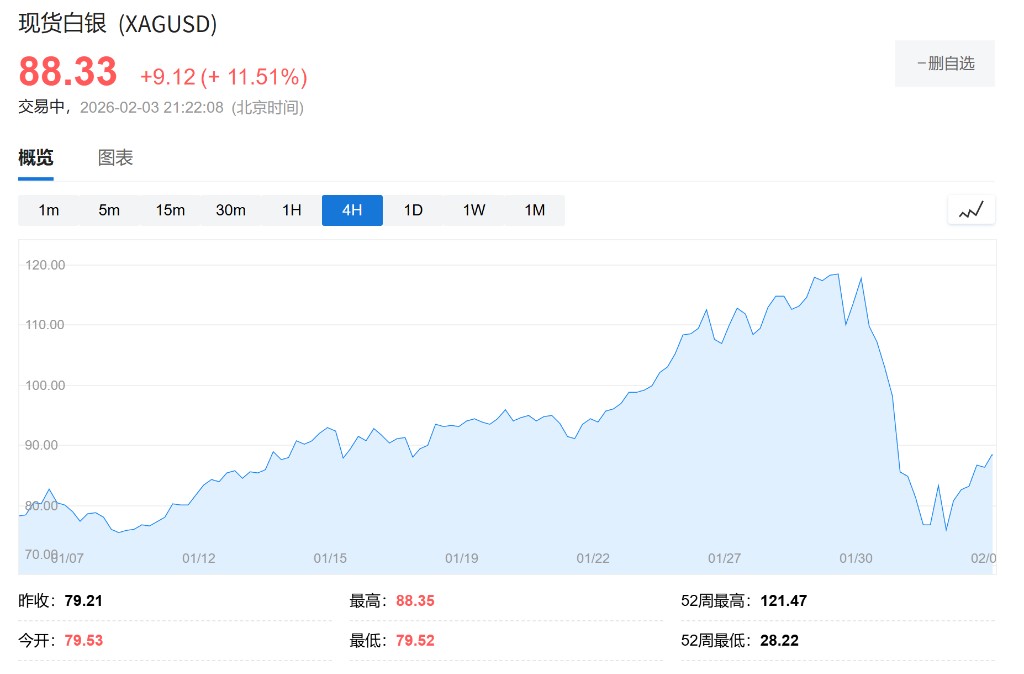
After silver prices hit a high of over $120 per ounce last Thursday, they suffered a brutal three-day decline, dropping more than 40%. Although prices rebounded by 9% on Tuesday, the extreme market volatility has caused significant damage. Meanwhile, gold prices also experienced a dramatic fluctuation, falling 21% from their peak before rebounding by 6%.

The trigger for this crash includes U.S. President Trump's nomination of Waller as Federal Reserve Chairman and exchanges raising margin requirements. However, traders generally believe that the speed and severity of the crash are primarily attributed to the rapid reversal of the recent speculative frenzy. In the previous months, especially retail funds from Asia poured in, attempting to profit from this highly volatile asset.
Market data shows that the market capitalization of ETFs tracking gold and silver has shrunk by about $150 billion since the market peaked last week. Among them, leveraged ETFs favored by retail investors have been severely impacted, with a double long silver ETF plummeting nearly 70% in two days, causing devastating losses for speculators active on forums like Reddit. Analysts warn that silver, often referred to as "gold on steroids" due to its high volatility, is experiencing an extreme market trend that is essentially a "waiting accident."
"Meme Stock"-like Speculative Frenzy
Although there was a rush to purchase physical silver in January, even leading to supply shortages at national mints and refiners working overtime to melt jewelry, market participants pointed out that the most fervent speculative behavior was primarily concentrated on financial assets linked to precious metals.
Data from Vanda Research shows that retail investors injected a record $1 billion into silver ETFs in January. As the most favored target for retail investors, the silver ETF SLV set multiple trading records last week. On January 26, when silver prices approached historical highs, SLV's trading volume reached $39.4 billion, nearly on par with the $41.9 billion trading volume of the hottest ETF tracking the S&P 500 index, SPY. On the same day last year, SPY's trading volume was 70 times that of SLV.
Eloise Goulder, head of global data assets and the Alpha team at JP Morgan, noted that mentions of silver by retail investors on social media in January were 20 times the average level of the past five years. Nicky Shiels, an analyst at refiner MKS Pamp, stated, "January will be remembered as the month silver traded like a 'Meme stock.'" She even received messages from people jokingly saying she was "officially working at a casino."
Leveraged ETFs Devastate Retail Investor Portfolios
For retail investors who entered the market using leveraged tools at high price levels, this pullback has been catastrophic. Trevor Yates from Global X ETFs pointed out that leveraged ETFs are typically driven by retail fund flows, as institutional investors have more effective ways to obtain leverage.
Among them, the popular 2x long silver price ETF—AGQ—plummeted 60% last Friday and then dropped another 9% this Monday. This severe one-sided decline has caused significant losses for many who bought in at high prices.
On the Reddit forum, the lamentations of retail investors are everywhere. One user who bought AGQ near the historical high of silver prices last week stated that as of the weekend, he had unrealized losses exceeding $25,000, writing: “I lost an amount today equivalent to my after-tax annual salary, nearly my entire portfolio.” Another user trading silver derivatives claimed to be “devastated” because he lost “astronomical amounts of money” when silver prices fell a record 27% in a single day last Friday.
StoneX analyst Rhona O’Connell bluntly stated:
“Silver has always been a death trap. The parabolic movement in the past few weeks has indeed been an accident waiting to happen.”
Policy Triggers and Market Structure Vulnerabilities
The sell-off was initially triggered by macro news. Trump's nomination of Waller as a candidate for Federal Reserve Chair led some investors to believe that Waller was less likely to yield to rate cut pressures compared to other candidates, which somewhat alleviated market concerns about the loss of central bank credibility—one of the driving forces behind the rebound in precious metals over the past six months. Additionally, the increase in margin requirements for precious metal trading on exchanges in both China and the U.S., along with seasonal sell-offs before the Lunar New Year, accelerated the decline.
However, the lack of depth in the silver market amplified these effects. Analysts pointed out that the silver market is relatively niche and unable to cope with the massive influx of hot money this year. CRU analyst Kirill Kirilenko explained that this is also why silver is referred to as “gold on steroids,” as it tends to overshoot in both directions. When investors rush to exit bullish bets, the market lacks sufficient liquidity to absorb the selling, leading to a price collapse.
Bull-Bear Divergence and Future Outlook
Despite the dramatic plunge, the current silver price has only fallen back to mid-January levels. Investors who have held gold and silver long-term over the past year still enjoy substantial gains.
Some market participants view this decline as a pullback within a deep rebound. Sébastien Le Page from consulting firm Acumet believes:
“This is just a knee-jerk reaction; we are still in a bullish zone.”
Meanwhile, the most loyal supporters of silver on online investment forums are still trying to maintain an optimistic outlook. Despite the market's sharp downturn last Thursday, one Reddit user still urged to “keep accumulating.” Even after the deepening decline on Monday, some posters insisted on a bullish stance, claiming “this is the most obvious long-term buy signal ever.” The extreme divergence in the market suggests that future volatility may continue. **
Risk Warning and Disclaimer
The market has risks, and investment should be cautious. This article does not constitute personal investment advice and does not take into account the specific investment goals, financial situation, or needs of individual users. Users should consider whether any opinions, views, or conclusions in this article are suitable for their specific circumstances. Investment based on this is at one's own risk.