


Citadel economists discuss Waller: The Federal Reserve may not cut interest rates for the next year, and the dollar bear market is paused
Nohshad Shah believes that the Federal Reserve may keep interest rates unchanged for the foreseeable future, possibly not lowering them for an entire year, and that the nominal GDP in the United States may be in the range of 5-6% this year. From a policy standpoint, Waller's historical record shows that he is "significantly more hawkish" than other competitors, consistently prioritizing inflation control over employment considerations. The dollar has fallen by about 11% over the past year, and it's time for short positions to take a step back
Nohshad Shah, an economist at Citadel Securities, stated in a recent column that the Federal Reserve may keep interest rates unchanged for the foreseeable future, a prospect that has become clearer with the nomination of Waller as the next Fed Chair. Against the backdrop of a resilient U.S. economy and the resurgence of inflation risks, the dollar, which has significantly declined over the past year, may find a moment of respite.
Nohshad Shah pointed out that under an almost unprecedented policy combination of loose financial conditions, relaxed monetary policy, and the upcoming large-scale fiscal stimulus (OBBA Act), the nominal GDP in the U.S. this year could be in the range of 5-6%. The Dallas Fed tracks the GDP growth rate for the fourth quarter at 2.49%, while the New York Fed's real-time forecast is 2.74%, achieved even with a prolonged government shutdown.
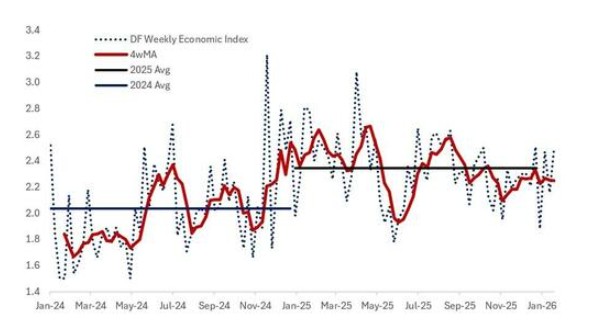
In last week's meeting, the Federal Reserve acknowledged the reality of stronger economic growth and indicated that the balance of risks has shifted from employment targets. The FOMC statement upgraded the description of economic activity from "moderate" in December to "robust" expansion, with the unemployment rate showing "signs of stability." The signals conveyed by Chair Powell during the press conference indicated that the committee generally believes that the policy rate is no longer in a restrictive zone, with rates nearing the estimates of neutral rates by most institutions (around 3.25%) after implementing a 75 basis point "insurance cut" last year.
The dollar has fallen about 11% over the past year, a significant decline. However, Shah believes that as the Fed may remain on hold in the coming months, the U.S. economic growth outlook gains broad recognition, and the independence of the Fed is re-emphasized, "dollar bears should be cautious at current valuation levels."
Reasons for the Fed's Inaction: Strong Economy and Inflation Concerns
Nohshad Shah emphasized in the report that the improvement in downside risks to employment has exceeded the improvement in upside risks to inflation. Although there are still some concerns in the labor market, consumer spending and business investment remain strong, and corporate profits are robust.
The U.S. economy has once again demonstrated resilience, rebounding strongly from last year's tariff shocks. Under the current policy mix, inflation risks may become a focal point again in the coming months. Shah explicitly stated: "I do not expect further rate cuts—certainly not from the Fed led by Powell—perhaps not for an entire year."
Powell reiterated concerns about the independence of the Fed during the press conference, and his strategy to respond to pressures from the Trump administration seems to be working well. The early reappointment of regional Fed presidents, a strong direct response to the Justice Department's subpoenas, and Senator Tillis's immediate rebuttal—who stated he would block the confirmation of new Fed governors until the issues are resolved—indicate that the government's strategy may backfire, failing to achieve greater control over the Fed and thus pushing for a more dovish monetary policy
Will Waller usher in a hawkish era?
Waller has been nominated as the next Chairman of the Federal Reserve, a choice that is at least partly rooted in the aforementioned political dynamics. Waller is widely seen as a more "establishment" candidate, enjoying considerable popularity among traditional Republican lawmakers, which should facilitate a smoother confirmation process.
However, from a policy standpoint, Waller's historical record shows that he is "significantly more hawkish" than other competitors, consistently prioritizing inflation control over employment considerations. Nohshad Shah points out that Waller has a low tolerance for expanding monetary easing through unconventional tools like quantitative easing. Under his leadership, interest rate cuts may only be implemented when current conditions clearly demonstrate the necessity, while also continuing to reduce the balance sheet.
Waller criticizes what he perceives as the "mission creep" during Powell's tenure, leaning towards a stricter focus on price stability rather than the broader goals that have increasingly fallen within the Federal Reserve's responsibilities in recent years, echoing Treasury Secretary Bessent's criticism of the Federal Reserve's "functional acquisition."
Although Waller explicitly supports the independence of the Federal Reserve, past statements indicate he is open to closer coordination with the Treasury and political institutions on broader economic strategies. Recently, Waller has also supported AI-driven productivity enhancements, using this argument to advocate for lower interest rates.
However, the institutional structure of the Federal Reserve means that staff, governors, and regional presidents need to reach a consensus on new balance sheet or policy interest rate paths before implementation. Given President Trump's well-known preference for lower policy rates, Waller may face the challenge of walking a tightrope between his historical policy instincts and the political pressure for easing.
Should dollar bears take a break?
The weakness of the dollar has been a dominant theme in the market, driven by a series of related factors. The bilateral exchange rate check by the Japanese Ministry of Finance and the New York Fed (representing the U.S. Treasury) triggered short covering in the yen but also broadly weakened the dollar, as the market focused on the risks of a weak dollar policy and speculation surrounding coordinated dollar depreciation.
Nohshad Shah believes that the reality seems more likely to be that Treasury Secretary Bessent is simply willing to support the Japanese Ministry of Finance's intervention threats to enhance their effectiveness in curbing the rapid depreciation of the yen, rather than signaling a shift in dollar policy. Nevertheless, President Trump's comments in response to specific questions about the dollar suggest he is satisfied with currency valuations, exacerbating the resulting dollar weakness.
The broad dollar index (DXY) has fallen about 11% over the past year, a significant fluctuation. Shah notes that this round of renewed weakness provides a good opportunity for long-term investors holding dollar short positions to take profits.
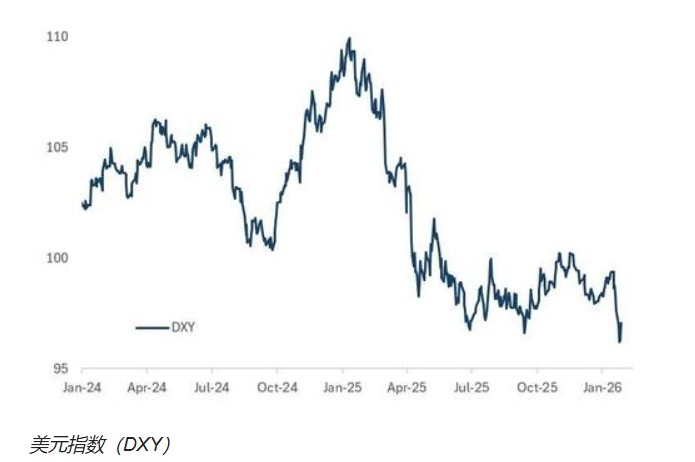
"As the Federal Reserve may remain on hold for at least the next few months, the outlook for strong U.S. economic growth gains widespread acceptance, and the aforementioned re-emphasis on Federal Reserve independence, dollar bears should exercise caution at current valuation levels," Shah summarizes. For those investors who view central bank independence as key to global financial stability, the future of the Federal Reserve appears less susceptible to overt political interference, which is a positive outcome
