Valuation exceeds $100 billion! JP Morgan initiates coverage on Waymo: predicts order volume will exceed 277 million by 2030, with a CAGR of up to 79%

JP Morgan released its first valuation model for Waymo, predicting that benefiting from the massive $16 billion financing and global expansion, Waymo's order volume will soar from 15 million in 2025 to 277 million by 2030. The company plans to achieve explosive growth by entering the airport and international markets, capturing 6% of the U.S. ride-hailing market by 2030
JP Morgan has released its first valuation model for Waymo, predicting that the Alphabet-owned autonomous driving company will experience explosive growth over the next five years. The bank forecasts that by 2030, Waymo's annual order volume will soar from 15 million in 2025 to 277 million, with a compound annual growth rate of up to 79%, and total bookings will approach $6 billion, capturing about 6% of the U.S. ride-hailing market.
This prediction comes as Waymo has just completed a $16 billion financing round, reaching a valuation of $126 billion, just 15 months after its previous $5.6 billion funding round. Waymo stated in its announcement that the new funds will allow the company to "advance at an unprecedented speed." During this period, Waymo's weekly paid order volume has nearly tripled from 150,000 to over 400,000, with a total of 15 million orders expected to be completed in 2025.
According to reports from the Wind Trading Desk, JP Morgan analyst Doug Anmuth stated in a report released on February 3 that Waymo's vehicle fleet is expected to expand from fewer than 3,000 vehicles at the end of 2025 to over 35,000 vehicles by the end of 2030, with a compound annual growth rate of 67%. By 2026, Waymo's fleet size is expected to double to approximately 5,725 vehicles, providing over 35 million orders and generating more than $800 million in total bookings.
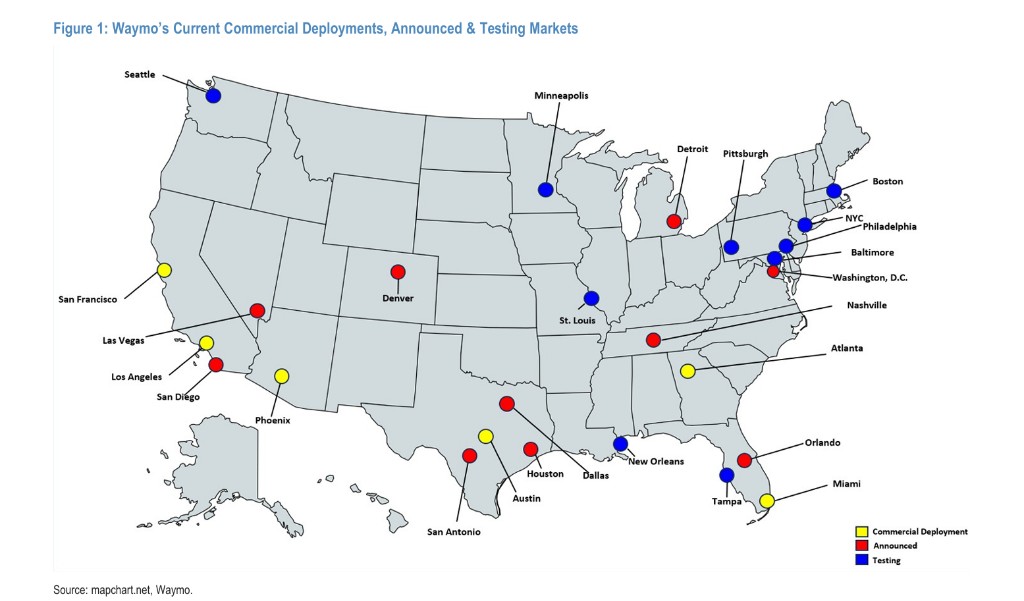
The bank believes that autonomous driving will expand the overall market size, with much of Waymo's growth coming from incremental markets, but it will also capture some share from traditional ride-hailing platforms like Uber and Lyft. Currently, Waymo operates in six markets, including Phoenix, San Francisco, and Los Angeles, and plans to add 10 new cities in the U.S. by 2026, as well as enter the London and Tokyo markets.
Aggressive Expansion Plans Support High Growth Expectations
JP Morgan's valuation model is based on Waymo's urban expansion plans and fleet growth trajectory. The bank expects Waymo to enter 10 new U.S. cities, including Dallas, Houston, San Antonio, and Orlando, by 2026, while also launching operations in London and possibly Tokyo, bringing the total number of operational and testing cities to over 20.

Specifically for the 2026 forecast, JP Morgan estimates that Waymo's fourth-quarter order volume will reach approximately 11.6 million, equivalent to an operational pace of about 900,000 per week, which is basically in line with Waymo's own target of achieving 1 million weekly orders by the end of 2026.
In terms of market share, JP Morgan expects Waymo to capture about 1% of the order volume and total bookings share in the U.S. ride-hailing market by 2026, with this proportion increasing to about 6% by 2030. However, the bank emphasizes that autonomous driving technology is a market enlarger, and Waymo's success will help grow the overall pie rather than simply taking share from existing players

$16 Billion Financing Accelerates Commercial Deployment
Waymo announced on February 2nd that it has completed $16 billion in financing, with investors including major backer Alphabet, as well as Dragoneer, DST Global, Sequoia Capital, and others. This follows a large-scale financing of $5.6 billion in October 2024, with only a 15-month gap between the two rounds of financing.
During this period, Waymo's operational data has rapidly increased. The number of paid orders per week has grown from 150,000 to over 400,000, with a total of 15 million orders completed in 2025, three times that of 2024. Reports indicate that Waymo reached an operational pace of 450,000 orders per week by December 2025, an 80% increase from 250,000 orders in April 2025.
Waymo stated that it will use the new funds to advance global expansion "at an unprecedented speed," aiming to achieve an operational pace of over 1 million orders per week by the end of 2026, approximately 2.5 times the current 400,000 orders. The company is laying the groundwork for ride-hailing operations in over 20 cities, including international markets like Tokyo and London.
JP Morgan noted that this large-scale financing will support Waymo in significantly expanding its fleet size in the short term, providing financial assurance for achieving fleet targets of 5,725 vehicles by the end of 2026 and 35,275 vehicles by 2030, the latter being about 13 times the current fleet size.
Airport and Highway Access as Key Breakthroughs
Waymo has recently made significant progress in airport access. Last week, Waymo announced the launch of commercial operations at San Francisco International Airport (SFO), initially open to select users, with plans to open to all users in the coming months. The timing is strategically significant, coinciding with the Super Bowl on February 8th and preparing for the FIFA World Cup in June and July, during which six matches will be held in Santa Clara.
Previously, Waymo had begun operations at San Jose Airport and received permission to test at Newark Airport. At Dallas Love Field Airport and San Antonio International Airport, Waymo has initiated employee testing. The company disclosed in December 2025 that the cumulative order volume at Phoenix and San Jose airports had exceeded 500,000 orders.
JP Morgan estimates that airport orders account for about 15% of Uber's total ride-hailing bookings, with a higher profit margin. Waymo's broader access to airports and highways could impact Uber's total ride-hailing bookings and EBITDA in the medium term. However, the firm also noted that autonomous driving could overall expand the addressable market size.
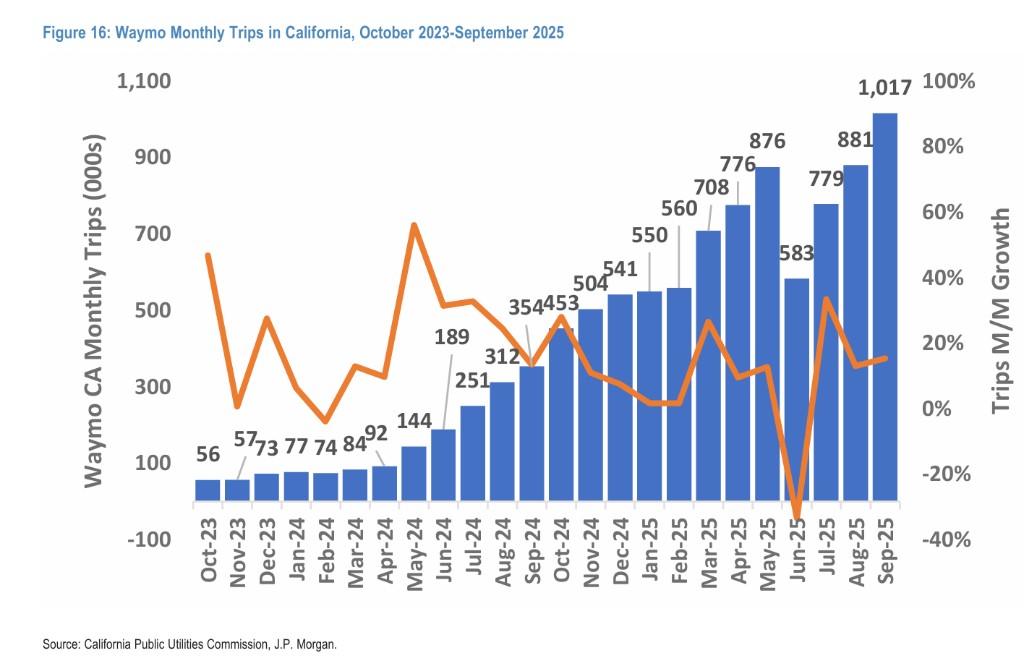
In terms of operational data, according to data from the California Public Utilities Commission, Waymo's order volume in California reached approximately 2.7 million orders in the third quarter of 2025, a 20% quarter-over-quarter increase and a threefold year-over-year increase. The monthly order volume in September surpassed 1 million for the first time, equivalent to about 237,000 orders per week, accounting for over 50% of Waymo's global weekly operational volume of 450,000 orders
User Data Shows Growth but Retention Needs Improvement
According to Sensor Tower data, the monthly active users of the Waymo One app increased by 63% year-on-year in January 2026, accounting for about 6.0% of Lyft's monthly active users in the U.S. and about 3.3% of Uber's monthly active users in the U.S. In terms of downloads, Waymo One is about 25% of Lyft's and 34% of Uber's.
However, in terms of user stickiness metrics, Waymo still lags behind traditional ride-hailing apps. The daily active users to monthly active users ratio (DAU/MAU) for Uber is 11%, for Lyft is 12%, while Waymo One is only 8%. Retention rate data shows that Waymo One's retention rates at various time points are lower than those of Uber and Lyft, which may indicate a certain novelty factor and one-time use related to tourism.

Google search trends indicate that in Waymo's five operational markets, its search popularity has surpassed Lyft in Phoenix, San Francisco, and Austin, while being slightly lower than Lyft in Los Angeles and Atlanta. Notably, in Las Vegas, the search popularity of Zoox, which just launched public operations in September, has also surpassed Lyft, despite its very limited operational area.
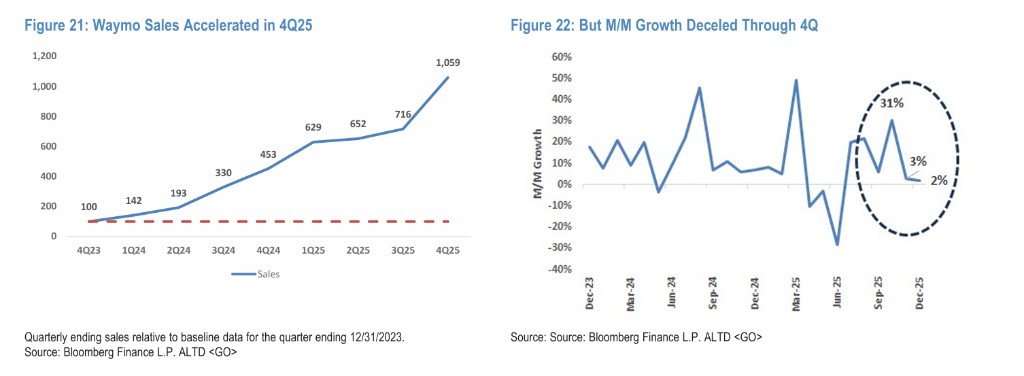
According to Bloomberg Second Measure data, Waymo's sales in the fourth quarter of 2025 increased by 134% year-on-year, up from 117% in the third quarter, but the month-on-month growth rate in the fourth quarter showed a slowing trend, with only a 2% month-on-month increase in December. This data does not include orders booked through the Uber app in Austin and Atlanta