The "liquidity illusion" behind prosperity: Canada's new regulations and Australia's interest rate hike resonate together, and liquidity in 2026 is not a one-sided easing

2026 is by no means a "year of comprehensive interest rate cuts." In 2026, global liquidity is shifting from "policy-driven" to "structural dependence." The new liquidity regulations from Canada's OSFI have sent conservative signals, and the unexpected interest rate hike by the Reserve Bank of Australia has shattered the illusion of unilateral easing. The resilience of financial institutions no longer depends on asset size, but rather on the ability to capture "sticky funds." Understanding this backdrop is key to avoiding the next potential "shock."
Summary
Recently, Canada's Office of the Superintendent of Financial Institutions (OSFI) released new regulations regarding liquidity adequacy requirements for 2026, which sharply contrasts with the prevailing market expectation of "interest rate cuts and easing." This article uses this as a starting point, combining the latest interest rate hike dynamics from the Reserve Bank of Australia and the subprime auto loan crisis that erupted at the end of 2025, to deeply analyze the multiple challenges facing global liquidity in 2026:
-
Market turbulence caused by behavioral liquidity gaps due to failed expectations of policy easing
-
Continued pressure in non-traditional financial instruments and private credit sectors
-
Macroeconomic factors further generating and accumulating market pressure
-
Volatility brought about by the repeated process of de-dollarization and the absence of global currencies
Note: The author of this article, Zhao Xinqian, serves as a senior risk analyst at the Financial Services Regulatory Authority (FSRA) in Ontario, Canada, with nearly 10 years of experience, holding both CFA and FRM certifications, and has been a contracted writer for magazines such as Pure Luxury.
Main Text
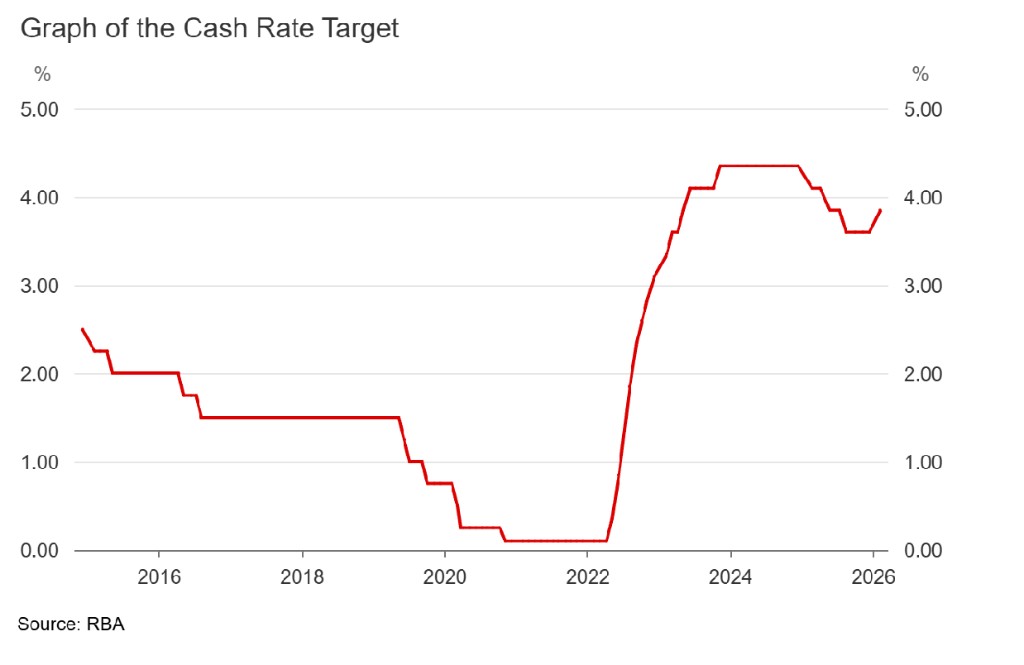
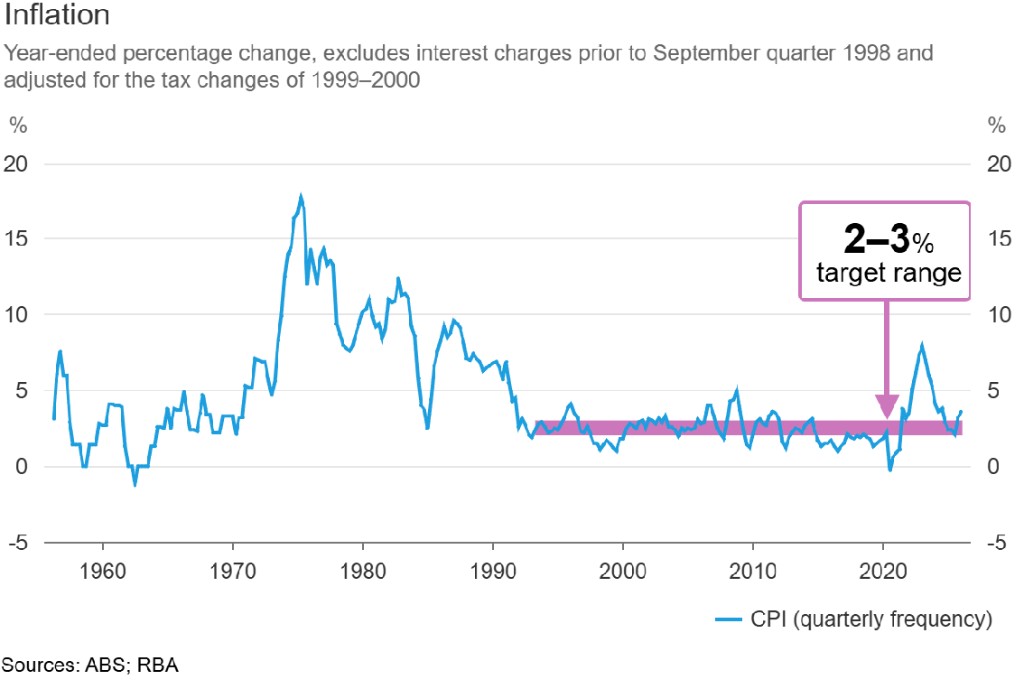
Recently, the Office of the Superintendent of Financial Institutions (OSFI) in Canada released guidelines regarding liquidity adequacy requirements for 2026, deciding to adopt a more segmented and conservative approach to multiple financial products. This seems to conflict with the overall macro expectation of interest rate easing. At the same time, both the Bank of Canada and the Federal Reserve decided to keep interest rates unchanged in their January rate decisions. More notably, the Reserve Bank of Australia's first interest rate decision for 2026 announced a 25 basis point hike based on "domestic and global economic conditions." The previously released Australian inflation rate for December was 3.8%, significantly higher than the central bank's target range of 2%-3%.


Central banks and regulatory agencies around the world are beginning to adopt a more cautious approach to potential economic uncertainties, and expectations for further policy easing may be dashed. Additionally, although interest rate policies in multiple countries have been adjusted or have entered a plateau, the contraction of liquidity in quantitative terms has only just begun to enter deeper waters. The redefinition of 'stable funding' by regulatory agencies has effectively initiated an 'atypical interest rate hike' within the balance sheets of financial institutions. The dominant forces of liquidity in 2026 may shift more towards structural liquidity buffer measures at the market level. This article will analyze the liquidity risk points that the international market may need to pay attention to based on the OSFI's policy changes for 2026.
Market turbulence caused by behavioral liquidity gaps due to failed expectations of policy easing
The repeated mention of "increased uncertainty in economic forecasts" in various central bank meetings reveals multiple concerns from central banks and regulatory agencies regarding the current fragile prosperity of the market. Considering the potential vulnerabilities brought about by high stock market valuations; the lack of clear directional guidance from diverging economic data; and the uncertainty surrounding monetary policy due to the upcoming change in the Federal Reserve chairmanship; The possible interest rate decision by the Bank of Japan, along with multiple pressure factors affecting market liquidity, may limit the potential for significant further declines in interest rates or substantial easing of financing conditions. Therefore, simulating the panic selling that investors may exhibit under pressure conditions, which could lead to liquidity issues, has urgent practical significance. In the new regulations, the Office of the Superintendent of Financial Institutions (OSFI) has made a more detailed classification of deposit and financing products, intending to reflect the true behavior of funds under pressure, making the assumed outflow rate of funds closer to its actual stability. Adjusting model assumptions to reflect the true flow of funds under pressure is crucial for targeting potential risks and maintaining the stability of the financial system and orderly market operations.
Continued Pressure on Non-Traditional Financial Instruments and Private Credit Sector
Liquidity risk has never existed in isolation. Factors such as credit environment and market risk affect liquidity, which in turn is influenced by liquidity. Pressure in specific areas may ripple through broader markets. Some credit instruments and structured products in the current market contain hidden liquidity crisis risks.
Previously, under the dual pressures of rising interest rates and a weakening economic environment, this sector has already been under significant pressure. For example, the bankruptcy of a subprime auto loan institution in September 2025 directly triggered widespread concerns about the health of the auto credit market, which amounts to tens of billions of dollars. The auto asset-backed securities (ABS) issued by the involved institution are deeply integrated into the U.S. credit market, with complex funding structures and risk connections with several large institutions.
This incident prompted regulators to reassess the high-risk lending models and risk exposures in this sector. When the market is volatile, structured products that were originally stable sources of funding may experience large-scale redemptions due to triggering conditions (defaults, repayments, etc.), leading to hedging failures. OSFI's new regulations provide more detailed explanations and clarifications on the handling of such structured products and other new credit instruments, ensuring that these complex products can be adequately included in the calculation of short-term liquidity indicators based on their characteristics, allowing for more reasonable risk weighting.
Investors should focus on the risk premiums of this category of products. Due to the increased liquidity and even capital requirements for such assets, the trading prices of issued products in the secondary market may face downward pressure, while financial institutions' newly issued similar products may lower interest rates to cover higher liquidity costs.
Macroeconomic Factors Further Generate and Accumulate Market Pressure
We are currently at a critical juncture characterized by profound technological transformation, geopolitical disintegration and reconstruction, a shift from global interconnectedness to regionalization in trade, and a reshuffling of industrial structures in energy. The results of changes at each level will have far-reaching impacts on the economies of countries worldwide.
The new technological revolution brought about by AI and automation has already deeply rooted itself in various aspects of the economy, causing varying degrees of impact across industries or bringing strong supply demand. This has also led to contradictions in economic data and even a polarization trend: the demand for liquidity among different industries has shown significant differentiation, greatly increasing future economic uncertainty.
The post-Cold War global order centered on the United States is being restructured. U.S.-China strategic competition dominates the direction of global trade, technology, and security policies. At the same time, Europe’s influence is declining due to its economic difficulties, while middle powers (such as South Asia, Gulf countries, and Southeast Asian countries) are gaining influence due to the restructuring of supply chains and the process of regionalization The regional conflicts during the process of constructing a new order may have a strong impact on the economy. The phase of global economic free trade coexisting and growing together is coming to an end, and structural growth will slow down. Capital flows are no longer solely dependent on returns; the driving effects of geopolitical factors have become more significant. Existing financing channels, especially the transmission of cross-border liquidity, may be affected, thus financial institutions engaged in cross-border operations or entities that rely on international financing channels for a long time may face pressure. Once the reconstruction is completed, regional group internal integration will form new synergies in multiple areas comprehensively.
Under the influence of the geopolitical international competition landscape, the efficiency of global supply chains is declining; coupled with the direct impact of tariff weaponization on prices, this has a reverse effect on the already fragile supply chains, making it difficult to predict the control of inflation and the achievement of economic goals. However, the existing ecological resilience is strong, achieving stable supply to a certain extent, buying time for the establishment of the new order.
It is precisely based on the uncertainty of multiple factors that OSFI emphasizes the necessity of regulatory judgment under multiple macro pressures in the new regulations, allowing regulatory agencies to exercise discretion and assess market pressure scenarios in real-time, and to respond and intervene promptly.
The Repeated Process of De-dollarization and the Turbulence Caused by the Absence of Global Currency
In current global trade, although the US dollar still holds a dominant position, its structural changes are irreversible: the uniqueness of the dollar is gradually being lost, and multiple alternative options are emerging.
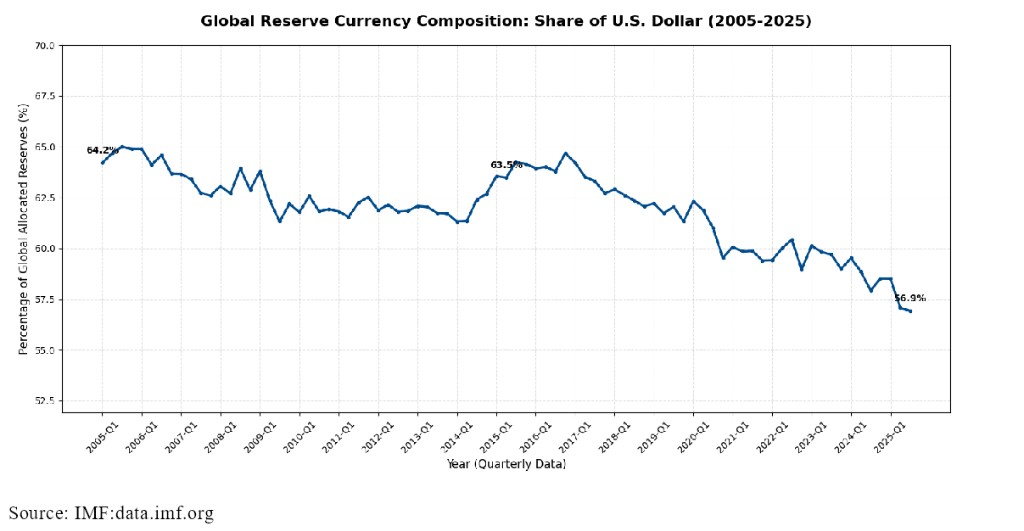
According to data released by the IMF, the dollar's share in global foreign exchange reserves has been continuously declining, from about 70% in 2000 to about 57% in 2025, the lowest level since the mid-1990s. At the same time, gold has also seen a structural systemic increase: since 2022, driven by the freezing of Russian foreign exchange reserves by the US and the EU, the market has gained a clearer understanding of the "political conditionality of dollar assets," thus gold is absorbing the trust loss in the dollar caused by this.

Similarly, sanctions against Russia have spawned a dual-currency system for energy, raw materials, and logistics trade. China's CIPS and Russia's SPFS have been put into use as partial alternatives to SWIFT, almost completely abandoning dollar settlements in practical operations. The BRICS countries, as systemically important commodity exporters, have established alternative payment channels at the infrastructure level to build a payment system that can resist sanctions. The exclusivity of the dollar in crude oil trade has also loosened, which has partially catalyzed the US military actions against Venezuela.
Currently, there is no single successor in the world monetary system that can replace the dollar, but it is highly feasible to replace some functions of the dollar through a multi-currency structure. A multi-currency reserve system paired with gold as a politically neutral reserve asset, with regional scope assuming some settlement functions through other currencies (such as the Renminbi), along with the gradually constructed central bank digital currency system, will form a new multipolar system Trust in the US dollar is transitioning from being the only default option to one of conditional trust. This transition process will inevitably be accompanied by pulls and turbulence: the threat to the dollar's status may trigger instability, precious metals, which serve as partial alternatives, may experience potential price fluctuations, and the existence of the renminbi as an alternative is limited by capital controls and transparency issues, while the technical limitations and security challenges of digital currencies may impact market liquidity. The loosening of the dollar's dominance essentially reconstructs the liquidity clearing paths for global cross-border trade. The partial absence of the dollar will lengthen or complicate cross-border settlement paths. Financial institutions, when calculating the Liquidity Coverage Ratio (LCR), will have to reserve a higher risk buffer for "settled funds," thereby directly compressing the liquidity available for the market.
2026 is not the 'one-sided easing year' that the market anticipates. The proactive measures of OSFI and the cautious attitudes of various central banks remind us that liquidity management is shifting from "policy-driven" to "structural dependence," from "simply looking at quantity" to "deeply looking at quality." In the context of multiple market uncertainties interacting, the resilience of financial institutions no longer solely depends on their asset size, but on their ability to capture "sticky funds" under extreme pressure scenarios. For investors, understanding this aspect of liquidity may be key to avoiding the next potential 'shock.'