


Weight loss drug sales explode! Eli Lilly's Q4 revenue increased by 43% year-on-year, net profit grew by 50%, and the revenue guidance for 2026 is between $80 billion and $83 billion | Earnings report insights
Thanks to the explosive sales of GLP-1 weight loss drugs, Eli Lilly's revenue, profit, and full-year guidance for the fourth quarter all exceeded market expectations. In the peak showdown between the two weight loss drug giants, Eli Lilly seems to have provided the answer to the winner. Novo Nordisk previously warned that its sales could decline by 13% this year due to intensified price competition, while Eli Lilly expects its own sales to achieve a growth of up to 27%
In the peak showdown between the two weight loss drug giants, Eli Lilly seems to have provided the answer to the outcome.
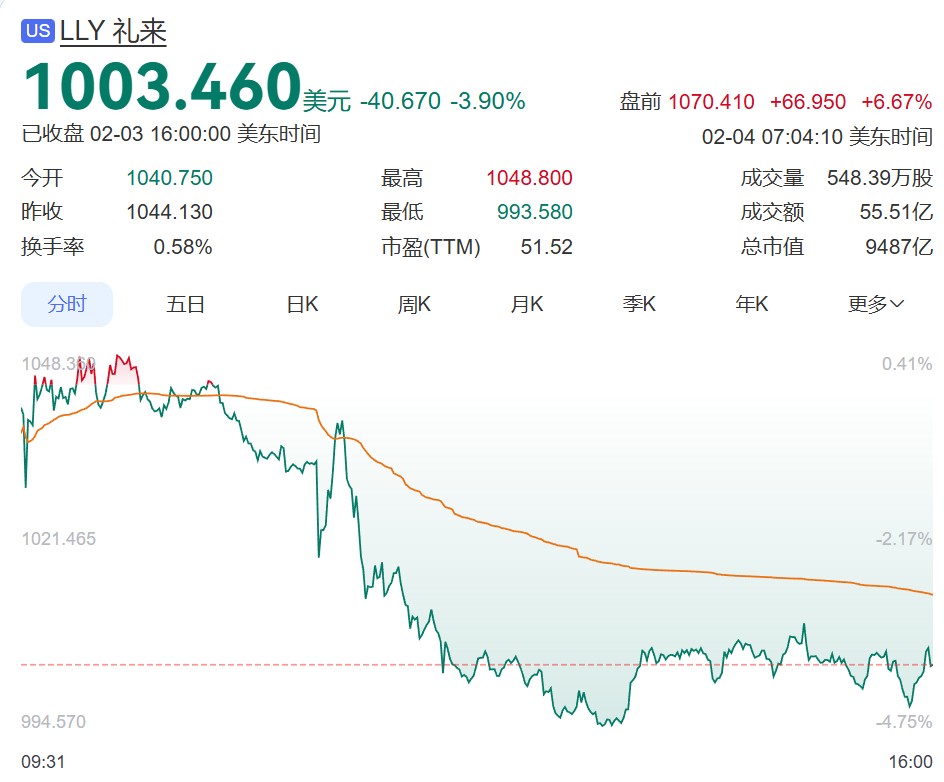
On Wednesday Eastern Time, Eli Lilly announced a strong Q4 2025 financial report and provided guidance for 2026 that far exceeded Wall Street expectations. Following this news, Eli Lilly's stock price surged by 8% in pre-market trading. This optimistic outlook sharply contrasts with the pessimistic warning issued by competitor Novo Nordisk on Tuesday—Novo Nordisk warned that due to intensified price competition, its sales could decline by 13% this year, while Eli Lilly expects its own sales to grow by as much as 27%.
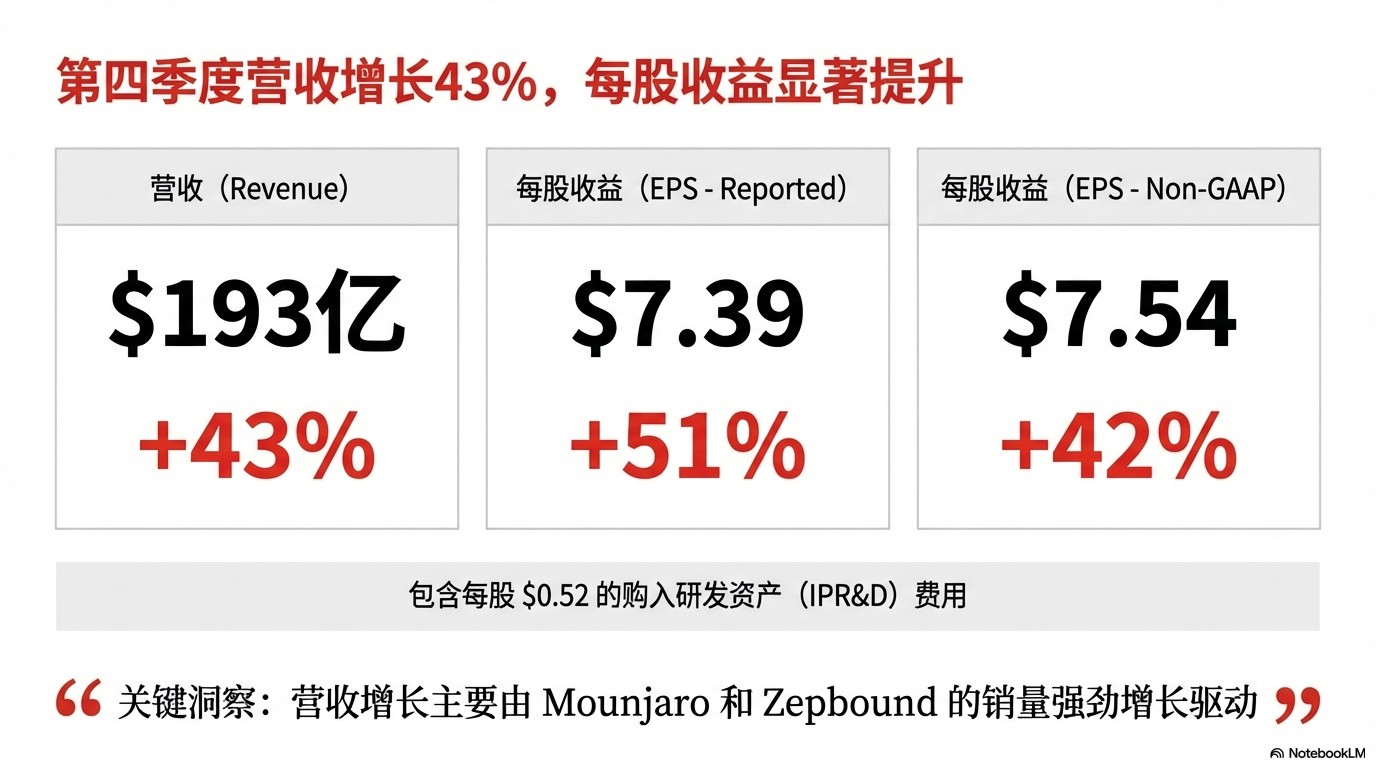
The financial report showed that Eli Lilly's Q4 revenue reached $19.3 billion, a 43% year-over-year increase, surpassing analysts' expectations of $18 billion; the non-GAAP earnings per share (EPS) was $7.54, a 42% year-over-year increase, also significantly higher than the market expectation of $6.73. This explosive performance is primarily attributed to the strong demand for its GLP-1 "twin stars"—the diabetes drug Mounjaro and the weight loss drug Zepbound. Data shows that in 2025, the total prescription volume of Zepbound has officially surpassed Novo Nordisk's Wegovy, further solidifying Eli Lilly's leadership position in the weight loss drug market.
More importantly, Eli Lilly's outlook for the future greatly boosted market confidence. The company expects its total revenue for 2026 to be between $80 billion and $83 billion, easily beating Wall Street's average expectation of $77.7 billion; the adjusted earnings per share are expected to be between $33.50 and $35.00, also better than analysts' expectation of $33.08. Eli Lilly is leveraging its patent moat, more aggressive capacity expansion, and the upcoming launch of oral formulations to gain an advantage in competition with telemedicine companies' cheap generics and Novo Nordisk.

Core Products Are Not Just "Cash Cows": Mounjaro and Zepbound Contribute Over 60% of Revenue
Undoubtedly, Tirzepatide is the absolute engine driving Eli Lilly's performance surge. Financial report data shows that the combined revenue of Mounjaro and Zepbound in Q4 exceeded $11.6 billion, accounting for more than 60% of the company's total revenue for the quarter.
- Mounjaro (diabetes indication): Quarterly revenue reached $7.41 billion, an astonishing year-over-year increase of 110%. Its revenue in the U.S. market reached $4.1 billion, while the growth rate in international markets was even more rapid, soaring from $899 million in the same period last year to $3.3 billion, demonstrating a rapid increase in global penetration
- Zepbound (obesity indication): As a rising star in the weight loss drug sector, Zepbound achieved revenue of $4.26 billion in Q4, a staggering year-on-year increase of 123%. The U.S. market remains its main battlefield, contributing the vast majority of its revenue.

It is worth noting that the breast cancer drug Verzenio performed steadily, with Q4 revenue of $1.6 billion, a year-on-year increase of 3%, continuing to provide stable cash flow support for the company.
Volume-for-Price Strategy Proves Effective: Sales Surge 46% to Offset Price Pressure
A deep analysis of revenue drivers reveals that Eli Lilly's growth is entirely volume-driven. In the fourth quarter, Eli Lilly's global product sales (Volume) increased by 46%, completely offsetting the negative impact of a 5% decline in realized prices.
In the U.S. market, sales surged by 50%, while realized prices fell by 7%. This primarily reflects concessions made in rebate and pricing strategies by Zepbound and Mounjaro to enter more insurance catalogs and expand patient coverage. Additionally, Eli Lilly announced an agreement with the U.S. government aimed at expanding access to obesity drugs for millions of Americans, which may lower unit prices but will greatly widen the moat and solidify market leadership through economies of scale.
In the international market, sales grew by 38%, mainly driven by Mounjaro. This indicates that Eli Lilly is successfully replicating its success in the U.S. globally, especially as capacity bottlenecks gradually ease, rapidly filling the global market's pent-up demand.

Revenue Target of $83 Billion by 2026, Crushing Novo Nordisk
The biggest highlight of this financial report is Eli Lilly's starkly different future outlook compared to Novo Nordisk.
Eli Lilly expects its revenue ceiling to reach $83 billion by 2026, indicating that even on the high base of $65.18 billion in revenue for 2025, the company will still maintain strong growth of over 20%. In comparison, Novo Nordisk previously warned investors that intensified price competition in the weight loss drug market led to a 13% decline in its annual sales. Novo Nordisk CEO Mike Doustdar candidly stated that the company will face "unprecedented pricing pressure" in 2026.
 In addition to the continuous increase in injectable drugs, oral weight loss medications may be the next killer app. Eli Lilly is awaiting regulatory approval for its oral weight loss drug, which could be approved as early as April this year. The company has pre-produced billions of doses of the oral medication in preparation for its launch. To address the demands for lower drug prices from Trump and telemedicine companies, Eli Lilly stated that if it receives FDA approval, the monthly fee for the lowest dose of its oral drug will be as low as $149. This highly aggressive pricing strategy will undoubtedly create a dual impact on the high-priced injectables and low-cost generics in the market.
In terms of profit forecasts, the Non-GAAP EPS guidance for 2026 is $33.50 to $35.00. Compared to the full-year figure of $24.21 for 2025, this indicates an approximately 40% growth in earnings per share. This phenomenon of profit growth outpacing revenue growth is attributed to the increased proportion of high-margin products (with gross margin guidance rising to over 83%) and the release of operational leverage. Although the company expects to continue increasing R&D and marketing investments in 2026, the scale effect of revenue is sufficient to cover these costs.
R&D Pipeline and Capacity Expansion: Building a Wider "Moat"
To maintain its long-term dominance, Eli Lilly is accelerating its layout for the "post-semaglutide era," focusing on the convenience of administration and the expansion of indications:
Oral weight loss medication is nearing approval: The company has submitted a marketing application for the oral non-peptide GLP-1 receptor agonist Orforglipron to the FDA and regulatory agencies in Japan and the EU. Once approved, this will be a significant weapon targeting many patients who are hesitant due to the inconvenience of injections, potentially further expanding the market.
Triple-target drug (Triple G): Retatrutide has achieved positive Phase 3 clinical results in patients with obesity combined with knee osteoarthritis, demonstrating not only its excellent weight loss effect (with an average weight loss of up to 71.2 pounds) but also its potential in improving complications.
Autoimmune and oncology: The Phase 3 trial of the psoriatic arthritis drug Taltz in combination with Zepbound has yielded positive results; the BTK inhibitor Jaypirca has also received FDA approval for expanded indications.
In terms of the supply chain, Eli Lilly is working hard to resolve the long-standing capacity issues that have hindered the volume of weight loss drugs. The company announced the construction of a new injectable production facility in Pennsylvania and is investing $6 billion in Alabama to build an active pharmaceutical ingredient factory, while also planning to invest $3 billion in Europe to expand oral drug capacity. These massive capital expenditures (Capex) are not only to meet current demand but also to pave the way for new drug launches in 2026 and beyond.

