Significant slowdown in employment! In January, the ADP employment number in the United States increased by 22,000, lower than the expected 45,000

Wallstreetcn
2026.02.04 13:52
portai
I'm PortAI, I can summarize articles.

The U.S. January ADP employment data significantly fell short of expectations, with only 22,000 new jobs added, highlighting a weakening momentum in the labor market at the beginning of the year. The growth was entirely driven by the education and healthcare services sector, while several key industries, such as professional business services and manufacturing, experienced job shrinkage, indicating structural weakness. Although wage growth remained stable at 4.5%, the overall weak data may reinforce the Federal Reserve's cautious outlook on the economy. Meanwhile, due to the government shutdown, the official non-farm payroll report has been postponed again

U.S. January ADP employment data fell short of expectations, indicating a further slowdown in the U.S. labor market at the beginning of the year.

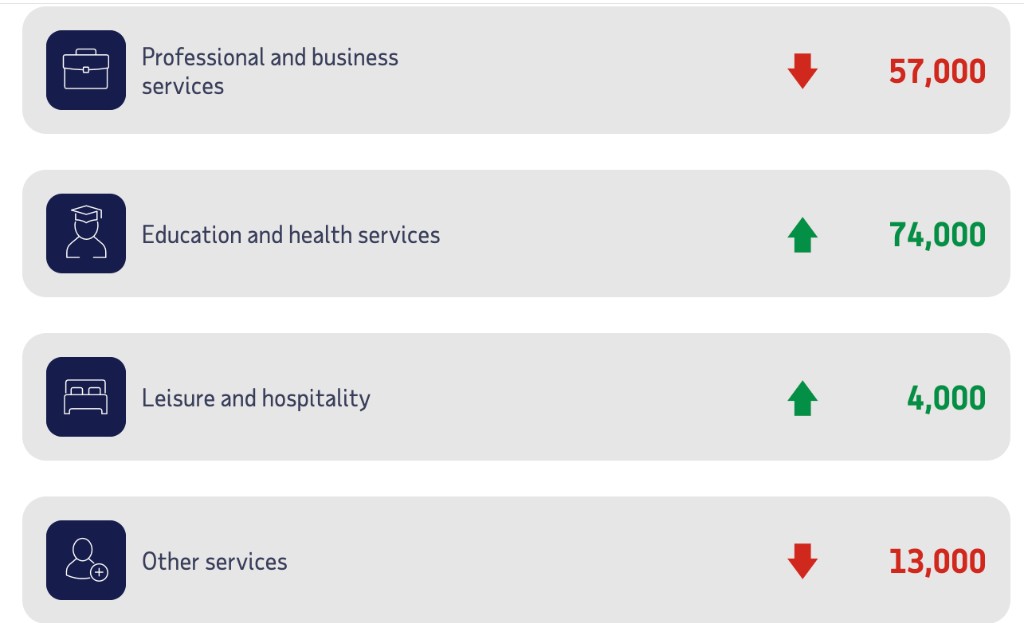
On February 4th, according to data released by the ADP Research Institute, the U.S. private sector added 22,000 jobs in January, far below the market expectation of 45,000, and also lower than the revised previous value (the December increase was revised down from 41,000 to 37,000). If not for the surge of 74,000 jobs in the education and healthcare services sector, overall employment numbers might have contracted.

By industry, multiple sectors showed signs of contraction. Among them, professional and business services saw a significant reduction of 57,000 positions, while manufacturing cut 8,000 jobs. Wage growth remained stable, with employee wages maintaining a year-on-year increase of 4.5%.

The report continued the weak trend since the end of 2025, indicating that the job market remains in a stalemate of "low hiring, low layoffs." It is worth noting that due to a partial federal government shutdown, the official non-farm payroll report from the U.S. Bureau of Labor Statistics, originally scheduled for release this Friday, has been postponed again, with the specific release time to be determined after Congress resolves the budget impasse.

Education and Healthcare Support Overall Employment

The employment growth structure in January highlighted a high degree of industry concentration. Data showed that the new jobs were almost entirely driven by the education and healthcare services sector, which saw a monthly surge of 74,000 positions, continuing its trend as the main employment engine last year.

Aside from healthcare-related positions, other industries contributed limitedly: the financial activities sector added 14,000 jobs, construction grew by 9,000, while trade, transportation, utilities, and leisure and hospitality each contributed only 4,000 jobs. In that month, the service sector accounted for all growth except for 1,000 jobs, further highlighting the current employment recovery's heavy reliance on a single industry's structural imbalance.

Multiple Industries Experience Layoffs

The structural weakness in the job market is evident in several key areas. The professional and business services sector suffered a significant blow, losing 57,000 positions in a single month, making it the industry with the most severe job losses. Meanwhile, other service categories cut 13,000 jobs, and manufacturing also reduced 8,000, reflecting a lack of growth across a wide range of sectors.

It is noteworthy that several large companies, including Dow Chemical and Amazon, have recently announced layoff plans, indicating that the scale of layoffs may push the unemployment rate higher in the future.

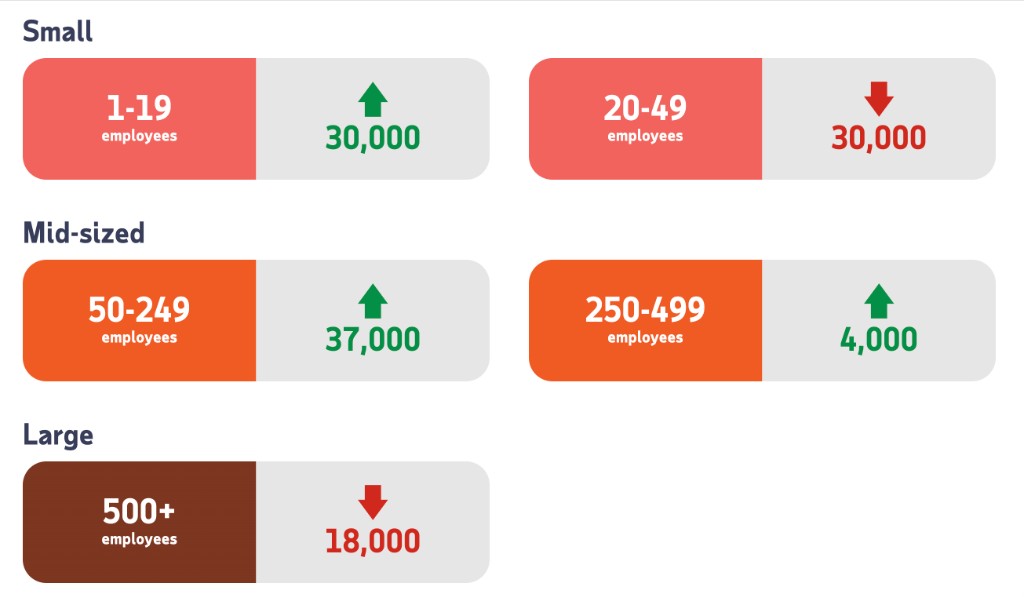
From the perspective of company size, the contribution structure of employment growth also shows an imbalance. All net job growth for the month came from medium-sized enterprises with 50 to 499 employees. In contrast, small businesses saw employment numbers remain basically flat, while large enterprises (with 500 or more employees) net reduced 18,000 positions.

Wage Growth Remains Stable

Wage growth momentum remains stable. In January, the annual wage increase for employed workers was 4.5%, which is basically unchanged from the previous month's data, indicating that despite a slowdown in employment growth, labor cost pressures still exist.

As a key leading indicator of the official non-farm payroll report, ADP data is usually closely watched by the market. However, due to a partial federal government shutdown, the non-farm payroll data from the U.S. Bureau of Labor Statistics, originally scheduled for release this Friday, has been confirmed to be postponed, with the specific release date depending on the progress of resolving the political deadlock in Washington.

This overall weak employment data may further reinforce the Federal Reserve's cautious assessment of the economic outlook, providing more room for potential policy easing in the future. Federal Reserve Chairman Jerome Powell stated last week, "Labor market indicators suggest that after a period of gradual slowdown, conditions may be stabilizing." Currently, the Federal Reserve is maintaining the benchmark interest rate in the target range of 3.50%-3.75%