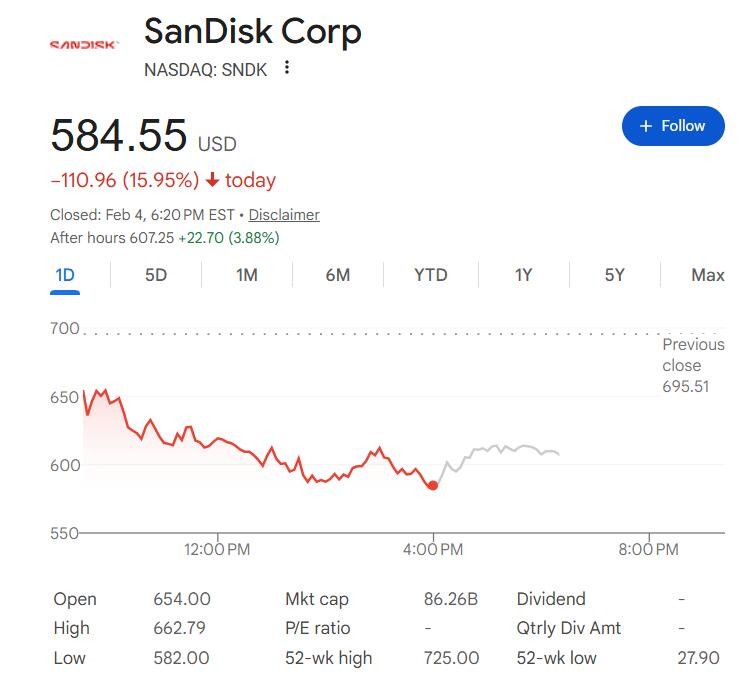
The sharp decline in tech stocks spreads, storage chip giants face a "collective stampede"! Sandisk drops over 10% during trading

Wallstreetcn
2026.02.04 21:00
portai
I'm PortAI, I can summarize articles.

The adjustment of storage chip stocks on Wednesday was not due to a single "black swan." SanDisk's fundamentals suddenly deteriorated, and during the tech stock sell-off, big winners like SanDisk, which had driven storage demand narratives through AI, experienced a more severe pullback. SanDisk's stock price has increased by at least over 1100% in the past six months, and after releasing its financial report last week, as of this Tuesday, the stock price had risen nearly 29% over three days

This Tuesday, the technology sector sell-off triggered by software stocks is spreading, with recently popular memory chip manufacturers experiencing a "collective stampede."

On Wednesday, February 4th, Eastern Time, the three major U.S. stock indices showed mixed performance, with the Dow rebounding, the S&P turning negative in the early session, and the Nasdaq opening lower and continuing to decline, indicating that funds are continuing to withdraw from the previously strong technology sector. In the early session, the Nasdaq's decline expanded to over 1%, with memory chip stocks experiencing even larger declines, showing a clear characteristic of "high-priced stocks correcting + profit-taking by funds." In the early session, SanDisk fell over 12%, Western Digital nearly 11%, Micron Technology over 9%, and Seagate Technology nearly 7%.

Why did SanDisk and other memory chip stocks plummet? What is the market worried about? On the surface, the adjustment of memory chip stocks on Wednesday did not have a single "black swan," but rather resembles a concentrated pullback after multiple factors overlapped: the overall market risk appetite weakened, individual stocks had previously risen too much, valuations and expectations were pushed to extreme positions, ultimately triggering profit-taking and short-term funds to withdraw in a stampede-like manner.

Fund Rotation Amplifies Technology Sector Pullback, SanDisk Faces High-Level Profit-Taking

On Wednesday morning, U.S. tech stocks weakened, and market sentiment was cautious. For the high-beta semiconductor sector, once the index corrects and funds shift to defensive positions, the stocks that are most likely to be sold off first are often those that have risen the most, are the most expensive in valuation, have the most crowded investor bets, and carry the heaviest options leverage.

Memory chips are in this typical position: they had previously risen continuously under the narrative of "AI driving a surge in memory/storage demand," and once the wind changes, the pullback is also more severe.

In this round of memory stock performance, SanDisk is almost the most representative "sentiment barometer."

An article from Wall Street Insight pointed out last week that SanDisk's stock price has increased by over 1140% in six months, making it one of the rare super strong stocks in the U.S. stock market. Such a large increase naturally gives it "bubble/sentiment trading" attributes.

More critically, after SanDisk released its earnings report last Thursday, market sentiment was further ignited: since the earnings report was released after the U.S. market closed last Thursday, as of Tuesday's close, SanDisk's stock price has cumulatively risen nearly 29% over three trading days, with a steep short-term increase.

Against this backdrop, the sharp drop in the early session on Wednesday seemed more like a "technical pullback after rapid gains": when short-term funds realized that "the good news has been fully priced in," any slight disturbance could trigger profit-taking.

Institutions Intensively Bullish, Pushing Expectations to a Dangerous Zone

It is noteworthy that after SanDisk's earnings report, a very typical market phenomenon occurred: institutional analysts collectively raised target prices, and ratings surged, forming a positive feedback loop of "the more it rises, the more optimistic it becomes." Last week, after SanDisk released its financial report, several institutions issued recommendations and proposed highly impactful target prices such as $750 and even $1000, based on the logic of "AI servers driving storage demand upward."

However, for the market, this kind of "stacked target price increase" often has two sides:

  • On one hand, it strengthens the confidence of the bulls, pushing the price higher in the short term;

  • On the other hand, it can lead to the stock price exhausting a large amount of expectations in a very short time, making the trading structure more fragile.

When market sentiment begins to cool, high target prices will not provide support; instead, they will be interpreted as: "Expectations have been fully priced in, and further upward movement requires stronger realization." This will directly increase the probability and magnitude of a pullback.

No matter how good the financial report, "high expectations" can become a selling point after positive realization

From the financial report perspective, the performance released by SanDisk last week was an important catalyst for this round of short-term acceleration.

Wall Street Insights previously summarized SanDisk's financial report: the market focused on its AI-related storage demand, price improvements, and clues about the industry's recovery.

However, in the case of "stock prices surging in advance," financial reports often fall into a typical dilemma:

The financial report does not need to be bad; as long as it does not continue to exceed extremely optimistic expectations, it may trigger profit-taking.

In other words, when the market has already factored in "explosive AI memory demand + price increases + cyclical reversal" into the valuation, the marginal increment from the financial report becomes increasingly difficult.

Therefore, Wednesday's decline was more about the cooling of overly enthusiastic sentiment after the financial report, rather than a sudden deterioration of the fundamentals.

Sector "rise and fall together": Storage chain is inherently strongly correlated, making pullbacks easy to resonate

Another characteristic of Wednesday was that not only did SanDisk decline, but Western Digital, Micron, Seagate, and other storage chain companies almost fell simultaneously. The reason lies in the highly consistent trading logic of the storage sector:

  • Demand side: AI servers, cloud capital expenditures, enterprise storage

  • Supply side: Capacity, inventory, price cycles

  • Price side: Expectations of rising NAND/DRAM prices

When "risk appetite weakens + high-level profit-taking" begins to occur, funds will not just sell one company but tend to directly reduce exposure across the entire storage chain, causing sector resonance.

What will the market focus on next: "short-term bubble bursting" or "economic recovery being falsified"?

Currently, the sharp drop in the early morning of Wednesday aligns more with the characteristics of "rapid bubble bursting at high levels," rather than a fundamental reversal. To determine whether this round of pullback can be halted, the market will focus on three clues:

  • Storage prices: Whether the rise in NAND/DRAM prices continues to materialize;
  • Cloud giants' capital expenditures and AI server demand: Whether there are signs of cooling;
  • Company guidance and channel inventory: Whether there is repeated pressure to destock.

If the above indicators remain strong, the market may view Wednesday's sharp decline as a "deep pullback within a strong trend"; conversely, if prices and demand show marginal weakness, the valuation pullback of storage stocks may continue