Vietnam's economy starts strong, with a GDP growth target exceeding 10% for 2026

Wallstreetcn
2026.02.05 03:35
portai
I'm PortAI, I can summarize articles.

Vietnam achieved a GDP growth of 8.02% in 2025, laying the foundation for a growth target of over 10% in 2026. If domestic policies and the international environment remain stable, Vietnam is expected to achieve this goal. In December, industrial output grew by 10.1% year-on-year, and the manufacturing PMI was 53, indicating positive expectations from businesses for the future. Although total retail sales increased by 9.8% year-on-year, they were under pressure from rising interest rates and liquidity tightening. The total amount of foreign investment registered in 2025 was USD 38.4 billion, demonstrating resilience in attracting foreign investment

Vietnam achieved positive economic growth results in 2025, reaching a historic milestone of 8.02%, laying a good momentum for more ambitious development plans for 2026-2030. Vietnam has set a high GDP growth target for 2026, exceeding 10%. If domestic policies and the international environment can remain stable and develop favorably, the likelihood of Vietnam achieving this growth target is high. The probability of economic growth falling within the range of 10%-10.5% is about 50%; the probability of falling within the range of 8%-8.5% is about 40%.

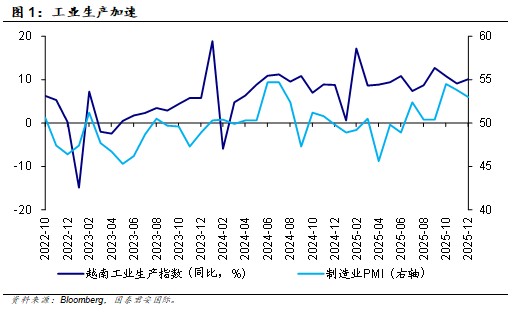
In December, Vietnam's industrial output grew by 10.1% year-on-year, driving the annual growth to 9.2%, which is quite strong by recent standards. Given that industry accounts for a significant proportion of GDP and has a notable spillover effect on the overall economy, the continued acceleration of industrial production highlights Vietnam's ongoing attractiveness as a manufacturing and investment destination.

In December, Vietnam's manufacturing PMI was 53, and businesses remained optimistic about production expansion. However, the index has slightly declined since October, reflecting increased global uncertainty in recent times. Overall, S&P Global stated that the confidence of surveyed Vietnamese manufacturers in the future business environment reached its highest level since March 2024.

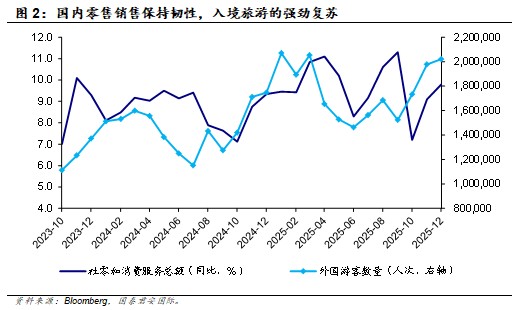
In December, total retail sales grew by 9.8% year-on-year, slowing from the double-digit growth seen at the end of the third quarter and the beginning of the fourth quarter. Total retail sales for the month reached 627.8 trillion Vietnamese dong, slightly above the average growth rate for 2025. The significant rise in interest rates at the end of the fourth quarter, combined with the previously anticipated tightening of liquidity in the banking system, has put pressure on retail momentum, with households remaining cautious in their spending. In contrast, accommodation services continued to show strong growth, while travel services performed even better.

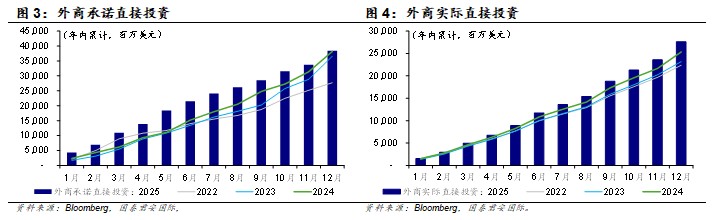
In 2025, Vietnam's total registered foreign direct investment (FDI) reached USD 38.4 billion, remaining strong but essentially flat compared to 2024. Overall, Vietnam has demonstrated resilience in attracting foreign investment.

In 2025, global trade faced severe headwinds, primarily due to ongoing trade frictions between the United States and other countries. Overall, Vietnam is at a critical turning point: economic growth urgently needs to shift from relying on quantity expansion to being led by quality improvement.

In December, the inflation rate rose by 3.48% year-on-year, within the recent range and far below the government's set inflation cap of 4.5%. The average inflation rate for the entire year of 2025 was 3.31%, confirming the successful achievement of the annual inflation target. In 2026, Vietnam will still set its inflation target at below 4.5%. Based on the current situation, this target is expected to be achieved, providing space for authorities to implement more flexible fiscal and monetary policies.

Vietnam achieved positive economic growth results in 2025, reaching a historic milestone of 8.02%, laying a good momentum for more ambitious development plans for 2026-2030. Vietnam has set a high GDP growth target for 2026, exceeding 10% We believe that if domestic policies and the international environment can remain stable and develop in a favorable direction, the likelihood of Vietnam achieving this growth target is high. However, considering the changes brought about by the leadership transition, along with the cautious stance of the State Bank of Vietnam on monetary policy earlier this year, as well as the aforementioned complex geopolitical situation, economic growth this year may also show lower scenarios. Overall, we expect: the probability of economic growth falling within the range of 10%–10.5% is about 50%; the probability of falling within the range of 8%–8.5% is about 40%; and the probability of only achieving 6.5%–7% growth is about 10%.

Accelerated Industrial Production

Vietnam's industrial output in December increased by 10.1% year-on-year, driving the annual growth to 9.2%, which is quite strong by recent standards. Given the significant proportion of industry in GDP and its substantial spillover effects on the overall economy, the continued acceleration of industrial production highlights Vietnam's ongoing attractiveness as a manufacturing and investment destination.

In various industrial sectors, the mining industry showed a moderate recovery, with a year-on-year growth of 0.2% in December and an annual growth of 0.5%. Although the growth rate is still small, considering that this industry has been in a long-term decline in recent years, returning to positive growth is significant.

The manufacturing sector continues to serve as the main growth engine, with December output increasing by 10.9% year-on-year and an annual growth of 10.5% for 2025. The automotive manufacturing sector stands out, with production surging by 22.0% in 2025, closely related to VinFast's accelerated operations and capacity expansion throughout the year.

More broadly, several sub-sectors of manufacturing achieved double-digit growth, including traditional industries such as apparel manufacturing, rubber and plastic products, and food processing. In contrast, the output of electronics, computers, and optical products grew by 8.3% year-on-year, with growth slowing towards the end of the year, despite the industry's critical importance to exports and the presence of numerous foreign manufacturers such as Samsung and LG.

In other industrial areas, electricity production and supply, as well as water supply and waste/wastewater treatment, are expected to grow by 6.7% and 7.8% respectively in 2025, providing support for stable growth across the industrial sector.

In December 2025, Vietnam's Manufacturing Purchasing Managers' Index (PMI) was 53, indicating that businesses remain optimistic about production expansion. However, the index has slightly declined since October, reflecting increased global uncertainty in recent times.

S&P Global, which compiles Vietnam's PMI, noted that manufacturers significantly increased production in December, primarily driven by an increase in new orders. Companies also accelerated hiring, showing limited concerns about short-term demand or production weakness. However, input costs continued to rise, partly due to supply chain constraints caused by adverse weather conditions at the end of the year. Overall, S&P Global stated that surveyed Vietnamese manufacturers' confidence in the future business environment reached its highest level since March 2024.

Domestic Retail Sales Remain Resilient

Vietnam's total retail sales in December increased by 9.8% year-on-year, slowing down from the double-digit growth rates seen at the end of the third quarter and the beginning of the fourth quarter. The total retail sales for the month reached 627.8 trillion Vietnamese Dong, slightly above the average growth rate of 9.2% in 2025. The significant rise in interest rates at the end of the fourth quarter, combined with the previously anticipated tightening of liquidity in the banking system, has put pressure on retail momentum.

Retail sales of goods continued to dominate in 2025, accounting for 76.1% of total retail sales of goods and services. This segment grew by 8.6% year-on-year in December and 8.0% for the entire year, indicating that household spending remains cautious.

In contrast, accommodation services showed strong growth, with a year-on-year increase of 14.2% in December and a 14.6% increase for the year, primarily benefiting from the robust recovery of inbound tourism, especially from Chinese tourists. Domestic holiday travel also saw a significant rebound, contributing to a notable recovery in the industry in 2025.

Travel services performed even better, with a year-on-year increase of 19.9% in December and a 20.2% increase for the year. However, due to its relatively small weight, accommodation services only accounted for 12.0% of total retail sales of goods and services, while travel services made up just 1.4%, limiting their contribution to overall retail.

In December, the number of international visitors increased by 15.7% year-on-year, with an annual growth of 20.4%, further solidifying Vietnam's position as a safe and attractive tourist destination amid escalating global geopolitical tensions. Most visitors arrived by air (84.3%), followed by land (14.4%), and sea accounted for only 1.3%.

Asian tourists continued to dominate, making up 78.6% of the total number of visitors. Chinese tourists (25.0%) surpassed South Korean tourists (20.0%) to become the largest source market. The trends for the two countries in 2025 showed a clear divergence: the number of Chinese tourists surged by 41.3%, while South Korean tourists declined by 5.2%. Notably, the growth rate of Chinese tourists slowed to nearly half in December, with a year-on-year increase of only 25.7%, while the decline in South Korean tourists widened, dropping by 10.7% year-on-year for the month.

Looking ahead, if Vietnam's tourism industry is to maintain the strong growth momentum of the past year in 2026, it may face a more challenging environment.

Foreign Direct Investment (FDI)

In 2025, Vietnam's registered foreign direct investment (FDI) totaled USD 38.4 billion, remaining strong but essentially flat compared to 2024. The growth rate of FDI significantly slowed after mid-year—initially recording growth of 4% to 6% at the beginning of the year, but achieving only a slight year-on-year increase of 0.5% for the entire year.

The slowdown in committed FDI is mainly attributed to a decrease in newly registered projects. In 2025, Vietnam attracted new FDI commitments amounting to USD 17.3 billion, down from USD 19.7 billion in 2024. In contrast, additional investments in existing projects reached USD 14 billion, remaining roughly the same as last year The most significant growth in FDI is in equity acquisitions and capital contributions, soaring to USD 7 billion in 2025, far exceeding the previous year's USD 4.5 billion.

The actual FDI inflow in 2025 reached USD 27.6 billion, further proving that foreign enterprises still place a high value on production layouts in Vietnam. The inflow of funds increased by 8.95% year-on-year, slightly lower than the 9.36% growth rate in 2024, but still remains robust.

Overall, Vietnam demonstrates resilience in attracting foreign investment. However, changes in the global economic and investment landscape are bringing new challenges, urgently requiring Vietnam to promote proactive reforms and implement more advanced policy frameworks to enhance national competitiveness and attractiveness to international investors.

Import and Export Trade

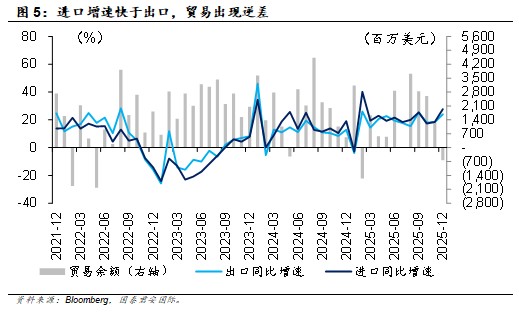
In 2025, global trade faces severe headwinds, primarily due to ongoing trade frictions between the United States and other countries. Although the disputes have shifted from broad measures at the beginning of the year to more targeted country-specific strategies in the third quarter, several U.S. allies, including Canada, South Korea, and Japan, are still occasionally caught off guard.

Vietnam has effectively leveraged its strategic position to reach constructive tariff-related agreements with the United States. As a result, Vietnam has maintained its role as a key manufacturing hub in the global supply chain, with strong growth in both imports and exports.

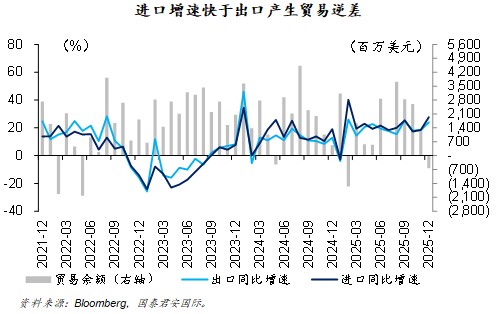
By the end of 2025, Vietnam's export value reached USD 475 billion, a year-on-year increase of 17.9%; imports also expanded robustly, growing by 20.1% year-on-year to USD 455 billion. The growth rate of imports outpaced that of exports, leading to a narrowing of the trade surplus in 2025 to USD 20 billion, down from the peak of USD 28.4 billion in 2023 and USD 24 billion in 2024.

Overall, Vietnam is at a critical turning point: economic growth urgently needs to shift from reliance on quantity expansion to a focus on quality improvement. Although foreign trade will remain an important pillar of economic expansion, its relative contribution may gradually decline in the coming years.

Inflation

In December, the inflation rate rose by 3.48% year-on-year, which is basically consistent with the recent range of 3.3%–3.5%. This level is far below the government's set inflation ceiling of 4.5%, reflecting effective management of living costs and social stability. The average inflation rate for the entire year of 2025 was 3.31%, confirming the successful achievement of the annual inflation target.

The inflation structure in December and for the entire year showed little change. The largest increase was in pharmaceuticals and healthcare products, which rose by 10.3% year-on-year in December, with an average annual increase of 13.1%; followed by housing and construction materials, which rose by 5.23% in December and 6.08% for the year. Notably, food prices (which account for about one-third of the CPI basket) accelerated to a 4.2% increase in December, significantly faster than in November If this trend continues, inflationary pressures in 2026 may exceed those of 2025.

On the other hand, transportation prices (down 0.55% year-on-year in December, down 2.14% for the whole year) and communication services (down 0.25% in December, down 0.45% for the whole year) help to curb the overall CPI increase. Given the stable trend in oil prices, transportation costs are not expected to experience significant fluctuations in 2026; while communication prices may continue to decline slightly due to intensified competition and ongoing technological innovation.

In 2026, Vietnam will still set its inflation target at below 4.5%. Based on the current situation, this target is expected to be achieved, providing space for authorities to implement more flexible fiscal and monetary policies.

Risk Warning and Disclaimer

The market has risks, and investment should be cautious. This article does not constitute personal investment advice and does not take into account the specific investment objectives, financial situation, or needs of individual users. Users should consider whether any opinions, views, or conclusions in this article are suitable for their specific circumstances. Investing based on this is at one's own risk.