"Optical module giant" Coherent conference call: CPO receives super large order, indium phosphide chip mass production breakthrough, 1.6T optical module enters explosive growth period

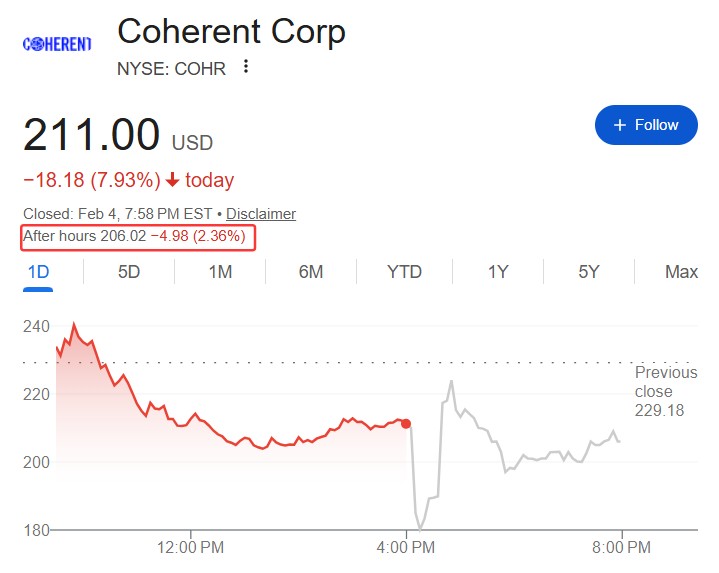
Optical module giant Coherent reported record revenue of $1.69 billion in the second quarter, a year-on-year increase of 17%. Benefiting from the leap in demand for artificial intelligence data center construction, the order shipment ratio for the data center business exceeded 4 times, with visibility extending to 2027. In terms of 6-inch indium phosphide wafer production volume, the company has reached 80% of its capacity target. Despite strong performance, the stock price fell 2.36% in after-hours trading. Analysts believe that high market expectations led to profit-taking

Optical module giant Coherent announced that it has secured a "super large" order for CPO (Co-Packaged Optics), while the 1.6T optical module is accelerating its volume production. However, profit-taking pressure caused the stock price to drop 2% in after-hours trading.
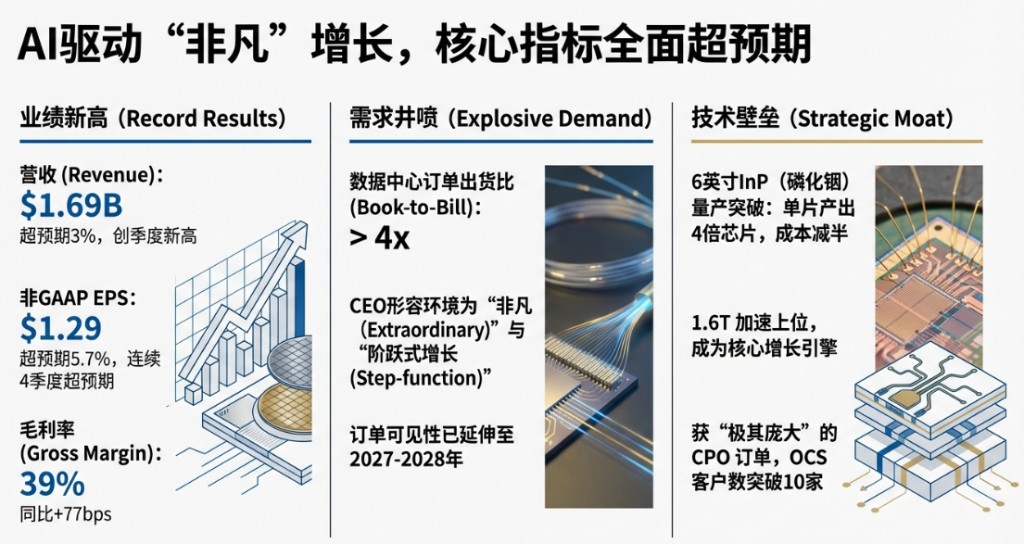
On February 4th, after the U.S. stock market closed, Coherent released its fiscal year 2026 second-quarter results, reporting an adjusted earnings per share of $1.29, exceeding the market consensus expectation of $1.22. Revenue reached $1.689 billion, also surpassing expectations and setting a new quarterly high. Compared to the same period last year, the company's profits and revenues showed significant growth.
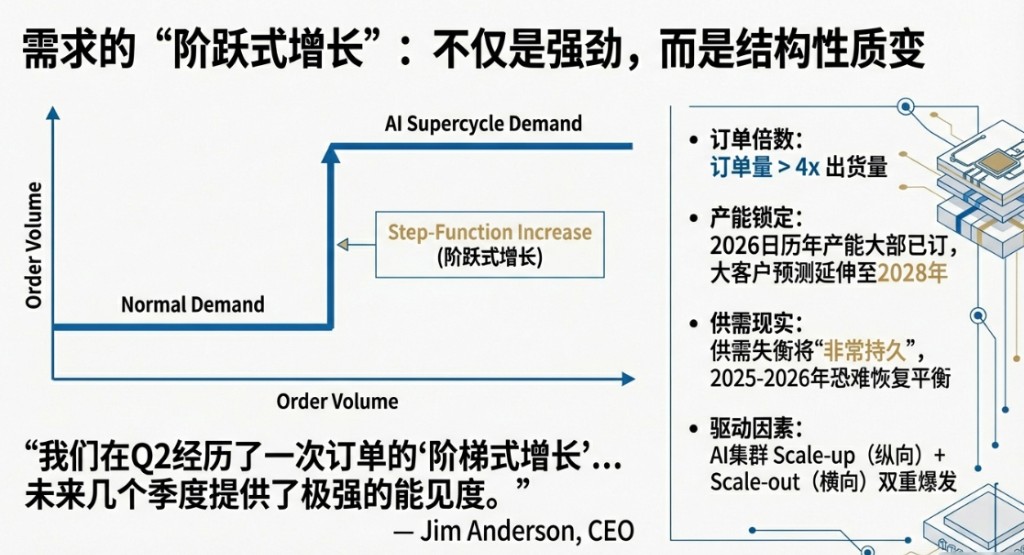
The company stated that the leap in demand driven by AI data center construction has led to a Book-to-Bill ratio for data center-related business orders exceeding 4 times, with visibility extending even to 2027. Such indicators typically reflect economic trends and supply-demand tightness better than single-quarter revenues.

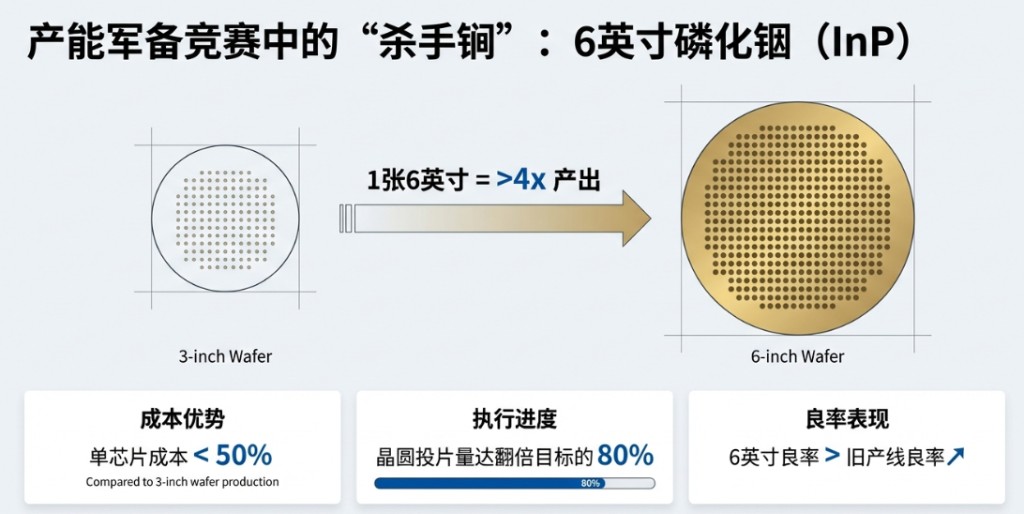
On the technology and capacity side, the company emphasized breakthroughs in the mass production of 6-inch indium phosphide (InP). The output of single wafer chips has increased more than fourfold, with costs reduced by about half, and the yield of the 6-inch line has surpassed that of the old production line, with plans to double internal capacity by the end of this year.
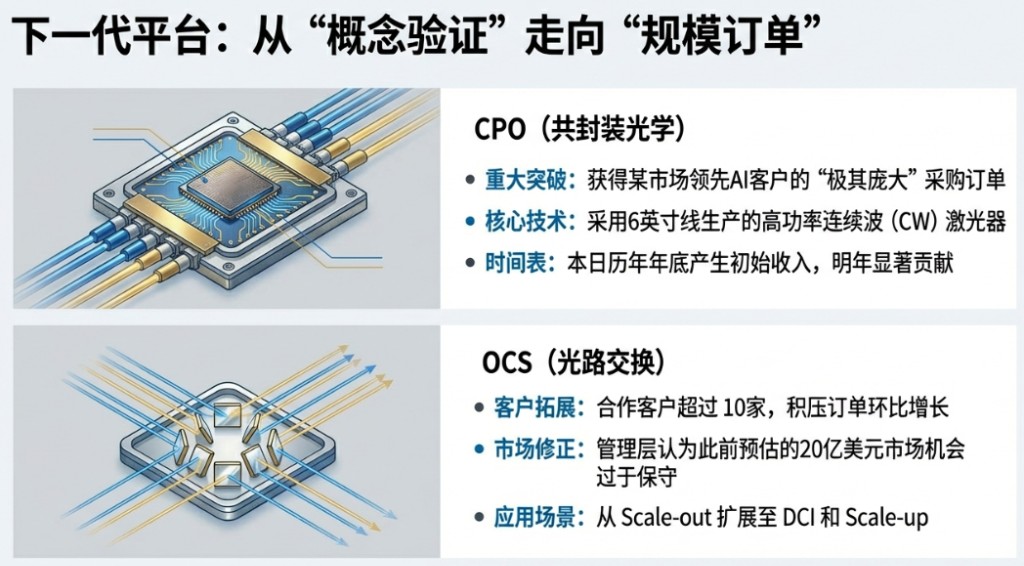
On the product and customer side, the company disclosed that it has received an "extremely large" CPO order, while the number of customers for the OCS (Optical Circuit Switching) platform has exceeded 10, with backlogged orders increasing, targeting a market opportunity exceeding $2 billion in the coming years.
However, after the impressive earnings report, the stock price fell by 2.36%, which analysts believe is not surprising.

Firstly, the company's stock has already seen considerable growth over the past year, and the market's expectations for the AI optical interconnect chain are already high, leading to "better than expected but not explosive" results that may trigger profit-taking.
Secondly, some of the growth is more reflective of orders and capacity/product ramp-up as leading indicators, while the actual realization of revenue and profit on the income statement will still take time (such as the demand release for 1.6T and semiconductor equipment falling more into subsequent cycles), making short-term funds more sensitive.
With the strength of orders already proven, the core issues in the next phase will focus more on: whether capacity expansion and yield ramp-up match demand, whether 1.6T and CPO can be ramped up as planned, and the pace at which new platforms like OCS transition from "customer participation" to "scale procurement."

AI-Driven "Extraordinary" Growth, Most of This Year's Capacity Already Booked
The financial report shows that Coherent's adjusted EPS for this quarter is $1.29, approximately 5.7% higher than market consensus expectations, continuing the trend of exceeding expectations for four consecutive quarters. Revenue of $1.689 billion also surpassed expectations by about 3%, setting a quarterly record.
CEO Jim Anderson described the current demand environment as "extraordinary" during the conference call. He revealed that the company experienced a "step-function increase" in orders in Q2, particularly in the data center sector, where order shipments exceeded four times.
Anderson stated:
Due to the continued increase in customer demand and longer order lead times, we have strong visibility for the next few quarters.

The financial report indicates that most of the capacity for the calendar year 2026 has already been booked, with orders quickly filling up into 2027, and even some major customers providing detailed forecasts extending to 2028.
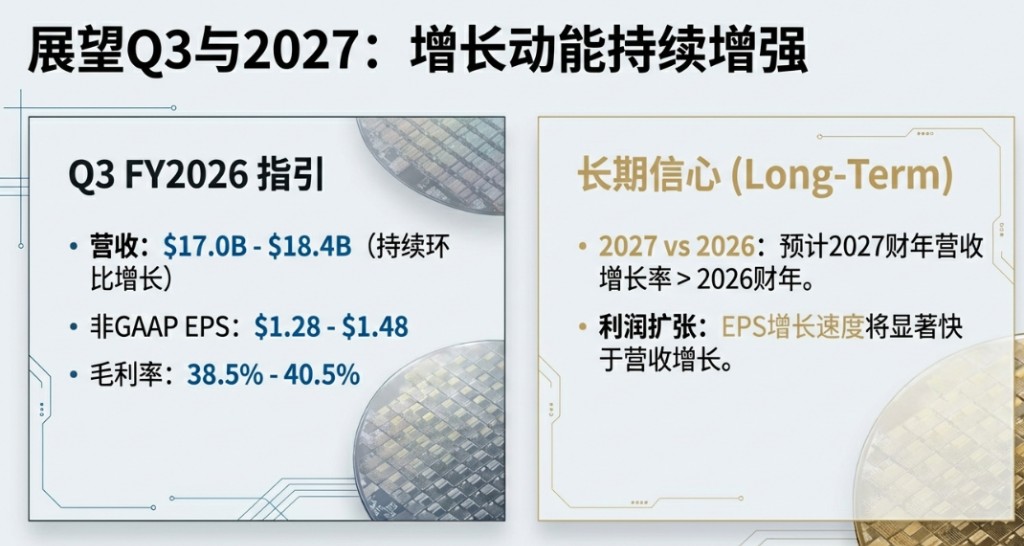
In the subsequent guidance, the company expects Q3 revenue to be between $1.7 billion and $1.84 billion.

1.6T Optical Modules Accelerate to the Forefront, Supply Shortages May Persist
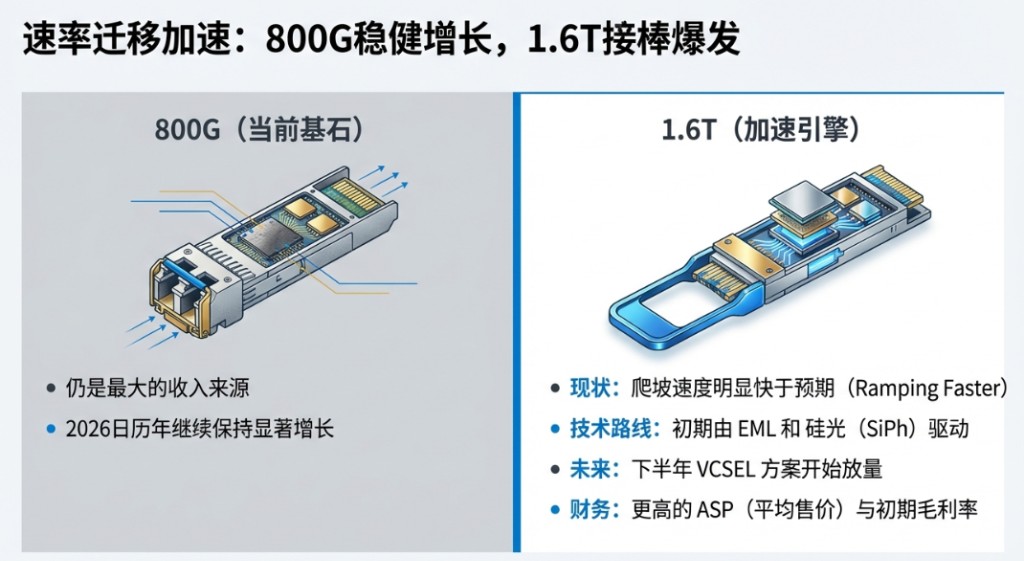
In terms of product structure, demand for AI data centers is rapidly shifting from 800G to the higher-speed 1.6T. Although 800G remains the largest source of revenue currently, the growth rate of 1.6T is significantly faster.

In the financial report, Coherent defines 800G and 1.6T high-speed optical modules as core growth engines and clearly states: AI clusters are expanding along both "Scale-up" (internal scaling) and "Scale-out" (larger cluster interconnections) paths, driving demand for high bandwidth and low power interconnections.
Anderson pointed out:
We see strong demand for 1.6T transceivers from multiple customers and continue to expect significant growth for both 800G and 1.6T in the calendar year 2026.
He specifically mentioned that the ramp-up of 1.6T is accelerating, initially driven by EML and silicon photonics solutions, with VCSEL-based 1.6T products expected to begin volume production in the second half of this year.
Regarding the market's concerns about capacity bottlenecks, Anderson candidly stated that the supply-demand imbalance is unlikely to be resolved in the short term. He emphasized:
I do not believe that supply and demand will return to balance this year or next year. Based on the forecasts we see from customers for indium phosphide lasers, we may be in a very prolonged period of supply-demand imbalance.
Capacity Arms Race: 6-Inch Indium Phosphide Becomes the "Killer App"
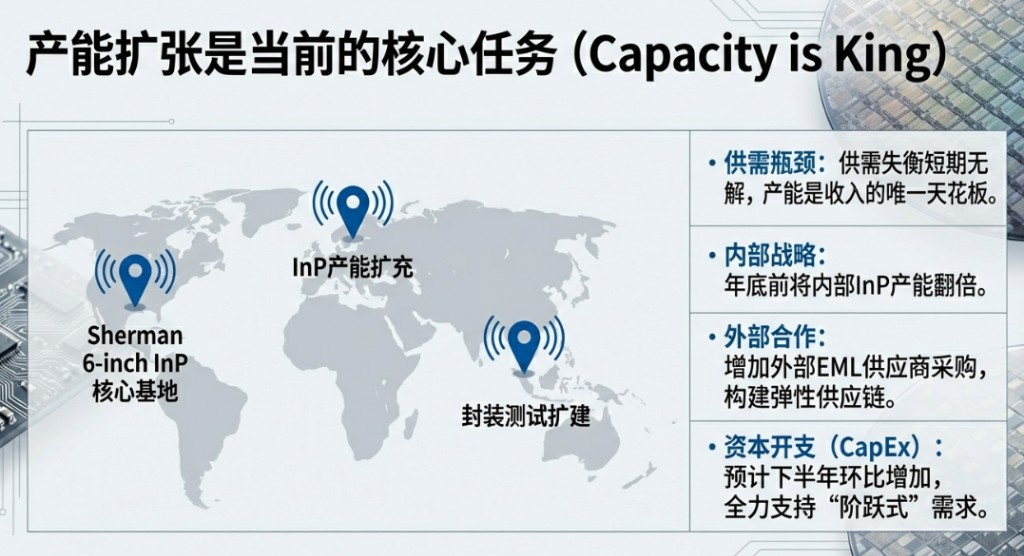
To address this "super cycle," Coherent is accelerating the capacity expansion of its first global 6-inch indium phosphide (InP) production line. The company plans to double its internal indium phosphide capacity by the end of this year.

Anderson revealed a key piece of data at the meeting: in terms of wafer starts, the company has currently achieved 80% of its capacity doubling target. This is seen as an important leading indicator of smooth capacity ramp-up.
Management has repeatedly emphasized the significant economic advantages of 6-inch wafers compared to traditional 3-inch wafers:
A 6-inch wafer produces more than four times the number of chips as a 3-inch wafer, while costing less than half.
This cost structure advantage, combined with the layout of domestic manufacturing (Texas Sherman plant), has become a key bargaining chip for Coherent to win major customers.
Analysts believe that in the high demand for AI optical interconnects, the strategic significance of 6-inch InP is not only "cost reduction" but also the infrastructure for "supply capacity and bargaining power."
As the industry enters a high bandwidth generation (800G→1.6T→higher), upstream lasers/active devices often become the bottleneck for capacity and cost, and advanced processes and large-scale production capabilities will more directly translate into order acquisition capabilities.
CPO and OCS: "Big Order" Opportunities for Next-Generation Technologies
In addition to the current boom in optical modules, Coherent has also announced significant good news regarding its next-generation technology layout.
Regarding Co-Packaged Optics (CPO), Anderson revealed:
We recently received an exceptionally large purchase order from a market-leading AI data center customer.
This CPO solution utilizes the company's latest high-power continuous wave (CW) lasers produced on its 6-inch line. This also means that CPO technology is beginning to transition from concept to substantial scale deployment.

In the Optical Circuit Switching (OCS) field, the company has also made breakthroughs, with over 10 customers currently involved, and backlogged orders achieved quarter-on-quarter growth in Q2. Management believes that previous estimates of the OCS market size (approximately $2 billion in the coming years) may be overly conservative, and the actual opportunities will far exceed this figure.
The full translation of Coherent's earnings call is as follows:
Conference Opening
Host: Welcome to the Coherent Q2 Fiscal Year 2026 Earnings Call. Now, I would like to introduce Mr. Paul Silverstein, Senior Vice President of Investor Relations at Coherent.
Paul Silverstein: Thank you, host, and good afternoon, everyone. Joining me today are Coherent's CEO Jim Anderson and CFO Sherri Luther. In today's call, we will review the financial and business performance for Q2 of Fiscal Year 2026 and look ahead to the business outlook for Q3 of Fiscal Year 2026. Our earnings press release can be found in the Investor Relations section of the company's website, coherent.com.
I would like to remind everyone that during the call, we may make predictions or other forward-looking statements regarding future events or the company's future financial performance. We hope and remind you that such statements or predictions are based on information currently available, and actual results may differ significantly. We encourage you to review the documents the company has filed with the SEC, including the 10-K, 10-Q, and 8-K reports. These documents contain and identify important risk factors that could cause actual results to differ materially from those projected or forward-looking statements.
This call constitutes the company's formal guidance for Q3 of Fiscal Year 2026. If at any time after this call we communicate any significant changes to this guidance, we intend to update it through public forums such as press releases or publicly announced conference calls.
Additionally, during this call, we will reference GAAP and non-GAAP financial metrics. By disclosing certain non-GAAP information, management aims to provide investors with additional information for further analysis of the company's performance and potential trends. For historical periods, we have provided reconciliations of these non-GAAP financial metrics to GAAP financial metrics in our earnings press release and investor presentation, which can be found in the Investor Relations section of our website, coherent.com.
Now, let me turn the call over to our CEO, Jim Anderson.
CEO Remarks
Jim Anderson: Thank you, Paul, and thank you all for joining today's call. As a global leader in photonic technology and solutions innovation and supply, Coherent is at the center of the extraordinary expansion of optical network infrastructure, which has enabled significant growth in data traffic across AI data centers' scale-across, scale-out, and scale-up networks. Thanks to AI development, we achieved strong revenue and profit growth in the December quarter. Our orders have also experienced another leap in growth, and we expect to see further growth in the current quarter.
Given the extraordinary strength and visibility of customer demand, combined with our continuously rapidly expanding capacity, we anticipate a sustained period of strong revenue growth in the coming quarters. In particular, we expect to see continued strong sequential revenue growth in both the March and June quarters, and we anticipate that the revenue growth rate for Fiscal Year 2027 will exceed that of Fiscal Year 2026
The key growth drivers we see in the coming quarters include the growth of 800G and 1.6T transceivers, the ramp-up of new products such as OCS and CPO solutions, and the continued exceptionally strong demand for our products used in data center interconnect (DCI) and scaling. Additionally, we are now seeing demand signals indicating that our industrial business growth will rebound in this calendar year, primarily due to strong orders from semiconductor equipment customers. Overall, we are excited about the growth prospects for the next few quarters. We are also focused on driving meaningful operational leverage and expect to continue achieving EPS growth rates significantly faster than the anticipated revenue growth rate.
Second Quarter Operational Performance
Now let me provide some additional details about the recent quarter and our expectations for the future.
Second quarter revenue increased by 9% quarter-over-quarter and 22% year-over-year (on a pro forma basis excluding the recently divested aerospace and defense business). Non-GAAP gross margin expanded by 24 basis points quarter-over-quarter and 77 basis points year-over-year. The combination of revenue growth and gross margin expansion drove non-GAAP earnings per share to increase by 11% quarter-over-quarter and 35% year-over-year.
Data Center and Communications Business
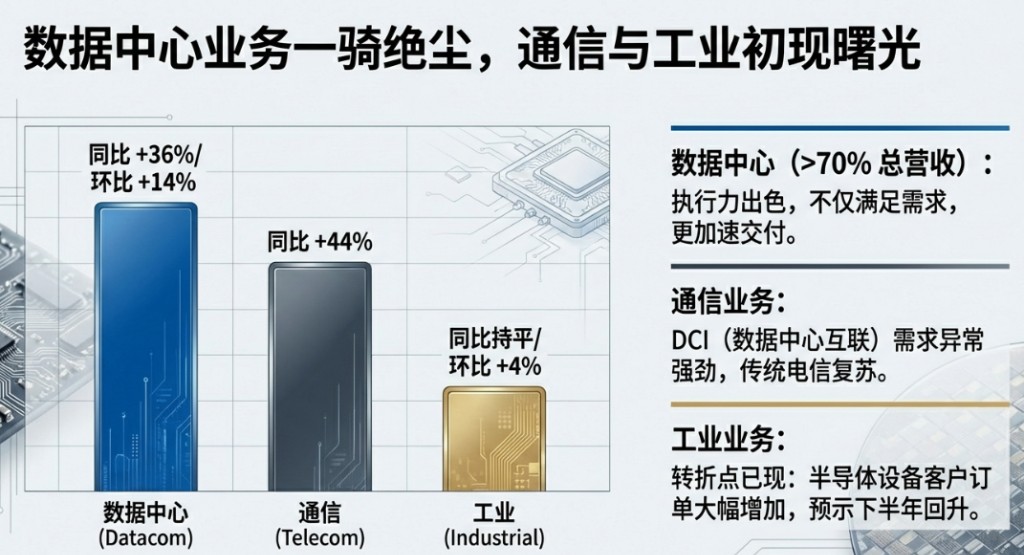
Now I will highlight some key points from our two operating segments. In the Data Center and Communications segment (which currently accounts for over 70% of our revenue), we saw an acceleration in the quarter-over-quarter growth rate, with second quarter revenue increasing by 11% quarter-over-quarter and 34% year-over-year, driven by strong growth in the data center and communications markets.
In the data center business, our quarter-over-quarter growth rate accelerated significantly, with second quarter revenue increasing by 14% quarter-over-quarter and 36% year-over-year. The acceleration in quarter-over-quarter growth in the second quarter was due to the excellent execution of our production team. Given the exceptionally strong demand and our rapidly expanding capacity, we expect the data center business to achieve double-digit quarter-over-quarter growth again in the March and June quarters.
As this is our largest and fastest-growing business, I would like to provide some additional details about the demand and supply situation in the data center business.
On the Demand Side
The growth in data center revenue in the second quarter was driven by the increase in 800G and 1.6T transceivers. In the second quarter, our data center orders experienced another leap in growth, with the order shipment ratio exceeding 4 times, as customer demand continued to grow and customers placed orders further out, providing us with strong visibility for the coming quarters.
Our strong product portfolio, combined with our vertical integration and expanding U.S. manufacturing footprint, provides our customers with a clear competitive advantage. We expect revenue growth in the current quarter to be driven by the growth of 1.6T and 800G transceivers as well as the growth of our OCS systems.
We are seeing strong demand from multiple customers for our 1.6T transceivers and continue to expect significant growth in both 800G and 1.6T in the 2026 calendar year. We anticipate that 1.6T will ramp up significantly in the coming quarters, with the early stages of ramp driven by our EML and silicon photonic-based transceivers, followed by our 1.6T transceivers based on 200G VCSEL ramping up in the second half of this calendar year
Supply Side
In response to extraordinary demand growth, we are rapidly expanding our production capacity. For example, we significantly increased our indium phosphide (InP) capacity in the second quarter, and we are on track to double our internal indium phosphide capacity by the fourth quarter of this calendar year.
Our indium phosphide capacity expansion is driven by the ramp-up of 6-inch wafer production. Compared to 3-inch wafers, 6-inch wafers will produce over four times the chips at less than half the cost. Our production team has done an excellent job in enhancing 6-inch indium phosphide capacity, and I would like to take this opportunity to thank our team for completing the plan ahead of schedule in the second quarter.
We are simultaneously increasing capacity at two locations: Sherman, Texas, and Tarfala, Sweden. We are producing three different types of critical transceiver components on 6-inch indium phosphide: EML, continuous wave lasers (CW Laser), and photodiodes. Our 6-inch yield continues to exceed the yield of the 3-inch production line. Additionally, we have multiple suppliers for 6-inch indium phosphide substrates, and we have secured committed substrate supply to support our goal of doubling capacity in the December quarter.
In short, we are very pleased with the ramp-up of the world's first 6-inch indium phosphide production line, and we expect this capacity ramp-up to support significant revenue growth and margin expansion for our transceiver products in the coming quarters.
We also expect to continue supplementing our internal indium phosphide capacity through external suppliers. For example, EML supply from external suppliers increased sequentially in the second quarter, and we expect this supply to increase again in the current quarter and this calendar year through ongoing long-term collaborations with key external suppliers.
We are also continuing to invest in expanding transceiver module assembly capacity. We are expanding capacity in Malaysia, Vietnam, and other locations. Overall, I am very pleased with our ongoing capacity expansion to meet rapidly growing demand.
Progress on CPO and OCS Products
I am equally excited about the progress of other key data center products and technologies. Specifically, I would like to provide an update on our CPO and OCS products, which we expect to be significant contributors to our long-term growth and profitability.
The transceiver technology platform continues to evolve, and as we make progress in LPO, LRO, CPO, and NPO-related products and technologies, we are well-positioned to collaborate extensively with an increasing number of customers.
In particular, we recently received an extremely large purchase order from a market-leading AI data center customer for CPO solutions, which includes our new high-power continuous wave laser that began sample shipments last year. A key factor in the customer's decision to partner with Coherent, in addition to the outstanding performance of the solution, is that our high-power continuous wave lasers are produced on our 6-inch indium phosphide production line in Sherman, Texas. We expect this significant design win to begin generating initial revenue by the end of this calendar year, with more substantial revenue contributions in the following year and beyond. We are also collaborating with several other customers on CPO and NPO application solutions based on indium phosphide and 200G VCSEL
In the second quarter, we made strong progress with our optoelectronic circuit switch (OCS) platform based on differentiated non-mechanical liquid crystal technology. OCS backlog orders increased sequentially in the second quarter, and we now have over 10 customers collaborating with us. The shipments and backlog orders include both 64/64 and 320/320 system scales, with most backlog orders leaning towards the larger system scale. We expect OCS revenue to grow sequentially in the current quarter and in the coming quarters as we ramp up capacity as quickly as possible to meet rapidly growing demand, as well as the anticipated addressable market opportunity of over $2 billion in the coming years.
Telecommunications Market
In the telecommunications market, revenue grew 9% sequentially and 44% year-over-year in the second quarter. The growth continues to be driven by strong demand for our products used in data center interconnect and scaling, as well as traditional telecom applications. We expect the telecommunications business to grow sequentially in the current quarter and the June quarter.
The strong momentum we see in the telecommunications sector is broad in both products and customers. We continue to see exceptionally strong product demand for data center interconnect market opportunities. These products include our ZR and ZR+ coherent transceiver products, as well as lasers and other components we sell to system OEMs. For example, we recently secured a significant multi-year design win with a leading DCI OEM that leverages Coherent's industry-first non-cooled 3-pin micro-pump solution.
We are also seeing strong demand in the traditional telecom business, driven by ongoing market recovery and new product launches, such as our award-winning new multi-track technology platform. We have also experienced very strong demand across our broader telecommunications product portfolio, including pump lasers, amplifiers, line cards, and systems.
Industrial Business
In the industrial sector, revenue grew 4% sequentially and was flat year-over-year on a pro forma basis, excluding the recently divested aerospace and defense business. The sequential growth in the second quarter was driven by our industrial laser and engineered materials product lines. We expect the industrial sector to be roughly flat on a pro forma basis in the current quarter.
However, looking ahead, we expect demand to improve. For example, we saw a significant increase in orders from semiconductor equipment customers in the second quarter, and we expect these orders to translate into sequential growth for our industrial business in the June quarter and for the remainder of this calendar year.
At the recent Photonics West conference, we highlighted many compelling long-term growth areas for our industrial product lines, including: data center XPU cooling solutions based on our 300mm silicon carbide and thermosensitive materials technology; thermoelectric generators that improve energy efficiency in data centers through waste heat recovery; excimer laser annealing systems for 8th generation OLED factories; high-power lasers for direct fusion energy generation; and excimer lasers used for processing superconducting tapes in magnetic fusion applications. This range of differentiated solutions enables our industrial business to achieve significant long-term growth.
Business Portfolio Optimization
Finally, I would like to provide the latest information on the business portfolio optimization plan. Last week, we completed the sale of the product division located in Munich, Germany, which produces material processing tools. The sale of this product division is expected to immediately enhance gross margins and earnings per share. Due to this sale and other operational streamlining measures, we exited 10 sites in the past quarter, bringing the total number of sites sold or exited to 33 over approximately six quarters since we began this plan. We plan to continue streamlining our footprint in the coming quarters and exit more underutilized and unnecessary sites.
Summary
In summary, we achieved strong revenue and earnings per share growth in the second quarter, and given the exceptional demand from customers and rapid capacity expansion, we expect fiscal years 2026 and 2027 to be strong growth years for Coherent. I would like to thank my Coherent colleagues for their strong execution and the incredible innovation they drive for our customers every day.
Now I will hand the conference call over to our Chief Financial Officer, Sherri Luther.
CFO Remarks
Sherri Luther: Thank you, Jim. In the second quarter, we continued to drive strong double-digit year-over-year revenue growth, gross margin expansion, and strong profitability. Capital allocation remains a key focus area, and we have maintained our debt leverage ratio below 2 times.
Second Quarter Financial Performance Summary
Now I will summarize the performance for the second quarter. Second quarter revenue reached a record $1.69 billion, a 7% increase quarter-over-quarter and a 17% increase year-over-year, driven by growth in AI data center and communication demand. On a pro forma basis, excluding the aerospace and defense business sold in the first quarter, second quarter revenue increased 9% quarter-over-quarter and 22% year-over-year.
Our non-GAAP gross margin for the second quarter was 39%, up 24 basis points from the previous quarter and up 77 basis points from the same period last year. We continue to execute our gross margin expansion strategy, achieving both quarter-over-quarter and year-over-year gross margin growth, primarily in the data center and communication sectors. These improvements were driven by lower product input costs, efficiency gains from reduced manufacturing cycle times, and yield improvements. Pricing optimization also continued to make a significant contribution to our gross margin expansion.
Non-GAAP operating expenses for the second quarter were $321 million, compared to $304 million in the previous quarter and $283 million in the same period last year. The percentage of operating expenses to revenue decreased to 19%, down from 19.2% in the previous quarter and 19.7% in the same period last year. The percentage of selling, general, and administrative expenses (SG&A) to revenue decreased to 9.6%, down from 9.8% in the previous quarter and 10.2% in the same period last year, thanks to our ongoing progress in driving efficiency and improving SG&A leverage.
We have made significant progress on the ERP integration project, and we expect that by the end of this fiscal year, most of the company will be using a single ERP platform. Additionally, we are implementing low-cost regional initiatives within the G&A functions, which will continue to show benefits this fiscal year and will be more meaningful in fiscal year 2027 The quarter-on-quarter and year-on-year growth in R&D expenses is mainly in the data center and communications sectors, as we continue to focus on investments with the highest return on investment that drive the company's future growth.
Our non-GAAP operating margin for the second quarter was 19.9%, compared to 19.5% in the previous quarter and 18.5% in the same period last year. Non-GAAP diluted earnings per share for the second quarter were $1.29, compared to $1.16 in the previous quarter and $0.95 in the same period last year.
From a capital allocation perspective, we maintained a debt leverage ratio of 1.7 times, down from 2.3 times in the same period last year.
Capital expenditures for the second quarter were $154 million, compared to $104 million in the previous quarter and $106 million in the same period last year. We are focused on supporting the exceptional customer demand in the data center and communications sectors. Therefore, we are rapidly expanding capacity and expect capital expenditures to increase quarter-on-quarter for the remainder of this fiscal year.
We have made good progress in strengthening our balance sheet, including significantly reducing our debt leverage ratio, refinancing debt, and improving working capital. With a strong balance sheet and a focus on enhancing profitability, the company is well-positioned to support exceptional customer demand through rapid capacity expansion investments.
As Jim pointed out, we completed the sale of our product division located in Munich, Germany, which produces material processing tools, at the end of last month. For reference, this business contributed an average of $25 million in revenue per quarter over the past four quarters, with gross margins significantly below Coherent's corporate gross margins. This sale will reduce our workforce by approximately 425 employees. We expect to use the proceeds from the sale to pay down debt to reduce interest expenses, which will immediately enhance our gross margins and earnings per share.
Third Quarter Guidance
Now I will turn to the guidance for the third quarter of fiscal year 2026. Our outlook for the third quarter includes $5 million in revenue from the period before the completion of the sale of the Munich product division at the end of January.
- We expect revenue to be between $1.7 billion and $1.84 billion
- We expect non-GAAP gross margin to be between 38.5% and 40.5%
- We expect non-GAAP operating expenses to total between $320 million and $340 million
- We expect a non-GAAP tax rate for the quarter to be between 18% and 20%
- We expect non-GAAP earnings per share to be between $1.28 and $1.48
Summary
In summary, I am very pleased with the strong performance in the second quarter. We continue to focus on expanding profitability through rigorous execution against our long-term financial goals model. We are excited about the significant growth trajectory ahead. This momentum reinforces our confidence in driving long-term growth and creating lasting value for shareholders.
That concludes my formal remarks. Moderator, please begin the Q&A session.
Q&A Session
Question 1 (Samik Chatterjee, JP Morgan)
Question: Jim, I hope your leg is recovering. Regarding demand, could you clarify the duration of visibility? How long of a demand visibility have customers provided? How should we consider this in relation to the capacity increase of indium phosphide, especially the contribution of 6-inch to the capacity increase?
Jim Anderson's response: Thank you, Samik, my leg is much better. Regarding demand, I would say the visibility we are seeing is extraordinary. If I look at some highlights from last quarter, the data center business has accelerated with a 14% quarter-over-quarter growth rate. The order-to-shipment ratio is over 4 times. We are seeing order bookings further out than in the past, which is very favorable for our visibility.
Specifically:
- Orders have been booked through the remainder of this calendar year, and most of the orders we are receiving now are for the 2027 calendar year.
- We have received very detailed long-term forecasts from major customers, which typically extend two to three years, with some forecasts extending to the 2028 calendar year.
- We have signed or are in the process of signing multiple long-term supply agreements with customers that guarantee a certain amount of supply in exchange for a certain amount of demand, usually with some form of financial commitment from the customer, such as capital expenditure investments.
All these factors combined give us the best visibility in the history of the business, which provides us with great confidence in future growth.
Regarding the capacity increase of indium phosphide, we are very satisfied with the team's execution on the 6-inch indium phosphide ramp. One key metric I am focused on is the wafer starts. Our goal is to double the indium phosphide capacity by the end of this calendar year.
If we look at the number of wafers we started this quarter, we have already reached 80% of our target capacity. In fact, last quarter our wafer starts grew more than fourfold from the September quarter to the December quarter. For me, this is a very important leading indicator of our progress on the indium phosphide ramp.
This is the beginning of the production line. It typically takes about six months from wafer starts to product being loaded into transceivers and shipped to customers. So we will start to see some benefits this quarter, but these benefits will ramp up over the next few quarters. Fast forward to the end of the year, when half of our internal capacity is running on 6-inch, you can think of it this way: the cost of our half of the internal capacity on 6-inch is about half of the other half, because the product cost of 6-inch is about half that of 3-inch.
Follow-up (OCS): Can you quantify the backlog size for 10 customers? Or how should we consider the timing when revenue exceeds $100 million?
Jim Anderson's response: Regarding OCS, this will be a common theme—demand is very strong. We are 100% focused on capacity ramp-up. The backlog is good and has grown from the September quarter to the December quarter. We expect revenue to grow this quarter and continue to increase throughout the calendar year and next year. We are working with over 10 customers. The market size has only grown since we assessed it a year ago. This is a huge opportunity, and we are ramping up capacity as quickly as possible. As we progress throughout the year, we may provide some more specific revenue milestones, but it will definitely contribute to our revenue growth this calendar year and will certainly contribute next year
Question 2 (Simon Leopold, Raymond James)
Question: Regarding 1.6T, you mentioned some progress. Can you provide some milestones to help us understand when it will exceed $100 million per quarter? And what is the competitive landscape for this product?
Jim Anderson's answer: First, we expect both 800G and 1.6T to continue growing this calendar year. We saw growth in both 800G and 1.6T last quarter. We expect both to grow again this quarter. 800G remains the largest portion of revenue, and we expect year-over-year growth this year. 1.6T is growing faster, but it is growing from a smaller base than 800G.
I would say the ramp for 1.6T has accelerated. Demand from customers has accelerated. We are ramping with multiple customers. I think this is a key primary growth driver for us throughout the year. We typically do not break down revenue by data rate, but both 800G and 1.6T are definitely key growth drivers for the company this calendar year. 1.6T will continue to ramp in the next calendar year. In fact, the large number of orders we are seeing now is certainly for 800G, but there are also a significant number of orders for 1.6T. So this gives us good visibility into future demand.
Our initial ramp is driven by EML-based 1.6T transceivers and silicon photonics. But we expect VCSEL-based 1.6T transceivers to start ramping in the second half of this year. So we are very pleased with the growth rate, pace, and future growth of 1.6T.
Follow-up (CPO and scale-up): What is the timeframe and market size for scale-up opportunities after CPO qualification?
Jim Anderson's answer: The CPO purchase orders we have received are very large for our high-power continuous wave laser-based solutions. Initially, it will be deployed in scale-out, but we expect it to lead to scale-up deployments over time. I would say there is very active collaboration and design win progress on scale-up, involving various CPO-related scale-up solutions across multiple customers. I would say this is very active deep collaboration.
Regarding the scale of scale-up opportunities, I would say it is actually very difficult to quantify. It is huge. Some forecasts we are seeing from customers are very, very large. If you consider scale-up opportunities, all these networks today, the networks within racks are electrical. As these networks transition to optical in the coming years, the amount of optical content we gain in the network scale-up portion is enormous. We are in a very favorable position.
We expect to supply customers in this field in several different ways:
- Providing high-power continuous wave lasers, detectors, and fiber optic cables at the component level
- Supplying at a higher level, such as external laser sources and pluggable laser sources that can be inserted into front panels
- CPO module components, etc.
Therefore, we will support this market in various ways. We believe that scale-up is a huge growth opportunity. Based on the plans we see from our customers, I wouldn't say this is something for years down the line; I think it will happen faster than that.
Question 3 (Ruben Roy, Stifel)
Question: Regarding CPO, how does the content opportunity for CPO compare to the strong performance of current 800G and 1.6T modules? As CPO ramps up in 2027, what are the growth opportunities?
Jim Anderson answered: We see this as additive. Our view is that pluggable transceivers will remain the dominant form in scale-across and scale-out networks for at least the remainder of this decade. So we see these pluggable formats having very strong growth in scale-across and scale-out in the coming years.
What we see in CPO is that CPO is starting to be deployed in scale-out, and we are seeing that. That is what we are getting in purchase orders. But we believe that the big growth for CPO is actually driven by scale-up. Based on our customer collaborations, this is a very tangible opportunity. We believe that the CPO opportunity in scale-up will dwarf the opportunities in scale-out by several orders of magnitude. So we see it as the entire incremental TAM for the optical industry, and certainly for us, as the network today is 100% electrical, and all the optical content in scale-up is incremental TAM.
Follow-up (Gross Margin): What is the impact of the mix of 800G and 1.6T along with the demand for 200G on module gross margins?
Jim Anderson answered: We expect the gross margin for 1.6T to be higher. Generally, what we see as an industry is that the ASP for each new data rate tends to be higher than the previous data rate. So we expect the ASP for 1.6T to be higher than that for 800G. Then typically, especially at the beginning of the data rate lifecycle, gross margins are higher. So we expect the gross margin for 1.6T to be higher. Therefore, we see the ramp of 1.6T as favorable for margin expansion for us.
Another point is that as we ramp up our 6-inch indium phosphide capacity (supporting 800G and 1.6T transceivers), the 6-inch capacity is also a driver of gross margins for our transceiver business.
Question 4 (Thomas O'Malley, Barclays)
Question: You mentioned an order-to-shipment ratio exceeding 4 times. Can you elaborate on the composition of the backlog? Where is the strength the greatest?
Jim Anderson answered: Regarding last quarter's order-to-shipment ratio, I would say that the vast majority was driven by orders for 800G and 1.6T transceivers. This is the combination of the 800G growth we expected, which continues to grow and may even be slightly stronger than we anticipated. Then there is the acceleration of 1.6T. So both 800G and 1.6T orders are very strong. We expect this to continue in this quarter
In addition, OCS's orders also contributed in the last quarter. If I look at the current quarter and our expectations for orders, we anticipate that orders will again be an incredibly strong quarter. This is actually a combination of the four things I mentioned, primarily the 800G and 1.6T transceiver orders. Over time, there are increasingly more 1.6T orders, along with CPO and OCS. So these are the main drivers within the data center order bucket.
Another area where we see very strong orders is in the communications business. So I would say that the growth we see in our DCI data center interconnect products is very, very strong. Its growth rate is faster than the overall growth rate of our communications business, but we also continue to see strong demand in the traditional telecom sector outside of DCI. So this is another area where we see strong orders.
Follow-up question: Regarding indium phosphide capacity, you mentioned a doubling by the end of the year, while competitors talk about a 40% increase. When will the industry be able to obtain the required products? When will balance be achieved?
Jim Anderson answered: That's a good question. It seems that every quarter we think we will catch up, and then demand continues to increase. So I expect that supply and demand will not return to balance this calendar year. I don't think it will happen next year either. Based on the forecasts we see from customers regarding the indium phosphide laser supply they need for their scale-up, I think we may be in a state of supply-demand imbalance for a long time, which is precisely why we are very focused on ramping up 6-inch capacity as quickly as possible.
The near-term goal is to double capacity by the end of this year, but we are pushing for very aggressive targets beyond that to continue to increase indium phosphide capacity. The demand we see from customers is absorbing all of this capacity, and even more.
Question 5 (Ezra Weener, Jefferies)
Question: Component pricing is rising, but you are also signing long-term agreements. Can you talk about pricing and how to consider gross margins in this context?
Jim Anderson answered: Regarding input costs, I think you are talking about the input costs of our pricing. We are indeed seeing an increase in input costs for externally sourced products like EML, but this is actually offset by our internal ramp-up of indium phosphide capacity. So I would say the net result is that as we continue to rapidly expand indium phosphide capacity, we are in a more favorable position in the coming quarters, which is beneficial for our gross margins. So the net result is positive for us. Therefore, we feel quite good about the position of indium phosphide costs.
Another perspective is that whenever the market price of indium phosphide rises, it makes our internally sourced indium phosphide more valuable in terms of margins. Then I would say that in terms of our own pricing, we continue to see opportunities to optimize pricing. I think Sherri mentioned in her prepared comments that some of the gross margin improvements we saw last quarter were based on pricing optimization. We continue to see opportunities for pricing optimization, especially in a very strong demand environment. So we believe we are in a good pricing environment across all businesses
Sherri Luther added: When you look at the improvements in gross margin on a month-over-month and year-over-year basis, the key factor is definitely the reduction in costs, as we see lower product input costs. The data center and communication businesses are actually the areas where we see greater benefits. The key elements of our BOM and the product input costs for larger components are lower.
We have also made improvements in the manufacturing process, achieving higher throughput, efficiency, and yield improvements. Similarly, this is in the data center part of our business.
Then in terms of pricing optimization, we have actually seen greater pricing optimization improvements month-over-month across multiple areas of the business. So these are the key elements of our gross margin expansion strategy, which we introduced as part of this strategy at our investor day last year, and we continue to focus on it.
If you look at the 39% gross margin we achieved this recent quarter and compare it to our gross margin for fiscal year 2024, through the strategic elements I described here, we have actually increased the gross margin by about 470 basis points. So I am very satisfied with the progress. We still believe we are in the early stages, as we continue to push towards a target of greater than 42%.
Follow-up question: Regarding the timing of the 6-inch capacity increase and long-term outlook, how do you expect the layering? Will most of the capacity be 6-inch in the long term? What is the advantage compared to peers?
Jim Anderson answered: In terms of the long term, essentially all the capacity we are adding now is 6-inch. We have added a little 3-inch, but aside from that, the vast majority is 6-inch capacity, which will continue. So over time, the 6-inch capacity will become a larger proportion. If you consider that we are doubling our capacity each year, almost all of this comes from 6-inch; another way to think about it is that by the end of this calendar year, about half of our capacity will be 6-inch and will grow in the following years.
Regarding the progress of the increase, as I shared, in terms of wafer starts, we have reached 80% of our goal to double capacity this year. We plan to significantly expand in the following years, far beyond just doubling capacity. It is still too early to talk about this. But as we progress throughout the year, I will provide some guidance on the expected continued increase in indium phosphide in the coming years.
Regarding cost structure advantages, the basic cost structure advantage is that 6-inch wafers yield over four times the product compared to 3-inch wafers, at less than half the cost. So this is a huge cost saving. I think this is also a key factor for our customers choosing us. For example, we just received a very large order for high-power continuous wave lasers, and one important reason is that the high-power continuous wave laser will be manufactured on 6-inch indium phosphide and will be made in Sherman, Texas, USA. So this is definitely one of the reasons our customers decide to choose Coherent, the advantage of 6-inch capacity and its location.
Question 6 (Papa Sylla, Citigroup)
Question: Regarding the increase in indium phosphide capacity, can you update the mix ratio of the internally developed indium phosphide transceivers? Previously it reached around 50%, where is it now? What is the long-term target mix ratio?
Jim Anderson answered: What we have shared in the past is that most of our indium phosphide (for example, lasers) comes from internal sources. Looking ahead, given the rapid increase in our 6-inch capacity this year and in the coming years, I believe the percentage of internal sourcing will grow over time.
That said, we expect to continue utilizing external suppliers. We believe there are good reasons for doing so, including customer and supply chain resilience. So we expect to continue leveraging external sources. However, over time, internal sources will become a larger proportion of the supply.
Follow-up question (OCS): The number of OCS collaborations has grown from 7 to 10. What types of workloads do the first 7 collaborations involve? What about the additional 3?
Jim Anderson answered: I will talk about the applications we see for OCS. Initially, we saw OCS being adopted in places where it has historically been used, such as in the spine part of the network or in redundancy-type applications. But as we work with more customers and deepen our collaboration with existing customers, we see the applications of OCS expanding.
So perhaps initially, most applications were in the scale-out part of the network, and we are now definitely seeing OCS being applied even in the DCI part. As we work closely with customers on scale-up plans, we are now seeing customers discussing the use of OCS in scale-up networks as well. So this is actually an expansion of customers and applications.
That’s why when we assessed the size of this market a year ago, we estimated it to be around $2 billion by the end of this decade. We may have underestimated it. If we reassess it now, it will far exceed $2 billion. So we see continued growth in customers and applications.
Question 7 (George Notter, Wolfe Research)
Question: Regarding the capacity to manufacture all these things, the demand is obviously very impressive. How is the utilization of transceiver supply from Malaysia and Vietnam, as well as the telecom business? Is there a need to expand capacity? Will outsourcing be considered?
Jim Anderson answered: We have been more focused on updating you on indium phosphide capacity, as this has been a constraint across the industry, and we have been constrained by it as well. But at the same time, we have certainly been building capacity, such as for transceiver assembly and testing.
I shared last quarter that we opened our second factory in Penang, Malaysia. We are also planning to build transceivers in our Vietnam factory. Vietnam has already manufactured many components that go into our transceivers. We are now starting to build transceivers internally in Vietnam. So this is an expansion. We have been expanding our assembly and testing capacity.
You mentioned telecom. For our DCI and telecom products, we are also rapidly expanding capacity. So I would say we are really ramping up capacity as quickly as possible. I feel like my main job right now is to increase capacity. Given the strong demand we are seeing, this is definitely a focus for the entire organization and many different product lines
Regarding outsourcing, we are very willing to outsource, and we do use many different partners for outsourcing. Our approach has always been that if manufacturing something provides us with a technological advantage (which our customers care about) or if it provides a cost structure advantage, then we will do it in-house. But if it does not provide either of those advantages, then yes, we will consider outsourcing. There are many areas where we have historically outsourced and things we are considering for the future.
What we keep in-house are those things that are beneficial to our product technology and have cost structure advantages. A clear example is 6-inch indium phosphide; we are the only 6-inch indium phosphide manufacturer in the world. So we are certainly willing to outsource, and we will continue to look for opportunities to leverage outsourcing.
Question 8 (Karl Ackerman, BNP Paribas)
Question: Regarding investments driving growth in 2027, can the increase in operating expenses account for half of the sales growth? How does this relate to the sale of the materials processing business?
Jim Anderson answered: From an operating expense perspective, perhaps from a research and development perspective, our approach is that we have a lot of businesses that have tremendous growth in the future, and we want to ensure we maximize that opportunity. If these businesses require R&D, we will certainly expand R&D to maximize the opportunity. I think we will definitely scale with revenue, maybe slightly below revenue. But I think the big opportunity for driving operating leverage lies in SG&A.
Sherri Luther added: From an operating expense perspective, in terms of R&D, as Jim mentioned, we focus on making those investments that drive long-term growth for the company. When you look at our year-over-year R&D growth, you will see it has grown by 16%. So we are absolutely investing in R&D, and these areas are primarily focused on data centers and communications businesses because that is where we see long-term growth.
But on the other hand, from an SG&A perspective, the SG&A target we presented on Investor Day is 8% of revenue, and we still have a way to go. We have certainly made progress. I am very pleased with the progress we have made; both sequentially and year-over-year, we are decreasing in terms of revenue percentage and are moving towards that goal.
Then in terms of R&D, to complete the whole picture, the target we provided on Investor Day is 10% of revenue. So we are focused on making those investments. I think it’s just a matter of how quickly you can spend the money because the commitment is definitely there, and we want to ensure we are making those investments. So I am satisfied with our investments so far. This is how we will continue to look at this issue in the future, right, investing in R&D while also trying to gain more efficiency and leverage from SG&A.
Follow-up: Several new products from the industrial portfolio were showcased at SPIE, and today there was talk about improvements in semiconductor equipment orders. Outside of semiconductor equipment, has the broader industrial business seen a significant recovery?
Jim Anderson answered: Good question. I would say it may be too early to say there is a broad industrial recovery in the wider industrial space, but we are certainly seeing a very strong rebound in the semiconductor equipment sector So we saw strong orders in the December quarter. We expect these orders to start bringing us sequential revenue growth in the June quarter and the second half of this calendar year. Semiconductor equipment is a large segment for us. So the rebound in order growth there is meaningful for us.
Question 9 (Ryan Koontz, Needham & Co.)
Question: Regarding the communications business, you emphasized multi-track technology, which I believe will be driven by this scale-across densification. How do you consider the timing and content of the long-haul fiber multi-track density upgrades?
Jim Anderson's answer: Thank you for the question, Ryan. First, we really like this new multi-track product. It provides service providers and network operators with a truly powerful capability to upgrade within their existing footprint, essentially gaining more traffic through existing optical infrastructure. So we are very satisfied with this product. We believe it is very unique in the market. We expect the enhancements to begin in the second half of this year. We see this product having very good design wins and orders, with revenue contributions starting in the second half of this year.
Then I would say more generally, in the DCI part of our business, even just traditional telecom, we are seeing very good growth. Last quarter, we saw a 9% sequential growth, but a 44% year-over-year growth. Based on the strong demand we are seeing, we expect this part of communications to grow sequentially in the March and June quarters.
This is also another area where we see backlog order growth. We sell at multiple different levels in this market segment. We sell at the system level, as we just discussed. We also sell ZR and ZR+ coherent transceivers at the module level. Then we also sell components like pump lasers and other similar products. We are seeing strong demand across all these product categories.
Follow-up question: Regarding the 3D sensing market and the transition to multi-junction, how do you view the transition relative to this business segment?
Jim Anderson's answer: Regarding 3D sensing, I just want to reiterate what we said before, that we have won an important new agreement with Apple, which they announced last summer as part of their U.S. manufacturing initiative. Revenue from this new partnership with Apple will start ramping up in the second half of this calendar year. This is a great multi-year partnership. We are very pleased with it. This is another example of a major customer leveraging our U.S. manufacturing footprint in Sherman, Texas. In that business, we have been running 6-inch gallium arsenide there for quite some time. So that is 6-inch gallium arsenide VCSEL technology. A big new partnership, and we are very pleased with it, with revenue expected to ramp up in the second half of this calendar year.
Question 10 (Michael Mani, Bank of America)
Question: How much gross margin leverage is the 6-inch indium phosphide ramp currently bringing you? What is the expected gross margin improvement over the next few quarters as annual supply doubles? What will be the biggest contributor to reaching the 42% gross margin target in the long term?
Jim Anderson answered: Perhaps I will first address the first part of the question about indium phosphide, and Sherri can answer the second part regarding broader gross margin drivers.
I would say that this quarter we are starting to see the benefits of the 6-inch capacity, because remember, we started the 6-inch capacity in the September quarter, and it typically takes about six months from wafer capacity to product loading into transceivers and actually shipping to customers. So we will see a bit of benefit this quarter, but this benefit will start to accumulate over the next few quarters.
If you fast forward to the end of this year, half of our internal capacity is running on 6 inches, you can think of it this way: the cost of our half of the internal 6-inch capacity is about half of the other half, because the product cost of 6 inches is about half of that of 3 inches. So this is a rough way to consider cost benefits.
Sherri Luther added: Michael, when you look at our gross margin, whether it’s the midpoint of our guidance for the third quarter at 39.5% or our long-term target model of over 42%, the biggest contributor will definitely be cost reductions. This is a big bucket, including product and input costs, some of which I mentioned earlier, where we did see benefits from reduced product input costs in our data center and communications businesses this quarter. But it also includes the yield improvements we continue to drive. Each quarter, we see the benefits of yield improvements, and I’m very excited to continue seeing that. There will always be opportunities, so we will continue to push, along with lower product input costs.
Another part will be pricing optimization, as we continue to capture value for our products. So we continue to see quarter-over-quarter improvements in pricing optimization. So that’s very good as well.
Now the timing of these plans will vary. Some will be near-term, and some will be long-term, depending on various initiatives. So the magnitude of benefits in any particular quarter may fluctuate, just because of the nature of the projects. But another benefit will certainly be volume, as we ship higher quantities. This will also benefit us. Then there’s the mix, which can always have adverse factors on a quarterly basis. So that’s the pros and cons within the gross margin, Michael.
Follow-up question: As the 1.6T ramp begins, primarily led by EML and CW lasers. Is there a significant change in the mix between silicon photonics and EML? Looking ahead to next year, as CPO becomes a bigger opportunity, does this make you reconsider how much CW laser capacity you need?
Jim Anderson answered: Regarding the first part about EML versus silicon photonics, since we have two products and are ramping both, it really depends on what mix the customers want, which depends on the application. So we are just building any version needed for customer applications. There’s not a significant financial difference for us between the two. We believe we have a very favorable competitive position in both EML-based 1.6T transceivers and silicon photonics.
Regarding the second part of the question, we are certainly ramping indium phosphide capacity for the transceiver demand we see, but we are also ramping capacity to support the high-power continuous wave laser demand in front of us
Closing Remarks
Jim Anderson: Alright. Thank you all for participating in today's conference call. We are certainly on track to achieve another outstanding year of revenue and profit growth in fiscal year 2026, and given the extraordinary demand we are seeing and our rapidly expanding capacity, we are well-prepared for a stronger fiscal year 2027.
Once again, I would like to thank all my Coherent colleagues for their hard work and dedication. Host, this concludes today's conference call.
Host: You may now disconnect. Thank you for your participation