


After the liquidity shock in commodities, which varieties were "wrongly killed"?
On February 3, 2026, the Shanghai Futures Exchange silver futures hit the limit down, closing at 21,446 yuan/kg, a decline of 16.71%. London silver spot closed at $79.2/ounce, and the SHFE silver futures premium fell to 7.46%. On February 4, the SHFE silver main contract rose by 5.93% in the night session. The limit down of silver futures triggered liquidity risks in the market, leading to declines in related varieties, but the subsequent rebound in silver futures indicates that the liquidity shock is basically over. The rotation in the commodity market continues, with silver, copper, and lithium becoming strong pillars
Event
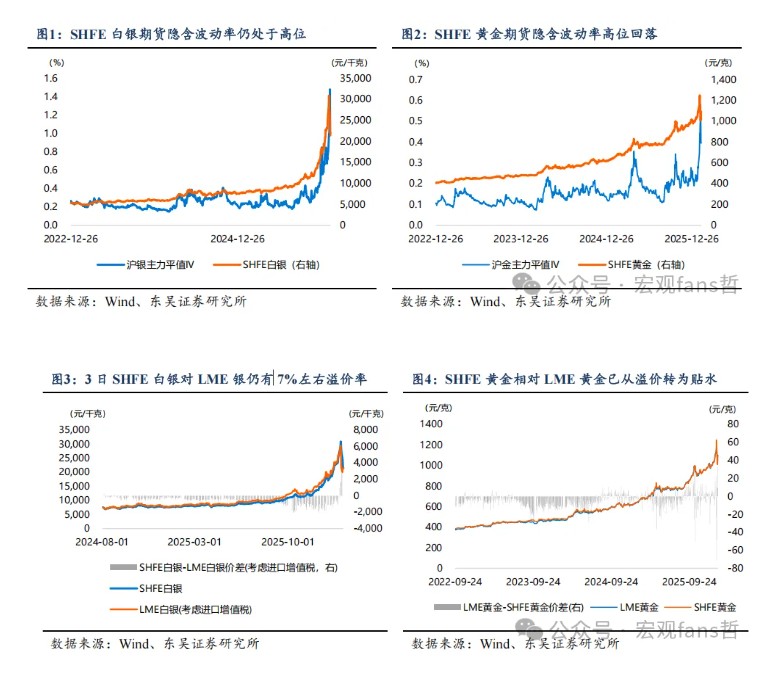
On February 3, 2026, the Shanghai Futures Exchange silver futures opened at the limit down and closed at 21,446 yuan/kg, a decline of 16.71%. From the perspective of the silver price difference between domestic and international markets, the London silver spot price closed at 79.2 USD/ounce that day. After considering the import value-added tax, the SHFE silver futures premium over LME silver fell from 29.8% at the end of January to 7.46% at the close on February 3. In the early hours of February 4, the SHFE silver main contract rose 5.93% in the night session, reporting 22,393 yuan/kg.
Core Viewpoint
The silver futures have ended the limit down, indicating that the current liquidity shock is basically over. Since November 2025, silver has taken over from gold and copper to enter a major upward wave, becoming an indicator of bullish sentiment in the commodity market. "Silver, copper, and lithium" have become the three strong pillars of the commodity market, and the upward trend of silver has also activated the rotation order of commodities. Since 2026, the bullish trend in commodities has followed the transmission chain of "gold, silver, platinum, and palladium precious metals group → copper, aluminum, tin, nickel, and other non-ferrous groups → crude oil and petrochemical industry chain," and even agricultural products are stirring. However, the rotation of commodities also reflects a downward rotation. The central variety of the current commodity market decline is silver futures. Taking the order of limit down in the commodity market on February 2 as an example, the order of this round of commodity decline is: "silver/tin → platinum/palladium → Shanghai nickel → copper aluminum → crude oil/fuel oil → lithium carbonate." The transmission logic of the downward movement between commodity categories mainly unfolds along two logical lines: 1) Silver futures limit down → triggers margin calls in the futures market → selling related varieties and commodity positions to supplement margin → related sectors and varieties decline; 2) Silver futures limit down → unable to reduce positions or stop losses → shorting related varieties to hedge silver position risks → related varieties decline. When silver futures were limit down from February 2 to February 3 night session, the liquidity risk contagion mechanism in the commodity market was triggered, leading to a wave of limit downs in sectors and varieties highly correlated with silver. Therefore, the process of silver liquidity clearing is also the process of market risk alleviation. The opening of the limit down in SHFE silver futures on February 3 indicates that this round of liquidity shock has come to an end.
From the perspective of volatility, silver futures have not yet passed the liquidity risk period. During the strong upward process in January, both gold and silver implied volatility rose rapidly, and during this round of decline, silver futures even experienced "rising volatility with limit down." On February 2, the implied volatility of at-the-money silver futures options reached 148%. After the limit down was opened on February 3, the volatility remained at 100%, far exceeding the average volatility level of 27% in 2025, indicating that although silver futures opened the limit down, they still need to "reduce volatility" to stabilize from the emotional to the liquidity level. The volatility of gold futures options is also at a historically high level. As of the close on February 3, the implied volatility of at-the-money gold futures remained at a high level close to 40%, higher than the average volatility level of 19% for the entire year of 2025. Gold still needs time, and silver still needs space to eliminate the liquidity risks that have not yet been completely resolved. After the liquidity shock, the core logic of the commodity sector remains unchanged. In each round of liquidity shocks and panic sell-offs in the commodity market, while "cleaning up" the highly leveraged and high-risk overbought varieties, some commodities that rely on the improvement logic of the supply-demand industrial chain have also been "misinjured" by liquidity risks. As the risk center gradually calms down, the commodities and sectors that were mispriced or misjudged may return to their respective fundamental pricing logic, presenting better entry opportunities compared to the rotational upward phase. In our 2026 asset allocation outlook report "Capital Markets Driven by Liquidity and Technology," we proposed three main lines for the commodity market in 2026. After experiencing liquidity shocks, commodities with solid fundamentals still possess allocation value for the entire year.
Precious Metals Sector: Long-term narrative unchanged, entering a period of consolidation after widespread gains. Looking ahead to 2026, due to the "dual easing" of U.S. fiscal and monetary policy, the global trend of weakening sovereign currency credit continues, and the narrative of "de-dollarization" remains an important logic supporting the rise in gold prices. In the short term, the sudden change in expectations for the Federal Reserve's monetary policy and the clearing of liquidity have ended the "crazy rise" of the precious metals sector in January. Currently, the commodity market needs some time to digest the uncertainty of the Federal Reserve's policy path. However, supported by long-term narrative logic, gold may consolidate near key support levels to accumulate for the next breakout, focusing on the support of CME and LME gold at the 60-day moving average.
Non-ferrous Metals: After the liquidity shock, the supply-demand value anchor remains solid. After gold sounded the horn for the rotational rise of commodities in 2022, more economically resilient non-ferrous metals like copper and aluminum became priority transmission targets, especially since 2025, where the prosperity of "new economy" driven by AI computing power, chips, and green electricity has improved expectations for new demand, pushing copper, aluminum, and other non-ferrous commodities to new highs. From the supply-demand logic of the non-ferrous metals sector, during China's "14th Five-Year Plan" period and even further into the future, cultivating "new productive forces" remains an important trend for China's economic growth. The active degree of "new economy" sectors such as artificial intelligence, new energy, robotics, and chips reflecting high-quality economic development will continue to increase. After profound changes in the economic demand structure, varieties like copper and aluminum will continue to benefit from the development of emerging industries such as AI computing power and new energy. The "shortage narrative" formed by the increase in demand and tight supply remains the value anchor for non-ferrous varieties like copper and aluminum. After the sudden liquidity shock in early 2026, although varieties like copper and aluminum experienced significant adjustments due to being dragged down, rationally speaking, the pricing mechanism of non-ferrous metals is still rooted in the supply-demand logic of the real industry, and fundamentally solid non-ferrous varieties still possess bullish allocation value.
Chemical Sector: The "anti-involution" main line extends, and the prosperity may continue to rise in 2026. In the second half of 2025, the rise of precious and non-ferrous metals transmitted to the chemical sector through funds and sentiment. However, due to the wide variety of chemical products and the complexity of the segmented industrial chain, the rise in chemical products is supported by both the extension of the "anti-involution" main line and the contraction of supply capacity, as well as expectations for improvement on the demand side. On the cost side, due to geopolitical conflicts in January, crude oil has shown strong performance, improving price expectations for downstream oil and chemical industries; On the demand side, the downstream demand in the chemical industry has shown structural differentiation. Although traditional industries such as construction and textiles have weak demand, emerging industries are experiencing rapid growth. The structural changes in the demand for emerging industries such as energy storage are leading the chemical sector to gradually end a prolonged "price reduction and destocking" phase in the second half of 2025. The expectation of "proactive restocking" in the downstream in 2026 is expected to boost the market prosperity of the fine chemicals sector. Since 2026, the chemical sector has also become an important direction for capital inflow. Although the sharp decline in precious metals has also dragged down the chemical sector, the dominant logic determining the price center of chemical products has always been the fundamental industry conditions and inventory cycle changes. The improvement in the supply-demand pattern of the fine chemicals sector may be the driving force for the continuous upward trend of the industry's prosperity. Therefore, the chemical sector, as the main line of "anti-involution," may be an important area that has been "misjudged" by precious metals.
New Energy Metals: Dual Support from Industry Cycle and Policy Support. Under the catalysis of the "anti-involution" market in July 2025, lithium carbonate and other new energy metals are gradually emerging from the trough. By the end of 2025, the price of lithium carbonate has increased by more than 120% compared to the low point within the year. As a core variety of "anti-involution," the state of oversupply in lithium carbonate may improve with the regulation of new capacity release and optimization of existing capacity. It is expected that under the combined effect of demand-side growth stabilization and supply-side capacity restructuring pushing up comprehensive costs, the core varieties of "anti-involution" will gradually move towards a basic balance of supply and demand. The new energy metals sector still has bullish allocation opportunities and is expected to continue the leading varieties of the "anti-involution" main line.
Risk Warning and Disclaimer
The market has risks, and investment requires caution. This article does not constitute personal investment advice and does not take into account the specific investment goals, financial conditions, or needs of individual users. Users should consider whether any opinions, views, or conclusions in this article are suitable for their specific circumstances. Investment based on this is at one's own risk
