


Bitcoin: The End of "Faith Trading"
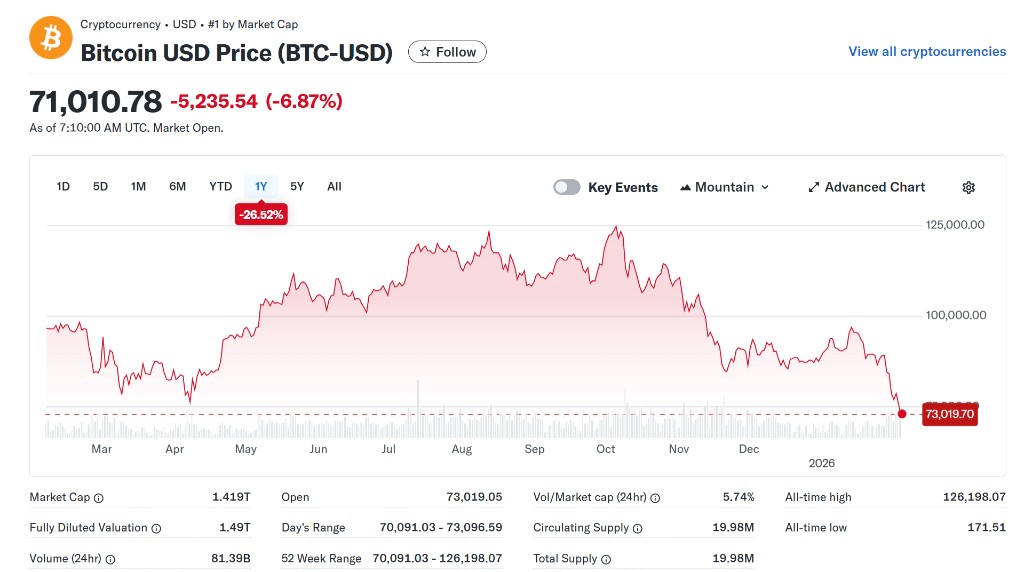
Bitcoin is undergoing a transformation from a speculative asset to an institutional asset, with prices dropping from $125,000 in October last year to $73,000, a decline of over 40%. A Deutsche Bank report indicates that hawkish signals, outflows of institutional funds, and regulatory stagnation are the main reasons for the decline. Bitcoin has fallen below the average entry price of U.S. spot ETFs, approaching the psychological threshold of $70,000. Despite the significant recent drop, it is still up 370% compared to the beginning of 2023. The crypto market is facing a transition from "faith-driven" to "value anchoring."
Bitcoin is undergoing a painful transformation from a purely speculative asset to an institutional asset. The world's largest cryptocurrency fell to around $73,000 on February 3, down more than 40% from its peak of about $125,000 in October last year. This marks the end of the so-called "Tinkerbell Effect" phase—where speculation supported solely by faith is retreating.
According to reports from the Chase trading desk, a report released by Deutsche Bank's Marion Laboure team on the 4th believes that the three main driving forces behind this round of decline are the hawkish signals from the Federal Reserve, continued outflows of institutional funds, and stagnation in regulatory progress. The news of Trump's nomination of Waller as the next Federal Reserve Chairman triggered a 5.5% drop in Bitcoin on January 29, and on January 31, it recorded its largest single-day drop of 7.1% since January 2018. Waller is known for supporting higher real interest rates and reducing the balance sheet.
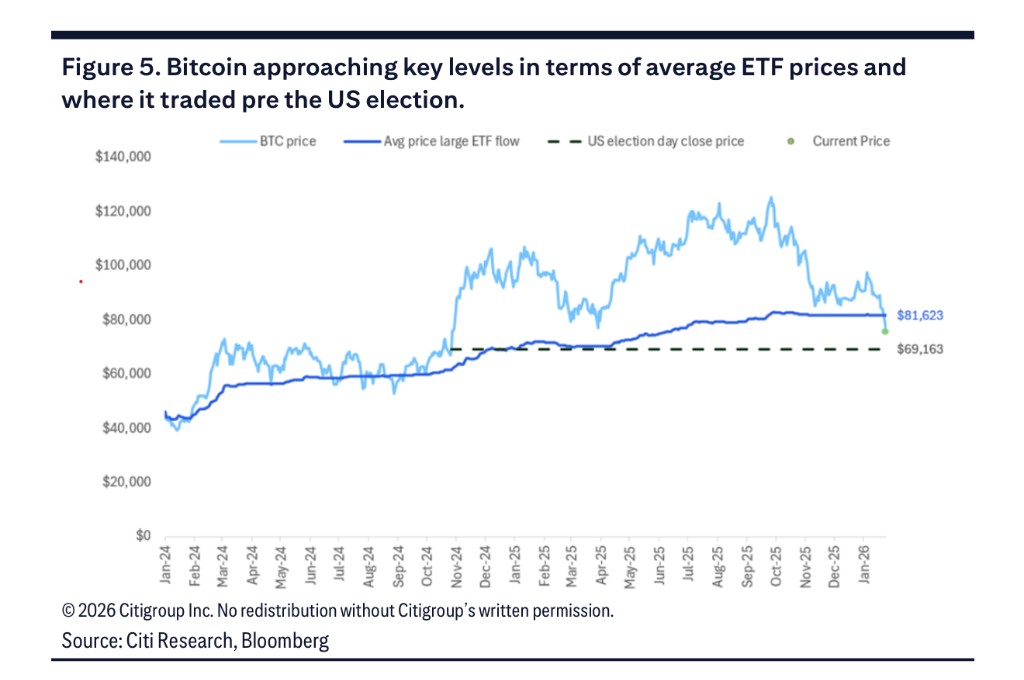
Prices are approaching critical technical levels. According to research by Citigroup analyst Alex Saunders on the 3rd, Bitcoin has fallen below the average entry price of $81,600 for U.S. spot ETFs and is nearing the level of about $70,000 before the U.S. elections. Given that the current administration has promised to strengthen the U.S. leadership in the digital asset space, $70,000 is seen as an important psychological barrier.
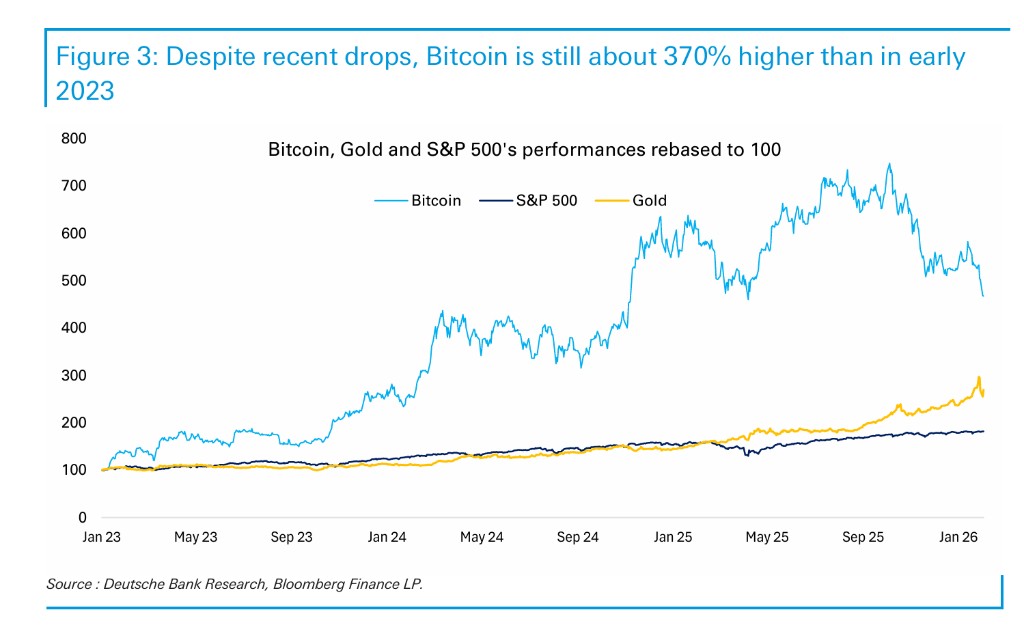
Despite the significant recent decline, Bitcoin is still up about 370% compared to the beginning of 2023. Deutsche Bank points out that the current adjustment reflects more of a pullback from the speculative gains of the past two years rather than a collapse of the fundamentals, but the crypto market is facing a difficult transition from "faith-driven" to "value-anchored."
Continued Outflow of Institutional Funds
The U.S. spot Bitcoin ETF has experienced large-scale redemptions, becoming a core factor putting pressure on prices. According to Deutsche Bank data, these funds recorded outflows of over $3 billion in January 2026, about $2 billion in December 2025, and about $7 billion in November.
Since the market turned in October 2025, institutional investors have been selling off billions of dollars in Bitcoin exposure each month. This persistent selling pressure indicates that traditional investors are losing interest, and the overall pessimism towards cryptocurrencies is intensifying. The Crypto Fear and Greed Index has fallen to about 15 points, indicating "extreme fear," close to the low of 10 points in November 2025.
Retail participation is also declining. Deutsche Bank's own dbDatainsights survey shows that the cryptocurrency adoption rate among U.S. consumers is currently about 12%, down from 17% in July 2025, indicating a comprehensive decline in interest.
The reduction of Bitcoin exposure by institutions has led to a decrease in trading volume, further exacerbating the price decline. Thinning liquidity makes the market's reaction to negative news more severe, creating a vicious cycle.

Decoupling from Traditional Assets
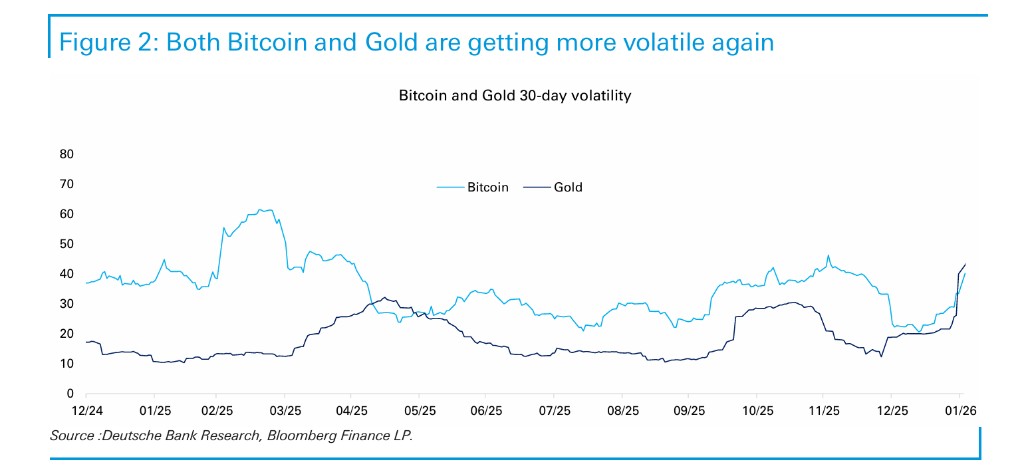
The price trend of Bitcoin has shown a significant divergence from gold, highlighting the fracture of its "digital gold" narrative. In January 2026, Bitcoin became one of the few major assets to decline, falling 11% to $78,197. In contrast, gold rose by 13%, and the S&P 500 index increased by 1.4%. This marks the fourth consecutive month of decline for Bitcoin, the longest losing streak since before the pandemic.
The annual performance is even more pronounced. In 2025, gold recorded a 65% return, while Bitcoin fell by 6.5%. This indicates that Bitcoin is no longer serving as "digital gold." Notably, although gold has recently shown volatility similar to cryptocurrencies, the fundamental drivers supporting gold demand remain strong—central bank purchases, geopolitical risks, and demand for safe-haven assets.
The correlation with the stock market is also changing. The 30-day correlation of Bitcoin with the Nasdaq and S&P 500 indices has dropped to around 15%. In contrast, during the market sell-off in October 2025, Bitcoin's correlation with the Nasdaq was about 57%, and with the S&P 500, it was about 52%—typical levels seen in previous macro-driven adjustments.
Previously, Bitcoin often led the stock market downturns due to its 24/7 trading and higher beta value. However, in this recent downturn, particularly in January 2026, Bitcoin performed poorly while the stock market excelled, indicating that its risk asset characteristics are being repriced.
Regulatory Progress Stalled
Despite early legislative progress, regulatory uncertainty has weighed on Bitcoin's performance. The bipartisan "Digital Asset Market Clarification Act" (CLARITY Act) has been stalled in Congress for months. This bill aims to establish a framework for classifying digital assets and designate the Commodity Futures Trading Commission (CFTC) as the primary regulator for the industry.
The delay stems from disagreements between cryptocurrency and lobbying groups over how to handle stablecoin rewards. The Senate Finance Committee released a draft but did not gain widespread approval, and the committee's vote has been postponed. The Senate Agriculture Committee has also advanced its version of the bill. According to Bloomberg, the White House has urged relevant lobbying groups to reach an agreement by the end of February.
The loss of regulatory momentum has hindered the portfolio integration and liquidity deepening momentum that Bitcoin exhibited earlier in 2025. According to a previous report by Deutsche Bank, early regulatory progress helped reduce Bitcoin's volatility at the beginning of 2025. Now, Bitcoin's 30-day volatility has risen back to 40.72, climbing to levels seen at the end of October, while just a week ago it was only 26 Citi Research believes that the passage of the U.S. Market Structure Act is a potential catalyst that could change market sentiment and restore capital inflows. History shows that positive news on regulation is an important factor in boosting investor confidence—capital inflows into ETFs have increased after the November 2024 elections and the passage of the GENIUS Act in July 2025.
Key Price Levels Approaching
Bitcoin is testing two technical levels closely watched by the market. Citi Research points out that the first is the average entry price of ETFs at $81,600—calculated based on the average of the maximum daily closing prices of ETFs. Bitcoin has currently fallen below this level, indicating that average holders are in a loss position.
The second key level is around $70,000 before the U.S. elections. This level has political and psychological significance. Cryptocurrency advocates are enthusiastic donors in the U.S. elections, and the current government has committed to strengthening the U.S. leadership in the digital asset space and establishing a strategic reserve of Bitcoin. This reserve is funded by seized Bitcoins and can only be increased in a "budget-neutral" manner.
There is still room for long liquidations in the futures market. Despite experiencing multiple rounds of liquidations since a significant rise last October, Citi data shows that exchanges are still discovering long positions being liquidated. The demand for leverage in cryptocurrency perpetual futures remains sluggish.
Notably, "whale" addresses holding over 1,000 Bitcoins have recently stopped reducing their holdings. Citi data indicates that these long-term holders have recently ceased their selling activities after expressing concerns about Bitcoin's cyclical weakness in November.

Federal Reserve Balance Sheet and "Winter" Concerns
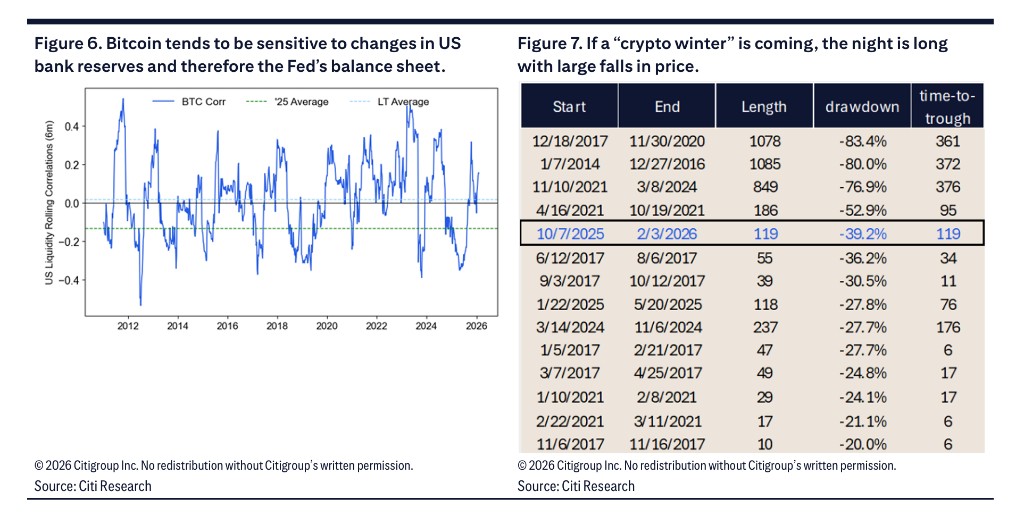
Bitcoin is highly sensitive to U.S. bank liquidity, and the Federal Reserve under Waller may reduce its balance sheet, adding extra concerns to the market. Citi Research shows that Bitcoin tends to be very sensitive to changes in U.S. bank reserves, and thus also to changes in the Federal Reserve's balance sheet.
The possibility of a "crypto winter" is also exacerbating market anxiety. Citi's previous research found that while a 20% pullback is common in Bitcoin, the current 40% decline from historical highs is approaching a critical level—historically, declines beyond this level have led to prolonged and significant "winters" in the cryptocurrency bear market.
Citi emphasizes that this is not its base case, but historical precedents still keep investors vigilant. Past "crypto winters" have been characterized by long durations and deep pullbacks, which are distinctly different from the common 20% corrections.
Deutsche Bank's interest rate strategists believe that there may be a reduction in reserve management purchases. Given Bitcoin and other digital assets' sensitivity to U.S. bank liquidity, this could pose additional headwinds
From Speculation to a Mature Long-term Transformation
Looking back, 2024 and 2025 were extraordinary years for Bitcoin, but they also raised questions about whether the price had decoupled from its fundamentals. Bitcoin started at around $16,000 in early 2023. It performed strongly in 2024, doubling in price, mainly driven by the following events: ETF approval (January), Bitcoin halving (April), positive comments from Trump's campaign team on the crypto industry (July-August), and Trump's election (November).
In 2025, Bitcoin's value soared again, reaching $101,000 in January. It was another record-breaking year, primarily driven by Trump's continued support and statements (such as Bitcoin reserves) and the GENIUS Act targeting stablecoins, reaching a record $125,000 in October.
While specific events in the crypto industry were key, Bitcoin's price increased by about 370% from 2023 to 2025. Deutsche Bank believes this indicates a potential decoupling from its fundamental value. When asset prices rise rapidly, driven by hopes for higher prices rather than actual fundamental value, and are typically accompanied by sharp crashes, a "bubble" forms.
Deutsche Bank's conclusion is that Bitcoin is experiencing the end of the so-called "Peter Pan effect" phase, transitioning from a purely speculative asset to a more realistic positioning. Bitcoin is not a true means of payment or currency, as it lacks the fundamental characteristics of a medium of exchange, unit of account, or store of value. Therefore, it is unlikely to replace existing assets like gold or traditional currencies. The volatility of Bitcoin is not a flaw but may be an inherent characteristic.
The above exciting content comes from the Wind Chaser Trading Platform.
For more detailed interpretations, including real-time analysis and frontline research, please join the【 **Wind Chaser Trading Platform ▪ Annual Membership**】

Risk Warning and Disclaimer
The market has risks, and investment should be cautious. This article does not constitute personal investment advice and does not take into account individual users' specific investment goals, financial situations, or needs. Users should consider whether any opinions, views, or conclusions in this article align with their specific circumstances. Investing based on this is at your own risk